![Problem 10 For a 2 step consecutive reaction: k: The concentration of B, [B], as a function of time was derived to be: [B] = (k2-k1) a. Show that the time when the maximum value of [B] occurs is: tmax = (ka-ki) Ln (k2 b. If ki = 0.100 s., and k2 = 0.0500 s., how much time (in s) does it take for [B] to reach its maximum value?](http://img.homeworklib.com/questions/dba4fc40-b6c1-11ec-808c-bbd4c69002e6.png?x-oss-process=image/resize,w_560)
Homework Answers

Add Answer to:
Problem 10 For a 2 step consecutive reaction: k: The concentration of B, [B], as a...
The reaction 2A + B → C occurs by the following 2 step mechanism: A +...
The reaction 2A + B → C occurs by the following 2 step mechanism: A + B ------(k1)------> AB AB ------(-k1) ------> A+B AB + A ----- (k2)------> C Apply the steady-state approximation for the reaction intermediate concentration to obtain the overall rate law from this mechanism: a) k1 [A][B] b) k1k2[A][B]/((-k1) - k2[A]) c) k1k2[A]^2[B]/((-k1)+k2[A])
For the consecutive reactions A ‹ B‹C, k1=0.35/h, k2=0.13/h, CA0=4 lbmol/ft concentration of B is maximum.and...
For the consecutive reactions A ‹ B‹C, k1=0.35/h, k2=0.13/h, CA0=4 lbmol/ft concentration of B is maximum.and CB0=0, CC0=0. Find the time when the concentration of B is maximum. 7.2 hrs b. 6.5 hrs c. 4.6 hrs d. 3.9 hrs Based from the preceding problem, what is the maximum concentration of B in lbmols/ft3 if the reactor used is a single CSTR? a. 1.85 b. 2.01 c. 1.22 d. 2.32
The rate constant of a chemical reaction increased from 0.100 s−1 to 2.80 s−1 upon raising...
The rate constant of a chemical reaction increased from 0.100 s−1 to 2.80 s−1 upon raising the temperature from 25.0∘C to 55.0 ∘C a) Calculate the value of (1/T2−1/T1) where T1 is the initial temperature and T2 is the final temperature. (in K^-1) b)Calculate the value of ln(k1/k2) where k1 and k2 correspond to the rate constants at the initial and the final temperatures as defined in part A. c) What is the activation energy of the reaction? (in kJ/mol)
The rate constant of a chemical reaction increased from 0.100 s−1 to 3.10 s−1 upon raising...
The rate constant of a chemical reaction increased from 0.100 s−1 to 3.10 s−1 upon raising the temperature from 25.0 ∘C to 47.0 ∘C . part A : Calculate the value of (1/T2−1/T1) where T1 is the initial temperature and T2 is the final temperature. = K−1 Part B : Calculate the value of ln(k1/ k2) where k1 and k2 correspond to the rate constants at the initial and the final temperatures as defined in part A. Part C :...
Use the Arrhenius equation to calculate the activation energy. The rate constant of a chemical reaction...
Use the Arrhenius equation to calculate the activation energy. The rate constant of a chemical reaction increased from 0.100 s−1 to 2.70 s−1 upon raising the temperature from 25.0 ∘C to 43.0 ∘C . a) Calculate the value of (1/T2−1/T1) where T1 is the initial temperature and T2 is the final temperature. (in units of k-1) b) Calculate the value of ln(k1/k2) where k1 and k2 correspond to the rate constants at the initial and the final temperatures as defined...
P8-3B The following reactions D ku[CA-CD 1A. 1A. ka [CA-C, T/K take place in a batch...
 P8-3B The following reactions D ku[CA-CD 1A. 1A. ka [CA-C, T/K take place in a batch reactor. Additional information: k1 31.0 min-1, K1A 10 k2 100 2A CAO- 1 mol/dm3 (Adapted from a problem by John Falconer, University of Colorado.) (a) Plot and analyze conversion and the concentrations of A, D, and U as a function of time. When would you stop the reaction to maximize the concentration of D? Describe what you find. (b) When does the maximum concentration...
Can I please get full working and explanations for each step for this past exam question. Both parts (a) and (b) and (c)...
 Can I please get full working and explanations for each step for
this past exam question. Both parts (a) and (b) and (c). Thanks
will up-vote
Question B1 The isomerisation shown below has an equilibrium constant of K = 0.74 k1 trans-Co(en)2(H2O)OH) k1 cis-Co(en)2(H2O)(OH)2 The kinetics of the reaction was followed and it was found that a plot of the natural log of the concentration of the cis isomer ('cis') minus its equilibrium concentration (In([cis]- [cis]eq) versus time gave a...
Can I please get full working and explanations for each step for
this past exam question. Both parts (a) and (b) and (c). Thanks
will up-vote
Question B1 The isomerisation shown below has an equilibrium constant of K = 0.74 k1 trans-Co(en)2(H2O)OH) k1 cis-Co(en)2(H2O)(OH)2 The kinetics of the reaction was followed and it was found that a plot of the natural log of the concentration of the cis isomer ('cis') minus its equilibrium concentration (In([cis]- [cis]eq) versus time gave a...
The rate constant of a chemical reaction increased from 0.100 s-1 to 3.00 s-1 upon raising...
The rate constant of a chemical reaction increased from 0.100 s-1 to 3.00 s-1 upon raising the temperature from 25.0 ∘C to 55.0 ∘C. Part A: Calculate the value of ((1/T2)-(1/T1)) where T1 is the initial temperature and T2 is the final temperature. Express your answer numerically in K-1 Part B: Calculate the value of ln (k1/k2) where k1 and k2 correspond to the rate constants at the initial and the final temperatures as defined in part A. Express your...
Problem 2. Consider n flips of a coin. A run is a sequence of consecutive tosses...
 Problem 2. Consider n flips of a coin. A run is a sequence of consecutive tosses with the same result. For k<n, let Ek be the event that a run is completed at time k; this means that the results of the kth and (k1)st flips are different. For example, if 10 and the outcomes of the first 10 flips are HHHTTHHTTH then runs are completed at times 3,5,7,9 (a) Show that if the coin is fair, then the events...
For the next balance equation: a) Calculate the concentration of [S] at a time in the...
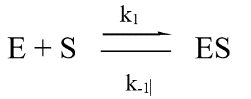 For the next balance equation:
a) Calculate the concentration of [S]
at a time in the reaction where [ES] = 0.09 mM if [S]0
was 2.55 mM.
b) What was [E]0 if at the
same time [E] was 0.02 mM?
c) If the reaction is in equilibrium,
calculate the equilibrium constant value for the reaction and the
ratio between k1 and k-1.
ki ES E S k.11
For the next balance equation:
a) Calculate the concentration of [S]
at a time in the reaction where [ES] = 0.09 mM if [S]0
was 2.55 mM.
b) What was [E]0 if at the
same time [E] was 0.02 mM?
c) If the reaction is in equilibrium,
calculate the equilibrium constant value for the reaction and the
ratio between k1 and k-1.
ki ES E S k.11
 P8-3B The following reactions D ku[CA-CD 1A. 1A. ka [CA-C, T/K take place in a batch reactor. Additional information: k1 31.0 min-1, K1A 10 k2 100 2A CAO- 1 mol/dm3 (Adapted from a problem by John Falconer, University of Colorado.) (a) Plot and analyze conversion and the concentrations of A, D, and U as a function of time. When would you stop the reaction to maximize the concentration of D? Describe what you find. (b) When does the maximum concentration...
 Can I please get full working and explanations for each step for
this past exam question. Both parts (a) and (b) and (c). Thanks
will up-vote
Question B1 The isomerisation shown below has an equilibrium constant of K = 0.74 k1 trans-Co(en)2(H2O)OH) k1 cis-Co(en)2(H2O)(OH)2 The kinetics of the reaction was followed and it was found that a plot of the natural log of the concentration of the cis isomer ('cis') minus its equilibrium concentration (In([cis]- [cis]eq) versus time gave a...
Can I please get full working and explanations for each step for
this past exam question. Both parts (a) and (b) and (c). Thanks
will up-vote
Question B1 The isomerisation shown below has an equilibrium constant of K = 0.74 k1 trans-Co(en)2(H2O)OH) k1 cis-Co(en)2(H2O)(OH)2 The kinetics of the reaction was followed and it was found that a plot of the natural log of the concentration of the cis isomer ('cis') minus its equilibrium concentration (In([cis]- [cis]eq) versus time gave a...
 Problem 2. Consider n flips of a coin. A run is a sequence of consecutive tosses with the same result. For k<n, let Ek be the event that a run is completed at time k; this means that the results of the kth and (k1)st flips are different. For example, if 10 and the outcomes of the first 10 flips are HHHTTHHTTH then runs are completed at times 3,5,7,9 (a) Show that if the coin is fair, then the events...
 For the next balance equation:
a) Calculate the concentration of [S]
at a time in the reaction where [ES] = 0.09 mM if [S]0
was 2.55 mM.
b) What was [E]0 if at the
same time [E] was 0.02 mM?
c) If the reaction is in equilibrium,
calculate the equilibrium constant value for the reaction and the
ratio between k1 and k-1.
ki ES E S k.11
For the next balance equation:
a) Calculate the concentration of [S]
at a time in the reaction where [ES] = 0.09 mM if [S]0
was 2.55 mM.
b) What was [E]0 if at the
same time [E] was 0.02 mM?
c) If the reaction is in equilibrium,
calculate the equilibrium constant value for the reaction and the
ratio between k1 and k-1.
ki ES E S k.11
Most questions answered within 3 hours.
-
Where is the error in this code sequence?
String s1 = "Hello";
String s2 = "ello";...
asked 10 months ago -
Financial data for Joel de Paris, Inc., for last year
follow:
Joel de Paris, Inc.
Balance...
asked 10 months ago -
Consider this reaction:
Al2(SO4)3 (aq)+ BaCl3
(aq) Al2Cl6 (aq)- +
3BaSO4(s) . What is the...
asked 10 months ago -
Suppose that Savneet is considering increasing her
recent random sample from 20 car rentals to 40...
asked 10 months ago -
Trucks arrive at an unloading terminal at an average rate of 120
per hour.
Trucks arrive...
asked 10 months ago -
Why are methanol and ethanol completely soluble in water while
octanol is not very little soluble....
asked 10 months ago -
A facilities manager at a university reads in a research report
that the mean amount of...
asked 10 months ago -
When the CuSO4 is rehydrated by adding water to the anhydrous
compound, is this an endothermic...
asked 10 months ago -
A ray of sunlight is passing from diamond into crown glass; the
angle of incidence is...
asked 10 months ago -
A block of mass 0.249 kg is placed on top of a light, vertical
spring of...
asked 10 months ago -
how do the kidneys compensate in the presences of acidosis
a) trigger hyperventilate
b) reserve acid...
asked 10 months ago -
Question 501 pts
The rental rate of capital to the firm increases. Which of the
following...
asked 10 months ago