
Homework Answers

Add Answer to:
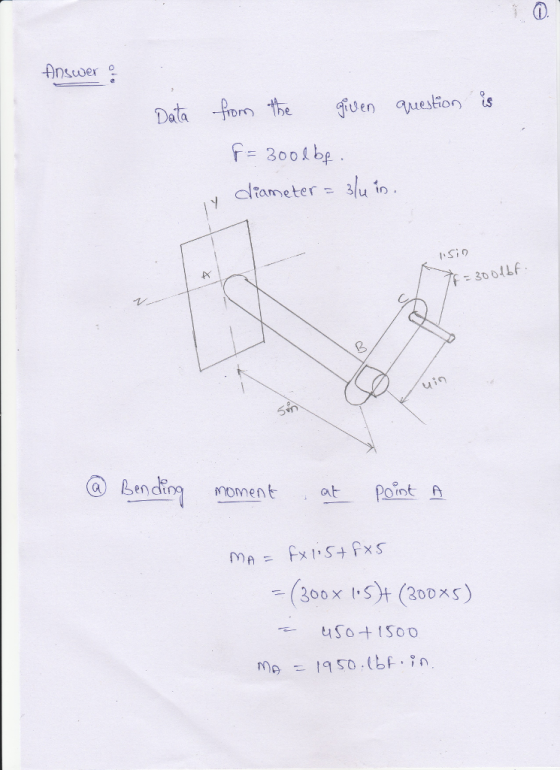
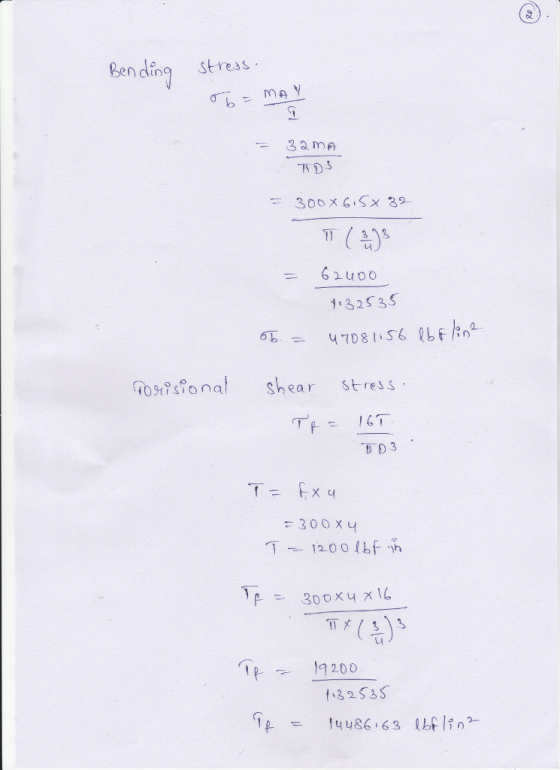
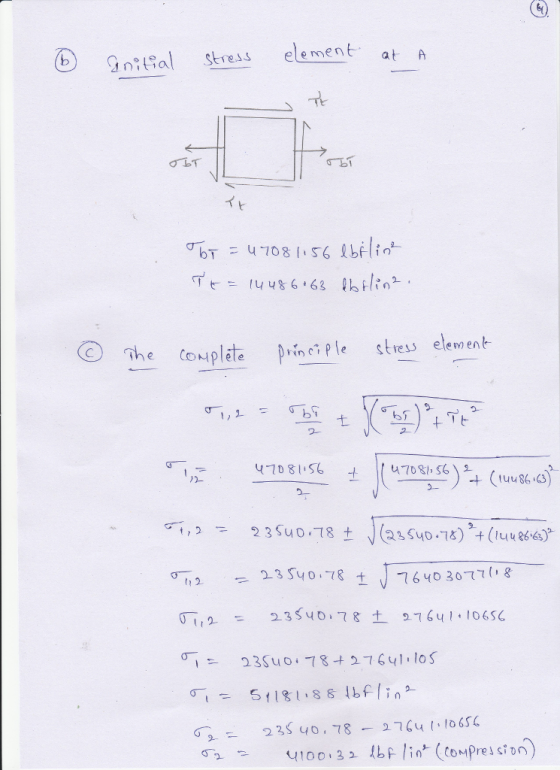
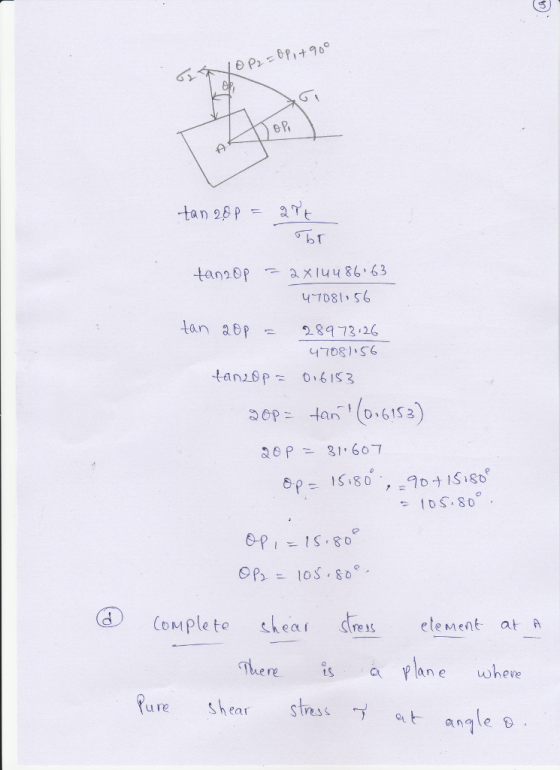
The figure shows a crank loaded by a force F 300 lbr that causes twisting and...
. A 25-mm diameter steel shaft is loaded by a 1000 N force as shown. Determine (a) the free body diagram of the shaft and reaction loading at the support, (b) the stresses at A (top surface) and d...
 . A 25-mm diameter steel shaft is loaded by a 1000 N force as shown. Determine (a) the free body diagram of the shaft and reaction loading at the support, (b) the stresses at A (top surface) and draw the stress element at A, and (c) the stresses at B (side surface) and draw the stress element at B. 200 mm 100 1000 N
. A 25-mm diameter steel shaft is loaded by a 1000 N force as shown. Determine...
. A 25-mm diameter steel shaft is loaded by a 1000 N force as shown. Determine (a) the free body diagram of the shaft and reaction loading at the support, (b) the stresses at A (top surface) and draw the stress element at A, and (c) the stresses at B (side surface) and draw the stress element at B. 200 mm 100 1000 N
. A 25-mm diameter steel shaft is loaded by a 1000 N force as shown. Determine...
the steel lever shown in figure is loaded by a vertical force f=2000 N. A stress...
 the steel lever shown in figure
is loaded by a vertical force f=2000 N. A stress element is located
on the upper side of the lever at A (on the smaller diameter) as
shown .Draw the stress element at A showing the magnitude and
directions of the stresses acting on it and find the principal
stresses and directions.
Problem 3 The steel lever shown in figure is loaded by a vertical force F = 2000 N A stress element is...
the steel lever shown in figure
is loaded by a vertical force f=2000 N. A stress element is located
on the upper side of the lever at A (on the smaller diameter) as
shown .Draw the stress element at A showing the magnitude and
directions of the stresses acting on it and find the principal
stresses and directions.
Problem 3 The steel lever shown in figure is loaded by a vertical force F = 2000 N A stress element is...
A countershaft carrying two V-belt pulleys is shown in the figure. Pulley A receives power from...
 A countershaft carrying two V-belt pulleys is shown in the
figure. Pulley A receives power from a motor through a belt with
the belt tensions shown. The power is transmitted through the shaft
and delivered to the belt on pulley B. Assume the belt tension on
the loose side at B is 15 percent of the tension on the tight side.
Yield of the Shaft ?? = 560 ???
a) Determine the tensions in the belt on pulley B, assuming...
A countershaft carrying two V-belt pulleys is shown in the
figure. Pulley A receives power from a motor through a belt with
the belt tensions shown. The power is transmitted through the shaft
and delivered to the belt on pulley B. Assume the belt tension on
the loose side at B is 15 percent of the tension on the tight side.
Yield of the Shaft ?? = 560 ???
a) Determine the tensions in the belt on pulley B, assuming...
Problem 3 (17 points) The two static forces are applied to a circular 1-in diameter shaft as shown. The shaft is ma...
 Problem 3 (17 points) The two static forces are applied to a circular 1-in diameter shaft as shown. The shaft is made from 1045 CD Steel with a yield strength of 77 ksi. 8 in 1000 lbf 1 in dia. Cross section at the wall 800 lbf (2) a) Identify the location of the most critical stress element. (A. E, F or D?) (10) b) Determine the stresses and draw the stresses on the critical element identified in part a)....
Solve in SI units. A gear reduction unit uses the countershaft shown in the figure. Gear...
 Solve in SI units.
A gear reduction unit uses the countershaft shown in the figure.
Gear A receives power from another gear with the transmitted force
FA applied at the 20ᵒ pressure angle as shown. The power is
transmitted through the shaft and delivered through gear B through
a transmitted force FB at the pressure angle shown. a) Determine
the force FB, assuming the shaft is running at a constant speed. b)
Find the magnitudes of the bearing reaction forces,...
Solve in SI units.
A gear reduction unit uses the countershaft shown in the figure.
Gear A receives power from another gear with the transmitted force
FA applied at the 20ᵒ pressure angle as shown. The power is
transmitted through the shaft and delivered through gear B through
a transmitted force FB at the pressure angle shown. a) Determine
the force FB, assuming the shaft is running at a constant speed. b)
Find the magnitudes of the bearing reaction forces,...
2. Figure 2 below shows a crank loaded by a force F. The material used for...
 2. Figure 2 below shows a crank loaded by a force F. The material used for the crank is steel AISI 4142, and its yield stress is 235 kpsi. Determine the critical load F by using the following different failure theories (assume factor of safety n-2): a. Maximum normal stress theory (MNS); b. Maximum shear stress theory (MSS); c. Distortion-energy theory (DE). Figure 2. A crank under a force F
Learning Goal: To calculate torsional deformation and shear stress due to an applied force in a...
 Learning Goal: To calculate torsional deformation and shear stress due to an applied force in a door handle design. A locked door handle is composed of a solid circular shaft AB with a diameter fb = 105 mm and a flat plate BC with a force P = 76 N applied at point C as shown. Let c = 543 mm, d = 125 mm, and e = 145 mm. (Treat the handle as if it were a cantilever beam.)...
Learning Goal: To calculate torsional deformation and shear stress due to an applied force in a...
 Learning Goal: To calculate torsional deformation and shear stress due to an applied force in a door handle design. A locked door handle is composed of a solid circular shaft AB with a diameter fb = 105 mm and a flat plate BC with a force P = 76 N applied at point C as shown. Let c = 543 mm, d = 125 mm, and e = 145 mm. (Treat the handle as if it were a cantilever beam.)...
Learning Goal: To calculate torsional deformation and shear stress due to an applied force in a...
 Learning Goal: To calculate torsional deformation and shear stress due to an applied force in a door handle design. A locked door handle is composed of a solid circular shaft AB with a diameter of b = 101 mm and a flat plate BC with a force P = 77 N applied at point C as shown. Let c = 473 mm, d = 126 mm, and e = 148 mm (Treat the handle as if it were a cantilever...
Problem 1: A shaft, with a diameter of 43 mm, is shown below. On the right-hand side at location ...
 Problem 1: A shaft, with a diameter of 43 mm, is shown below. On the right-hand side at location D a wheel has a force F of 4824N applied. The diameter of this wheel is 150 mm. The torque produced by F is transmitted through the entire shaft to location A where the torque is reacted. There are no other constraints at location A. Bearings, are located at B and C, and provide radial constraint. The bearing at B also...
 . A 25-mm diameter steel shaft is loaded by a 1000 N force as shown. Determine (a) the free body diagram of the shaft and reaction loading at the support, (b) the stresses at A (top surface) and draw the stress element at A, and (c) the stresses at B (side surface) and draw the stress element at B. 200 mm 100 1000 N
. A 25-mm diameter steel shaft is loaded by a 1000 N force as shown. Determine...
. A 25-mm diameter steel shaft is loaded by a 1000 N force as shown. Determine (a) the free body diagram of the shaft and reaction loading at the support, (b) the stresses at A (top surface) and draw the stress element at A, and (c) the stresses at B (side surface) and draw the stress element at B. 200 mm 100 1000 N
. A 25-mm diameter steel shaft is loaded by a 1000 N force as shown. Determine...
 the steel lever shown in figure
is loaded by a vertical force f=2000 N. A stress element is located
on the upper side of the lever at A (on the smaller diameter) as
shown .Draw the stress element at A showing the magnitude and
directions of the stresses acting on it and find the principal
stresses and directions.
Problem 3 The steel lever shown in figure is loaded by a vertical force F = 2000 N A stress element is...
the steel lever shown in figure
is loaded by a vertical force f=2000 N. A stress element is located
on the upper side of the lever at A (on the smaller diameter) as
shown .Draw the stress element at A showing the magnitude and
directions of the stresses acting on it and find the principal
stresses and directions.
Problem 3 The steel lever shown in figure is loaded by a vertical force F = 2000 N A stress element is...
 A countershaft carrying two V-belt pulleys is shown in the
figure. Pulley A receives power from a motor through a belt with
the belt tensions shown. The power is transmitted through the shaft
and delivered to the belt on pulley B. Assume the belt tension on
the loose side at B is 15 percent of the tension on the tight side.
Yield of the Shaft ?? = 560 ???
a) Determine the tensions in the belt on pulley B, assuming...
A countershaft carrying two V-belt pulleys is shown in the
figure. Pulley A receives power from a motor through a belt with
the belt tensions shown. The power is transmitted through the shaft
and delivered to the belt on pulley B. Assume the belt tension on
the loose side at B is 15 percent of the tension on the tight side.
Yield of the Shaft ?? = 560 ???
a) Determine the tensions in the belt on pulley B, assuming...
 Problem 3 (17 points) The two static forces are applied to a circular 1-in diameter shaft as shown. The shaft is made from 1045 CD Steel with a yield strength of 77 ksi. 8 in 1000 lbf 1 in dia. Cross section at the wall 800 lbf (2) a) Identify the location of the most critical stress element. (A. E, F or D?) (10) b) Determine the stresses and draw the stresses on the critical element identified in part a)....
 Solve in SI units.
A gear reduction unit uses the countershaft shown in the figure.
Gear A receives power from another gear with the transmitted force
FA applied at the 20ᵒ pressure angle as shown. The power is
transmitted through the shaft and delivered through gear B through
a transmitted force FB at the pressure angle shown. a) Determine
the force FB, assuming the shaft is running at a constant speed. b)
Find the magnitudes of the bearing reaction forces,...
Solve in SI units.
A gear reduction unit uses the countershaft shown in the figure.
Gear A receives power from another gear with the transmitted force
FA applied at the 20ᵒ pressure angle as shown. The power is
transmitted through the shaft and delivered through gear B through
a transmitted force FB at the pressure angle shown. a) Determine
the force FB, assuming the shaft is running at a constant speed. b)
Find the magnitudes of the bearing reaction forces,...
 2. Figure 2 below shows a crank loaded by a force F. The material used for the crank is steel AISI 4142, and its yield stress is 235 kpsi. Determine the critical load F by using the following different failure theories (assume factor of safety n-2): a. Maximum normal stress theory (MNS); b. Maximum shear stress theory (MSS); c. Distortion-energy theory (DE). Figure 2. A crank under a force F
 Learning Goal: To calculate torsional deformation and shear stress due to an applied force in a door handle design. A locked door handle is composed of a solid circular shaft AB with a diameter fb = 105 mm and a flat plate BC with a force P = 76 N applied at point C as shown. Let c = 543 mm, d = 125 mm, and e = 145 mm. (Treat the handle as if it were a cantilever beam.)...
 Learning Goal: To calculate torsional deformation and shear stress due to an applied force in a door handle design. A locked door handle is composed of a solid circular shaft AB with a diameter fb = 105 mm and a flat plate BC with a force P = 76 N applied at point C as shown. Let c = 543 mm, d = 125 mm, and e = 145 mm. (Treat the handle as if it were a cantilever beam.)...
 Learning Goal: To calculate torsional deformation and shear stress due to an applied force in a door handle design. A locked door handle is composed of a solid circular shaft AB with a diameter of b = 101 mm and a flat plate BC with a force P = 77 N applied at point C as shown. Let c = 473 mm, d = 126 mm, and e = 148 mm (Treat the handle as if it were a cantilever...
 Problem 1: A shaft, with a diameter of 43 mm, is shown below. On the right-hand side at location D a wheel has a force F of 4824N applied. The diameter of this wheel is 150 mm. The torque produced by F is transmitted through the entire shaft to location A where the torque is reacted. There are no other constraints at location A. Bearings, are located at B and C, and provide radial constraint. The bearing at B also...
Most questions answered within 3 hours.
-
Where is the error in this code sequence?
String s1 = "Hello";
String s2 = "ello";...
asked 11 months ago -
Financial data for Joel de Paris, Inc., for last year
follow:
Joel de Paris, Inc.
Balance...
asked 11 months ago -
Consider this reaction:
Al2(SO4)3 (aq)+ BaCl3
(aq) Al2Cl6 (aq)- +
3BaSO4(s) . What is the...
asked 11 months ago -
Suppose that Savneet is considering increasing her
recent random sample from 20 car rentals to 40...
asked 11 months ago -
Trucks arrive at an unloading terminal at an average rate of 120
per hour.
Trucks arrive...
asked 11 months ago -
Why are methanol and ethanol completely soluble in water while
octanol is not very little soluble....
asked 11 months ago -
A facilities manager at a university reads in a research report
that the mean amount of...
asked 11 months ago -
When the CuSO4 is rehydrated by adding water to the anhydrous
compound, is this an endothermic...
asked 11 months ago -
A ray of sunlight is passing from diamond into crown glass; the
angle of incidence is...
asked 11 months ago -
A block of mass 0.249 kg is placed on top of a light, vertical
spring of...
asked 11 months ago -
how do the kidneys compensate in the presences of acidosis
a) trigger hyperventilate
b) reserve acid...
asked 11 months ago -
Question 501 pts
The rental rate of capital to the firm increases. Which of the
following...
asked 11 months ago