Q19) You and your buddy are scuba diving and notice that air bubbles triple in volume...
Q19) You and your buddy are scuba diving and notice that air bubbles triple in volume as they rise to the surface from where you are in the ocean. Ignoring any temperature changes, how far below the surface of the water (in m) are you when these bubbles are released? The ocean has a density of 1032 kg/m3.
Homework Answers

Add Answer to:
Q19) You and your buddy are scuba diving and notice that air
bubbles triple in volume...
A scuba diver exhales 3.32 L of air while swimming at a depth of 20.0 m...
A scuba diver exhales 3.32 L of air while swimming at a depth of 20.0 m where the sum of atmospheric and water pressure is 2.95 atm. By the time the bubbles of air rise to the surface, where the pressure is 1.00 atm, what is their total volume? Assume the temperature of the water body is uniform.
7. In a hot summer day, a spherical air bubble that has a volume of 1.20...
 7. In a hot summer day, a spherical air bubble that has a volume of 1.20 cm3 is released at temperature 17.0 °C by a scuba diver 20.0 m below the surface of ocean. Calculate the volume of the spherical bubble in units of cm3 when it reaches the surface at temperature 30 °C? Assume that the number of air molecules in the bubble remain the same (pressure at depth h: P = Po + pgh, Po = 1.01 X...
9. A scuba diver is in fresh water has an air tank with a volume of...
9. A scuba diver is in fresh water has an air tank with a volume of 0.0100 m3. The air in the tank is initially at a pressure of 1.00 × 10⁷ Pa. Assume that the diver breathes 0.500 L/s of air. Density of fresh water is 1.00 × 10³ kg/m3. How long will the air in the tank last at 17.4 m? Answer is in min
Imagine that you were to take a volleyball scuba diving with you. If the ball started...
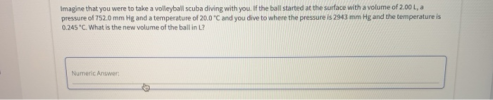 Imagine that you were to take a volleyball scuba diving with you. If the ball started at the surface with a volume of 2.00 L, a pressure of 752.0 mm Hg and a temperature of 20.0'C and you dive to where the pressure is 2943 mm Hg and the temperature is 0.245 'C. What is the new volume of the ball in L? Numeric Antwo
To whom it may concern, I need help with this question: Question: A scuba diver at...
To whom it may concern, I need help with this question: Question: A scuba diver at 10 m below the surface of a lake, where the temperature is 5 degrees C, releases an air bubble with a volume of 16 cm^3. The bubble rises to the surface, where the temperature is 22 degrees C. What is the volume of the bubble (in cubic centimeters) just before it reaches the surface? (The density of water is 1000 kg/m^3 and air pressure...
An air bubble has a volume of 1.6 cm when it is released by a submarine...
 An air bubble has a volume of 1.6 cm when it is released by a submarine 120 m below the surface of a freshwater lake. What is the volume of the bubble (in cm) when it reaches the surface? Assume that the temperature and the number of air molecules in the bubble remain constant during the ascent. (The density of water is 1,000 kg/m”.) Hint V= cm3
Please show work. 40) As shown in the figure, an air pocket atthe top of a...
 Please show work.
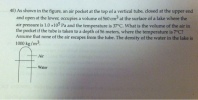
40) As shown in the figure, an air pocket atthe top of a vertical tube, closed at the upper end and open at the lower, occupies a volume of 560 cm3 at the surface of a lake where the air pressure is 1.0 x10⁵ Pa and the temperature is 37oC. What is the volume of the air in the pocket if the tube is taken to a depth of 56 meters, where the temperature is 7eC? Assume...
Please show work.
40) As shown in the figure, an air pocket atthe top of a vertical tube, closed at the upper end and open at the lower, occupies a volume of 560 cm3 at the surface of a lake where the air pressure is 1.0 x10⁵ Pa and the temperature is 37oC. What is the volume of the air in the pocket if the tube is taken to a depth of 56 meters, where the temperature is 7eC? Assume...
During a test dive in 1939, prior to being accepted by the U.S. Navy, the submarine...
 During a test dive in 1939, prior to being accepted by the U.S.
Navy, the submarine Squalus sank at a point where the
depth of water was 73.0 mm. The temperature at the surface was 27.0
∘C∘C and at the bottom it was 7.0 ∘C∘C. The density of seawater is
1030 kg/m3kg/m3.
Constants During a test dive in 1939, prior to being accepted by the U.S. Navy, the submarine Squalus sank at a point where the depth of water was...
During a test dive in 1939, prior to being accepted by the U.S.
Navy, the submarine Squalus sank at a point where the
depth of water was 73.0 mm. The temperature at the surface was 27.0
∘C∘C and at the bottom it was 7.0 ∘C∘C. The density of seawater is
1030 kg/m3kg/m3.
Constants During a test dive in 1939, prior to being accepted by the U.S. Navy, the submarine Squalus sank at a point where the depth of water was...
The sperm whale can dive to a depth of 2250 meters. For sea water with a density of 1020 kg/m3 wh...
 The sperm whale can dive to a depth of 2250 meters. For sea water with a density of 1020 kg/m3 what is the difference in pressure at this depth as compared to the surface? Supply your answer in atmospheres" (atm), where 1 atm approximately equals 1x10⁵ Pa. (This is an incredibly large pressure. Human bodies would be crushed. The deepest human dive recorded was around 300 m, and even then, the diver had to spend 12 hours to surface from...
Consider a hot air balloon with a volume of 1,500 m3. As you may remember, it...
Consider a hot air balloon with a volume of 1,500 m3. As you may remember, it will float when its average density (including its payload) is less than the density of air. Suppose that the empty balloon plus its payload have a mass of 200 kg, and that the bottom neck of the balloon is open to the air, as shown in the picture. a) What is the density of air at room temperature at ground level? (Assume that, by...
 7. In a hot summer day, a spherical air bubble that has a volume of 1.20 cm3 is released at temperature 17.0 °C by a scuba diver 20.0 m below the surface of ocean. Calculate the volume of the spherical bubble in units of cm3 when it reaches the surface at temperature 30 °C? Assume that the number of air molecules in the bubble remain the same (pressure at depth h: P = Po + pgh, Po = 1.01 X...
 Imagine that you were to take a volleyball scuba diving with you. If the ball started at the surface with a volume of 2.00 L, a pressure of 752.0 mm Hg and a temperature of 20.0'C and you dive to where the pressure is 2943 mm Hg and the temperature is 0.245 'C. What is the new volume of the ball in L? Numeric Antwo
 An air bubble has a volume of 1.6 cm when it is released by a submarine 120 m below the surface of a freshwater lake. What is the volume of the bubble (in cm) when it reaches the surface? Assume that the temperature and the number of air molecules in the bubble remain constant during the ascent. (The density of water is 1,000 kg/m”.) Hint V= cm3
 Please show work.
40) As shown in the figure, an air pocket atthe top of a vertical tube, closed at the upper end and open at the lower, occupies a volume of 560 cm3 at the surface of a lake where the air pressure is 1.0 x10⁵ Pa and the temperature is 37oC. What is the volume of the air in the pocket if the tube is taken to a depth of 56 meters, where the temperature is 7eC? Assume...
Please show work.
40) As shown in the figure, an air pocket atthe top of a vertical tube, closed at the upper end and open at the lower, occupies a volume of 560 cm3 at the surface of a lake where the air pressure is 1.0 x10⁵ Pa and the temperature is 37oC. What is the volume of the air in the pocket if the tube is taken to a depth of 56 meters, where the temperature is 7eC? Assume...
 During a test dive in 1939, prior to being accepted by the U.S.
Navy, the submarine Squalus sank at a point where the
depth of water was 73.0 mm. The temperature at the surface was 27.0
∘C∘C and at the bottom it was 7.0 ∘C∘C. The density of seawater is
1030 kg/m3kg/m3.
Constants During a test dive in 1939, prior to being accepted by the U.S. Navy, the submarine Squalus sank at a point where the depth of water was...
During a test dive in 1939, prior to being accepted by the U.S.
Navy, the submarine Squalus sank at a point where the
depth of water was 73.0 mm. The temperature at the surface was 27.0
∘C∘C and at the bottom it was 7.0 ∘C∘C. The density of seawater is
1030 kg/m3kg/m3.
Constants During a test dive in 1939, prior to being accepted by the U.S. Navy, the submarine Squalus sank at a point where the depth of water was...
 The sperm whale can dive to a depth of 2250 meters. For sea water with a density of 1020 kg/m3 what is the difference in pressure at this depth as compared to the surface? Supply your answer in atmospheres" (atm), where 1 atm approximately equals 1x10⁵ Pa. (This is an incredibly large pressure. Human bodies would be crushed. The deepest human dive recorded was around 300 m, and even then, the diver had to spend 12 hours to surface from...
Most questions answered within 3 hours.
-
Where is the error in this code sequence?
String s1 = "Hello";
String s2 = "ello";...
asked 10 months ago -
Financial data for Joel de Paris, Inc., for last year
follow:
Joel de Paris, Inc.
Balance...
asked 10 months ago -
Consider this reaction:
Al2(SO4)3 (aq)+ BaCl3
(aq) Al2Cl6 (aq)- +
3BaSO4(s) . What is the...
asked 10 months ago -
Suppose that Savneet is considering increasing her
recent random sample from 20 car rentals to 40...
asked 10 months ago -
Trucks arrive at an unloading terminal at an average rate of 120
per hour.
Trucks arrive...
asked 10 months ago -
Why are methanol and ethanol completely soluble in water while
octanol is not very little soluble....
asked 10 months ago -
A facilities manager at a university reads in a research report
that the mean amount of...
asked 10 months ago -
When the CuSO4 is rehydrated by adding water to the anhydrous
compound, is this an endothermic...
asked 10 months ago -
A ray of sunlight is passing from diamond into crown glass; the
angle of incidence is...
asked 10 months ago -
A block of mass 0.249 kg is placed on top of a light, vertical
spring of...
asked 10 months ago -
how do the kidneys compensate in the presences of acidosis
a) trigger hyperventilate
b) reserve acid...
asked 10 months ago -
Question 501 pts
The rental rate of capital to the firm increases. Which of the
following...
asked 10 months ago