
Homework Answers
The answer has been provided below with an explanation. Hope it helps :)
Add Answer to:
1. Reversible phosphorylation is a control mechanism usedthroughout metabolism. What are the general names of the...
Reversible phosphorylation is a control mechanism used throughout metabolism. What are the general names of the...
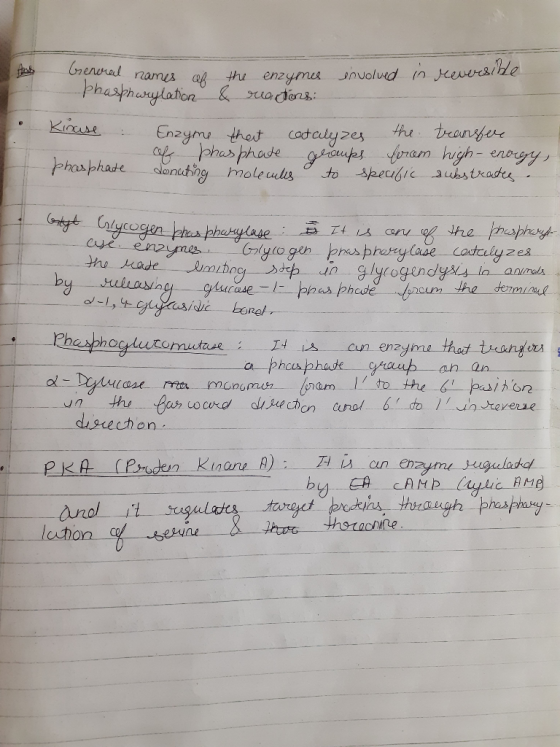
 Reversible phosphorylation is a control mechanism used throughout metabolism. What are the general names of the enzymes involved in reversible phosphorylation and what general reactions do they catalyze?
Reversible phosphorylation is a control mechanism used throughout metabolism. What are the general names of the...
Reversible phosphorylation is a control mechanism used throughout metabolism. What are the general names of the enzymes involved in reversible phosphorylation and waht general reactions do they catalyze?
1. Write the category names of the following enzymes: hexokinase (EC 2.7.1.1) _; ATPases (EC 3.6.1.3)...
 1. Write the category names of the following enzymes: hexokinase (EC 2.7.1.1) _; ATPases (EC 3.6.1.3) Fructose-bisphosphate aldolase (EC 4.1.2.13) ; ATP synthase (EC 7.1.2.2). phosphoglycerate mutase 1 (EC 5.4.2.11) ;DNA ligase (EC 6.5.1.1). Glyceraldehyde 3-phosphate dehydrogenase (EC 1.2.1.12) 2. True or False Enzymes are general chemical catalysts and each enzyme can recognize many different substrates in cells. Enzymes change the equilibrium constants for the reactions they catalyze. Enzymes lower the activation energy for the reactions they catalyze. Enzymes do...
Biochemistry help 1) Write the names of the degradative and the biosynthetic enzymes of glycogen metabolism...
Biochemistry help 1) Write the names of the degradative and the biosynthetic enzymes of glycogen metabolism that are targeted to regulate glycogen metabolism. 2) ) Discuss, by drawing structures, how hormones regulate the enzymes you name in Question 1. 3) Discuss, with structures, the reactions of the non-oxidative phase of the pentose phosphate pathway and show how the non-oxidative phase is used to synthesize all the pentoses in nature.
Reversible protein phosphorylation is a critical mediator of cellular physiology. What are the roles of phosphorylation...
Reversible protein phosphorylation is a critical mediator of cellular physiology. What are the roles of phosphorylation with respect to the Tau protein? How does the presence of multiple phosphorylation sites complicate our understanding it’s regulation (or does it?). In term of protein evolution, is this a selective advantage, side effect, or something else entirely?
a. The metabolism of glucose by glycolysis to acetyl-coenzyme A, followed by the TCA cycle, releases...
a. The metabolism of glucose by glycolysis to acetyl-coenzyme A, followed by the TCA cycle, releases CO2 molecules by oxidative decarboxylation reactions. Write down the oxidative decarboxylation reactions that result in CO2 production. Name the enzyme involved in each reaction and give the names and complete structures of all reactants and products. Only abbreviated names of enzyme cofactors are required. (b) From the steps drawn in part (a) above, how many total ATP molecules would be produced from oxidative phosphorylation?
(35 pts) The overall objective of metabolism is to generate energy in the form of ATP by oxidizing carbon and reducing oxygen. (a) (2 pts) Write chemical reaction for the only oxidation step i...
 (35 pts) The overall objective of metabolism is to generate energy in the form of ATP by oxidizing carbon and reducing oxygen. (a) (2 pts) Write chemical reaction for the only oxidation step in glycolysis with full chemical structures of the reactant(s) and product(s), list the name(s) of the enzyme(s) and cofactor(s) involved in the equation. Indicate which carbons are oxidized in the chemical structures (b) (8 pts) Write the chemical reactions for all oxidation steps for citrate acid cycle...
2. Concept Map: construct a concept map that depicts the metabolism of glucose through glycolysis, the...
2. Concept Map: construct a concept map that depicts the metabolism of glucose through glycolysis, the TCA cycle, electron transport and oxidative phosphorylation. For your drawing, include where in the cell these processes occur. The map should show the names of all intermediates (but do not show structures), the names of all enzymes, all products and cofactors required/produced and all membrane complexes. (10) Hint: Include Glucose →glycolysis steps → pyruvate → acetylCoA → TCA cycle steps → electron transport chain...
Why do drugs undergo metabolism in the body? What are the organs in the body that...
Why do drugs undergo metabolism in the body? What are the organs in the body that are involved with drug metabolism? Explain in detail about Phase I and Phase II reactions
1. Show the fate of fructose in the liver: Draw the structures and list names of...
1. Show the fate of fructose in the liver: Draw the structures and list names of all intermediates, names of all enzymes required, and the product that is a glycolytic intermediate. 2. Show the use of galactose in the liver for the biosynthesis of glycogen. Write out all structures, names of intermediates, names of enzymes involved in the conversion. 3. What is the difference between lactate recycling in the muscle as compared to the liver? What enzymes are involved?
 Reversible phosphorylation is a control mechanism used throughout metabolism. What are the general names of the enzymes involved in reversible phosphorylation and what general reactions do they catalyze?
 1. Write the category names of the following enzymes: hexokinase (EC 2.7.1.1) _; ATPases (EC 3.6.1.3) Fructose-bisphosphate aldolase (EC 4.1.2.13) ; ATP synthase (EC 7.1.2.2). phosphoglycerate mutase 1 (EC 5.4.2.11) ;DNA ligase (EC 6.5.1.1). Glyceraldehyde 3-phosphate dehydrogenase (EC 1.2.1.12) 2. True or False Enzymes are general chemical catalysts and each enzyme can recognize many different substrates in cells. Enzymes change the equilibrium constants for the reactions they catalyze. Enzymes lower the activation energy for the reactions they catalyze. Enzymes do...
 (35 pts) The overall objective of metabolism is to generate energy in the form of ATP by oxidizing carbon and reducing oxygen. (a) (2 pts) Write chemical reaction for the only oxidation step in glycolysis with full chemical structures of the reactant(s) and product(s), list the name(s) of the enzyme(s) and cofactor(s) involved in the equation. Indicate which carbons are oxidized in the chemical structures (b) (8 pts) Write the chemical reactions for all oxidation steps for citrate acid cycle...
Most questions answered within 3 hours.
-
Where is the error in this code sequence?
String s1 = "Hello";
String s2 = "ello";...
asked 10 months ago -
Financial data for Joel de Paris, Inc., for last year
follow:
Joel de Paris, Inc.
Balance...
asked 10 months ago -
Consider this reaction:
Al2(SO4)3 (aq)+ BaCl3
(aq) Al2Cl6 (aq)- +
3BaSO4(s) . What is the...
asked 10 months ago -
Suppose that Savneet is considering increasing her
recent random sample from 20 car rentals to 40...
asked 10 months ago -
Trucks arrive at an unloading terminal at an average rate of 120
per hour.
Trucks arrive...
asked 10 months ago -
Why are methanol and ethanol completely soluble in water while
octanol is not very little soluble....
asked 10 months ago -
A facilities manager at a university reads in a research report
that the mean amount of...
asked 10 months ago -
When the CuSO4 is rehydrated by adding water to the anhydrous
compound, is this an endothermic...
asked 10 months ago -
A ray of sunlight is passing from diamond into crown glass; the
angle of incidence is...
asked 10 months ago -
A block of mass 0.249 kg is placed on top of a light, vertical
spring of...
asked 10 months ago -
how do the kidneys compensate in the presences of acidosis
a) trigger hyperventilate
b) reserve acid...
asked 10 months ago -
Question 501 pts
The rental rate of capital to the firm increases. Which of the
following...
asked 10 months ago