Why do drugs undergo metabolism in the body? What are the organs in the body that...
Why do drugs undergo metabolism in the body? What are the organs in the body that are involved with drug metabolism? Explain in detail about Phase I and Phase II reactions
Homework Answers
The purpose of metabolism in the body is usually to change the chemical structure of the substance,the increase the ease with which it can be excreted from the body.Drug metabolism is the chemical alteration of a drug by the body.Most drugs must pass through the liver,it is the primary site for metabolism.The liver's primary mechanism for metabolizing drugs is via a specific group of cytochrome P-450 enzymes.The level of these cytochrome P-450 enzymes controls the rate at which many drugs are metabolized.The capacity of the enzymes to metabolize is limited, so the can become overloaded when blood levels are high.The substances that result from metabolism may be inactive,or they may be similar to or different from the original drug in therapeutic activity or toxicity.Some drugs,called prodrugs ,are administered in an inactive form ,which is metabolized into active form.The resulting active metabolites produce the desired therapeutic effects.Metabolites may be metabolized further instead of being excreted from the body.The subsequent metabolites are then excreted.Excretion involves the elimination of drug from the body,for eg; the urine or bile.
Liver is the most important organ that involved in drug metabolism.In addition to the liver,every biological tissue of the body has the ability to metabolize the drugs.The other sites include lungs, kidney,placenta,epithelial cells of GI tract, adrenals and skin.
Phase 1 reaction is also known as non synthetic phase or non conjugative phase.It include the reactions which catalyze oxidation,reduction and hydrolysis of drugs.A change in drug molecule generally results in the introduction of a functional group into molecules or the exposure of new functional group of molecules.In phase 1 reactions ,small polar functional groups -OH,-NH2,-SH,-COOH,etc.are either added or unmasked(if already present) on the lipid soluble drugs so that the resulting products may undergo phase 2 reactions.It results in activation,change or inactivation of drug.
Phase 2 reaction is also known as synthetic phase.It is the last step in detoxification reactions and almost always results in loss of biological activity of a compound.It may preceded by one or more of phase 1 reaction.It involves conjugation of functional groups of molecules with hydrophilic endogenous substrates.Formation of conjugates is formed with (an endogenous substance such as carbohydrates and amino acids) with drug or its metabolites formed in phase 1 reaction.Then attatchment of small polar endogenous molecules like glucuronic acid,sulphate,methyl ,amino acids,etc to either unchanged drug or to phase 1 products take place.Products called as 'conjugates' are water soluble metabolites which are readily excreted from the body.
Why Do Drugs Undergo Metabolism in the Body?
Drug metabolism is a biochemical process that modifies drugs to:
Enhance elimination (convert lipophilic drugs into water-soluble metabolites for excretion via urine/bile).
Detoxify harmful substances (reduce toxicity).
Activate prodrugs (convert inactive compounds into active forms).
Regulate drug duration (terminate pharmacological effects).
Organs Involved in Drug Metabolism:
Liver (Primary Site):
Contains high concentrations of metabolizing enzymes (e.g., cytochrome P450).
Intestines:
Gut bacteria and enterocytes contribute to metabolism (e.g., hydrolysis).
Kidneys:
Metabolize and excrete water-soluble metabolites.
Lungs/Skin:
Minor roles in metabolizing inhaled or topical drugs.
Phase I Reactions (Functionalization):
Goal: Introduce or expose polar groups (e.g., -OH, -COOH) to increase water solubility.
Key Reactions:
Oxidation: Cytochrome P450 enzymes (e.g., hydroxylation, dealkylation).
Reduction: Nitro-reductases (e.g., nitro-compounds → amines).
Hydrolysis: Esterases/amidases (e.g., aspirin → salicylic acid).
Example:
Phase II Reactions (Conjugation):
Goal: Attach polar molecules to Phase I products to further enhance excretion.
Key Reactions:
Glucuronidation: UGT enzymes (e.g., morphine → morphine-3-glucuronide).
Sulfation: SULT enzymes (e.g., acetaminophen → sulfate conjugate).
Acetylation/Methylation: NAT/COMT enzymes (e.g., isoniazid → acetyl-isoniazid).
Example:
Add Answer to:
Why do drugs undergo metabolism in the body? What are the organs
in the body that...
True or False: a. Glucuronidation is the main type of Phase I metabolism. b. Glutathione conjugation...
True or False: a. Glucuronidation is the main type of Phase I metabolism. b. Glutathione conjugation is the most common type of Phase II metabolism. c. Drugs must undergo Phase II metabolism to leave the body. d. When a drug is metabolized, it will always become less potent. e. Drugs administered intravenously largely undergo first-pass metabolism. f. All metabolism requires enzymes.
The liver is a key site for drug and hormone metabolism. a. Describe how drugs and...
The liver is a key site for drug and hormone metabolism. a. Describe how drugs and hormones are metabolized in the liver, in addition to other locations in the body (be sure to state where this may occur, the main types of proteins involved and the action). b. Explain how drug-induced liver disease occurs, and outline the basic types of drug induced liver disease. c. Choose one specific drug/drug type associated with cholestatic reactions, and describe that drug’s mechanism of...
Question 9 The liver and other organs have enzymes which metabolize drugs. This metabolism usually results...
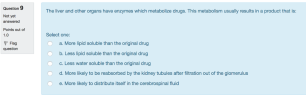 Question 9 The liver and other organs have enzymes which metabolize drugs. This metabolism usually results in a product that is: Not yet answered Points out of 1.0 Select Flag question a. More lipid soluble than the original drug b. Less lipid soluble than the original drug O c. Less water soluble than the original drug d. More likely to be reabsorbed by the kidney tubules after filtration out of the glomerulus e. More likely to distribute itself in the...
What is the metabolism phase 2 reactions that (acyclovir) can Undergo ? Write all chemical reactions...
 What is the metabolism phase 2 reactions that (acyclovir) can
Undergo ? Write all chemical reactions (structures)
Medical chemistry
NH2 ОН: -N NH N
What is the metabolism phase 2 reactions that (acyclovir) can
Undergo ? Write all chemical reactions (structures)
Medical chemistry
NH2 ОН: -N NH N
Question Not yet answered Points out of 1.0 Which statement best describes the phase I reactions...
 Question Not yet answered Points out of 1.0 Which statement best describes the phase I reactions of drug metabolism? Select one: a. Phase I reactions are required for all drugs before they can undergo Phase II reactions b. Phase I reactions are due to enzymes which are primarily located in the kidney c. Phase I reactions involve the addition or unmasking of an-OH or other small polar group d. Phase I reactions involve both cytochrome P450 reductase and cytochrome P450...
How do phase I and phase II metabolism influence both renal and hepatic elimination of a...
How do phase I and phase II metabolism influence both renal and hepatic elimination of a drug?
PCSK9 is a gene that provides instructions for regulating cholesterol in the body. New drugs have...
PCSK9 is a gene that provides instructions for regulating cholesterol in the body. New drugs have been made to target PSCK9. What is the purpose of these medications and how do they affect cholesterol metabolism? Under what circumstances would this drug be beneficial?
Indicate what metabolites are produced when the following drug undergoes Phase I metabolism and Phase II...
 Indicate what metabolites are produced when the following drug
undergoes Phase I metabolism and Phase II metabolism.
CONHCH2CH2N(CH2CH3)2
Indicate what metabolites are produced when the following drug
undergoes Phase I metabolism and Phase II metabolism.
CONHCH2CH2N(CH2CH3)2
4. Which of the following is not a source of drugs? a. Plants b. Animals c....
 4. Which of the following is not a source of drugs? a. Plants b. Animals c. Minerals d. Microbiological sources All of the above This use of drugs relicves the symptoms while the body fights off the disease. a. Prevention 5. b. Cure c. Treatment d. Palliative e. Replacement 6. This use of drugs do not cure or treat the disease but improves a person's quality of life. a. Prevention b. Treatment c. Contraceptive d. Health maintenance e. Palliative uion,...
What other macromolecules are involved in glucose metabolism and how this can be beneficial if there...
What other macromolecules are involved in glucose metabolism and how this can be beneficial if there is a lack of glucose in the body? Where in the process of metabolism do, they function, under what conditions/environment and why? Describe their role.
 Question 9 The liver and other organs have enzymes which metabolize drugs. This metabolism usually results in a product that is: Not yet answered Points out of 1.0 Select Flag question a. More lipid soluble than the original drug b. Less lipid soluble than the original drug O c. Less water soluble than the original drug d. More likely to be reabsorbed by the kidney tubules after filtration out of the glomerulus e. More likely to distribute itself in the...
 What is the metabolism phase 2 reactions that (acyclovir) can
Undergo ? Write all chemical reactions (structures)
Medical chemistry
NH2 ОН: -N NH N
What is the metabolism phase 2 reactions that (acyclovir) can
Undergo ? Write all chemical reactions (structures)
Medical chemistry
NH2 ОН: -N NH N
 Question Not yet answered Points out of 1.0 Which statement best describes the phase I reactions of drug metabolism? Select one: a. Phase I reactions are required for all drugs before they can undergo Phase II reactions b. Phase I reactions are due to enzymes which are primarily located in the kidney c. Phase I reactions involve the addition or unmasking of an-OH or other small polar group d. Phase I reactions involve both cytochrome P450 reductase and cytochrome P450...
 Indicate what metabolites are produced when the following drug
undergoes Phase I metabolism and Phase II metabolism.
CONHCH2CH2N(CH2CH3)2
Indicate what metabolites are produced when the following drug
undergoes Phase I metabolism and Phase II metabolism.
CONHCH2CH2N(CH2CH3)2
 4. Which of the following is not a source of drugs? a. Plants b. Animals c. Minerals d. Microbiological sources All of the above This use of drugs relicves the symptoms while the body fights off the disease. a. Prevention 5. b. Cure c. Treatment d. Palliative e. Replacement 6. This use of drugs do not cure or treat the disease but improves a person's quality of life. a. Prevention b. Treatment c. Contraceptive d. Health maintenance e. Palliative uion,...
Most questions answered within 3 hours.
-
Where is the error in this code sequence?
String s1 = "Hello";
String s2 = "ello";...
asked 11 months ago -
Financial data for Joel de Paris, Inc., for last year
follow:
Joel de Paris, Inc.
Balance...
asked 11 months ago -
Consider this reaction:
Al2(SO4)3 (aq)+ BaCl3
(aq) Al2Cl6 (aq)- +
3BaSO4(s) . What is the...
asked 11 months ago -
Suppose that Savneet is considering increasing her
recent random sample from 20 car rentals to 40...
asked 11 months ago -
Trucks arrive at an unloading terminal at an average rate of 120
per hour.
Trucks arrive...
asked 11 months ago -
Why are methanol and ethanol completely soluble in water while
octanol is not very little soluble....
asked 11 months ago -
A facilities manager at a university reads in a research report
that the mean amount of...
asked 11 months ago -
When the CuSO4 is rehydrated by adding water to the anhydrous
compound, is this an endothermic...
asked 11 months ago -
A ray of sunlight is passing from diamond into crown glass; the
angle of incidence is...
asked 11 months ago -
A block of mass 0.249 kg is placed on top of a light, vertical
spring of...
asked 11 months ago -
how do the kidneys compensate in the presences of acidosis
a) trigger hyperventilate
b) reserve acid...
asked 11 months ago -
Question 501 pts
The rental rate of capital to the firm increases. Which of the
following...
asked 11 months ago