What other macromolecules are involved in glucose metabolism and how this can be beneficial if there...
What other macromolecules are involved in glucose metabolism and how this can be beneficial if there is a lack of glucose in the body? Where in the process of metabolism do, they function, under what conditions/environment and why? Describe their role.
Homework Answers
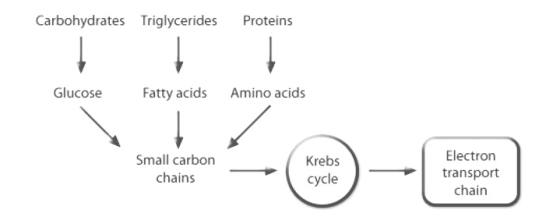
Lipids and proteins are involved in the glucose metabolism. The condition where there is a lack of glucose in the body , they get converted into glucose by the process known as gluconeogenesis. These two other biomolecules while during their metabolism process break down into smaller units like fatty acid and amino acid. Further, the fatty acid by beta oxidation convert into acetyl CoA that enter the Krebs cycle of glucose metabolism whereas some amino acid also form acetyl CoA during their metabolism and enter the Krebs cycle. After that, the process of oxidative phosphorylation takes place
Add Answer to:
What other macromolecules are involved in glucose metabolism and
how this can be beneficial if there...
How obesity link with glucose metabolism? (i) What is glucose metabolism? Is it include glycolysis, TCA...
How obesity link with glucose metabolism? (i) What is glucose metabolism? Is it include glycolysis, TCA cycle, oxidative phosphorylation and electron transport chain? Explain the process. (ii) What is the effect of obesity? (iii) How obesity affects metabolism? iv) What is the cause of obesity? (v) Regulation of energy homeostasis and obesity.
Describe how the body maintains homeostasis in regulating glucose metabolism in the body. Tell what happens...
Describe how the body maintains homeostasis in regulating glucose metabolism in the body. Tell what happens when there is too much or too little of each major regulatory hormone. Describe the path food follows as it travels through the digestive system. Summarize the major structures and functions of those structures along the way.
The liver is a key site for drug and hormone metabolism. a. Describe how drugs and...
The liver is a key site for drug and hormone metabolism. a. Describe how drugs and hormones are metabolized in the liver, in addition to other locations in the body (be sure to state where this may occur, the main types of proteins involved and the action). b. Explain how drug-induced liver disease occurs, and outline the basic types of drug induced liver disease. c. Choose one specific drug/drug type associated with cholestatic reactions, and describe that drug’s mechanism of...
1(a) The complete metabolic oxidation of glucose to CO2 and O2 yields 38 ATPs. What is...
1(a) The complete metabolic oxidation of glucose to CO2 and O2 yields 38 ATPs. What is the yield of ATP from Glc if it is first added to a glycogen polymer before being converted to CO2 and O2? What is the FRACTIONAL energetic cost in terms of ATP (eg., 1%, 2%, 10%, etc.) of storing glucose as glycogen and later metabolizing the glycogen rather than directly metabolizing the glucose? Be sure to show your work and state any assumptions being...
All mechanisms of glucose metabolism begin with glycolysis and produce 2 pyruvates, 2 ATP and 2...
All mechanisms of glucose metabolism begin with glycolysis and produce 2 pyruvates, 2 ATP and 2 NADH. Make a table comparing aerobic and anaerobic metabolism (after glycolysis) to describe how pyruvate is metabolized. Columns: Cell Respiration, Lactic Acid, Alcohol Fermentation Rows: Where (in the cell) does pyruvate go? What happens to pyruvate (explain in step by step detail)? Is pyruvate oxidized or reduced? What energy-storing molecules are made? What energy-storing molecules are used? What byproducts str produced (CO2 or H2O)?...
Explain how bacteria address the following challenges and which cellular structures or components are involved and...
 Explain how bacteria address the following challenges and which cellular structures or components are involved and how they function. Be complete in your answers. In most instances bacteria have multiple strategies for dealing with these conditions - address as many as you can. • Harmful chemicals in the environment • Lack of moisture • Existence in an aqueous environment • Elevated temperatures • In the case of bacterial animal pathogens, white blood cells that "gobble up" the bacteria (i.e., phagocytes...
1. Why do fats provide more energy per molecule than glucose? Explain your answer in terms...
 1. Why do fats provide more energy per molecule than glucose? Explain your answer in terms of the electrons extracted during the process of cellular respiration. 2. A rare, frameshift genetic mutation can alter the structure of the Pyruvate Dehydrogenase Complex such that it no longer functions within the cell. Describe what parts of the process of cellular respiration would be impacted due to this non- functional enzyme. 3. The citric acid cycle functions to completely oxidize glucose in the...
Ch. 8 Plant Chemistry and Metabolism. 1. List the 4 main types of macromolecules found in...
Ch. 8 Plant Chemistry and Metabolism. 1. List the 4 main types of macromolecules found in plants. 2. What is the most abundant compound in plants? 3. List 2 common phenolics and their purposes. 4. What are the structural components of lipids? In what ratio? 5. Describe the structure of membranes and their properties. 6. Explain why some amino acids are “essential” in animals, but not in plants. 7. Which have more saturated fats, temperate or tropical plants? What happens...
From the information in Chapter 8 on metabolism and Appendix A, we can see the multiple...
From the information in Chapter 8 on metabolism and Appendix A, we can see the multiple metabolic pathways involved in generating ATP from the breakdown of the nutrients glucose, protein and fats. Glycolysis generates pyruvate, the pyruvate then becomes Acetyl CoA, which enters the Krebs Cycle (TCA), products of the Krebs Cycle then enter the Electron Transport Chain (ETC) where ATP is the final product. Fat breakdown (beta-oxidation) also generates Acetyl CoA, which then enters the Krebs Cycle to produce...
Paragraph SPRING Answer as many of the following questions as you can with as much detail...
 Paragraph SPRING Answer as many of the following questions as you can with as much detail as you can using the material provided in your textbook, the provided notes and powerpoints. You do not have to finish all of them, but in order to receive full credit for the assignment, please, complete at least half of the questions for each chapter. **Note that the homework assignments will not be specifically graded for exact content. They are meant as a study...
 Explain how bacteria address the following challenges and which cellular structures or components are involved and how they function. Be complete in your answers. In most instances bacteria have multiple strategies for dealing with these conditions - address as many as you can. • Harmful chemicals in the environment • Lack of moisture • Existence in an aqueous environment • Elevated temperatures • In the case of bacterial animal pathogens, white blood cells that "gobble up" the bacteria (i.e., phagocytes...
 1. Why do fats provide more energy per molecule than glucose? Explain your answer in terms of the electrons extracted during the process of cellular respiration. 2. A rare, frameshift genetic mutation can alter the structure of the Pyruvate Dehydrogenase Complex such that it no longer functions within the cell. Describe what parts of the process of cellular respiration would be impacted due to this non- functional enzyme. 3. The citric acid cycle functions to completely oxidize glucose in the...
 Paragraph SPRING Answer as many of the following questions as you can with as much detail as you can using the material provided in your textbook, the provided notes and powerpoints. You do not have to finish all of them, but in order to receive full credit for the assignment, please, complete at least half of the questions for each chapter. **Note that the homework assignments will not be specifically graded for exact content. They are meant as a study...
Most questions answered within 3 hours.
-
Where is the error in this code sequence?
String s1 = "Hello";
String s2 = "ello";...
asked 10 months ago -
Financial data for Joel de Paris, Inc., for last year
follow:
Joel de Paris, Inc.
Balance...
asked 10 months ago -
Consider this reaction:
Al2(SO4)3 (aq)+ BaCl3
(aq) Al2Cl6 (aq)- +
3BaSO4(s) . What is the...
asked 10 months ago -
Suppose that Savneet is considering increasing her
recent random sample from 20 car rentals to 40...
asked 10 months ago -
Trucks arrive at an unloading terminal at an average rate of 120
per hour.
Trucks arrive...
asked 10 months ago -
Why are methanol and ethanol completely soluble in water while
octanol is not very little soluble....
asked 10 months ago -
A facilities manager at a university reads in a research report
that the mean amount of...
asked 10 months ago -
When the CuSO4 is rehydrated by adding water to the anhydrous
compound, is this an endothermic...
asked 10 months ago -
A ray of sunlight is passing from diamond into crown glass; the
angle of incidence is...
asked 10 months ago -
A block of mass 0.249 kg is placed on top of a light, vertical
spring of...
asked 10 months ago -
how do the kidneys compensate in the presences of acidosis
a) trigger hyperventilate
b) reserve acid...
asked 10 months ago -
Question 501 pts
The rental rate of capital to the firm increases. Which of the
following...
asked 10 months ago