1(a) The complete metabolic oxidation of glucose to CO2 and O2 yields 38 ATPs. What is...
1(a) The complete metabolic oxidation of glucose to CO2 and O2
yields 38 ATPs. What is the yield of ATP
from Glc if it is first added to a glycogen polymer before being
converted to CO2 and O2? What is the
FRACTIONAL energetic cost in terms of ATP (eg., 1%, 2%, 10%, etc.)
of storing glucose as glycogen and
later metabolizing the glycogen rather than directly metabolizing
the glucose? Be sure to show your work
and state any assumptions being made. Briefly explain whether this
is a big loss of energy due to storage of
glycogen. (Recall that the breakdown of glycogen yields more than
one product.)
(b) Glycogen metabolism is heavily regulated, and phosphorylase
kinase plays an important role in this
regulation. An individual has a defective liver phosphorylase
kinase. Describe what effect this defect will
have on glycogen metabolism in the liver. Describe what effect this
defect will have on the ability of this
individual to buffer blood glucose under HIGH and LOW blood glucose
conditions.
Homework Answers
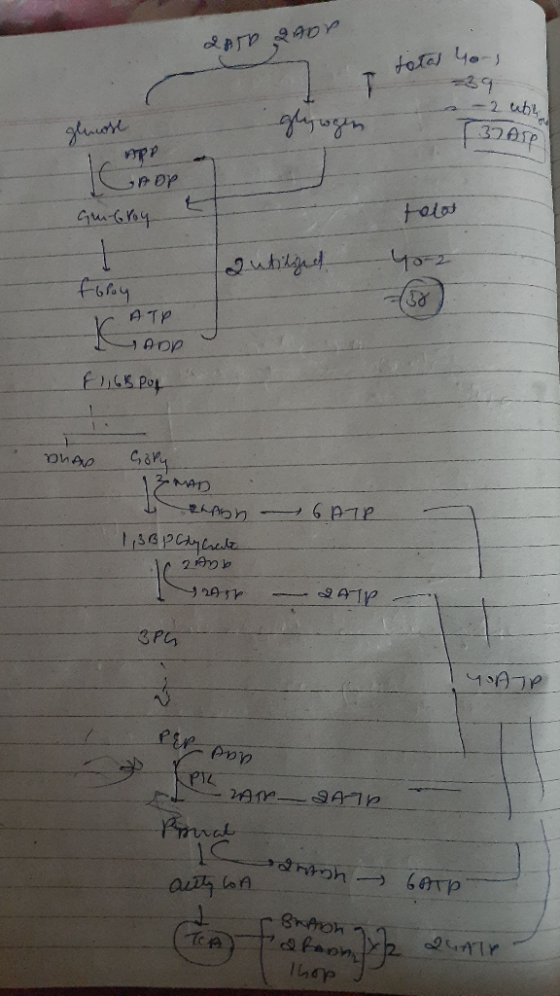
During glycogensis 2 molecules of ATP used to incorporate one molecule of glucose in glycogen. While during glycogenolysis , there is production of glucose 6 phosphate which enter in to glycolysis. Thus omit requirement of one ATP molecule required in glucose activation.
Total energy produced by glucose , released from glycogen after storage = energy spent in storage - glucose 6 phosphate energy production in glycolysis
= 39-2
= 37
Total 37 molecule of ATP will be produced. From this glucose released from glycogen.
All the calculations has been shown in digramatic way for easy understanding
B)glycogen phosphorylase is regulatory enzyme of glycogenolytic pathway. Help in degradation of glycogen and releasing of glucose when required like to maintain blood glucose or during exercise in muscle. So in defect in PhK , glucose is not released even in decrese blood glucose level , lead to hypoglycemia which in long run lead to ketone body formation ( ketosis) . In muscle, during exercise, glucose will not release lead to cramps , exercise intolerance , progressive muscle weakness.
Phosphorylase kinase ( PhK) deficiency cause glycogen storage duseas type IX. Phosphorylase kinase is involved in activation of phosphorylase enzyme meiated by hormones. Two firms of PhK deficiency is found -
1) liver PhK deficiency- early childhood hepatomegaly, hypoglycemia, ketosis and growth restriction.
2) muscle PhK deficiency- kind of rare. Exercose in tolerance, myalgia , muscle cramps ,myoglobinuria, progressive muscle weakness.
Even though blood glucose is low ---' stimulation of release of glucagon--- but to decetive PhK , -----, glycogen phosphorylase in not activated------ no release of glucose----- hypoglycemia
Add Answer to:
1(a) The complete metabolic oxidation of glucose to CO2 and O2
yields 38 ATPs. What is...
The complete aerobic metabolism of one molecule of glucose yields a maximum of how many ATPs?...
 The complete aerobic metabolism of one molecule of glucose yields a maximum of how many ATPs? a. 2 b. 4 c. 18 d. 32 to 34. e. 36 to 38 The cell maintains a ratio of ATP to ADP that is at the equilibrium point. True False What are the two main determinants of blood pressure? a. the size of the blood vessel b. the amount of blood in the blood vessel c. both a and b d. none of...
€ → C .ap2020.collegeboard.org/Praott-aa857320- glucagon (a) A cell where PKB is always active has a mutation...
 € → C .ap2020.collegeboard.org/Praott-aa857320- glucagon (a) A cell where PKB is always active has a mutation that results in the permanent activation of GSK3. Based on the information in Figure 2, predict the effect of this mutation on the activity of glycogen synthase. (b) Justify your prediction in part (a). Describe the process that results in the activation of multiple copies of PKB in response to the binding of a single molecule of insulin to its receptor. (d) Explain why...
1. Beer is produced from wheat and/or barley. Explain why the grains are allowed to sprout,...
 1. Beer is produced from wheat and/or barley. Explain why the grains are allowed to sprout, a process in which their starch is broken down to glucose before fermentation (breakdown of sugar to ethanol) begins. 2. Some bread bakers add amylase (reaction shown below) to bread dough prior to the fermentation process. What role does this enzyme play in making bread? B-Amylase OH OH OH OH OH -2,8 OH Qyo O 0400 Poly-a-D-glucose Maltose 3. The disaccharide trehalose is one...
1. What is happening in a healthy individual about an hour into a glucose tolerance test? (Note: At this early time-poin...
1. What is happening in a healthy individual about an hour into a glucose tolerance test? (Note: At this early time-point, blood glucose levels are still high. Also, remember that a person who is taking a glucose tolerance test was fasting for 12 hours prior to the test!) (Select ALL that apply!) Hint: Review pages 319-325, 462-467 and 489-491 of Tymoczko 3E before attempting this question. A. Glucose is being exported by the liver B. Glucose is being taken up...
QUESTION 15 Which of the following is EXERGONIC? 6 CO2 + 6H20 - glucose + O2...
 QUESTION 15 Which of the following is EXERGONIC? 6 CO2 + 6H20 - glucose + O2 fructose 6-phosphate + ATP – fructose 1,6-bisphosphate + ADP (AG = -3.4 kcal/mol) glucose 6-phosphate + ATP – fructose 6-phosphate + ADP (AG = +0.5 kcal/mol) GDP - Pi GTP + H2O QUESTION 17 Fate(s) of pyruvate is(are) Check all that apply. formation of ethyl alcohol by yeasts formation of glucose by gluconeogenesis in liver cells production of ketone bodies formation of lactate under...
Glucose oxidation rapidly adjusts to the dietary intake of carbohydrate. Which of these statements is true...
 Glucose oxidation rapidly adjusts to the dietary intake of carbohydrate. Which of these statements is true regarding excess carbohydrate intake? Choose all that apply. Excess carbohydrates slanul the body to store amino acids Excess carbohydrates are stored as glycogen Excess carbohydrates trager the process of gluconeogenesis. Excess carbohydrates can be converted to fat. Match the term with the correct definition Synthesis of glycogen lyropeless Synthesis of fatty acids & triglycerides ketogenic amino acids Amino acids that can be used to...
During the aerobic metabolism of glucose, glucose is ____________. Reduced to form water Oxidized to form...
During the aerobic metabolism of glucose, glucose is ____________. Reduced to form water Oxidized to form water Reduced to form CO2 Oxidized to form CO2 Which of the following describes the equation: FAD + XH2 à FADH2 + X. FAD is reduced to FADH2 It is a coupled reduction – oxidation reaction XH2 is oxidized to X All of the above Which of the following is FALSE about glycolysis? The initial steps of glycolysis requires energy derived from the splitting...
Which of these statements regarding the structure of the respiratory system is INCORRECT? The nose and...
Which of these statements regarding the structure of the respiratory system is INCORRECT? The nose and pharynx are primarily involved in warming and humidifying air The bronchial tree becomes increasingly smaller towards the alveoli with the primary bronchi involved in filtering the air and removing foreign particles In the alveoli Type I cells are involved in surfactant production and Type II cells are involved in gas exchange The conducting airways of the lower respiratory system include the trachea and primary...
1. According to the paper, what does lactate dehydrogenase (LDH) do and what does it allow...
 1. According to the paper, what does lactate dehydrogenase
(LDH) do and what does it allow to happen within the myofiber? (5
points)
2. According to the paper, what is the major disadvantage of
relying on glycolysis during high-intensity exercise? (5
points)
3. Using Figure 1 in the paper, briefly describe the different
sources of ATP production at 50% versus 90% AND explain whether you
believe this depiction of ATP production applies to a Type IIX
myofiber in a human....
1. According to the paper, what does lactate dehydrogenase
(LDH) do and what does it allow to happen within the myofiber? (5
points)
2. According to the paper, what is the major disadvantage of
relying on glycolysis during high-intensity exercise? (5
points)
3. Using Figure 1 in the paper, briefly describe the different
sources of ATP production at 50% versus 90% AND explain whether you
believe this depiction of ATP production applies to a Type IIX
myofiber in a human....
Questions on Metabolic Pathways & Energy balance 81 Match the items. #2 What can be said...
 Questions on Metabolic Pathways & Energy balance
81 Match the items. #2 What can be said about the glycolysis pathway? a. Initial breakdown of carbohydrate b. Initial breakdown of fat C. Made by all three energy nutrients d. Removal of nitrogen from an amino acid e. Most ATP is produced a. requires oxygen. b. is the breakdown of pyruvate to acetyl COA. C. converts acetyl CoA into pantothenic acid. od results in the formation of pyruvate. 1. Electron Transport Chain...
Questions on Metabolic Pathways & Energy balance
81 Match the items. #2 What can be said about the glycolysis pathway? a. Initial breakdown of carbohydrate b. Initial breakdown of fat C. Made by all three energy nutrients d. Removal of nitrogen from an amino acid e. Most ATP is produced a. requires oxygen. b. is the breakdown of pyruvate to acetyl COA. C. converts acetyl CoA into pantothenic acid. od results in the formation of pyruvate. 1. Electron Transport Chain...
 The complete aerobic metabolism of one molecule of glucose yields a maximum of how many ATPs? a. 2 b. 4 c. 18 d. 32 to 34. e. 36 to 38 The cell maintains a ratio of ATP to ADP that is at the equilibrium point. True False What are the two main determinants of blood pressure? a. the size of the blood vessel b. the amount of blood in the blood vessel c. both a and b d. none of...
 € → C .ap2020.collegeboard.org/Praott-aa857320- glucagon (a) A cell where PKB is always active has a mutation that results in the permanent activation of GSK3. Based on the information in Figure 2, predict the effect of this mutation on the activity of glycogen synthase. (b) Justify your prediction in part (a). Describe the process that results in the activation of multiple copies of PKB in response to the binding of a single molecule of insulin to its receptor. (d) Explain why...
 1. Beer is produced from wheat and/or barley. Explain why the grains are allowed to sprout, a process in which their starch is broken down to glucose before fermentation (breakdown of sugar to ethanol) begins. 2. Some bread bakers add amylase (reaction shown below) to bread dough prior to the fermentation process. What role does this enzyme play in making bread? B-Amylase OH OH OH OH OH -2,8 OH Qyo O 0400 Poly-a-D-glucose Maltose 3. The disaccharide trehalose is one...
 QUESTION 15 Which of the following is EXERGONIC? 6 CO2 + 6H20 - glucose + O2 fructose 6-phosphate + ATP – fructose 1,6-bisphosphate + ADP (AG = -3.4 kcal/mol) glucose 6-phosphate + ATP – fructose 6-phosphate + ADP (AG = +0.5 kcal/mol) GDP - Pi GTP + H2O QUESTION 17 Fate(s) of pyruvate is(are) Check all that apply. formation of ethyl alcohol by yeasts formation of glucose by gluconeogenesis in liver cells production of ketone bodies formation of lactate under...
 Glucose oxidation rapidly adjusts to the dietary intake of carbohydrate. Which of these statements is true regarding excess carbohydrate intake? Choose all that apply. Excess carbohydrates slanul the body to store amino acids Excess carbohydrates are stored as glycogen Excess carbohydrates trager the process of gluconeogenesis. Excess carbohydrates can be converted to fat. Match the term with the correct definition Synthesis of glycogen lyropeless Synthesis of fatty acids & triglycerides ketogenic amino acids Amino acids that can be used to...
 1. According to the paper, what does lactate dehydrogenase
(LDH) do and what does it allow to happen within the myofiber? (5
points)
2. According to the paper, what is the major disadvantage of
relying on glycolysis during high-intensity exercise? (5
points)
3. Using Figure 1 in the paper, briefly describe the different
sources of ATP production at 50% versus 90% AND explain whether you
believe this depiction of ATP production applies to a Type IIX
myofiber in a human....
1. According to the paper, what does lactate dehydrogenase
(LDH) do and what does it allow to happen within the myofiber? (5
points)
2. According to the paper, what is the major disadvantage of
relying on glycolysis during high-intensity exercise? (5
points)
3. Using Figure 1 in the paper, briefly describe the different
sources of ATP production at 50% versus 90% AND explain whether you
believe this depiction of ATP production applies to a Type IIX
myofiber in a human....
 Questions on Metabolic Pathways & Energy balance
81 Match the items. #2 What can be said about the glycolysis pathway? a. Initial breakdown of carbohydrate b. Initial breakdown of fat C. Made by all three energy nutrients d. Removal of nitrogen from an amino acid e. Most ATP is produced a. requires oxygen. b. is the breakdown of pyruvate to acetyl COA. C. converts acetyl CoA into pantothenic acid. od results in the formation of pyruvate. 1. Electron Transport Chain...
Questions on Metabolic Pathways & Energy balance
81 Match the items. #2 What can be said about the glycolysis pathway? a. Initial breakdown of carbohydrate b. Initial breakdown of fat C. Made by all three energy nutrients d. Removal of nitrogen from an amino acid e. Most ATP is produced a. requires oxygen. b. is the breakdown of pyruvate to acetyl COA. C. converts acetyl CoA into pantothenic acid. od results in the formation of pyruvate. 1. Electron Transport Chain...
Most questions answered within 3 hours.
-
Where is the error in this code sequence?
String s1 = "Hello";
String s2 = "ello";...
asked 11 months ago -
Financial data for Joel de Paris, Inc., for last year
follow:
Joel de Paris, Inc.
Balance...
asked 11 months ago -
Consider this reaction:
Al2(SO4)3 (aq)+ BaCl3
(aq) Al2Cl6 (aq)- +
3BaSO4(s) . What is the...
asked 11 months ago -
Suppose that Savneet is considering increasing her
recent random sample from 20 car rentals to 40...
asked 11 months ago -
Trucks arrive at an unloading terminal at an average rate of 120
per hour.
Trucks arrive...
asked 11 months ago -
Why are methanol and ethanol completely soluble in water while
octanol is not very little soluble....
asked 11 months ago -
A facilities manager at a university reads in a research report
that the mean amount of...
asked 11 months ago -
When the CuSO4 is rehydrated by adding water to the anhydrous
compound, is this an endothermic...
asked 11 months ago -
A ray of sunlight is passing from diamond into crown glass; the
angle of incidence is...
asked 11 months ago -
A block of mass 0.249 kg is placed on top of a light, vertical
spring of...
asked 11 months ago -
how do the kidneys compensate in the presences of acidosis
a) trigger hyperventilate
b) reserve acid...
asked 11 months ago -
Question 501 pts
The rental rate of capital to the firm increases. Which of the
following...
asked 11 months ago