
Homework Answers
5. Balance the following equation: Al(s)+3Cl 2 (g) AlCl 3 (s) 5. Balance the following equation:...
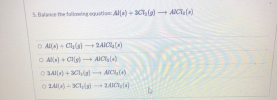 5. Balance the following equation: Al(s)+3Cl 2 (g) AlCl 3
(s)
5. Balance the following equation: Al(s) + 3C1 (9) AICI: (8) Al(s) + Cl2(g) + 2A1C13 (8) O Al(s) + C1(9) AICI: (s) O 3Al(s) + 3C12 (9) AICI: (3) 2Al(s) – 3C12(9) 2AICI:(s)
5. Balance the following equation: Al(s)+3Cl 2 (g) AlCl 3
(s)
5. Balance the following equation: Al(s) + 3C1 (9) AICI: (8) Al(s) + Cl2(g) + 2A1C13 (8) O Al(s) + C1(9) AICI: (s) O 3Al(s) + 3C12 (9) AICI: (3) 2Al(s) – 3C12(9) 2AICI:(s)
Consider the following cell diagram: Pt(s) | Fe3+(aq) , Fe2+(aq) || Cl–(aq) | Cl2(g) | Pt(s)...
Consider the following cell diagram: Pt(s) | Fe3+(aq) , Fe2+(aq) || Cl–(aq) | Cl2(g) | Pt(s) The reaction utilized by this cell is Question 8 options: Fe2+(aq) + 2Cl–(aq) --> Fe(s) + Cl2(g) Fe(s) + Cl2(g) --> Fe2+(aq) + 2Cl–(aq) 2Fe3+(aq) + 2Cl–(aq) --> 2Fe2+(aq) + Cl2(g) Fe3+(aq) + Cl–(aq) --> Fe2+(aq) + 1/2Cl2(g) 2Fe2+(aq) + Cl2(g) --> 2Fe3+(aq) + 2Cl–(aq)
Calculate AH for the reaction PC13(1) + Cl2(g) → PC15(s) given the following data: Equation ΔΗ...
 Calculate AH for the reaction PC13(1) + Cl2(g) → PC15(s) given the following data: Equation ΔΗ P4(s) + 6 Cl2(g) → 4 PC13(1) -1280 kJ P4(s) + 10 C12(g) → 4 PC1:($) -1774 kJ pt pt AH= 1 pt
Consider the following equation. CO(g) + Cl2 (8) → COCI2 (8) If 0.90 moles of Cl2...
 Consider the following equation. CO(g) + Cl2 (8) → COCI2 (8) If 0.90 moles of Cl2 (8) react fully with carbon monoxide how many moles of COCI2 (8) will be made? 2.7 moles COC12 (8) 1.8 moles COCI2 (8) 0.90 moles COCI2 (8) 0.45 moles COC12 (8)
Interpret the following equation for a chemical reaction using the coefficients given: CO(g) + Cl2(g) -...
 Interpret the following equation for a chemical reaction using the coefficients given: CO(g) + Cl2(g) - COC12(g) On the particulate level: of CO(g) reacts with of Cl2(g) to form of COC12(g). On the molar level: of CO(g) reacts with of Cl2(g) to form of COCIz(g) The balanced chemical equation for the reaction between carbon disulfide and chlorine is: CS(s) + 4Cl2() CCI (1) +2 SCI2 (8) We can interpret this to mean: 4 moles of chlorine and mole(s) of carbon...
For the following electrochemical cell: Fe(s)| Fe3+(aq) || Cl(aq) | Cl2(g)|| Pt(s) a) Write the Cell...
 For the following electrochemical cell: Fe(s)| Fe3+(aq) || Cl(aq) | Cl2(g)|| Pt(s) a) Write the Cell Reaction for this Cell. b) Identify the Anode and Cathode.
Based on the following information, Cl2(g) + 2 e- → 2 Cl-(aq) E° = +1.36 V Mg2+(aq) + 2 e- → 2 Mg(s) E° = -2.37 V which...
Based on the following information, Cl2(g) + 2 e- → 2 Cl-(aq) E° = +1.36 V Mg2+(aq) + 2 e- → 2 Mg(s) E° = -2.37 V which of the following chemical species is the strongest reducing agent? A. Cl2(g) B. Mg2+(aq) C. Mg(s) D. Cl-(aq)
From the following balanced equation, 2 Na(s) + Cl2(8) — 2 NaCl(s) how many moles of...
 From the following balanced equation, 2 Na(s) + Cl2(8) — 2 NaCl(s) how many moles of NaCl can be formed from 3 mol Cl,? • Your answer should have one significant figure.
Balance the chemical reaction equation P4(s)+Cl2(g)→PCl5(g) Enter the coefficients in order, separated by commas (e.g., 1,2,3)....
Balance the chemical reaction equation P4(s)+Cl2(g)→PCl5(g) Enter the coefficients in order, separated by commas (e.g., 1,2,3). View Available Hint(s) 1,10,4 The balanced equation is P4(s)+10Cl2(g)→4PCl5(g) Calculations involving a limiting reactant Now consider a situation in which 28.0 g of P4 is added to 53.0 g of Cl2, and a chemical reaction occurs. To identify the limiting reactant, you will need to perform two separate calculations: Calculate the number of moles of PCl5 that can be produced from 28.0 g of...
4. a) Determine Eº for the cell Pt (s) | Cl2 (g) | Cl− (aq) ||...
4. a) Determine Eº for the cell Pt (s) | Cl2 (g) | Cl− (aq) || Pb2+ (aq), H+ (aq) | PbO2 (s). b) What is the Standard Gibbs free energy of this reaction?
 5. Balance the following equation: Al(s)+3Cl 2 (g) AlCl 3
(s)
5. Balance the following equation: Al(s) + 3C1 (9) AICI: (8) Al(s) + Cl2(g) + 2A1C13 (8) O Al(s) + C1(9) AICI: (s) O 3Al(s) + 3C12 (9) AICI: (3) 2Al(s) – 3C12(9) 2AICI:(s)
5. Balance the following equation: Al(s)+3Cl 2 (g) AlCl 3
(s)
5. Balance the following equation: Al(s) + 3C1 (9) AICI: (8) Al(s) + Cl2(g) + 2A1C13 (8) O Al(s) + C1(9) AICI: (s) O 3Al(s) + 3C12 (9) AICI: (3) 2Al(s) – 3C12(9) 2AICI:(s)
 Calculate AH for the reaction PC13(1) + Cl2(g) → PC15(s) given the following data: Equation ΔΗ P4(s) + 6 Cl2(g) → 4 PC13(1) -1280 kJ P4(s) + 10 C12(g) → 4 PC1:($) -1774 kJ pt pt AH= 1 pt
 Consider the following equation. CO(g) + Cl2 (8) → COCI2 (8) If 0.90 moles of Cl2 (8) react fully with carbon monoxide how many moles of COCI2 (8) will be made? 2.7 moles COC12 (8) 1.8 moles COCI2 (8) 0.90 moles COCI2 (8) 0.45 moles COC12 (8)
 Interpret the following equation for a chemical reaction using the coefficients given: CO(g) + Cl2(g) - COC12(g) On the particulate level: of CO(g) reacts with of Cl2(g) to form of COC12(g). On the molar level: of CO(g) reacts with of Cl2(g) to form of COCIz(g) The balanced chemical equation for the reaction between carbon disulfide and chlorine is: CS(s) + 4Cl2() CCI (1) +2 SCI2 (8) We can interpret this to mean: 4 moles of chlorine and mole(s) of carbon...
 For the following electrochemical cell: Fe(s)| Fe3+(aq) || Cl(aq) | Cl2(g)|| Pt(s) a) Write the Cell Reaction for this Cell. b) Identify the Anode and Cathode.
 From the following balanced equation, 2 Na(s) + Cl2(8) — 2 NaCl(s) how many moles of NaCl can be formed from 3 mol Cl,? • Your answer should have one significant figure.
Most questions answered within 3 hours.
-
Where is the error in this code sequence?
String s1 = "Hello";
String s2 = "ello";...
asked 11 months ago -
Financial data for Joel de Paris, Inc., for last year
follow:
Joel de Paris, Inc.
Balance...
asked 11 months ago -
Consider this reaction:
Al2(SO4)3 (aq)+ BaCl3
(aq) Al2Cl6 (aq)- +
3BaSO4(s) . What is the...
asked 11 months ago -
Suppose that Savneet is considering increasing her
recent random sample from 20 car rentals to 40...
asked 11 months ago -
Trucks arrive at an unloading terminal at an average rate of 120
per hour.
Trucks arrive...
asked 11 months ago -
Why are methanol and ethanol completely soluble in water while
octanol is not very little soluble....
asked 11 months ago -
A facilities manager at a university reads in a research report
that the mean amount of...
asked 11 months ago -
When the CuSO4 is rehydrated by adding water to the anhydrous
compound, is this an endothermic...
asked 11 months ago -
A ray of sunlight is passing from diamond into crown glass; the
angle of incidence is...
asked 11 months ago -
A block of mass 0.249 kg is placed on top of a light, vertical
spring of...
asked 11 months ago -
how do the kidneys compensate in the presences of acidosis
a) trigger hyperventilate
b) reserve acid...
asked 11 months ago -
Question 501 pts
The rental rate of capital to the firm increases. Which of the
following...
asked 11 months ago