
Homework Answers
Request Answer!
We need at least 10 more requests to produce the answer.
0 / 10 have requested this problem solution
The more requests, the faster the answer.
Add Answer to:
Consider the following equation. CO(g) + Cl2 (8) → COCI2 (8) If 0.90 moles of Cl2...
Consider the following reaction: COCI() =CO() + Cl2(8) If 2.51x10 moles of COCI2, 0.362 moles of...
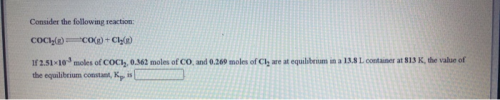 Consider the following reaction: COCI() =CO() + Cl2(8) If 2.51x10 moles of COCI2, 0.362 moles of Co, and 0.269 moles of Claro at equilibrium in a 13.8 L container at 813 K, the value of the equilibrium constant, Kp is
Interpret the following equation for a chemical reaction using the coefficients given: CO(g) + Cl2(g) -...
 Interpret the following equation for a chemical reaction using the coefficients given: CO(g) + Cl2(g) - COC12(g) On the particulate level: of CO(g) reacts with of Cl2(g) to form of COC12(g). On the molar level: of CO(g) reacts with of Cl2(g) to form of COCIz(g) The balanced chemical equation for the reaction between carbon disulfide and chlorine is: CS(s) + 4Cl2() CCI (1) +2 SCI2 (8) We can interpret this to mean: 4 moles of chlorine and mole(s) of carbon...
Consider the following reaction: COCl2(g) = CO(g) + Cl2(8) A reaction mixture initially contains 1.6 M...
 Consider the following reaction: COCl2(g) = CO(g) + Cl2(8) A reaction mixture initially contains 1.6 M COC12. Determine the equilibrium concentrations of COCI, CO, and Cl2 if Kc for the reaction at this temperature is 8.33 x 10⁻⁴. Calculate this based on the assumption that the answer is negligible compared to 1.6. Use x is small approximation. Show Q Validity check [Cl2] = [CO]= [COCI2] = Calculate the reaction quotient, Q A % Validity Check A Calculate the A/ equilibrium...
4. Phosgene (COCI2) is a highly toxic industrial chemical made from carbon monoxide and chlorine gases...
 4. Phosgene (COCI2) is a highly toxic industrial chemical made from carbon monoxide and chlorine gases over a catalyst: CO + Cl2 → COC12. Assume carbon monoxide at 270C at a pressure of 24.6 atm is feeding a continuous reactor at a flow rate of 100.0 L/hour. Chlorine gas is also feeding the same reactor at a flow rate of 164.0 L/hr, at a temperature of 7 °C and a pressure of 21.0 atm. Assuming ideal gas behavior and complete...
Consider the following reaction: COCI2(g) = CO(g) + Cl2(g) A reaction mixture initially contains 1.6 M...
 Consider the following reaction: COCI2(g) = CO(g) + Cl2(g) A reaction mixture initially contains 1.6 M COCI2. Determine the equilibrium concentration of CO if Kc for the reaction at this temperature is 8.33 x 10⁻⁴ (Hint: Note the size of Kc). 4.2 x 10⁻⁴M O 1.5 x 10⁻³M O 2.1 x 10⁻² M 3.7 x 10⁻² M O 1.3x10⁻³M
At 100 °C the equilibrium constant for the reaction COCI2 (g) CO (g) +Cl2 (g) has...
 At 100 °C the equilibrium constant for the reaction COCI2 (g) CO (g) +Cl2 (g) has the value Ke following mixtures of COCI2, CO, and Cl2 at 100 °C at equilibrium? If not, indicate the direction that the reaction must proceed to achieve equilibrium. 2.19 x 10¹⁰. Are the Part A 3.3 x 10⁻⁶ M. [Cl2] = 6.62 x 10- M [COCI2] = 2.00 x 10⁻³ M. [CO] The reaction is at equilibrium. The reaction will proceed right to attain...
CO(g) + Cl2(g) <==-=> COCI2(8) AH = 58 kJ Determine Kp at 500°C if the pressure...
 CO(g) + Cl2(g) <==-=> COCI2(8) AH = 58 kJ Determine Kp at 500°C if the pressure is in atm and Kc is 5.55 x 10¹⁰ A 5.82 x 10⁻⁵ B 2.28 x 10¹² 5.30 x 1025 1.35 x 10° E 8.75 x 10⁸
The equilibrium constant, K, for the following reaction is 1.29x10⁻² at 600 K. COCI2(g) CO(g) +...
 The equilibrium constant, K, for the following reaction is 1.29x10⁻² at 600 K. COCI2(g) CO(g) + Cl2(g) Calculate the equilibrium concentrations of reactant and products when 0.252 moles of CoCl2(g) are introduced into a 1.00 L vessel at 600 K. [COCI2] = [Co] = (C12] =
Carbon monoxide and hydrogen react according to the following equation: CO(g) + 3H_2(g) CH_4(g) + H_2...
 Carbon monoxide and hydrogen react according to the following equation: CO(g) + 3H_2(g) CH_4(g) + H_2 O (g) When 1.000mol CO and 3.000 moles H_2, are placed in a 10.00-L vessel at 9271 C and allowed to come to equilibrium the mixture is found to contain 0.387 moles of H.O. What is the molar composition of the equilibrium mixture? That is how many moles of cach substancc arc present? Set up the Data Table.
A student ran the following reaction in the laboratory at 541 K: COC12(E) CO(g) + Cl2(g)...
 A student ran the following reaction in the laboratory at 541 K: COC12(E) CO(g) + Cl2(g) When she introduced 1.13 moles of COC12(e) into a 1.00 liter container, she found the equilibrium concentration of Cl2(g) to be 3.83x10⁻² M. Calculate the equilibrium constant, K, she obtained for this reaction.
 Consider the following reaction: COCI() =CO() + Cl2(8) If 2.51x10 moles of COCI2, 0.362 moles of Co, and 0.269 moles of Claro at equilibrium in a 13.8 L container at 813 K, the value of the equilibrium constant, Kp is
 Interpret the following equation for a chemical reaction using the coefficients given: CO(g) + Cl2(g) - COC12(g) On the particulate level: of CO(g) reacts with of Cl2(g) to form of COC12(g). On the molar level: of CO(g) reacts with of Cl2(g) to form of COCIz(g) The balanced chemical equation for the reaction between carbon disulfide and chlorine is: CS(s) + 4Cl2() CCI (1) +2 SCI2 (8) We can interpret this to mean: 4 moles of chlorine and mole(s) of carbon...
 Consider the following reaction: COCl2(g) = CO(g) + Cl2(8) A reaction mixture initially contains 1.6 M COC12. Determine the equilibrium concentrations of COCI, CO, and Cl2 if Kc for the reaction at this temperature is 8.33 x 10⁻⁴. Calculate this based on the assumption that the answer is negligible compared to 1.6. Use x is small approximation. Show Q Validity check [Cl2] = [CO]= [COCI2] = Calculate the reaction quotient, Q A % Validity Check A Calculate the A/ equilibrium...
 4. Phosgene (COCI2) is a highly toxic industrial chemical made from carbon monoxide and chlorine gases over a catalyst: CO + Cl2 → COC12. Assume carbon monoxide at 270C at a pressure of 24.6 atm is feeding a continuous reactor at a flow rate of 100.0 L/hour. Chlorine gas is also feeding the same reactor at a flow rate of 164.0 L/hr, at a temperature of 7 °C and a pressure of 21.0 atm. Assuming ideal gas behavior and complete...
 Consider the following reaction: COCI2(g) = CO(g) + Cl2(g) A reaction mixture initially contains 1.6 M COCI2. Determine the equilibrium concentration of CO if Kc for the reaction at this temperature is 8.33 x 10⁻⁴ (Hint: Note the size of Kc). 4.2 x 10⁻⁴M O 1.5 x 10⁻³M O 2.1 x 10⁻² M 3.7 x 10⁻² M O 1.3x10⁻³M
 At 100 °C the equilibrium constant for the reaction COCI2 (g) CO (g) +Cl2 (g) has the value Ke following mixtures of COCI2, CO, and Cl2 at 100 °C at equilibrium? If not, indicate the direction that the reaction must proceed to achieve equilibrium. 2.19 x 10¹⁰. Are the Part A 3.3 x 10⁻⁶ M. [Cl2] = 6.62 x 10- M [COCI2] = 2.00 x 10⁻³ M. [CO] The reaction is at equilibrium. The reaction will proceed right to attain...
 CO(g) + Cl2(g) <==-=> COCI2(8) AH = 58 kJ Determine Kp at 500°C if the pressure is in atm and Kc is 5.55 x 10¹⁰ A 5.82 x 10⁻⁵ B 2.28 x 10¹² 5.30 x 1025 1.35 x 10° E 8.75 x 10⁸
 The equilibrium constant, K, for the following reaction is 1.29x10⁻² at 600 K. COCI2(g) CO(g) + Cl2(g) Calculate the equilibrium concentrations of reactant and products when 0.252 moles of CoCl2(g) are introduced into a 1.00 L vessel at 600 K. [COCI2] = [Co] = (C12] =
 Carbon monoxide and hydrogen react according to the following equation: CO(g) + 3H_2(g) CH_4(g) + H_2 O (g) When 1.000mol CO and 3.000 moles H_2, are placed in a 10.00-L vessel at 9271 C and allowed to come to equilibrium the mixture is found to contain 0.387 moles of H.O. What is the molar composition of the equilibrium mixture? That is how many moles of cach substancc arc present? Set up the Data Table.
 A student ran the following reaction in the laboratory at 541 K: COC12(E) CO(g) + Cl2(g) When she introduced 1.13 moles of COC12(e) into a 1.00 liter container, she found the equilibrium concentration of Cl2(g) to be 3.83x10⁻² M. Calculate the equilibrium constant, K, she obtained for this reaction.
Most questions answered within 3 hours.
-
Where is the error in this code sequence?
String s1 = "Hello";
String s2 = "ello";...
asked 10 months ago -
Financial data for Joel de Paris, Inc., for last year
follow:
Joel de Paris, Inc.
Balance...
asked 10 months ago -
Consider this reaction:
Al2(SO4)3 (aq)+ BaCl3
(aq) Al2Cl6 (aq)- +
3BaSO4(s) . What is the...
asked 10 months ago -
Suppose that Savneet is considering increasing her
recent random sample from 20 car rentals to 40...
asked 10 months ago -
Trucks arrive at an unloading terminal at an average rate of 120
per hour.
Trucks arrive...
asked 10 months ago -
Why are methanol and ethanol completely soluble in water while
octanol is not very little soluble....
asked 10 months ago -
A facilities manager at a university reads in a research report
that the mean amount of...
asked 10 months ago -
When the CuSO4 is rehydrated by adding water to the anhydrous
compound, is this an endothermic...
asked 10 months ago -
A ray of sunlight is passing from diamond into crown glass; the
angle of incidence is...
asked 10 months ago -
A block of mass 0.249 kg is placed on top of a light, vertical
spring of...
asked 10 months ago -
how do the kidneys compensate in the presences of acidosis
a) trigger hyperventilate
b) reserve acid...
asked 10 months ago -
Question 501 pts
The rental rate of capital to the firm increases. Which of the
following...
asked 10 months ago