A car traveling at 18m/s goes around a flat turn with a radius of 40m without...
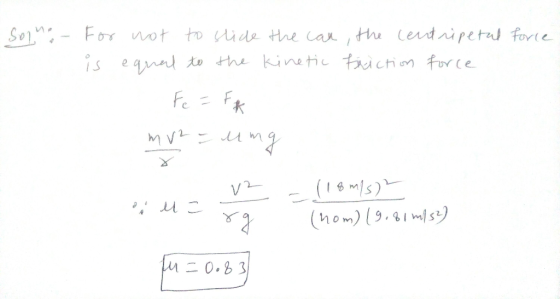
A car traveling at 18m/s goes around a flat turn with a radius of 40m without skidding. What is the minimum possible coefficient of friction for this road?
Homework Answers
Add Answer to:
A car traveling at 18m/s goes around a flat turn with a radius
of 40m without...
A 780 kg car is driving around a comer with a radius of 25 m at...
 A 780 kg car is driving around a comer with a radius of 25 m at a velocity of 14 m/s. a) Draw a FBD of the car on the corner. Be sure to indicate which direction is towards the center of the corner. b) Use the FBD to find an equation for the normal force and the force due to friction c) What is the smallest possible coefficient of friction between the tires and the road without the car...
show work 5) Racing on a FLAT track a car going at 32m/s rounds a curve...
 show work
5) Racing on a FLAT track a car going at 32m/s rounds a curve of 56m radius. a) What is the centripetal acceleration of the car? b) Calculate the minimum coefficient of Static Friction needed, between the tires and the road, to round the curve without skidding e) Determine the BANKING ANGLE on a curve of radius 80m, if the marked velocity to enter the curve is 50 miles/hr. 6) A 5g bullet is fired, horizontally, with a...
show work
5) Racing on a FLAT track a car going at 32m/s rounds a curve of 56m radius. a) What is the centripetal acceleration of the car? b) Calculate the minimum coefficient of Static Friction needed, between the tires and the road, to round the curve without skidding e) Determine the BANKING ANGLE on a curve of radius 80m, if the marked velocity to enter the curve is 50 miles/hr. 6) A 5g bullet is fired, horizontally, with a...
A curve of radius 70 m is banked so that a 1000 kg car traveling at...
A curve of radius 70 m is banked so that a 1000 kg car traveling at 60 km/h can round it even if the road is so icy that the coefficient of static friction is approximately zero. The acceleration of gravity is 9.81 m/s 2 . a) Find the minimum speed at which a car can travel around this curve without skidding if the coefficient of static friction between the road and the tires is 0.2 b) Find the maximum...
A car travelling on a flat road enters a turn with a radius of 30 meters...
A car travelling on a flat road enters a turn with a radius of 30 meters at a speed of 28 m/s. Will the car make the turn without skidding? You can leave the variable for mass as m.
5. (10 pts): A car of mass M goes around an icy banked turn of radius...
 5. (10 pts): A car of mass M goes around an icy banked turn of radius t at a speed v. If there is no frictional force and the car takes the turn without skidding, at what angle 0 is the turn banked?
a car goes around an unbanked (flat) curve with a radius of 75 m. The cars...
a car goes around an unbanked (flat) curve with a radius of 75 m. The cars tires are worn down so the coefficient of friction between the tired and asphalt is 0.60. What is the magnitude of the cars maximum possible velocity around the curve?
A car drives around a flat 119 m radius circular track at 20 m/s. Assume that...
A car drives around a flat 119 m radius circular track at 20 m/s. Assume that this speed is the maximum speed that the car can have without out "skidding out" of the curve.The car moves into the next curve. The radius of this new curve is twice as great as the previous. Assume the coefficient of static friction has not changed. Calculate the car's maximum speed in this curve. m/s
A car travels around an unbanked 60 m radius curve without skidding, If the coefficient of...
 A car travels around an unbanked 60 m radius curve without skidding, If the coefficient of friction between the tires and road is 0.4, what is the car's maximum speed? 55 kph 47 43 kph 76 kph 62 kph
3. A car is driving at a speed of 20 m/sec on a circular horizontal flat...
 3. A car is driving at a speed of 20 m/sec on a circular horizontal flat (unbanked) road of radius 200 m. (a) What minimum coefficient of static friction will permit the car to follow the circular path without skidding? (b) If the road had a radius of 32 m, what is the maximum speed of the car without skidding? (c) If the road was banked (not flat), could the car go faster? Explain your answer Possibly (but not necessarily)...
5. A car with mass of 1200 kg rounds a flat, unbanked curve with radius of...
 5. A car with mass of 1200 kg rounds a flat, unbanked curve with radius of 250 m. (a) Make a free body diagram of this car (1pts). driver can take the curve without sliding is yos. -18m/s. (6pts) (c) Calculate the coefficient of static friction (u, between tires and road. (6pts) at is the magnitude of the maximum friction force necessary to hold a car on the curve if the maximum speed at which the
 A 780 kg car is driving around a comer with a radius of 25 m at a velocity of 14 m/s. a) Draw a FBD of the car on the corner. Be sure to indicate which direction is towards the center of the corner. b) Use the FBD to find an equation for the normal force and the force due to friction c) What is the smallest possible coefficient of friction between the tires and the road without the car...
 show work
5) Racing on a FLAT track a car going at 32m/s rounds a curve of 56m radius. a) What is the centripetal acceleration of the car? b) Calculate the minimum coefficient of Static Friction needed, between the tires and the road, to round the curve without skidding e) Determine the BANKING ANGLE on a curve of radius 80m, if the marked velocity to enter the curve is 50 miles/hr. 6) A 5g bullet is fired, horizontally, with a...
show work
5) Racing on a FLAT track a car going at 32m/s rounds a curve of 56m radius. a) What is the centripetal acceleration of the car? b) Calculate the minimum coefficient of Static Friction needed, between the tires and the road, to round the curve without skidding e) Determine the BANKING ANGLE on a curve of radius 80m, if the marked velocity to enter the curve is 50 miles/hr. 6) A 5g bullet is fired, horizontally, with a...
 5. (10 pts): A car of mass M goes around an icy banked turn of radius t at a speed v. If there is no frictional force and the car takes the turn without skidding, at what angle 0 is the turn banked?
 A car travels around an unbanked 60 m radius curve without skidding, If the coefficient of friction between the tires and road is 0.4, what is the car's maximum speed? 55 kph 47 43 kph 76 kph 62 kph
 3. A car is driving at a speed of 20 m/sec on a circular horizontal flat (unbanked) road of radius 200 m. (a) What minimum coefficient of static friction will permit the car to follow the circular path without skidding? (b) If the road had a radius of 32 m, what is the maximum speed of the car without skidding? (c) If the road was banked (not flat), could the car go faster? Explain your answer Possibly (but not necessarily)...
 5. A car with mass of 1200 kg rounds a flat, unbanked curve with radius of 250 m. (a) Make a free body diagram of this car (1pts). driver can take the curve without sliding is yos. -18m/s. (6pts) (c) Calculate the coefficient of static friction (u, between tires and road. (6pts) at is the magnitude of the maximum friction force necessary to hold a car on the curve if the maximum speed at which the
Most questions answered within 3 hours.
-
Where is the error in this code sequence?
String s1 = "Hello";
String s2 = "ello";...
asked 11 months ago -
Financial data for Joel de Paris, Inc., for last year
follow:
Joel de Paris, Inc.
Balance...
asked 11 months ago -
Consider this reaction:
Al2(SO4)3 (aq)+ BaCl3
(aq) Al2Cl6 (aq)- +
3BaSO4(s) . What is the...
asked 11 months ago -
Suppose that Savneet is considering increasing her
recent random sample from 20 car rentals to 40...
asked 11 months ago -
Trucks arrive at an unloading terminal at an average rate of 120
per hour.
Trucks arrive...
asked 11 months ago -
Why are methanol and ethanol completely soluble in water while
octanol is not very little soluble....
asked 11 months ago -
A facilities manager at a university reads in a research report
that the mean amount of...
asked 11 months ago -
When the CuSO4 is rehydrated by adding water to the anhydrous
compound, is this an endothermic...
asked 11 months ago -
A ray of sunlight is passing from diamond into crown glass; the
angle of incidence is...
asked 11 months ago -
A block of mass 0.249 kg is placed on top of a light, vertical
spring of...
asked 11 months ago -
how do the kidneys compensate in the presences of acidosis
a) trigger hyperventilate
b) reserve acid...
asked 11 months ago -
Question 501 pts
The rental rate of capital to the firm increases. Which of the
following...
asked 11 months ago