
Homework Answers
![Hea ci Toth 년 매 HH ů -c-NA t SSE エーローやー - H-c-H 1 ] Oluase 9HT - NR, .. H2 Alcohol -c=0 q + dehydrogenase CH3 Cethanal) CH3 -](http://img.homeworklib.com/questions/89eb4b70-700e-11ea-9d19-1123c2ba8924.png?x-oss-process=image/resize,w_560)

Add Answer to:
Biochemistry
In this reaction what is transferred from the alcohol to the NAD+ to generate the...
The mechanism of glyceraldehyde 3 phosphate dehydrogenase. In step 1 (Top Left) the sulfur from the cysteine loses its...
 The mechanism of glyceraldehyde 3 phosphate dehydrogenase. In
step 1 (Top Left) the sulfur from the cysteine loses its hydrogen
to the carbonyl carbon of the substrate. I think is wrong and the
hydrogen is stolen by the histidine (nitrogen) using a base
catalyst reaction.
lser Glyceraldehyde 3-phosphate NAD CONH2 H -N + HH Hemithioacetal Oxidation NAD NADH CONH CONH2 Но RN + H -N / H Η Η Hн s NADH NAD Thioester intermediate Thioester intermediate Phosphorylation CONH2 O...
The mechanism of glyceraldehyde 3 phosphate dehydrogenase. In
step 1 (Top Left) the sulfur from the cysteine loses its hydrogen
to the carbonyl carbon of the substrate. I think is wrong and the
hydrogen is stolen by the histidine (nitrogen) using a base
catalyst reaction.
lser Glyceraldehyde 3-phosphate NAD CONH2 H -N + HH Hemithioacetal Oxidation NAD NADH CONH CONH2 Но RN + H -N / H Η Η Hн s NADH NAD Thioester intermediate Thioester intermediate Phosphorylation CONH2 O...
2. The image at right shows NAD+ and ethanol in the active site of alcohol dehydrogenase....
 2. The image at right shows NAD+ and ethanol in the active site of alcohol dehydrogenase. The reaction catalyzed by this enzyme is: CH3CHO + NADH + H+ + CH3CH2OH + NAD+. Which of the statements below concerning this reaction is true? O The proton (H) is likely supplied by a basic amino acid such as lysine in its positively charged form. O The reaction mechanism involves an alkoxide intermediate. O This reaction establishes a stereocenter in ethanol. O NADH...
Which of the following statements are false regarding NAD+ and NADH? 1.) in a typical biological...
Which of the following statements are false regarding NAD+ and NADH? 1.) in a typical biological oxidation reaction, hydride from alcohol is transferred to NADH giving NAD+. 2.) these are commonly called pyridine nucleotides 3.) they dissociate from the enzyme after the reaction 4.) none of the answers are correct
The body can break down alcohol through the following reaction: ethanol + NAD +→ acetadehyde +...
 The body can break down alcohol through the following reaction:
ethanol + NAD +→ acetadehyde + NADH + H+ Calculate Delta G* for
this reaction at 25C.
The standard reduction potentials are:
ethanol →acetaldehyde + 2H+ + 2e- E = -0.197V
NAD+ + H+ + 2e- → NADH E= -0.320V
1. The body can break down alcohol through the following reaction: ethanol + NAD* acetadehyde + NADH+H* Calculate AGº for this reaction at 25°C. The standard reduction potentials are: ethanol...
The body can break down alcohol through the following reaction:
ethanol + NAD +→ acetadehyde + NADH + H+ Calculate Delta G* for
this reaction at 25C.
The standard reduction potentials are:
ethanol →acetaldehyde + 2H+ + 2e- E = -0.197V
NAD+ + H+ + 2e- → NADH E= -0.320V
1. The body can break down alcohol through the following reaction: ethanol + NAD* acetadehyde + NADH+H* Calculate AGº for this reaction at 25°C. The standard reduction potentials are: ethanol...
The consumption of alcohol (ethanol), especially after periods of strenuous activity or after not eating for...
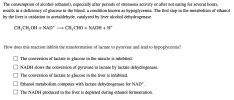 The consumption of alcohol (ethanol), especially after periods of strenuous activity or after not eating for several hours, results in a deficiency of glucose in the blood, a condition known as hypoglycemia. The first step in the metabolism of ethanol by the liver is oxidation to acetaldehyde, catalyzed by liver alcohol dehydrogenase. CH,CH,OH + NAD+ CH CHO + NADH + H+ How does this reaction inhibit the transformation of lactate to pyruvate and lead to hypoglycemia? The conversion of lactate...
2. The necessary chemical reagents (or reactants) and reaction conditions are respectively filled in the reaction...
 2. The necessary chemical reagents (or reactants) and reaction conditions are respectively filled in the reaction formulas of the following specified raw materials and products. a PROHLCHGH OH P RCH-CHOH O CHO L =C(CH G CH.CO.CH CH OH H.CO CAN CH.CO.CH сно H.CO.C-N CONH CONH CHICHI CH.CH 110) H.C.CHCHOC, H.) HCCHCHOCH он он - сно, сност, CHCH.CH OCP
1. The body can break down alcohol through the following reaction: ethanol + NAD + acetadehyde...
 1. The body can break down alcohol through the following reaction: ethanol + NAD + acetadehyde + NADH+H* Calculate AGⓇ for this reaction at 25°C. The standard reduction potentials are: ethanol - acetaldehyde + 2H+ + 2e E-.0.197 V NAD + H+ +2e - NADH E = -0.320 V HINT: These reactions are already balanced and written in the correct direction. You do not need to flip either of these reactions. 2. Electrolysis is used to plate zinc from a...
A) In this reaction, Acetaldehyde + NADH + H+ --> ethanol + NAD+ 1. Acetaldehyde is...
A) In this reaction, Acetaldehyde + NADH + H+ --> ethanol + NAD+ 1. Acetaldehyde is the reducing agent 2. Acetaldehyde is the oxidizing agent 3. NAD+ is oxidized 4. NADH is the oxidizing agent B) In ATP synthase complex, the F0 portion: 1. serves as proton channel 2. goes through conformational change to release ATP 3. oversees transport of ATP from mitochondria of eukaryotic cells 4. pumps proton against concentration gradient
This is a biochemistry question i need answers to 6-12 What is the purpose of fermentation...
 This is a biochemistry question i need answers to 6-12
What is the purpose of fermentation of pyruvate to lactate or ethanol? to produce additional ATP to provide a precursor for lactose synthesis to regenerate NAD* for glycolysis to prevent pyruvate from entering the TCA cycle none of the above Pyruvate kinase catalyzes what reaction? conversion of phosphoenol-pyruvate to pyruvate phosphorylation of pyruvate to 3-phosphoglycerate conversion of pyruvate to acetaldehyde and CO_2 conversion of pyruvate to lactate conversion of pyruvate...
This is a biochemistry question i need answers to 6-12
What is the purpose of fermentation of pyruvate to lactate or ethanol? to produce additional ATP to provide a precursor for lactose synthesis to regenerate NAD* for glycolysis to prevent pyruvate from entering the TCA cycle none of the above Pyruvate kinase catalyzes what reaction? conversion of phosphoenol-pyruvate to pyruvate phosphorylation of pyruvate to 3-phosphoglycerate conversion of pyruvate to acetaldehyde and CO_2 conversion of pyruvate to lactate conversion of pyruvate...
3) In an acid-base reaction, what is transferred from the acid to the base?
3) In an acid-base reaction, what is transferred from the acid to the base? A) an oxidizing agent B) an oxygen atom C) an OH-ion D) an electron E) a hydrogen cation, H+ 4) Classify the following reaction: Ce4+ (aq) + Fe2+(aq) → Ce3+ (aq) + Fe3+ (aq) A) oxidation - reduction B) acid - base C) decomposition D) precipitation E) combustion
 The mechanism of glyceraldehyde 3 phosphate dehydrogenase. In
step 1 (Top Left) the sulfur from the cysteine loses its hydrogen
to the carbonyl carbon of the substrate. I think is wrong and the
hydrogen is stolen by the histidine (nitrogen) using a base
catalyst reaction.
lser Glyceraldehyde 3-phosphate NAD CONH2 H -N + HH Hemithioacetal Oxidation NAD NADH CONH CONH2 Но RN + H -N / H Η Η Hн s NADH NAD Thioester intermediate Thioester intermediate Phosphorylation CONH2 O...
The mechanism of glyceraldehyde 3 phosphate dehydrogenase. In
step 1 (Top Left) the sulfur from the cysteine loses its hydrogen
to the carbonyl carbon of the substrate. I think is wrong and the
hydrogen is stolen by the histidine (nitrogen) using a base
catalyst reaction.
lser Glyceraldehyde 3-phosphate NAD CONH2 H -N + HH Hemithioacetal Oxidation NAD NADH CONH CONH2 Но RN + H -N / H Η Η Hн s NADH NAD Thioester intermediate Thioester intermediate Phosphorylation CONH2 O...
 2. The image at right shows NAD+ and ethanol in the active site of alcohol dehydrogenase. The reaction catalyzed by this enzyme is: CH3CHO + NADH + H+ + CH3CH2OH + NAD+. Which of the statements below concerning this reaction is true? O The proton (H) is likely supplied by a basic amino acid such as lysine in its positively charged form. O The reaction mechanism involves an alkoxide intermediate. O This reaction establishes a stereocenter in ethanol. O NADH...
 The body can break down alcohol through the following reaction:
ethanol + NAD +→ acetadehyde + NADH + H+ Calculate Delta G* for
this reaction at 25C.
The standard reduction potentials are:
ethanol →acetaldehyde + 2H+ + 2e- E = -0.197V
NAD+ + H+ + 2e- → NADH E= -0.320V
1. The body can break down alcohol through the following reaction: ethanol + NAD* acetadehyde + NADH+H* Calculate AGº for this reaction at 25°C. The standard reduction potentials are: ethanol...
The body can break down alcohol through the following reaction:
ethanol + NAD +→ acetadehyde + NADH + H+ Calculate Delta G* for
this reaction at 25C.
The standard reduction potentials are:
ethanol →acetaldehyde + 2H+ + 2e- E = -0.197V
NAD+ + H+ + 2e- → NADH E= -0.320V
1. The body can break down alcohol through the following reaction: ethanol + NAD* acetadehyde + NADH+H* Calculate AGº for this reaction at 25°C. The standard reduction potentials are: ethanol...
 The consumption of alcohol (ethanol), especially after periods of strenuous activity or after not eating for several hours, results in a deficiency of glucose in the blood, a condition known as hypoglycemia. The first step in the metabolism of ethanol by the liver is oxidation to acetaldehyde, catalyzed by liver alcohol dehydrogenase. CH,CH,OH + NAD+ CH CHO + NADH + H+ How does this reaction inhibit the transformation of lactate to pyruvate and lead to hypoglycemia? The conversion of lactate...
 2. The necessary chemical reagents (or reactants) and reaction conditions are respectively filled in the reaction formulas of the following specified raw materials and products. a PROHLCHGH OH P RCH-CHOH O CHO L =C(CH G CH.CO.CH CH OH H.CO CAN CH.CO.CH сно H.CO.C-N CONH CONH CHICHI CH.CH 110) H.C.CHCHOC, H.) HCCHCHOCH он он - сно, сност, CHCH.CH OCP
 1. The body can break down alcohol through the following reaction: ethanol + NAD + acetadehyde + NADH+H* Calculate AGⓇ for this reaction at 25°C. The standard reduction potentials are: ethanol - acetaldehyde + 2H+ + 2e E-.0.197 V NAD + H+ +2e - NADH E = -0.320 V HINT: These reactions are already balanced and written in the correct direction. You do not need to flip either of these reactions. 2. Electrolysis is used to plate zinc from a...
 This is a biochemistry question i need answers to 6-12
What is the purpose of fermentation of pyruvate to lactate or ethanol? to produce additional ATP to provide a precursor for lactose synthesis to regenerate NAD* for glycolysis to prevent pyruvate from entering the TCA cycle none of the above Pyruvate kinase catalyzes what reaction? conversion of phosphoenol-pyruvate to pyruvate phosphorylation of pyruvate to 3-phosphoglycerate conversion of pyruvate to acetaldehyde and CO_2 conversion of pyruvate to lactate conversion of pyruvate...
This is a biochemistry question i need answers to 6-12
What is the purpose of fermentation of pyruvate to lactate or ethanol? to produce additional ATP to provide a precursor for lactose synthesis to regenerate NAD* for glycolysis to prevent pyruvate from entering the TCA cycle none of the above Pyruvate kinase catalyzes what reaction? conversion of phosphoenol-pyruvate to pyruvate phosphorylation of pyruvate to 3-phosphoglycerate conversion of pyruvate to acetaldehyde and CO_2 conversion of pyruvate to lactate conversion of pyruvate...
Most questions answered within 3 hours.
-
Where is the error in this code sequence?
String s1 = "Hello";
String s2 = "ello";...
asked 11 months ago -
Financial data for Joel de Paris, Inc., for last year
follow:
Joel de Paris, Inc.
Balance...
asked 11 months ago -
Consider this reaction:
Al2(SO4)3 (aq)+ BaCl3
(aq) Al2Cl6 (aq)- +
3BaSO4(s) . What is the...
asked 11 months ago -
Suppose that Savneet is considering increasing her
recent random sample from 20 car rentals to 40...
asked 11 months ago -
Trucks arrive at an unloading terminal at an average rate of 120
per hour.
Trucks arrive...
asked 11 months ago -
Why are methanol and ethanol completely soluble in water while
octanol is not very little soluble....
asked 11 months ago -
A facilities manager at a university reads in a research report
that the mean amount of...
asked 11 months ago -
When the CuSO4 is rehydrated by adding water to the anhydrous
compound, is this an endothermic...
asked 11 months ago -
A ray of sunlight is passing from diamond into crown glass; the
angle of incidence is...
asked 11 months ago -
A block of mass 0.249 kg is placed on top of a light, vertical
spring of...
asked 11 months ago -
how do the kidneys compensate in the presences of acidosis
a) trigger hyperventilate
b) reserve acid...
asked 11 months ago -
Question 501 pts
The rental rate of capital to the firm increases. Which of the
following...
asked 11 months ago