
Homework Answers
Alcohol dehydrogenase is required to convert ethanol to acetaldehyde in our body. In this process Alcohol undergoes oxidation and NAD+ undergoes reduction.
The first step involves deprotonation from alcohol, which makes it an alkoxide intermediate. And this proton is supplied by serine ,present in active site of the enzyme (not a basic amino acid , but polar one) .
No stereocenter is setup as carbon center does not 4 different substituents on it.
So i can say 2nd statement is a correct one in this case.
Add Answer to:
2. The image at right shows NAD+ and ethanol in the active site of alcohol dehydrogenase....
Which of the following sentences is nottrue about alcohol dehydrogenase a. The enzyme uses NADH as cofactor. b. The enzyme transfers the hydride, H- between the substrates. c. If yeast alcohol dehydr...
 Which of the following sentences is nottrue about alcohol dehydrogenase a. The enzyme uses NADH as cofactor. b. The enzyme transfers the hydride, H- between the substrates. c. If yeast alcohol dehydrogenase is reacted with CH3CD2OH, the generated NADH will contain deuterium in the pro-R position. d. If deuterium NAD+ is reacted with CH3CH2OH, the generated aldehyde will contain deuterium. e. If a pro-R deuterium NADH is reacted with Glyceraldehyde-3-phosphate dehydrogenase, deuterium will be remained in NAD+
Which of the...
Which of the following sentences is nottrue about alcohol dehydrogenase a. The enzyme uses NADH as cofactor. b. The enzyme transfers the hydride, H- between the substrates. c. If yeast alcohol dehydrogenase is reacted with CH3CD2OH, the generated NADH will contain deuterium in the pro-R position. d. If deuterium NAD+ is reacted with CH3CH2OH, the generated aldehyde will contain deuterium. e. If a pro-R deuterium NADH is reacted with Glyceraldehyde-3-phosphate dehydrogenase, deuterium will be remained in NAD+
Which of the...
Biochemistry In this reaction what is transferred from the alcohol to the NAD+ to generate the...
 Biochemistry
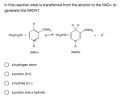
In this reaction what is transferred from the alcohol to the NAD+ to generate the NADH? HH CONH2 CONH -.- снан,он + CH,CHO + (NAD+) (NADH) O a hydrogen atom O a proton (H+) O a hydride (H:-) O a proton and a hydride
Biochemistry
In this reaction what is transferred from the alcohol to the NAD+ to generate the NADH? HH CONH2 CONH -.- снан,он + CH,CHO + (NAD+) (NADH) O a hydrogen atom O a proton (H+) O a hydride (H:-) O a proton and a hydride
The consumption of alcohol (ethanol), especially after periods of strenuous activity or after not eating for...
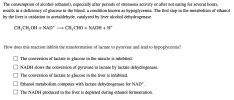 The consumption of alcohol (ethanol), especially after periods of strenuous activity or after not eating for several hours, results in a deficiency of glucose in the blood, a condition known as hypoglycemia. The first step in the metabolism of ethanol by the liver is oxidation to acetaldehyde, catalyzed by liver alcohol dehydrogenase. CH,CH,OH + NAD+ CH CHO + NADH + H+ How does this reaction inhibit the transformation of lactate to pyruvate and lead to hypoglycemia? The conversion of lactate...
The mechanism of glyceraldehyde 3 phosphate dehydrogenase. In step 1 (Top Left) the sulfur from the cysteine loses its...
 The mechanism of glyceraldehyde 3 phosphate dehydrogenase. In
step 1 (Top Left) the sulfur from the cysteine loses its hydrogen
to the carbonyl carbon of the substrate. I think is wrong and the
hydrogen is stolen by the histidine (nitrogen) using a base
catalyst reaction.
lser Glyceraldehyde 3-phosphate NAD CONH2 H -N + HH Hemithioacetal Oxidation NAD NADH CONH CONH2 Но RN + H -N / H Η Η Hн s NADH NAD Thioester intermediate Thioester intermediate Phosphorylation CONH2 O...
The mechanism of glyceraldehyde 3 phosphate dehydrogenase. In
step 1 (Top Left) the sulfur from the cysteine loses its hydrogen
to the carbonyl carbon of the substrate. I think is wrong and the
hydrogen is stolen by the histidine (nitrogen) using a base
catalyst reaction.
lser Glyceraldehyde 3-phosphate NAD CONH2 H -N + HH Hemithioacetal Oxidation NAD NADH CONH CONH2 Но RN + H -N / H Η Η Hн s NADH NAD Thioester intermediate Thioester intermediate Phosphorylation CONH2 O...
1. 2. 3. 4. Select all that apply. Identify the reaction(s) of glycolysis inhibited by ATP □ glyceraldehyde-3-phosphate → 1,3-bisphosphoglycerate phosphoenolpyruvate +pyruvate 3-phosphoglycerate...
 1.
2.
3.
4.
Select all that apply. Identify the reaction(s) of glycolysis inhibited by ATP □ glyceraldehyde-3-phosphate → 1,3-bisphosphoglycerate phosphoenolpyruvate +pyruvate 3-phosphoglycerate ~2-phosphoglycerate 1) fructose-6-phosphate→ fructose-1,6-bisphosphate . glucose glucose-6-phosphate Select all that apply. Alcohol fermentation: consumes ATP as it produces ethanol. O produces carbon dioxide begins as pyruvate is decarboxylated to acetaldehyde in a reaction catalyzed by alcohol dehydrogenase m regenerates NAD requires the enzyme alcohol dehydrogenase, In the figure below, what is the reaction occurring at the location...
1.
2.
3.
4.
Select all that apply. Identify the reaction(s) of glycolysis inhibited by ATP □ glyceraldehyde-3-phosphate → 1,3-bisphosphoglycerate phosphoenolpyruvate +pyruvate 3-phosphoglycerate ~2-phosphoglycerate 1) fructose-6-phosphate→ fructose-1,6-bisphosphate . glucose glucose-6-phosphate Select all that apply. Alcohol fermentation: consumes ATP as it produces ethanol. O produces carbon dioxide begins as pyruvate is decarboxylated to acetaldehyde in a reaction catalyzed by alcohol dehydrogenase m regenerates NAD requires the enzyme alcohol dehydrogenase, In the figure below, what is the reaction occurring at the location...
15. Genetic defect in pyruvate dehydrogenase complex lead a. maple syrup urine disease b. phenyike d....
 15. Genetic defect in pyruvate dehydrogenase complex lead a. maple syrup urine disease b. phenyike d. lactic acidemia e. pellagra syrup urine disease b, phenylketonuria c. galactosemia 10. Chemical modification by phosphorylation of pyruvate dehydros a. deactivates the enzyme b. activates the enzyme lation of pyruvate dehydrogenase complex : 17. Pyruvate carboxylase is positively ated through the allosteric mechanism by : a. ATP b. NADH c. Acetyl-SCOA d. TPP e. Biotin 18. Which of the listed coenzymes does not particip...
4. What is the commited step of glycolysis and how is this enzyme regulated? 5. Glyceraldehyde-3-phophate...
 4. What is the commited step of glycolysis and how is this enzyme regulated? 5. Glyceraldehyde-3-phophate dehydrogenase (GAPDH) is the most important enzyme in glycolysis. a. What two reactions are coupled by GAPDH? b. Draw the structure of the thiohemiacetal intermediate and show the mechanism for generating the acyl thioester intermediate. A+Bred Ared +B For the reaction: AG = Given: ngAE RT In n[Aj{8,al Nernst Equation: AE=A Use the reduction potentials in Table 14-4 to calculate the electromotive force, AE,...
I1. Mammals lack the enzyme a. Lactate dehydrogenase b. Pyruvate kinase Alcohol Dehydrogenase c. d. Pyruvate...
 I1. Mammals lack the enzyme a. Lactate dehydrogenase b. Pyruvate kinase Alcohol Dehydrogenase c. d. Pyruvate decarboxylase None of the above are correct e. 12. The first reaction of the Krebs cycle combines Oxaloacetate and Acetyl CoA to make Citrate b. a. Malate and NADH to make Citrate a-ketoglutarate and citrate to make CO2 d. c- Succinate and Citrate to make Oxaloacetate 13. The electrons held by NADH and FADH, are donated to the which complexes in the ETC respectively?...
BE Map. The Claisen condensation converts 2 molecules of an ester into a B-keto ester. The...
 BE Map. The Claisen condensation converts 2 molecules of an ester into a B-keto ester. The reaction starts with the ester in an alkoxide/alcohol solution and is worked up with acid to form the neutral B-keto ester product. Show the curved-arrow mechanism for the Claisen condensation of ethyl ethanoate treated with ethoxide ion. :0: :0: 1. -OCH2CH/CH3CH2OH 2 2. H30* Mechanism Tutorial Step 1a. Classify step Mechanism steps can be classified into a few key processes. Knowing these key processes...
Question 2a (1 pt): Alcohol dehydrogenase catalyzes the reversible reaction shown. In the space below, write...
 Question 2a (1 pt): Alcohol dehydrogenase catalyzes the reversible reaction shown. In the space below, write the two half-reactions for the redox reaction. Then, determine the cell potential (AE) and standard Gibbs free energy change (AG) for the reaction. (Hint: Use Tables 13.7a/b in "Metabolism Overview") Acetaldehyde + NADH+H→ Ethanol + NAD Question 2b (1 pt): Under physiological conditions, the reaction actually proceeds in the direction that has a positive AG. What would be the minimum value of the reaction...
 Which of the following sentences is nottrue about alcohol dehydrogenase a. The enzyme uses NADH as cofactor. b. The enzyme transfers the hydride, H- between the substrates. c. If yeast alcohol dehydrogenase is reacted with CH3CD2OH, the generated NADH will contain deuterium in the pro-R position. d. If deuterium NAD+ is reacted with CH3CH2OH, the generated aldehyde will contain deuterium. e. If a pro-R deuterium NADH is reacted with Glyceraldehyde-3-phosphate dehydrogenase, deuterium will be remained in NAD+
Which of the...
Which of the following sentences is nottrue about alcohol dehydrogenase a. The enzyme uses NADH as cofactor. b. The enzyme transfers the hydride, H- between the substrates. c. If yeast alcohol dehydrogenase is reacted with CH3CD2OH, the generated NADH will contain deuterium in the pro-R position. d. If deuterium NAD+ is reacted with CH3CH2OH, the generated aldehyde will contain deuterium. e. If a pro-R deuterium NADH is reacted with Glyceraldehyde-3-phosphate dehydrogenase, deuterium will be remained in NAD+
Which of the...
 Biochemistry
In this reaction what is transferred from the alcohol to the NAD+ to generate the NADH? HH CONH2 CONH -.- снан,он + CH,CHO + (NAD+) (NADH) O a hydrogen atom O a proton (H+) O a hydride (H:-) O a proton and a hydride
Biochemistry
In this reaction what is transferred from the alcohol to the NAD+ to generate the NADH? HH CONH2 CONH -.- снан,он + CH,CHO + (NAD+) (NADH) O a hydrogen atom O a proton (H+) O a hydride (H:-) O a proton and a hydride
 The consumption of alcohol (ethanol), especially after periods of strenuous activity or after not eating for several hours, results in a deficiency of glucose in the blood, a condition known as hypoglycemia. The first step in the metabolism of ethanol by the liver is oxidation to acetaldehyde, catalyzed by liver alcohol dehydrogenase. CH,CH,OH + NAD+ CH CHO + NADH + H+ How does this reaction inhibit the transformation of lactate to pyruvate and lead to hypoglycemia? The conversion of lactate...
 The mechanism of glyceraldehyde 3 phosphate dehydrogenase. In
step 1 (Top Left) the sulfur from the cysteine loses its hydrogen
to the carbonyl carbon of the substrate. I think is wrong and the
hydrogen is stolen by the histidine (nitrogen) using a base
catalyst reaction.
lser Glyceraldehyde 3-phosphate NAD CONH2 H -N + HH Hemithioacetal Oxidation NAD NADH CONH CONH2 Но RN + H -N / H Η Η Hн s NADH NAD Thioester intermediate Thioester intermediate Phosphorylation CONH2 O...
The mechanism of glyceraldehyde 3 phosphate dehydrogenase. In
step 1 (Top Left) the sulfur from the cysteine loses its hydrogen
to the carbonyl carbon of the substrate. I think is wrong and the
hydrogen is stolen by the histidine (nitrogen) using a base
catalyst reaction.
lser Glyceraldehyde 3-phosphate NAD CONH2 H -N + HH Hemithioacetal Oxidation NAD NADH CONH CONH2 Но RN + H -N / H Η Η Hн s NADH NAD Thioester intermediate Thioester intermediate Phosphorylation CONH2 O...
 1.
2.
3.
4.
Select all that apply. Identify the reaction(s) of glycolysis inhibited by ATP □ glyceraldehyde-3-phosphate → 1,3-bisphosphoglycerate phosphoenolpyruvate +pyruvate 3-phosphoglycerate ~2-phosphoglycerate 1) fructose-6-phosphate→ fructose-1,6-bisphosphate . glucose glucose-6-phosphate Select all that apply. Alcohol fermentation: consumes ATP as it produces ethanol. O produces carbon dioxide begins as pyruvate is decarboxylated to acetaldehyde in a reaction catalyzed by alcohol dehydrogenase m regenerates NAD requires the enzyme alcohol dehydrogenase, In the figure below, what is the reaction occurring at the location...
1.
2.
3.
4.
Select all that apply. Identify the reaction(s) of glycolysis inhibited by ATP □ glyceraldehyde-3-phosphate → 1,3-bisphosphoglycerate phosphoenolpyruvate +pyruvate 3-phosphoglycerate ~2-phosphoglycerate 1) fructose-6-phosphate→ fructose-1,6-bisphosphate . glucose glucose-6-phosphate Select all that apply. Alcohol fermentation: consumes ATP as it produces ethanol. O produces carbon dioxide begins as pyruvate is decarboxylated to acetaldehyde in a reaction catalyzed by alcohol dehydrogenase m regenerates NAD requires the enzyme alcohol dehydrogenase, In the figure below, what is the reaction occurring at the location...
 15. Genetic defect in pyruvate dehydrogenase complex lead a. maple syrup urine disease b. phenyike d. lactic acidemia e. pellagra syrup urine disease b, phenylketonuria c. galactosemia 10. Chemical modification by phosphorylation of pyruvate dehydros a. deactivates the enzyme b. activates the enzyme lation of pyruvate dehydrogenase complex : 17. Pyruvate carboxylase is positively ated through the allosteric mechanism by : a. ATP b. NADH c. Acetyl-SCOA d. TPP e. Biotin 18. Which of the listed coenzymes does not particip...
 4. What is the commited step of glycolysis and how is this enzyme regulated? 5. Glyceraldehyde-3-phophate dehydrogenase (GAPDH) is the most important enzyme in glycolysis. a. What two reactions are coupled by GAPDH? b. Draw the structure of the thiohemiacetal intermediate and show the mechanism for generating the acyl thioester intermediate. A+Bred Ared +B For the reaction: AG = Given: ngAE RT In n[Aj{8,al Nernst Equation: AE=A Use the reduction potentials in Table 14-4 to calculate the electromotive force, AE,...
 I1. Mammals lack the enzyme a. Lactate dehydrogenase b. Pyruvate kinase Alcohol Dehydrogenase c. d. Pyruvate decarboxylase None of the above are correct e. 12. The first reaction of the Krebs cycle combines Oxaloacetate and Acetyl CoA to make Citrate b. a. Malate and NADH to make Citrate a-ketoglutarate and citrate to make CO2 d. c- Succinate and Citrate to make Oxaloacetate 13. The electrons held by NADH and FADH, are donated to the which complexes in the ETC respectively?...
 BE Map. The Claisen condensation converts 2 molecules of an ester into a B-keto ester. The reaction starts with the ester in an alkoxide/alcohol solution and is worked up with acid to form the neutral B-keto ester product. Show the curved-arrow mechanism for the Claisen condensation of ethyl ethanoate treated with ethoxide ion. :0: :0: 1. -OCH2CH/CH3CH2OH 2 2. H30* Mechanism Tutorial Step 1a. Classify step Mechanism steps can be classified into a few key processes. Knowing these key processes...
 Question 2a (1 pt): Alcohol dehydrogenase catalyzes the reversible reaction shown. In the space below, write the two half-reactions for the redox reaction. Then, determine the cell potential (AE) and standard Gibbs free energy change (AG) for the reaction. (Hint: Use Tables 13.7a/b in "Metabolism Overview") Acetaldehyde + NADH+H→ Ethanol + NAD Question 2b (1 pt): Under physiological conditions, the reaction actually proceeds in the direction that has a positive AG. What would be the minimum value of the reaction...
Most questions answered within 3 hours.
-
Where is the error in this code sequence?
String s1 = "Hello";
String s2 = "ello";...
asked 11 months ago -
Financial data for Joel de Paris, Inc., for last year
follow:
Joel de Paris, Inc.
Balance...
asked 11 months ago -
Consider this reaction:
Al2(SO4)3 (aq)+ BaCl3
(aq) Al2Cl6 (aq)- +
3BaSO4(s) . What is the...
asked 11 months ago -
Suppose that Savneet is considering increasing her
recent random sample from 20 car rentals to 40...
asked 11 months ago -
Trucks arrive at an unloading terminal at an average rate of 120
per hour.
Trucks arrive...
asked 11 months ago -
Why are methanol and ethanol completely soluble in water while
octanol is not very little soluble....
asked 11 months ago -
A facilities manager at a university reads in a research report
that the mean amount of...
asked 11 months ago -
When the CuSO4 is rehydrated by adding water to the anhydrous
compound, is this an endothermic...
asked 11 months ago -
A ray of sunlight is passing from diamond into crown glass; the
angle of incidence is...
asked 11 months ago -
A block of mass 0.249 kg is placed on top of a light, vertical
spring of...
asked 11 months ago -
how do the kidneys compensate in the presences of acidosis
a) trigger hyperventilate
b) reserve acid...
asked 11 months ago -
Question 501 pts
The rental rate of capital to the firm increases. Which of the
following...
asked 11 months ago