![(c) Tптичи погоогоТТІ (a) Explain why [Fe(H2O).]5+ is colored and [Nb(H20)6]5+ is not. (b) What kind of crystal field (Ao lar](http://img.homeworklib.com/questions/c5373540-700f-11ea-9877-5908fe23ec82.png?x-oss-process=image/resize,w_560)
Homework Answers
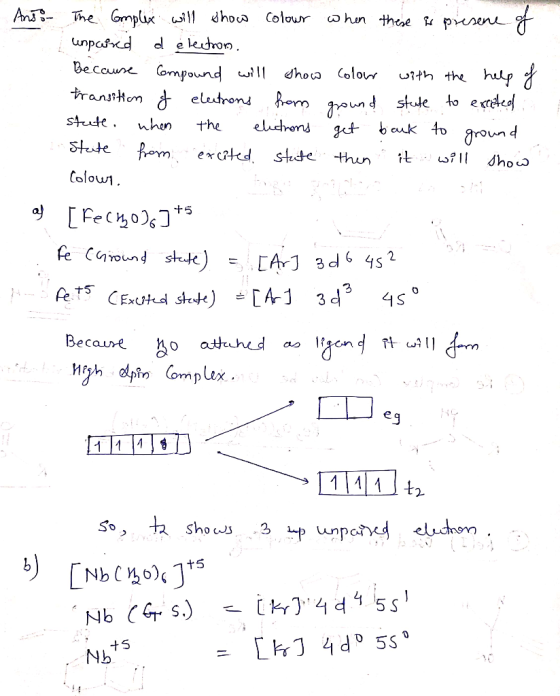
![sits It CNbts) doesnt have d electron hence No transition will ocur. Hence [fecholots is coloured & [nb (120% ]st es not . (](http://img.homeworklib.com/questions/c6368d10-700f-11ea-8317-192f0519d3ff.png?x-oss-process=image/resize,w_560)
Add Answer to:
(c) Tптичи погоогоТТІ (a) Explain why [Fe(H2O).]5+ is colored and [Nb(H20)6]5+ is not. (b) What kind...
(a) Explain why [Fe(H2O)6]5+ is colored and [Nb(H20)6]5+ is not. (b) What kind of crystal field...
 (a) Explain why [Fe(H2O)6]5+ is colored and [Nb(H20)6]5+ is not. (b) What kind of crystal field (Ao large or small) the NH3 ligands are creating if there are only 4 unpaired electrons in [Fe(H20)6]2+ complex ion ? Explain
(a) Explain why [Fe(H20)6]5* is colored and (Nb(H20)6] is not (b) What kind of crystal field...
 (a) Explain why [Fe(H20)6]5* is colored and (Nb(H20)6] is not (b) What kind of crystal field (Ao large or small) the NH3 ligands are creating it there are only 4 unpaired electrons in [Fe(H20)6]2* complex ion ? Explain
The complex ion [Co(H2O)6]3+is found to be diamagnetic whereas the complex ion [Fe(H2O)6]2+is found to be...
The complex ion [Co(H2O)6]3+is found to be diamagnetic whereas the complex ion [Fe(H2O)6]2+is found to be paramagnetic, with four unpaired electrons. Use the crystal field model to explain these observations.
calculuate valence electrons for each complex (a) [Mn(H20)]3+ (d) [Fe(H20).]3+ (b) [Cr(H2O)6]2+ (e) [Co(NH3)4] * (h)...
 calculuate valence electrons for each complex
(a) [Mn(H20)]3+ (d) [Fe(H20).]3+ (b) [Cr(H2O)6]2+ (e) [Co(NH3)4] * (h) [Pd(NH3).]4+ (c) [V(H2O).]2+ (1) [Ni(H2O)]2+ (1) [Re(CN).]3- (g) MoF6
calculuate valence electrons for each complex
(a) [Mn(H20)]3+ (d) [Fe(H20).]3+ (b) [Cr(H2O)6]2+ (e) [Co(NH3)4] * (h) [Pd(NH3).]4+ (c) [V(H2O).]2+ (1) [Ni(H2O)]2+ (1) [Re(CN).]3- (g) MoF6
Date: 1117 mework 10 - Ch. 21-23 A) CN B)NO c)r D) CO Name: E ) en 24. Place the ligands, CN-, Br., H2O, and OH-in o...
 Date: 1117 mework 10 - Ch. 21-23 A) CN B)NO c)r D) CO Name: E ) en 24. Place the ligands, CN-, Br., H2O, and OH-in order from least to greatest according ability to split the d orbital energy level. A) CN-, OH, H2O, Br- C) Br,H20, CN-, OH- B) Br., OH, H2O, CN- D) None of the above 25. The charge on the central metal ion in (Cr(NH3)(CO3)2+ is A)-1. B) 0. C) 1. D) 3. E) 5 26....
.. Fe is identified by the rapid formation of the intensely colored pentaaquathio-cyanatoiron (III) complex ion,...
 .. Fe is identified by the rapid formation of the intensely colored pentaaquathio-cyanatoiron (III) complex ion, [Fe(H,O),SCN , which forms when tiocyante, SCN, is added to a solution containing heaaquairon (III), [Fe(H,0).J. Use the information and diagram to answer the following questions: Absorbance 300 400 500 600 700 Wavelength (nm) FIGURE a Absorption Spectrum of [Fe(H20),SCN)2+ A Molecular Approach 4le Tro a) Determine the color of the aqueous solution of [Fe(HO),SCN b) Calculate the crystal field splitting energy of [Fe(H,0),SCN]...
8. Explain why the complex (Fe(H2O) has de = 14,000 cm', while [Fe(H2O) has 3 =...
 8. Explain why the complex (Fe(H2O) has de = 14,000 cm', while [Fe(H2O) has 3 = 9,350 cm. 9. Suggest a reason why copper'll) compounds are often colored but copper(l) compounds are colorless. 10. Sketch the d-orbital energy-level diagram for a square planar complex Spectrochemical series: COCN' >phen > NOx > en > NH3> NCS > H2O > F>RCOO > OH > CT > Br> 50m 750 nm 400 m Sem 430 nm 190 mm
can anyone please confirm my answers for 5&6? And can you explain how to fill in...
 can
anyone please confirm my answers for 5&6? And can you explain
how to fill in the electrons for 7? Please and Thank you.
5. The values of A, for some coordination complexes are given below. (a) [Fe(ox)) --- 14,100 cm-1 (ox-oxalato ligand-----weak ligand] (b) [Fe(CN).-----35,000 cm ©) [Fe(CN)6]* -----33,800 cm (1) Explain reason(s) why A. of complex (a) and (b) are different (ii) Explain reason(s) why 4, of complex (b) and (c) are different 6. Answer the following questions...
can
anyone please confirm my answers for 5&6? And can you explain
how to fill in the electrons for 7? Please and Thank you.
5. The values of A, for some coordination complexes are given below. (a) [Fe(ox)) --- 14,100 cm-1 (ox-oxalato ligand-----weak ligand] (b) [Fe(CN).-----35,000 cm ©) [Fe(CN)6]* -----33,800 cm (1) Explain reason(s) why A. of complex (a) and (b) are different (ii) Explain reason(s) why 4, of complex (b) and (c) are different 6. Answer the following questions...
6. a) Which complex ion should have the larger crystal field splitting, A? Explain why. [Cr(H20).13+...
 6. a) Which complex ion should have the larger crystal field splitting, A? Explain why. [Cr(H20).13+ or [CrCl.13- b) Which complex ion should absorb light of shorter wavelength? Explain why. [Cr(H20)613+ or [CrC1613 -
1. What distinguish a transition metal from a main group metal? 2. Why is zinc not...
 1. What distinguish a transition metal from a main group metal? 2. Why is zinc not considered a transition metal? 3. Write the electronic configuration of the following ions; V". Cr, Mn, Fe, Ni, Ti" 4. What are basic assumptions of Crystal Field Theory? 5. Compounds containing the Scion are colorless whereas those containing Ti* ion are colored. Explain. 6. Predict the number of unpaired electrons in [Cr(en) ions. 7. What are spectrochemical series? 8. The compound hexaminecobalt(III) chloride is...
 (a) Explain why [Fe(H2O)6]5+ is colored and [Nb(H20)6]5+ is not. (b) What kind of crystal field (Ao large or small) the NH3 ligands are creating if there are only 4 unpaired electrons in [Fe(H20)6]2+ complex ion ? Explain
 (a) Explain why [Fe(H20)6]5* is colored and (Nb(H20)6] is not (b) What kind of crystal field (Ao large or small) the NH3 ligands are creating it there are only 4 unpaired electrons in [Fe(H20)6]2* complex ion ? Explain
 calculuate valence electrons for each complex
(a) [Mn(H20)]3+ (d) [Fe(H20).]3+ (b) [Cr(H2O)6]2+ (e) [Co(NH3)4] * (h) [Pd(NH3).]4+ (c) [V(H2O).]2+ (1) [Ni(H2O)]2+ (1) [Re(CN).]3- (g) MoF6
calculuate valence electrons for each complex
(a) [Mn(H20)]3+ (d) [Fe(H20).]3+ (b) [Cr(H2O)6]2+ (e) [Co(NH3)4] * (h) [Pd(NH3).]4+ (c) [V(H2O).]2+ (1) [Ni(H2O)]2+ (1) [Re(CN).]3- (g) MoF6
 Date: 1117 mework 10 - Ch. 21-23 A) CN B)NO c)r D) CO Name: E ) en 24. Place the ligands, CN-, Br., H2O, and OH-in order from least to greatest according ability to split the d orbital energy level. A) CN-, OH, H2O, Br- C) Br,H20, CN-, OH- B) Br., OH, H2O, CN- D) None of the above 25. The charge on the central metal ion in (Cr(NH3)(CO3)2+ is A)-1. B) 0. C) 1. D) 3. E) 5 26....
 .. Fe is identified by the rapid formation of the intensely colored pentaaquathio-cyanatoiron (III) complex ion, [Fe(H,O),SCN , which forms when tiocyante, SCN, is added to a solution containing heaaquairon (III), [Fe(H,0).J. Use the information and diagram to answer the following questions: Absorbance 300 400 500 600 700 Wavelength (nm) FIGURE a Absorption Spectrum of [Fe(H20),SCN)2+ A Molecular Approach 4le Tro a) Determine the color of the aqueous solution of [Fe(HO),SCN b) Calculate the crystal field splitting energy of [Fe(H,0),SCN]...
 8. Explain why the complex (Fe(H2O) has de = 14,000 cm', while [Fe(H2O) has 3 = 9,350 cm. 9. Suggest a reason why copper'll) compounds are often colored but copper(l) compounds are colorless. 10. Sketch the d-orbital energy-level diagram for a square planar complex Spectrochemical series: COCN' >phen > NOx > en > NH3> NCS > H2O > F>RCOO > OH > CT > Br> 50m 750 nm 400 m Sem 430 nm 190 mm
 can
anyone please confirm my answers for 5&6? And can you explain
how to fill in the electrons for 7? Please and Thank you.
5. The values of A, for some coordination complexes are given below. (a) [Fe(ox)) --- 14,100 cm-1 (ox-oxalato ligand-----weak ligand] (b) [Fe(CN).-----35,000 cm ©) [Fe(CN)6]* -----33,800 cm (1) Explain reason(s) why A. of complex (a) and (b) are different (ii) Explain reason(s) why 4, of complex (b) and (c) are different 6. Answer the following questions...
can
anyone please confirm my answers for 5&6? And can you explain
how to fill in the electrons for 7? Please and Thank you.
5. The values of A, for some coordination complexes are given below. (a) [Fe(ox)) --- 14,100 cm-1 (ox-oxalato ligand-----weak ligand] (b) [Fe(CN).-----35,000 cm ©) [Fe(CN)6]* -----33,800 cm (1) Explain reason(s) why A. of complex (a) and (b) are different (ii) Explain reason(s) why 4, of complex (b) and (c) are different 6. Answer the following questions...
 6. a) Which complex ion should have the larger crystal field splitting, A? Explain why. [Cr(H20).13+ or [CrCl.13- b) Which complex ion should absorb light of shorter wavelength? Explain why. [Cr(H20)613+ or [CrC1613 -
 1. What distinguish a transition metal from a main group metal? 2. Why is zinc not considered a transition metal? 3. Write the electronic configuration of the following ions; V". Cr, Mn, Fe, Ni, Ti" 4. What are basic assumptions of Crystal Field Theory? 5. Compounds containing the Scion are colorless whereas those containing Ti* ion are colored. Explain. 6. Predict the number of unpaired electrons in [Cr(en) ions. 7. What are spectrochemical series? 8. The compound hexaminecobalt(III) chloride is...
Most questions answered within 3 hours.
-
Where is the error in this code sequence?
String s1 = "Hello";
String s2 = "ello";...
asked 10 months ago -
Financial data for Joel de Paris, Inc., for last year
follow:
Joel de Paris, Inc.
Balance...
asked 10 months ago -
Consider this reaction:
Al2(SO4)3 (aq)+ BaCl3
(aq) Al2Cl6 (aq)- +
3BaSO4(s) . What is the...
asked 10 months ago -
Suppose that Savneet is considering increasing her
recent random sample from 20 car rentals to 40...
asked 10 months ago -
Trucks arrive at an unloading terminal at an average rate of 120
per hour.
Trucks arrive...
asked 10 months ago -
Why are methanol and ethanol completely soluble in water while
octanol is not very little soluble....
asked 10 months ago -
A facilities manager at a university reads in a research report
that the mean amount of...
asked 10 months ago -
When the CuSO4 is rehydrated by adding water to the anhydrous
compound, is this an endothermic...
asked 10 months ago -
A ray of sunlight is passing from diamond into crown glass; the
angle of incidence is...
asked 10 months ago -
A block of mass 0.249 kg is placed on top of a light, vertical
spring of...
asked 10 months ago -
how do the kidneys compensate in the presences of acidosis
a) trigger hyperventilate
b) reserve acid...
asked 10 months ago -
Question 501 pts
The rental rate of capital to the firm increases. Which of the
following...
asked 10 months ago