
Homework Answers
Add Answer to:
Multiple Choice: 1) Assume the MPC is 0.75 and lump sum taxes are collected by the...
Multiple Choice: 1) Assume the MPC is 0.75 and lump sum taxes are collected by the government. What is the governm...
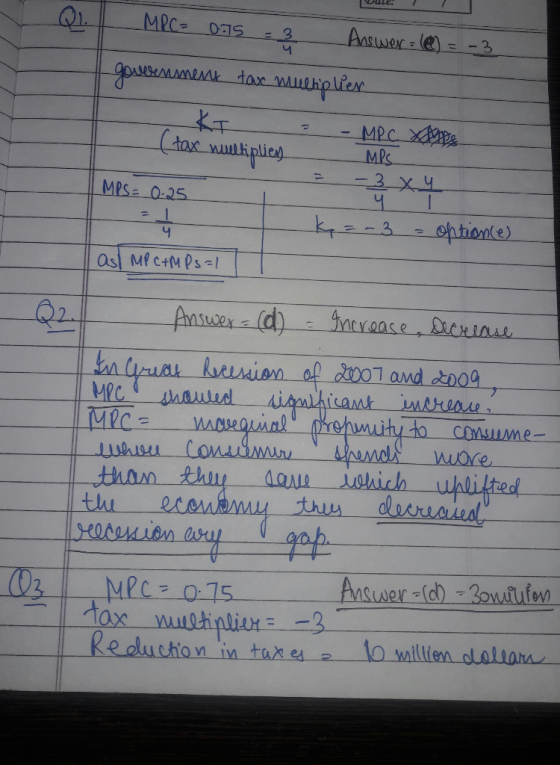
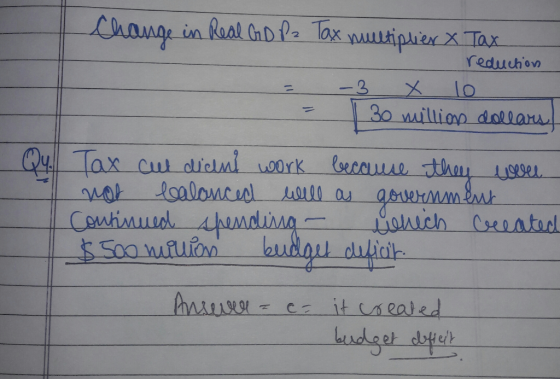
 Multiple Choice: 1) Assume the MPC is 0.75 and lump sum taxes are collected by the government. What is the government tax multiplier? A)-1.33 B) - 25 C) - 75 D) -4 E) -3 , which the recessionary gap. 2) During a Recession, the MPC tends to a) Increase, increases b) Decrease, decreases c Decrease, increases d) Increase, decreases 3) Suppose that the MPC is.75 and the US Federal Government reduces taxes by 10 million dollars. After 3 rounds of...
2) During a Recession, the MPC tends to a) Increase, increases b) Decrease, decreases c) Decrease,...
 2) During a Recession, the MPC tends to a) Increase, increases b) Decrease, decreases c) Decrease, increases d Increase, decreases which the recessionary gap 3) Suppose that the MPC is .75 and the U.S Federal Government reduces taxes by 10 million dollars. After 3 rounds of the multiplier process RGDP will change by a) 4.23 million b) 17.34 million c) 23.13 million dollars. d) 30 million 4) "George W. Bush's $152 billion tax rebate plan of 2008 was designed to...
a sponsora de pensamente en el e n la mano dalam ales 3) Suppose that the...
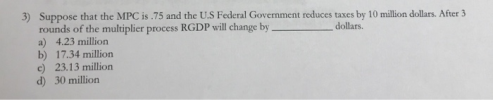 a sponsora de pensamente en el e n la mano dalam ales 3) Suppose that the MPC is .75 and the U.S Federal Government reduces taxes by 10 million dollars. After 3 rounds of the multiplier process RGDP will change by _ dollars. a) 4.23 million b) 17.34 million c) 23.13 million d) 30 million
two countries A and B can each be described by a keynesian-cross model with lump-sum taxes....
two countries A and B can each be described by a keynesian-cross model with lump-sum taxes. the MPC is .9 in A and B. A decides to increase gobernment spending by 2 billion while B decides to cut tax by 2 billion a. calculate government purchase multiplier for A b. tax multiplier for B assume lump sum taxation
1. Suppose the MPC is 0.8 and the crowding out effect is $30 billion. The government...
1. Suppose the MPC is 0.8 and the crowding out effect is $30 billion. The government aims to increase GDP by $250 billion. a) Calculate the fiscal multiplier b) how much the government needs to increase spending to increase GDP by $250 billion c) Calculate the tax cut multiplier, d) How much the government needs to cut taxes to increase GDP by $250 billion? e) Explain why the tax multiplier is smaller than the fiscal multiplier. f) If you were...
help... 22. Given the MPC = 75, the initial equilibrium = $20,000, and the target Y=...
 help...
22. Given the MPC = 75, the initial equilibrium = $20,000, and the target Y= $25,000. a. Calculate the spending multiplier. Calculate the tax multiplier. b. By how much would G have to be increased to reach the target Y? c. By how much would T have to be decreased to reach the target Y? 23. True or False AND explain why: a. If G > T, the government budget is in a deficit. b. A tax cut will...
help...
22. Given the MPC = 75, the initial equilibrium = $20,000, and the target Y= $25,000. a. Calculate the spending multiplier. Calculate the tax multiplier. b. By how much would G have to be increased to reach the target Y? c. By how much would T have to be decreased to reach the target Y? 23. True or False AND explain why: a. If G > T, the government budget is in a deficit. b. A tax cut will...
Investment Problem: 1. Assume the MPC is 3/4, if investment spending increase by $50 billion, the...
Investment Problem: 1. Assume the MPC is 3/4, if investment spending increase by $50 billion, the level of GDP will: 2. Assume the MPC is 2/3, if investment spending decreases by $30 billion, the level of GDP will: Export Problem: 3. If the multiplier in an economy is 4, a $50 billion increase in exports will: 4. If the multiplier in an economy is 3,a $30 billion decrease in exports will: Balanced Budget Problem: 5. If the MPC is .75...
14. (2 pt) Explain the effect of a discretionary cut in taxes of $40 billion on...
 14. (2 pt) Explain the effect of a discretionary cut in taxes of $40 billion on the economy when the economy's MPC is .75. How does this discretionary fiscal policy differ from a discretionary increase in government spending of $40 billion? A tax cut of $40 billion will result in initial increase in consumption of S billion). (Note that $10Bil. is saved based on marginal propensity to save (MPS), that is 25 (because 1-MPC-MPS). Then .25 x $40-$10 billion). This...
Question 14 6 pts Assume the government cuts taxes by $250 billion. If the MPC is...
 Question 14 6 pts Assume the government cuts taxes by $250 billion. If the MPC is 0.8, what is the maximum potential impact on real GDP according to the simple Keynesian model? Real GDP decreases by $1,000 billion Real GDP decreases by $1.250 billion Real GDP increases by $1,000 billion Real GDP increases by $1.250 billion D Question 15 6 pts in Keynesian theory, if the marginal propensity to consume is 0.90 and government spending is increased by $40 billion,...
1. Suppose in a simple closed economy with MPC = 0.75, the planned investment spending nas...
 1. Suppose in a simple closed economy with MPC = 0.75, the planned investment spending nas suddenly fallen, reducing AD and output to a level that below the natural level of output by 100 Million. Assume that the real interest rate is constant so that there is no crowding out of (gross) investment. (a) If the government decided to try to get the output back to the natural level of output using only a change in government spending (AG), by...
 Multiple Choice: 1) Assume the MPC is 0.75 and lump sum taxes are collected by the government. What is the government tax multiplier? A)-1.33 B) - 25 C) - 75 D) -4 E) -3 , which the recessionary gap. 2) During a Recession, the MPC tends to a) Increase, increases b) Decrease, decreases c Decrease, increases d) Increase, decreases 3) Suppose that the MPC is.75 and the US Federal Government reduces taxes by 10 million dollars. After 3 rounds of...
 2) During a Recession, the MPC tends to a) Increase, increases b) Decrease, decreases c) Decrease, increases d Increase, decreases which the recessionary gap 3) Suppose that the MPC is .75 and the U.S Federal Government reduces taxes by 10 million dollars. After 3 rounds of the multiplier process RGDP will change by a) 4.23 million b) 17.34 million c) 23.13 million dollars. d) 30 million 4) "George W. Bush's $152 billion tax rebate plan of 2008 was designed to...
 a sponsora de pensamente en el e n la mano dalam ales 3) Suppose that the MPC is .75 and the U.S Federal Government reduces taxes by 10 million dollars. After 3 rounds of the multiplier process RGDP will change by _ dollars. a) 4.23 million b) 17.34 million c) 23.13 million d) 30 million
 help...
22. Given the MPC = 75, the initial equilibrium = $20,000, and the target Y= $25,000. a. Calculate the spending multiplier. Calculate the tax multiplier. b. By how much would G have to be increased to reach the target Y? c. By how much would T have to be decreased to reach the target Y? 23. True or False AND explain why: a. If G > T, the government budget is in a deficit. b. A tax cut will...
help...
22. Given the MPC = 75, the initial equilibrium = $20,000, and the target Y= $25,000. a. Calculate the spending multiplier. Calculate the tax multiplier. b. By how much would G have to be increased to reach the target Y? c. By how much would T have to be decreased to reach the target Y? 23. True or False AND explain why: a. If G > T, the government budget is in a deficit. b. A tax cut will...
 14. (2 pt) Explain the effect of a discretionary cut in taxes of $40 billion on the economy when the economy's MPC is .75. How does this discretionary fiscal policy differ from a discretionary increase in government spending of $40 billion? A tax cut of $40 billion will result in initial increase in consumption of S billion). (Note that $10Bil. is saved based on marginal propensity to save (MPS), that is 25 (because 1-MPC-MPS). Then .25 x $40-$10 billion). This...
 Question 14 6 pts Assume the government cuts taxes by $250 billion. If the MPC is 0.8, what is the maximum potential impact on real GDP according to the simple Keynesian model? Real GDP decreases by $1,000 billion Real GDP decreases by $1.250 billion Real GDP increases by $1,000 billion Real GDP increases by $1.250 billion D Question 15 6 pts in Keynesian theory, if the marginal propensity to consume is 0.90 and government spending is increased by $40 billion,...
 1. Suppose in a simple closed economy with MPC = 0.75, the planned investment spending nas suddenly fallen, reducing AD and output to a level that below the natural level of output by 100 Million. Assume that the real interest rate is constant so that there is no crowding out of (gross) investment. (a) If the government decided to try to get the output back to the natural level of output using only a change in government spending (AG), by...
Most questions answered within 3 hours.
-
Where is the error in this code sequence?
String s1 = "Hello";
String s2 = "ello";...
asked 10 months ago -
Financial data for Joel de Paris, Inc., for last year
follow:
Joel de Paris, Inc.
Balance...
asked 10 months ago -
Consider this reaction:
Al2(SO4)3 (aq)+ BaCl3
(aq) Al2Cl6 (aq)- +
3BaSO4(s) . What is the...
asked 10 months ago -
Suppose that Savneet is considering increasing her
recent random sample from 20 car rentals to 40...
asked 10 months ago -
Trucks arrive at an unloading terminal at an average rate of 120
per hour.
Trucks arrive...
asked 10 months ago -
Why are methanol and ethanol completely soluble in water while
octanol is not very little soluble....
asked 10 months ago -
A facilities manager at a university reads in a research report
that the mean amount of...
asked 10 months ago -
When the CuSO4 is rehydrated by adding water to the anhydrous
compound, is this an endothermic...
asked 10 months ago -
A ray of sunlight is passing from diamond into crown glass; the
angle of incidence is...
asked 10 months ago -
A block of mass 0.249 kg is placed on top of a light, vertical
spring of...
asked 10 months ago -
how do the kidneys compensate in the presences of acidosis
a) trigger hyperventilate
b) reserve acid...
asked 10 months ago -
Question 501 pts
The rental rate of capital to the firm increases. Which of the
following...
asked 10 months ago