
Homework Answers
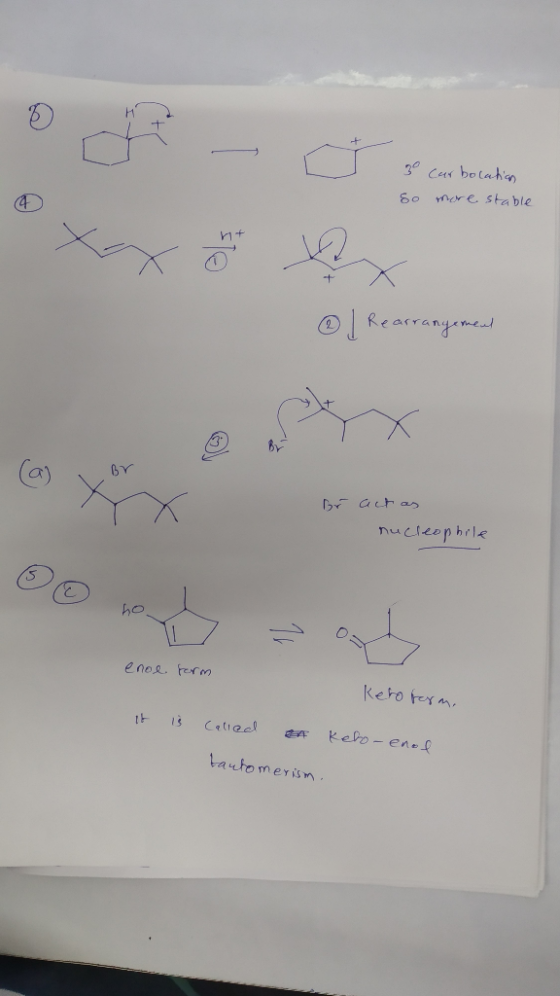
Do rate if you understand
Add Answer to:
Indicate the cation that would most likely form on rearrangement of the following: 4. What is...
1. What is the nucleophile in the following S2 reaction and what is the leaving group Br + NaCN 2. What are produc...
 1. What is the nucleophile in the following S2 reaction and what is the leaving group Br + NaCN 2. What are products of the following sequences of elementary steps? ci 1. Proton transfer involving NaOH 2. Nucleophile elimination 3. Nucleophilic addition of CH,MgBr 4. Sy2 involving CH Br (c) 1. Electrophilic addition of C 2. Electrophile elimination of HC (b) 1. E2 involving NaOCH, 2. Electrophilic addition involving H 3. Coordination involving H20 4. Proton transfer involving H2O OH...
on- QUESTION 3 What is a product of the following sequence of elementary steps? Br 1....
 on- QUESTION 3 What is a product of the following sequence of elementary steps? Br 1. E2 involving NaOCH Ph. Ph 2. Electrophilic addition involving H 3. Coordination involving H2O 4. Proton transfer involving HO OCH3 он OCH3 Ph. Ph. Ph Ph Ph. Ph Ph Ph Он (a) (b) (c) (d) A C QUESTION 4 Use charge stability to determine which of the following heterolsis steps will happen at the fastest rate Chick Soue and Subeir to save and submit....
1. What is the nucleophile in the following S2 reaction and what is the leaving group?...
 1. What is the nucleophile in the following S2 reaction and what is the leaving group? + NaCN 2. What are products of the following sequences of elementary steps? 1. Proton transfer involving NaOH 2. Nucleophile elimination 3. Nucleophilic addition of CH Mgr 4. Sy2 involving CH Br 1. Electrophilic addition of Ci 2. Electrophile elimination of H3C (b) (c) 1. E2 involving NaOCH, 2. Electrophilic addition involving H™ 3. Coordination involving H2O 4. Proton transfer involving H 0 осн,...
Use curved arrows to indicate the flow of electrons for the following elementary steps. label each...
 Use
curved arrows to indicate the flow of electrons for the following
elementary steps. label each step of the proper name such as Sn2,
E2, electrophile elimination, bond dissociation, coordination,
nucleophilic addition, electrophilic addition, or nucleophilic
elimination
These are the answers I had but they are incorrect... could
you explain which are correct?
4. Use curved arrow to indicate the flow of electrons for the following elementary steps. Label each-st with a proper name such as S 2, E2, electrophile...
Use
curved arrows to indicate the flow of electrons for the following
elementary steps. label each step of the proper name such as Sn2,
E2, electrophile elimination, bond dissociation, coordination,
nucleophilic addition, electrophilic addition, or nucleophilic
elimination
These are the answers I had but they are incorrect... could
you explain which are correct?
4. Use curved arrow to indicate the flow of electrons for the following elementary steps. Label each-st with a proper name such as S 2, E2, electrophile...
Help on all parts of question 3 would be greatly appreciated! 3. Treating alkene "A" below...
 Help on all parts of question 3 would be greatly
appreciated!
3. Treating alkene "A" below with HBr can lead to a number of products. "A" + H-Br A bunch of products. For real, hella products. 3.A. Label the stereocenters in compound "A" as R or S and label the alkene as E or Z. 3.B. Draw the curved arrow mechanism leading to the most stabilized carbo- cation intermediate. (don't do any rearrangements, just acid/base with the alkene) H-Br most...
Help on all parts of question 3 would be greatly
appreciated!
3. Treating alkene "A" below with HBr can lead to a number of products. "A" + H-Br A bunch of products. For real, hella products. 3.A. Label the stereocenters in compound "A" as R or S and label the alkene as E or Z. 3.B. Draw the curved arrow mechanism leading to the most stabilized carbo- cation intermediate. (don't do any rearrangements, just acid/base with the alkene) H-Br most...
1. Rank the following carbocations in order from most stable (1) to least stable (4). o...
 1. Rank the following carbocations in order from most stable (1) to least stable (4). o ó no 8 2. Consider the following carbocation. Would this carbocation undergo a rearrangement? If so, show the mechanism (curved arrows) for the rearrangement (including the rearranged cation that is the product of your curved arrows) and explain why it happens. If not, explain why it would not rearrange.
. (10 pts) Electrophilic addition reaction (E) and Wagner-Meerwein rearrangement (W) are involved in the biosynthe...
 . (10 pts) Electrophilic addition reaction (E) and Wagner-Meerwein rearrangement (W) are involved in the biosynthesis of various terpenes in nature. List four approaches for generation of carbocation and label them with A, B, C, and D, respectively (2 pts). List three approaches for discharge of carbocation and label them with F, G, and H, respectively (1.5 pts). Draw out the structure of farnesyl diphosphate (FPP) (1 pts). Identify the following processes by labeling individual processes with a letter selected...
answer all questions 1. For the following substrates, predict whether a carbocation rearrangement will take place...
 answer all questions
1. For the following substrates, predict whether a carbocation rearrangement will take place in an SN1/E1 mechanism by first drawing the carbocation intermediate, then deciding if the carbocation will rearrange (can it form a more stable carbocation by hydride or methyl shift?): Carbocation: Sturcture Rearrange? If yes, draw the rearranged product. If no, write No н.с Br Н,с, Cн, 2. For each pair of nucle ophiles, circle which will react faster with CHsl in an Sx2 reaction....
answer all questions
1. For the following substrates, predict whether a carbocation rearrangement will take place in an SN1/E1 mechanism by first drawing the carbocation intermediate, then deciding if the carbocation will rearrange (can it form a more stable carbocation by hydride or methyl shift?): Carbocation: Sturcture Rearrange? If yes, draw the rearranged product. If no, write No н.с Br Н,с, Cн, 2. For each pair of nucle ophiles, circle which will react faster with CHsl in an Sx2 reaction....
D) Br 6. Which of the following alkyl bromides is likely to undergo rearrangement by a...
 D) Br 6. Which of the following alkyl bromides is likely to undergo rearrangement by a 1, 2-methyl shift during an Sy1 or El reaction (both reaction mechanisms form a carbocation)? A) benzylł bromide B) 2 -bromo 3-ethytpentane C) 3-bromo-3-methylpentane D) 2-bromo-3, 3-dimethylpentane r is untrue about the rate of an E2 elimination of an alky
7. Draw the most likely structure of the following cation after it has rearranged. 8. Identify...
 7. Draw the most likely structure of the following cation after it has rearranged. 8. Identify the nucleophilic and electrophilic sites (one of each) in the two reactants in the following reaction. HOME
 1. What is the nucleophile in the following S2 reaction and what is the leaving group Br + NaCN 2. What are products of the following sequences of elementary steps? ci 1. Proton transfer involving NaOH 2. Nucleophile elimination 3. Nucleophilic addition of CH,MgBr 4. Sy2 involving CH Br (c) 1. Electrophilic addition of C 2. Electrophile elimination of HC (b) 1. E2 involving NaOCH, 2. Electrophilic addition involving H 3. Coordination involving H20 4. Proton transfer involving H2O OH...
 on- QUESTION 3 What is a product of the following sequence of elementary steps? Br 1. E2 involving NaOCH Ph. Ph 2. Electrophilic addition involving H 3. Coordination involving H2O 4. Proton transfer involving HO OCH3 он OCH3 Ph. Ph. Ph Ph Ph. Ph Ph Ph Он (a) (b) (c) (d) A C QUESTION 4 Use charge stability to determine which of the following heterolsis steps will happen at the fastest rate Chick Soue and Subeir to save and submit....
 1. What is the nucleophile in the following S2 reaction and what is the leaving group? + NaCN 2. What are products of the following sequences of elementary steps? 1. Proton transfer involving NaOH 2. Nucleophile elimination 3. Nucleophilic addition of CH Mgr 4. Sy2 involving CH Br 1. Electrophilic addition of Ci 2. Electrophile elimination of H3C (b) (c) 1. E2 involving NaOCH, 2. Electrophilic addition involving H™ 3. Coordination involving H2O 4. Proton transfer involving H 0 осн,...
 Use
curved arrows to indicate the flow of electrons for the following
elementary steps. label each step of the proper name such as Sn2,
E2, electrophile elimination, bond dissociation, coordination,
nucleophilic addition, electrophilic addition, or nucleophilic
elimination
These are the answers I had but they are incorrect... could
you explain which are correct?
4. Use curved arrow to indicate the flow of electrons for the following elementary steps. Label each-st with a proper name such as S 2, E2, electrophile...
Use
curved arrows to indicate the flow of electrons for the following
elementary steps. label each step of the proper name such as Sn2,
E2, electrophile elimination, bond dissociation, coordination,
nucleophilic addition, electrophilic addition, or nucleophilic
elimination
These are the answers I had but they are incorrect... could
you explain which are correct?
4. Use curved arrow to indicate the flow of electrons for the following elementary steps. Label each-st with a proper name such as S 2, E2, electrophile...
 Help on all parts of question 3 would be greatly
appreciated!
3. Treating alkene "A" below with HBr can lead to a number of products. "A" + H-Br A bunch of products. For real, hella products. 3.A. Label the stereocenters in compound "A" as R or S and label the alkene as E or Z. 3.B. Draw the curved arrow mechanism leading to the most stabilized carbo- cation intermediate. (don't do any rearrangements, just acid/base with the alkene) H-Br most...
Help on all parts of question 3 would be greatly
appreciated!
3. Treating alkene "A" below with HBr can lead to a number of products. "A" + H-Br A bunch of products. For real, hella products. 3.A. Label the stereocenters in compound "A" as R or S and label the alkene as E or Z. 3.B. Draw the curved arrow mechanism leading to the most stabilized carbo- cation intermediate. (don't do any rearrangements, just acid/base with the alkene) H-Br most...
 1. Rank the following carbocations in order from most stable (1) to least stable (4). o ó no 8 2. Consider the following carbocation. Would this carbocation undergo a rearrangement? If so, show the mechanism (curved arrows) for the rearrangement (including the rearranged cation that is the product of your curved arrows) and explain why it happens. If not, explain why it would not rearrange.
 . (10 pts) Electrophilic addition reaction (E) and Wagner-Meerwein rearrangement (W) are involved in the biosynthesis of various terpenes in nature. List four approaches for generation of carbocation and label them with A, B, C, and D, respectively (2 pts). List three approaches for discharge of carbocation and label them with F, G, and H, respectively (1.5 pts). Draw out the structure of farnesyl diphosphate (FPP) (1 pts). Identify the following processes by labeling individual processes with a letter selected...
 answer all questions
1. For the following substrates, predict whether a carbocation rearrangement will take place in an SN1/E1 mechanism by first drawing the carbocation intermediate, then deciding if the carbocation will rearrange (can it form a more stable carbocation by hydride or methyl shift?): Carbocation: Sturcture Rearrange? If yes, draw the rearranged product. If no, write No н.с Br Н,с, Cн, 2. For each pair of nucle ophiles, circle which will react faster with CHsl in an Sx2 reaction....
answer all questions
1. For the following substrates, predict whether a carbocation rearrangement will take place in an SN1/E1 mechanism by first drawing the carbocation intermediate, then deciding if the carbocation will rearrange (can it form a more stable carbocation by hydride or methyl shift?): Carbocation: Sturcture Rearrange? If yes, draw the rearranged product. If no, write No н.с Br Н,с, Cн, 2. For each pair of nucle ophiles, circle which will react faster with CHsl in an Sx2 reaction....
 D) Br 6. Which of the following alkyl bromides is likely to undergo rearrangement by a 1, 2-methyl shift during an Sy1 or El reaction (both reaction mechanisms form a carbocation)? A) benzylł bromide B) 2 -bromo 3-ethytpentane C) 3-bromo-3-methylpentane D) 2-bromo-3, 3-dimethylpentane r is untrue about the rate of an E2 elimination of an alky
 7. Draw the most likely structure of the following cation after it has rearranged. 8. Identify the nucleophilic and electrophilic sites (one of each) in the two reactants in the following reaction. HOME
Most questions answered within 3 hours.
-
Where is the error in this code sequence?
String s1 = "Hello";
String s2 = "ello";...
asked 10 months ago -
Financial data for Joel de Paris, Inc., for last year
follow:
Joel de Paris, Inc.
Balance...
asked 10 months ago -
Consider this reaction:
Al2(SO4)3 (aq)+ BaCl3
(aq) Al2Cl6 (aq)- +
3BaSO4(s) . What is the...
asked 10 months ago -
Suppose that Savneet is considering increasing her
recent random sample from 20 car rentals to 40...
asked 10 months ago -
Trucks arrive at an unloading terminal at an average rate of 120
per hour.
Trucks arrive...
asked 10 months ago -
Why are methanol and ethanol completely soluble in water while
octanol is not very little soluble....
asked 10 months ago -
A facilities manager at a university reads in a research report
that the mean amount of...
asked 10 months ago -
When the CuSO4 is rehydrated by adding water to the anhydrous
compound, is this an endothermic...
asked 10 months ago -
A ray of sunlight is passing from diamond into crown glass; the
angle of incidence is...
asked 10 months ago -
A block of mass 0.249 kg is placed on top of a light, vertical
spring of...
asked 10 months ago -
how do the kidneys compensate in the presences of acidosis
a) trigger hyperventilate
b) reserve acid...
asked 10 months ago -
Question 501 pts
The rental rate of capital to the firm increases. Which of the
following...
asked 10 months ago