
Homework Answers


 thank you
Add Answer to:
(10 points) Draw a molecular energy diagram of the ground electronic state (S) and the first...
(ii) Draw an energy level diagram for an electronic transition from an electronic ground state to...
 (ii) Draw an energy level diagram for an electronic transition from an electronic ground state to an excited state that has an increase in bond length. Include vibrational energy levels in your diagram. (iii) Sketch the electronic absorption spectrum corresponding to the energy level diagram of part (ii) showing the vibrational components.
Draw a simplified diagram of the energy levels for a generic molecule with three main energy...
Draw a simplified diagram of the energy levels for a generic molecule with three main energy levels, plus the associated vibrational energy states. Include one triplet state to the right of the other states. • Label the ground state S0, the major excited states S1 and S2, and the triplet state T1. • Draw arrows to represent the major transitions that could occur for the molecule due to light absorption, fluorescence, and phosphorescence. Label each arrow. • Draw and label...
3. Draw a Jablonski diagram and label absorption, internal conversion, vibration relaxation, intersystem crossing, fluorescence and...
 3. Draw a Jablonski diagram and label absorption, internal conversion, vibration relaxation, intersystem crossing, fluorescence and phosphorescence processes. What are the characteristic time scales for absorption, fluorescence, phosphorescence, and vibrational relaxation transitions?
4. For phenanthrene, the measured lifetime of the triplet state is 5 = 3.3 s. The...
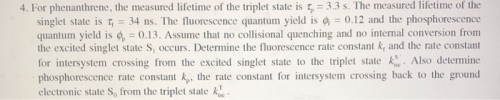 4. For phenanthrene, the measured lifetime of the triplet state is 5 = 3.3 s. The measured lifetime of the singlet state is = 34 ns. The fluorescence quantum yield is 4 -0.12 and the phosphorescence quantum yield i 0.13. Assume that no collisional quenching and no internal conversion from the excited singlet state S, occurs. Determine the fluorescence rate constant k, and the rate constant for intersystem crossing from the excited singlet state to the triplet state . Also...
A molecule which has absorbed a photon of energy in the visible range could move from...
 A molecule which has absorbed a photon of energy in the visible range could move from the excited electronic state (S1) to a highly excited vibrational level of the ground state (So) with the same energy. What is this process called? O a. fluorescence O b.internal conversion O C. vibrational relaxation d. intersystem crossing
Energy So 6 M 4. (a) Using only the arrows in the diagram, give the most...
 Energy So 6 M 4. (a) Using only the arrows in the diagram, give the most probable sequence of arrows by which a molecule excited in the highest energy vibrational/rotational in Sl will return to the ground state. (b) Using only the arrows in the diagram, give the most probable sequence of arrows involving fluorescence by which a molecule excited in the highest energy vibrational/rotational in S1 will return to the ground state. (c) Using only the arrows in the...
(i) State which wavelength (primary peak) corresponds to fluorescence and also to phosphorescence...
 (i) State which wavelength (primary peak) corresponds to fluorescence and also to phosphorescence? By calculating the energy of each peak, draw the energy level diagram corresponding to the graph below. Highlight transition of light absorbance, fluorescence and phosphorescence emission Briefly state with appropriate diagrams, a) why the phosphorescence emission has a longer lifetime and b) appears at a lower energy with a lower intensity. (ii) (iii) 900 800 700 600 500 400 300 200 100 350 400 450 500 550...
Energy (eV) 1. The figure to the right shows the first few energy levels for lithium. The ground state for the valence electron (the electron most likely to change 4 energy levels) is the 2s state wh...
 Energy (eV) 1. The figure to the right shows the first few energy levels for lithium. The ground state for the valence electron (the electron most likely to change 4 energy levels) is the 2s state which is why that state is set to O eV. Make a table showing all possible transitions in the emission spectrum. For each possible transition indicate A. Energy change of possible transition. B. At for the transition. Is the transition allowed? C. Wavelength of...
1. Riboflavin is an important nutrient required for a number of biochemical processes that produce energy...
 1. Riboflavin is an important nutrient required for a number of biochemical processes that produce energy in our bodies. Which of the following statements about riboflavin is NOT true the yellow color of a riboflavin containing solution is due to the absorption of light by the sugar component of the molecule it name is derived from the two principal compounds that make up the molecule we know as riboflavin the heterocycering component is a type of avonoid vering component is...
In the ro-vibrational model for spectra of diatomic molecules, the total rotational and vibrational energy for...
 In the ro-vibrational model for spectra of diatomic molecules, the total rotational and vibrational energy for a given state is: Évj = ū(v + 3) + BJC +1) (Equation 1) where v is the vibrational quantum number and J is the rotational quantum number. Complete the following steps to create a model energy level diagram for a hypothetical diatomic molecule with ✓ = 2000 cm-1 and B = 1 cm-1. i) Draw a horizontal line to represent the ground vibrational...
 (ii) Draw an energy level diagram for an electronic transition from an electronic ground state to an excited state that has an increase in bond length. Include vibrational energy levels in your diagram. (iii) Sketch the electronic absorption spectrum corresponding to the energy level diagram of part (ii) showing the vibrational components.
 3. Draw a Jablonski diagram and label absorption, internal conversion, vibration relaxation, intersystem crossing, fluorescence and phosphorescence processes. What are the characteristic time scales for absorption, fluorescence, phosphorescence, and vibrational relaxation transitions?
 4. For phenanthrene, the measured lifetime of the triplet state is 5 = 3.3 s. The measured lifetime of the singlet state is = 34 ns. The fluorescence quantum yield is 4 -0.12 and the phosphorescence quantum yield i 0.13. Assume that no collisional quenching and no internal conversion from the excited singlet state S, occurs. Determine the fluorescence rate constant k, and the rate constant for intersystem crossing from the excited singlet state to the triplet state . Also...
 A molecule which has absorbed a photon of energy in the visible range could move from the excited electronic state (S1) to a highly excited vibrational level of the ground state (So) with the same energy. What is this process called? O a. fluorescence O b.internal conversion O C. vibrational relaxation d. intersystem crossing
 Energy So 6 M 4. (a) Using only the arrows in the diagram, give the most probable sequence of arrows by which a molecule excited in the highest energy vibrational/rotational in Sl will return to the ground state. (b) Using only the arrows in the diagram, give the most probable sequence of arrows involving fluorescence by which a molecule excited in the highest energy vibrational/rotational in S1 will return to the ground state. (c) Using only the arrows in the...
 (i) State which wavelength (primary peak) corresponds to fluorescence and also to phosphorescence? By calculating the energy of each peak, draw the energy level diagram corresponding to the graph below. Highlight transition of light absorbance, fluorescence and phosphorescence emission Briefly state with appropriate diagrams, a) why the phosphorescence emission has a longer lifetime and b) appears at a lower energy with a lower intensity. (ii) (iii) 900 800 700 600 500 400 300 200 100 350 400 450 500 550...
 Energy (eV) 1. The figure to the right shows the first few energy levels for lithium. The ground state for the valence electron (the electron most likely to change 4 energy levels) is the 2s state which is why that state is set to O eV. Make a table showing all possible transitions in the emission spectrum. For each possible transition indicate A. Energy change of possible transition. B. At for the transition. Is the transition allowed? C. Wavelength of...
 1. Riboflavin is an important nutrient required for a number of biochemical processes that produce energy in our bodies. Which of the following statements about riboflavin is NOT true the yellow color of a riboflavin containing solution is due to the absorption of light by the sugar component of the molecule it name is derived from the two principal compounds that make up the molecule we know as riboflavin the heterocycering component is a type of avonoid vering component is...
 In the ro-vibrational model for spectra of diatomic molecules, the total rotational and vibrational energy for a given state is: Évj = ū(v + 3) + BJC +1) (Equation 1) where v is the vibrational quantum number and J is the rotational quantum number. Complete the following steps to create a model energy level diagram for a hypothetical diatomic molecule with ✓ = 2000 cm-1 and B = 1 cm-1. i) Draw a horizontal line to represent the ground vibrational...
Most questions answered within 3 hours.
-
Where is the error in this code sequence?
String s1 = "Hello";
String s2 = "ello";...
asked 11 months ago -
Financial data for Joel de Paris, Inc., for last year
follow:
Joel de Paris, Inc.
Balance...
asked 11 months ago -
Consider this reaction:
Al2(SO4)3 (aq)+ BaCl3
(aq) Al2Cl6 (aq)- +
3BaSO4(s) . What is the...
asked 11 months ago -
Suppose that Savneet is considering increasing her
recent random sample from 20 car rentals to 40...
asked 11 months ago -
Trucks arrive at an unloading terminal at an average rate of 120
per hour.
Trucks arrive...
asked 11 months ago -
Why are methanol and ethanol completely soluble in water while
octanol is not very little soluble....
asked 11 months ago -
A facilities manager at a university reads in a research report
that the mean amount of...
asked 11 months ago -
When the CuSO4 is rehydrated by adding water to the anhydrous
compound, is this an endothermic...
asked 11 months ago -
A ray of sunlight is passing from diamond into crown glass; the
angle of incidence is...
asked 11 months ago -
A block of mass 0.249 kg is placed on top of a light, vertical
spring of...
asked 11 months ago -
how do the kidneys compensate in the presences of acidosis
a) trigger hyperventilate
b) reserve acid...
asked 11 months ago -
Question 501 pts
The rental rate of capital to the firm increases. Which of the
following...
asked 11 months ago