
Homework Answers
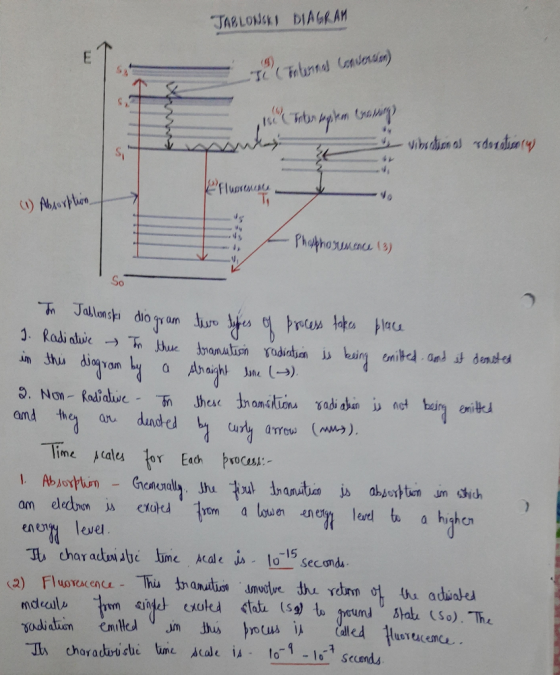
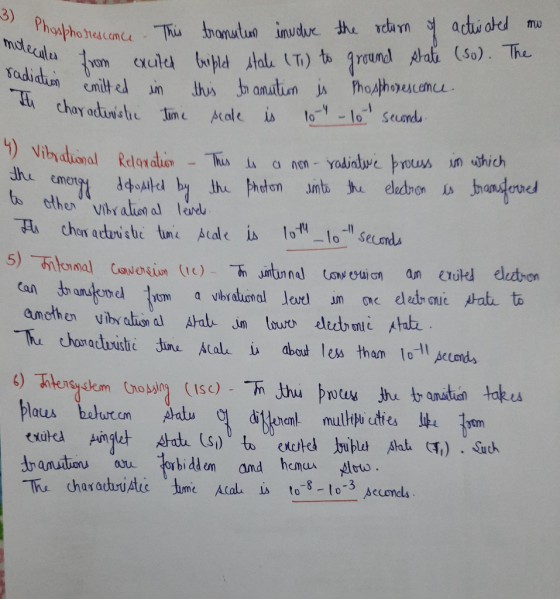
Jablonski diagram is an energy diagram which represents various transitions.This shows various elecronic states which includes several vibrational states in them.It explains the several possibilities or transition that may happen after absorption of light.
Add Answer to:
3. Draw a Jablonski diagram and label absorption, internal conversion, vibration relaxation, intersystem crossing, fluorescence and...
(10 points) Draw a molecular energy diagram of the ground electronic state (S) and the first...
 (10 points) Draw a molecular energy diagram of the ground electronic state (S) and the first excited state (Si) including some vibrational levels (V) in each electronic state. Show the following transitions on the diagram and briefly explain each transition (a) (b) @a resonant absorption fluorescence phosphorescence intersystem crossing non-radiative decay
a.)Draw the Jablonski diagram. why is the rate of fluorescence higher than that of phosphorescence?
a.)Draw the Jablonski diagram. why is the rate of fluorescence higher than that of phosphorescence?
Please compare and contrast the luminescence processes known as fluorescence and phosphorescence using Jablonski diagrams alongside...
Please compare and contrast the luminescence processes known as fluorescence and phosphorescence using Jablonski diagrams alongside a brief written summary. Please utilize the Jablonski diagram to clearly explain what it means for an emissions spectrum to have “vibrational structure.”
Draw a simplified diagram of the energy levels for a generic molecule with three main energy...
Draw a simplified diagram of the energy levels for a generic molecule with three main energy levels, plus the associated vibrational energy states. Include one triplet state to the right of the other states. • Label the ground state S0, the major excited states S1 and S2, and the triplet state T1. • Draw arrows to represent the major transitions that could occur for the molecule due to light absorption, fluorescence, and phosphorescence. Label each arrow. • Draw and label...
The following is absorption (A) and fluorescence (F) spectra of spinach chloroplasts. Draw an energy level...
 The following is absorption (A) and fluorescence (F) spectra of spinach chloroplasts. Draw an energy level diagram for the chromophore showing transitions with arrows for the peaks at 730 nm, 683 nm, 678 nm, 625 nm, and 440 nm. Label the states. The peaks of absorption and emission bands are at slightly different wavelengths, why? 2. r -1.5 1.5 6787r683 -1.0 1.0H A H0.5군 0.5 F 0.0 400 Jo.0 800 600 700 WAVELENGTH (nm) 500 igure 1. Absorption (A) and...
Draw and label the following diagrams for fluorescence spectroscopy: 1) Sample interaction with electromagnetic radiation 2)...
Draw and label the following diagrams for fluorescence spectroscopy: 1) Sample interaction with electromagnetic radiation 2) Energy level diagram (E0, E1, E2) 3) A correcsponding plot of luminescence versus wavelength. Breifly explainphotoluminescence process interms of electronic transitions.
Organic Chemistry Post Lab Questions for the Synthesis of Luminol synthesis of Luminol fro...
 Organic Chemistry Post Lab Questions for the Synthesis of Luminol
synthesis of Luminol from 3-nitrophthalic acid and hydrazide
1. A. Draw a well-labeled diagram which shows the singlet state, singlet excited state and the triplet state in a energy level diagram. Show the spin of electrons in each of these states. B. Show transitions in your diagram and label the radiative processes as either phosphorescence or fluorescence C. Discuss which of these are "allowed "transitions and which are "forbidden" transitions....
Organic Chemistry Post Lab Questions for the Synthesis of Luminol
synthesis of Luminol from 3-nitrophthalic acid and hydrazide
1. A. Draw a well-labeled diagram which shows the singlet state, singlet excited state and the triplet state in a energy level diagram. Show the spin of electrons in each of these states. B. Show transitions in your diagram and label the radiative processes as either phosphorescence or fluorescence C. Discuss which of these are "allowed "transitions and which are "forbidden" transitions....
2) Draw and label a diagram of the carbon cycle. See Figure 4-3 for an example....
2) Draw and label a diagram of the carbon cycle. See Figure 4-3 for an example. Show the important reservoirs and indicate an approximate size (give units) of the reservoirs. Label arrows to depict the pathways that carbon takes through the various reservoirs (I don't expect you to list or memorize all the flux rates, but you should know which ones are important at different time scales). Then, below your diagram, list the carbon pathways that are most involved in...
Please assist with below: Please label answer with number. Also, please draw diagram as indicated for...
Please assist with below: Please label answer with number. Also, please draw diagram as indicated for 3.1 #3: 3.1) Draw a diagram showing how addresses are translated on a virtual memory system 3.2) Explain temporal locality and how it is used in memory paging systems. 3.3) Explain what a stub is 3.4) Explain external fragmentation 3.5) Explain internal fragmentation
3: Consider the Rankine power cycle using vapor and liquid. a: Explain what kinds of problems the Carnot Vapor Cycle has. b: Draw a T-s diagram for the ideal Rankine cycle and label each process...
 3: Consider the Rankine power cycle using vapor and liquid. a: Explain what kinds of problems the Carnot Vapor Cycle has. b: Draw a T-s diagram for the ideal Rankine cycle and label each process explicitly c: There is a method to lower the condenser pressure (or to decrease the average low temperature) in order to improve the efficiency of the ideal Rankine cycle. Explain its advantages and disadvantages explicitly. d: Name the gas power cycle which uses the same...
 (10 points) Draw a molecular energy diagram of the ground electronic state (S) and the first excited state (Si) including some vibrational levels (V) in each electronic state. Show the following transitions on the diagram and briefly explain each transition (a) (b) @a resonant absorption fluorescence phosphorescence intersystem crossing non-radiative decay
 The following is absorption (A) and fluorescence (F) spectra of spinach chloroplasts. Draw an energy level diagram for the chromophore showing transitions with arrows for the peaks at 730 nm, 683 nm, 678 nm, 625 nm, and 440 nm. Label the states. The peaks of absorption and emission bands are at slightly different wavelengths, why? 2. r -1.5 1.5 6787r683 -1.0 1.0H A H0.5군 0.5 F 0.0 400 Jo.0 800 600 700 WAVELENGTH (nm) 500 igure 1. Absorption (A) and...
 Organic Chemistry Post Lab Questions for the Synthesis of Luminol
synthesis of Luminol from 3-nitrophthalic acid and hydrazide
1. A. Draw a well-labeled diagram which shows the singlet state, singlet excited state and the triplet state in a energy level diagram. Show the spin of electrons in each of these states. B. Show transitions in your diagram and label the radiative processes as either phosphorescence or fluorescence C. Discuss which of these are "allowed "transitions and which are "forbidden" transitions....
Organic Chemistry Post Lab Questions for the Synthesis of Luminol
synthesis of Luminol from 3-nitrophthalic acid and hydrazide
1. A. Draw a well-labeled diagram which shows the singlet state, singlet excited state and the triplet state in a energy level diagram. Show the spin of electrons in each of these states. B. Show transitions in your diagram and label the radiative processes as either phosphorescence or fluorescence C. Discuss which of these are "allowed "transitions and which are "forbidden" transitions....
 3: Consider the Rankine power cycle using vapor and liquid. a: Explain what kinds of problems the Carnot Vapor Cycle has. b: Draw a T-s diagram for the ideal Rankine cycle and label each process explicitly c: There is a method to lower the condenser pressure (or to decrease the average low temperature) in order to improve the efficiency of the ideal Rankine cycle. Explain its advantages and disadvantages explicitly. d: Name the gas power cycle which uses the same...
Most questions answered within 3 hours.
-
Where is the error in this code sequence?
String s1 = "Hello";
String s2 = "ello";...
asked 11 months ago -
Financial data for Joel de Paris, Inc., for last year
follow:
Joel de Paris, Inc.
Balance...
asked 11 months ago -
Consider this reaction:
Al2(SO4)3 (aq)+ BaCl3
(aq) Al2Cl6 (aq)- +
3BaSO4(s) . What is the...
asked 11 months ago -
Suppose that Savneet is considering increasing her
recent random sample from 20 car rentals to 40...
asked 11 months ago -
Trucks arrive at an unloading terminal at an average rate of 120
per hour.
Trucks arrive...
asked 11 months ago -
Why are methanol and ethanol completely soluble in water while
octanol is not very little soluble....
asked 11 months ago -
A facilities manager at a university reads in a research report
that the mean amount of...
asked 11 months ago -
When the CuSO4 is rehydrated by adding water to the anhydrous
compound, is this an endothermic...
asked 11 months ago -
A ray of sunlight is passing from diamond into crown glass; the
angle of incidence is...
asked 11 months ago -
A block of mass 0.249 kg is placed on top of a light, vertical
spring of...
asked 11 months ago -
how do the kidneys compensate in the presences of acidosis
a) trigger hyperventilate
b) reserve acid...
asked 11 months ago -
Question 501 pts
The rental rate of capital to the firm increases. Which of the
following...
asked 11 months ago