
Homework Answers
 I hope it helps you, please
give me a positive feedback
I hope it helps you, please
give me a positive feedback
Add Answer to:
Organic Chemistry Post Lab Questions for the Synthesis of Luminol synthesis of Luminol fro...
The initial reaction mixture of 1g 3-nitrophthalic acid, 2ml of 8% aqueous hydrazine and 3ml of...
 The initial reaction
mixture of 1g 3-nitrophthalic acid, 2ml of 8% aqueous hydrazine and
3ml of triethylene glycol.
This was asked for
the Synthesis of a Chemiluminescence Compound: Luminol
(LAB)
Here is the data collected:
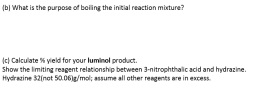
(b) What is the purpose of boiling the initial reaction mixture? (c) Calculate % yield for your luminol product. Show the limiting reagent relationship between 3-nitrophthalic acid and hydrazine. Hydrazine 32(not 50.06)g/mol; assume all other reagents are in excess. 3-nitrophthalic acid (211.13 g/mol) 0.9456g used...
The initial reaction
mixture of 1g 3-nitrophthalic acid, 2ml of 8% aqueous hydrazine and
3ml of triethylene glycol.
This was asked for
the Synthesis of a Chemiluminescence Compound: Luminol
(LAB)
Here is the data collected:
(b) What is the purpose of boiling the initial reaction mixture? (c) Calculate % yield for your luminol product. Show the limiting reagent relationship between 3-nitrophthalic acid and hydrazine. Hydrazine 32(not 50.06)g/mol; assume all other reagents are in excess. 3-nitrophthalic acid (211.13 g/mol) 0.9456g used...
Can someone pliz use the lab experiment n answer the question below. Especially calculating limiting reagent...
 Can someone pliz use the lab experiment n answer the question
below. Especially calculating limiting reagent n theoretical yield.
Pliz show well organize work
A CHEMILUMINESCENT COMPOUND: LUMINOL Discussion describes the production of light as a result of a chemical reaction. oerally produce a product in an electronically excited state. As the Chemiluminescence describes These reactions generally different s to its ground state, a photon is emitted, and light is produced. Many known ors have adopted these reactions for specific...
Can someone pliz use the lab experiment n answer the question
below. Especially calculating limiting reagent n theoretical yield.
Pliz show well organize work
A CHEMILUMINESCENT COMPOUND: LUMINOL Discussion describes the production of light as a result of a chemical reaction. oerally produce a product in an electronically excited state. As the Chemiluminescence describes These reactions generally different s to its ground state, a photon is emitted, and light is produced. Many known ors have adopted these reactions for specific...
When preparing the molecule luminol why do you need to heat the mixture of hydrazine and...
When preparing the molecule luminol why do you need to heat the mixture of hydrazine and 3-nitrophthalic acid? Write the equation. These are the procedures for the lab: Method Part 1 in hood Weigh 0.15g 3-nitrophthalic acid and place in -0.2 mL 10% hydrazine Insert Al block Gently heat to dissolve- hot plate @ 125 C Add 10 drops ethylene glycol Add boiling stone Turn hotplate to 450 C- heat to 210-220 C for 3 min and use temperature probe...
3. (3 pts) You accidentally add too much hydrazine solution (H2NNH2, 30 ml) to the reaction....
 3. (3 pts) You accidentally add too much hydrazine solution (H2NNH2, 30 ml) to the reaction. How would you correct this mistake? If it was left unfixed, what do you predict the effect on the yield to be? NO2 o NO2 HANNH_HO 220 °C, 3-4 min a.) NaOH/H,O, Na, $,04 -100 °C, 5 min ОН NH -OH NH b.) CH,COOH OH HO (Triethylene glycol - solvent) O 3-nitrophthalic acid (Does NOT chemiluminesce.) 3-nitrophthalhydrazide (Does NOT chemiluminesce.) NH₂ i NH NH...
1. Please calculate for the missing mmol and equivalents and show your calculations. 2. Use 3g...
 1. Please calculate for the missing mmol and equivalents and
show your calculations.
2. Use 3g of 3-nitrophthalic acid and the new equivalent values
to determine what quantities of reactants and solvents are needed
for the specific mass of 3-nitrophthalic acid given. Please show
your calculations.
Reactant or Solvent d (g/mL) or M(mol/L) Molecular Weight (g/mol) Reaction Weight (g) or Volume (mL) mmol Equivalents 3-Nitrophthalic Acid NA 211.13 1.00 g 4.74 mmol 1.00 32.05 2.00 mL mmol Hydrazine (8 wt%...
1. Please calculate for the missing mmol and equivalents and
show your calculations.
2. Use 3g of 3-nitrophthalic acid and the new equivalent values
to determine what quantities of reactants and solvents are needed
for the specific mass of 3-nitrophthalic acid given. Please show
your calculations.
Reactant or Solvent d (g/mL) or M(mol/L) Molecular Weight (g/mol) Reaction Weight (g) or Volume (mL) mmol Equivalents 3-Nitrophthalic Acid NA 211.13 1.00 g 4.74 mmol 1.00 32.05 2.00 mL mmol Hydrazine (8 wt%...
Using your mass of 3-nitrophthalic acid and the new equivalent values, determine what quantities of reactants...
 Using your mass of 3-nitrophthalic acid and the new equivalent values, determine what quantities of reactants and solvents are needed for the specific mass of 3-nitrophthalic acid given to you. Reactant or Solvent d (g/MI) or M (mol/L) mmol Equivalents Molecular Weight (g/mol 211.13 Reaction Weight (g) or Volume (mL) 6.78g 1.00 3-Nitrophthalic Acid Hydrazine (8 wt% aqueous solution) Triethylene glycol 32.05 mL 1.20 98% purity 1.00 g/mL. 8% by wt 1.125 g/mL 1.00 g/mL 3.00 mol/L n/a 150.17 mL...
Using your mass of 3-nitrophthalic acid and the new equivalent values, determine what quantities of reactants...
 Using your mass of 3-nitrophthalic acid and the new equivalent values, determine what quantities of reactants and solvents are needed for the specific mass of 3-nitrophthalic acid given to you. Reactant or Solvent d (g/MI) or M (mol/L) mmol Equivalents Molecular Weight (g/mol 211.13 Reaction Weight (g) or Volume (mL) 6.78g 1.00 3-Nitrophthalic Acid Hydrazine (8 wt% aqueous solution) Triethylene glycol 32.05 mL 1.20 98% purity 1.00 g/mL. 8% by wt 1.125 g/mL 1.00 g/mL 3.00 mol/L n/a 150.17 mL...
Using your mass of 3-nitrophthalic acid and the new equivalent values, determine what quantities of reactants...
 Using your mass of 3-nitrophthalic acid and the new equivalent values, determine what quantities of reactants and solvents are needed for the specific mass of 3-nitrophthalic acid given to you. Reactant or Solvent d (g/MD) or M (mol/L) mmol Equivalents Molecular Weight (g/mol) 211.13 Reaction Weight (g) or Volume (mL 6.78g 1.00 3-Nitrophthalic Acid Hydrazine (8 wt% aqueous solution) Triethylene glycol 32.05 mL 1.20 98% purity 1.00 g/ml 8% by wt 1.125 g/mL 1.00 g/mL 3.00 mol/L n/a 150.17 mL...
my starting reaction weight for 3-nitrophthalic acid is 6.65 g 2. (12 pts/1 pt per box)...
 my starting reaction weight for 3-nitrophthalic acid is 6.65
g
2. (12 pts/1 pt per box) Determine the mmol as well as the mass or volume of each reagent that would be required if the reaction was performed starting with a mass of 3-nitrophtalic acid equal to your UIN number divided by 108 (ex. 678459876/108 = 6.78 g of 3-nitrophtalic acid (98% purity)). Using your mass of 3-nitrophthalic acid and the new equivalent values, determine what quantities of reactants and...
my starting reaction weight for 3-nitrophthalic acid is 6.65
g
2. (12 pts/1 pt per box) Determine the mmol as well as the mass or volume of each reagent that would be required if the reaction was performed starting with a mass of 3-nitrophtalic acid equal to your UIN number divided by 108 (ex. 678459876/108 = 6.78 g of 3-nitrophtalic acid (98% purity)). Using your mass of 3-nitrophthalic acid and the new equivalent values, determine what quantities of reactants and...
combinatorial chemistry; ester synthesis Fundamentals of Organic Chemistry Lab Post-Lab Questions 1. If you were doing...
 combinatorial chemistry; ester synthesis
Fundamentals of Organic Chemistry Lab Post-Lab Questions 1. If you were doing these experiments on a larger scale, describe two ways that you could improve the yield of the target ester What is the point of adding sulfuric acid to the reaction? How about the heat? 2. Pick your favorite of the esters you made, and write the mechanism for its formation. 3.
combinatorial chemistry; ester synthesis
Fundamentals of Organic Chemistry Lab Post-Lab Questions 1. If you were doing these experiments on a larger scale, describe two ways that you could improve the yield of the target ester What is the point of adding sulfuric acid to the reaction? How about the heat? 2. Pick your favorite of the esters you made, and write the mechanism for its formation. 3.
 The initial reaction
mixture of 1g 3-nitrophthalic acid, 2ml of 8% aqueous hydrazine and
3ml of triethylene glycol.
This was asked for
the Synthesis of a Chemiluminescence Compound: Luminol
(LAB)
Here is the data collected:
(b) What is the purpose of boiling the initial reaction mixture? (c) Calculate % yield for your luminol product. Show the limiting reagent relationship between 3-nitrophthalic acid and hydrazine. Hydrazine 32(not 50.06)g/mol; assume all other reagents are in excess. 3-nitrophthalic acid (211.13 g/mol) 0.9456g used...
The initial reaction
mixture of 1g 3-nitrophthalic acid, 2ml of 8% aqueous hydrazine and
3ml of triethylene glycol.
This was asked for
the Synthesis of a Chemiluminescence Compound: Luminol
(LAB)
Here is the data collected:
(b) What is the purpose of boiling the initial reaction mixture? (c) Calculate % yield for your luminol product. Show the limiting reagent relationship between 3-nitrophthalic acid and hydrazine. Hydrazine 32(not 50.06)g/mol; assume all other reagents are in excess. 3-nitrophthalic acid (211.13 g/mol) 0.9456g used...
 Can someone pliz use the lab experiment n answer the question
below. Especially calculating limiting reagent n theoretical yield.
Pliz show well organize work
A CHEMILUMINESCENT COMPOUND: LUMINOL Discussion describes the production of light as a result of a chemical reaction. oerally produce a product in an electronically excited state. As the Chemiluminescence describes These reactions generally different s to its ground state, a photon is emitted, and light is produced. Many known ors have adopted these reactions for specific...
Can someone pliz use the lab experiment n answer the question
below. Especially calculating limiting reagent n theoretical yield.
Pliz show well organize work
A CHEMILUMINESCENT COMPOUND: LUMINOL Discussion describes the production of light as a result of a chemical reaction. oerally produce a product in an electronically excited state. As the Chemiluminescence describes These reactions generally different s to its ground state, a photon is emitted, and light is produced. Many known ors have adopted these reactions for specific...
 3. (3 pts) You accidentally add too much hydrazine solution (H2NNH2, 30 ml) to the reaction. How would you correct this mistake? If it was left unfixed, what do you predict the effect on the yield to be? NO2 o NO2 HANNH_HO 220 °C, 3-4 min a.) NaOH/H,O, Na, $,04 -100 °C, 5 min ОН NH -OH NH b.) CH,COOH OH HO (Triethylene glycol - solvent) O 3-nitrophthalic acid (Does NOT chemiluminesce.) 3-nitrophthalhydrazide (Does NOT chemiluminesce.) NH₂ i NH NH...
 1. Please calculate for the missing mmol and equivalents and
show your calculations.
2. Use 3g of 3-nitrophthalic acid and the new equivalent values
to determine what quantities of reactants and solvents are needed
for the specific mass of 3-nitrophthalic acid given. Please show
your calculations.
Reactant or Solvent d (g/mL) or M(mol/L) Molecular Weight (g/mol) Reaction Weight (g) or Volume (mL) mmol Equivalents 3-Nitrophthalic Acid NA 211.13 1.00 g 4.74 mmol 1.00 32.05 2.00 mL mmol Hydrazine (8 wt%...
1. Please calculate for the missing mmol and equivalents and
show your calculations.
2. Use 3g of 3-nitrophthalic acid and the new equivalent values
to determine what quantities of reactants and solvents are needed
for the specific mass of 3-nitrophthalic acid given. Please show
your calculations.
Reactant or Solvent d (g/mL) or M(mol/L) Molecular Weight (g/mol) Reaction Weight (g) or Volume (mL) mmol Equivalents 3-Nitrophthalic Acid NA 211.13 1.00 g 4.74 mmol 1.00 32.05 2.00 mL mmol Hydrazine (8 wt%...
 Using your mass of 3-nitrophthalic acid and the new equivalent values, determine what quantities of reactants and solvents are needed for the specific mass of 3-nitrophthalic acid given to you. Reactant or Solvent d (g/MI) or M (mol/L) mmol Equivalents Molecular Weight (g/mol 211.13 Reaction Weight (g) or Volume (mL) 6.78g 1.00 3-Nitrophthalic Acid Hydrazine (8 wt% aqueous solution) Triethylene glycol 32.05 mL 1.20 98% purity 1.00 g/mL. 8% by wt 1.125 g/mL 1.00 g/mL 3.00 mol/L n/a 150.17 mL...
 Using your mass of 3-nitrophthalic acid and the new equivalent values, determine what quantities of reactants and solvents are needed for the specific mass of 3-nitrophthalic acid given to you. Reactant or Solvent d (g/MI) or M (mol/L) mmol Equivalents Molecular Weight (g/mol 211.13 Reaction Weight (g) or Volume (mL) 6.78g 1.00 3-Nitrophthalic Acid Hydrazine (8 wt% aqueous solution) Triethylene glycol 32.05 mL 1.20 98% purity 1.00 g/mL. 8% by wt 1.125 g/mL 1.00 g/mL 3.00 mol/L n/a 150.17 mL...
 Using your mass of 3-nitrophthalic acid and the new equivalent values, determine what quantities of reactants and solvents are needed for the specific mass of 3-nitrophthalic acid given to you. Reactant or Solvent d (g/MD) or M (mol/L) mmol Equivalents Molecular Weight (g/mol) 211.13 Reaction Weight (g) or Volume (mL 6.78g 1.00 3-Nitrophthalic Acid Hydrazine (8 wt% aqueous solution) Triethylene glycol 32.05 mL 1.20 98% purity 1.00 g/ml 8% by wt 1.125 g/mL 1.00 g/mL 3.00 mol/L n/a 150.17 mL...
 my starting reaction weight for 3-nitrophthalic acid is 6.65
g
2. (12 pts/1 pt per box) Determine the mmol as well as the mass or volume of each reagent that would be required if the reaction was performed starting with a mass of 3-nitrophtalic acid equal to your UIN number divided by 108 (ex. 678459876/108 = 6.78 g of 3-nitrophtalic acid (98% purity)). Using your mass of 3-nitrophthalic acid and the new equivalent values, determine what quantities of reactants and...
my starting reaction weight for 3-nitrophthalic acid is 6.65
g
2. (12 pts/1 pt per box) Determine the mmol as well as the mass or volume of each reagent that would be required if the reaction was performed starting with a mass of 3-nitrophtalic acid equal to your UIN number divided by 108 (ex. 678459876/108 = 6.78 g of 3-nitrophtalic acid (98% purity)). Using your mass of 3-nitrophthalic acid and the new equivalent values, determine what quantities of reactants and...
 combinatorial chemistry; ester synthesis
Fundamentals of Organic Chemistry Lab Post-Lab Questions 1. If you were doing these experiments on a larger scale, describe two ways that you could improve the yield of the target ester What is the point of adding sulfuric acid to the reaction? How about the heat? 2. Pick your favorite of the esters you made, and write the mechanism for its formation. 3.
combinatorial chemistry; ester synthesis
Fundamentals of Organic Chemistry Lab Post-Lab Questions 1. If you were doing these experiments on a larger scale, describe two ways that you could improve the yield of the target ester What is the point of adding sulfuric acid to the reaction? How about the heat? 2. Pick your favorite of the esters you made, and write the mechanism for its formation. 3.
Most questions answered within 3 hours.
-
Where is the error in this code sequence?
String s1 = "Hello";
String s2 = "ello";...
asked 10 months ago -
Financial data for Joel de Paris, Inc., for last year
follow:
Joel de Paris, Inc.
Balance...
asked 10 months ago -
Consider this reaction:
Al2(SO4)3 (aq)+ BaCl3
(aq) Al2Cl6 (aq)- +
3BaSO4(s) . What is the...
asked 10 months ago -
Suppose that Savneet is considering increasing her
recent random sample from 20 car rentals to 40...
asked 10 months ago -
Trucks arrive at an unloading terminal at an average rate of 120
per hour.
Trucks arrive...
asked 10 months ago -
Why are methanol and ethanol completely soluble in water while
octanol is not very little soluble....
asked 10 months ago -
A facilities manager at a university reads in a research report
that the mean amount of...
asked 10 months ago -
When the CuSO4 is rehydrated by adding water to the anhydrous
compound, is this an endothermic...
asked 10 months ago -
A ray of sunlight is passing from diamond into crown glass; the
angle of incidence is...
asked 10 months ago -
A block of mass 0.249 kg is placed on top of a light, vertical
spring of...
asked 10 months ago -
how do the kidneys compensate in the presences of acidosis
a) trigger hyperventilate
b) reserve acid...
asked 10 months ago -
Question 501 pts
The rental rate of capital to the firm increases. Which of the
following...
asked 10 months ago