a.)Draw the Jablonski diagram. why is the rate of fluorescence higher than that of phosphorescence?
a.)Draw the Jablonski diagram. why is the rate of fluorescence higher than that of phosphorescence?
Homework Answers
Jablonski diagram is drawn below.

When the molecule absorbes the the energy it goes to the exited state(singlet) and the fluorescence process take place from the singlet state and sometime the molecule lose the energy in such a way ( inter state conversion/crossing) that it gose to triplet state which have lower energy than that of triplet state and from this state the phosphoroscence process takes place. Due higher energy of singlet state than that of it's triplet state the molecule stays for the longer time at triplet state than that of singlet state and therfore the rate of fluorescence is higher than that of phosphorescence.
Add Answer to:
a.)Draw the Jablonski diagram. why is the rate of fluorescence
higher than that of phosphorescence?
3. Draw a Jablonski diagram and label absorption, internal conversion, vibration relaxation, intersystem crossing, fluorescence and...
 3. Draw a Jablonski diagram and label absorption, internal conversion, vibration relaxation, intersystem crossing, fluorescence and phosphorescence processes. What are the characteristic time scales for absorption, fluorescence, phosphorescence, and vibrational relaxation transitions?
Please compare and contrast the luminescence processes known as fluorescence and phosphorescence using Jablonski diagrams alongside...
Please compare and contrast the luminescence processes known as fluorescence and phosphorescence using Jablonski diagrams alongside a brief written summary. Please utilize the Jablonski diagram to clearly explain what it means for an emissions spectrum to have “vibrational structure.”
Phosphorescence and fluorescence are two specific cases of a more general phenomenon called luminescence (emission of...
Phosphorescence and fluorescence are two specific cases of a more general phenomenon called luminescence (emission of light). What are the differences between phosphorescence and fluorescence? Draw a simple Jablonski diagram, explain in a few short sentences.
(i) State which wavelength (primary peak) corresponds to fluorescence and also to phosphorescence...
 (i) State which wavelength (primary peak) corresponds to fluorescence and also to phosphorescence? By calculating the energy of each peak, draw the energy level diagram corresponding to the graph below. Highlight transition of light absorbance, fluorescence and phosphorescence emission Briefly state with appropriate diagrams, a) why the phosphorescence emission has a longer lifetime and b) appears at a lower energy with a lower intensity. (ii) (iii) 900 800 700 600 500 400 300 200 100 350 400 450 500 550...
16 Marks] 3. Pyrene and 1-bromopyrene have the following parameters: 0.72 530 0.9
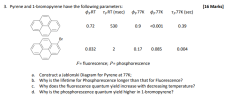 16 Marks] 3. Pyrene and 1-bromopyrene have the following parameters: 0.72 530 0.9<0.001 0.39 0.032 0.17 0.085 0.004 F- fluorescence; P- phosphorescence Construct a Jablonski Diagram for Pyrene at 77K; Why is the lifetime for Phosphorescence longer than that for Fluorescence? Why does the fluorescence quantum yield increase with decreasing temperature? Why is the phosphorescence quantum yield higher in 1-bromopyrene? a. b. c. d.
16 Marks] 3. Pyrene and 1-bromopyrene have the following parameters: 0.72 530 0.9
16 Marks] 3. Pyrene and 1-bromopyrene have the following parameters: 0.72 530 0.9<0.001 0.39 0.032 0.17 0.085 0.004 F- fluorescence; P- phosphorescence Construct a Jablonski Diagram for Pyrene at 77K; Why is the lifetime for Phosphorescence longer than that for Fluorescence? Why does the fluorescence quantum yield increase with decreasing temperature? Why is the phosphorescence quantum yield higher in 1-bromopyrene? a. b. c. d.
16 Marks] 3. Pyrene and 1-bromopyrene have the following parameters: 0.72 530 0.9
How to draw Jablonski diagram for chemiluminescence?
How to draw Jablonski diagram for chemiluminescence?
(10 points) Draw a molecular energy diagram of the ground electronic state (S) and the first...
 (10 points) Draw a molecular energy diagram of the ground electronic state (S) and the first excited state (Si) including some vibrational levels (V) in each electronic state. Show the following transitions on the diagram and briefly explain each transition (a) (b) @a resonant absorption fluorescence phosphorescence intersystem crossing non-radiative decay
Draw a diagram to illustrate what happens inside an atom when an object is experiencing fluorescence....
 Draw a diagram to illustrate what happens inside an atom when an object is experiencing fluorescence. Draw a diagram of light moving from water into air. Assume the light beam strikes the surface at about 30° relative to the normal.
2. The arrows in the Jablonski diagram of Scheme 1 represent transformations that can be written ...
 2. The arrows in the Jablonski diagram of Scheme 1 represent transformations that can be written explicitly as reactions, and thus have rate laws and rate constants associated with thenm For each arrow in the Jablonski diagram, write a chemical equation that represents that arrow. Example: Ru(bpy)*Ru(by)+ hv is the arow labelled emission. Please note that light (hv) should be indicated as a product or reactant where appropriate. Straight line arrows indicate processes involving light, wavy line arrows indicate processes...
(6) The rate of fluorescence process is the rate of UV absorption process. The rate of...
 (6) The rate of fluorescence process is the rate of UV absorption process. The rate of fluorescence process is A the rate of phosphorescence process. ster than (b) slower than (c) about the same as (8) The C = Ö group in acetone (CH3CO CH3) has a strong absorption line at 189 nm, and a weak absorption line at 280 nm. The line at 280 nm corresponds to a transition; and the line at 189 nm corresponds to a_ B....
 3. Draw a Jablonski diagram and label absorption, internal conversion, vibration relaxation, intersystem crossing, fluorescence and phosphorescence processes. What are the characteristic time scales for absorption, fluorescence, phosphorescence, and vibrational relaxation transitions?
 (i) State which wavelength (primary peak) corresponds to fluorescence and also to phosphorescence? By calculating the energy of each peak, draw the energy level diagram corresponding to the graph below. Highlight transition of light absorbance, fluorescence and phosphorescence emission Briefly state with appropriate diagrams, a) why the phosphorescence emission has a longer lifetime and b) appears at a lower energy with a lower intensity. (ii) (iii) 900 800 700 600 500 400 300 200 100 350 400 450 500 550...
 16 Marks] 3. Pyrene and 1-bromopyrene have the following parameters: 0.72 530 0.9<0.001 0.39 0.032 0.17 0.085 0.004 F- fluorescence; P- phosphorescence Construct a Jablonski Diagram for Pyrene at 77K; Why is the lifetime for Phosphorescence longer than that for Fluorescence? Why does the fluorescence quantum yield increase with decreasing temperature? Why is the phosphorescence quantum yield higher in 1-bromopyrene? a. b. c. d.
16 Marks] 3. Pyrene and 1-bromopyrene have the following parameters: 0.72 530 0.9
16 Marks] 3. Pyrene and 1-bromopyrene have the following parameters: 0.72 530 0.9<0.001 0.39 0.032 0.17 0.085 0.004 F- fluorescence; P- phosphorescence Construct a Jablonski Diagram for Pyrene at 77K; Why is the lifetime for Phosphorescence longer than that for Fluorescence? Why does the fluorescence quantum yield increase with decreasing temperature? Why is the phosphorescence quantum yield higher in 1-bromopyrene? a. b. c. d.
16 Marks] 3. Pyrene and 1-bromopyrene have the following parameters: 0.72 530 0.9
 (10 points) Draw a molecular energy diagram of the ground electronic state (S) and the first excited state (Si) including some vibrational levels (V) in each electronic state. Show the following transitions on the diagram and briefly explain each transition (a) (b) @a resonant absorption fluorescence phosphorescence intersystem crossing non-radiative decay
 Draw a diagram to illustrate what happens inside an atom when an object is experiencing fluorescence. Draw a diagram of light moving from water into air. Assume the light beam strikes the surface at about 30° relative to the normal.
 2. The arrows in the Jablonski diagram of Scheme 1 represent transformations that can be written explicitly as reactions, and thus have rate laws and rate constants associated with thenm For each arrow in the Jablonski diagram, write a chemical equation that represents that arrow. Example: Ru(bpy)*Ru(by)+ hv is the arow labelled emission. Please note that light (hv) should be indicated as a product or reactant where appropriate. Straight line arrows indicate processes involving light, wavy line arrows indicate processes...
 (6) The rate of fluorescence process is the rate of UV absorption process. The rate of fluorescence process is A the rate of phosphorescence process. ster than (b) slower than (c) about the same as (8) The C = Ö group in acetone (CH3CO CH3) has a strong absorption line at 189 nm, and a weak absorption line at 280 nm. The line at 280 nm corresponds to a transition; and the line at 189 nm corresponds to a_ B....
Most questions answered within 3 hours.
-
Where is the error in this code sequence?
String s1 = "Hello";
String s2 = "ello";...
asked 11 months ago -
Financial data for Joel de Paris, Inc., for last year
follow:
Joel de Paris, Inc.
Balance...
asked 11 months ago -
Consider this reaction:
Al2(SO4)3 (aq)+ BaCl3
(aq) Al2Cl6 (aq)- +
3BaSO4(s) . What is the...
asked 11 months ago -
Suppose that Savneet is considering increasing her
recent random sample from 20 car rentals to 40...
asked 11 months ago -
Trucks arrive at an unloading terminal at an average rate of 120
per hour.
Trucks arrive...
asked 11 months ago -
Why are methanol and ethanol completely soluble in water while
octanol is not very little soluble....
asked 11 months ago -
A facilities manager at a university reads in a research report
that the mean amount of...
asked 11 months ago -
When the CuSO4 is rehydrated by adding water to the anhydrous
compound, is this an endothermic...
asked 11 months ago -
A ray of sunlight is passing from diamond into crown glass; the
angle of incidence is...
asked 11 months ago -
A block of mass 0.249 kg is placed on top of a light, vertical
spring of...
asked 11 months ago -
how do the kidneys compensate in the presences of acidosis
a) trigger hyperventilate
b) reserve acid...
asked 11 months ago -
Question 501 pts
The rental rate of capital to the firm increases. Which of the
following...
asked 11 months ago