
Homework Answers
There is 3° leaving group which means there is steric crowding around the electrophilic carbon, therefore chances of substitution reaction is less and therefore elimination reaction will be preferred.
As nature of nucleophile is strong , so cannot undergo E1 reaction , therefore E2 pathway will prevail.
Add Answer to:
Consider a reaction with a 3° leaving group and a strong nucleophile/bad base. What reaction pathway...
strong nucleophile weak base strong bulky base strong nucleophile strong base Promote SN2/E2 weak nucleophile weak...
 strong nucleophile weak base strong bulky base strong nucleophile strong base Promote SN2/E2 weak nucleophile weak base Promote SN1/E1 Promote SN2 Promote E2 CH Br HS NCT HO CHO CHÚCHO NaNO NaOH NOME Noe HOORS Conjugate acids have pka 16-18 Conjugate acids Recall, you make hydroxide have pka 11 or alkoxide ons from the corresponding alcohol or water and Nat CH,OH (MOH) HO CH,CH,OH (EXOH) | HC-Ć-o to CH tert-BUOK NOCH KOHBU NEOBU The structures above are all ways of...
How can you tell what is a weak/strong nucleophile and a weak/strong base to determine what mechanism you use (SN1, SN2,...
 How can you tell what is a weak/strong nucleophile and
a weak/strong base to determine what mechanism you use (SN1, SN2,
E1, E2)?
3. Draw a structural formula for the major organic product(s) of each reaction and specify the mechanism by which each product is formed (SNI, SN2, El, or E2). NaOH HO CH2CH ON CH3CH OH CHON CH,OH CH,OH DMSO
How can you tell what is a weak/strong nucleophile and
a weak/strong base to determine what mechanism you use (SN1, SN2,
E1, E2)?
3. Draw a structural formula for the major organic product(s) of each reaction and specify the mechanism by which each product is formed (SNI, SN2, El, or E2). NaOH HO CH2CH ON CH3CH OH CHON CH,OH CH,OH DMSO
Compare and contrast SN1, SN2, E1 and E2 reactions. What are some obvious similarities and differences...
Compare and contrast SN1, SN2, E1 and E2 reactions. What are some obvious similarities and differences between each reaction pathway? What are the requirements for each reaction to work? Discuss why SN2 is in direct competition with E2 while SN1 is in direct competition with the E1 reaction pathway. What is the rate expression for each? Which reactions are concerted? Which reactions are step-wise? Which reactions are stereospecific and what is the stereospecificity of each that are? How do the...
For the following reaction, identify the nucleophile, electrophile, and leaving group. 0 + A Br AB...
 For the following reaction, identify the nucleophile, electrophile, and leaving group. 0 + A Br AB Nucleophile (Select] Electrophile (Select] Leaving Group (Select] Consider the following molecules: Br Ver - H Which will react the fastest in an SN2 reaction? [Select] Which will react the fastest in an E2 reaction? (Select]
give the major product of the reaction, and classify leaving group, Substrate, and whether it is...
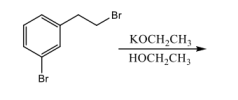 give the major product of the
reaction, and classify leaving group, Substrate, and whether it is
an SN1, SN2, E1, or E2 reaction. (Show arrow pushing).
KOCH.CH HOCH.CH
give the major product of the
reaction, and classify leaving group, Substrate, and whether it is
an SN1, SN2, E1, or E2 reaction. (Show arrow pushing).
KOCH.CH HOCH.CH
This is a multiple question discussion. Can someone please help and provide insight with definitions and...
This is a multiple question discussion. Can someone please help and provide insight with definitions and examples? Compare and contrast SN1, SN2, E1 and E2 reactions. What are some obvious similarities and differences between each reaction pathway? What are the requirements for each reaction to work? Discuss why SN2 is in direct competition with E2 while SN1 is in direct competition with the E1 reaction pathway. What is the rate expression for each? Which reactions are concerted? Which reactions are...
1) Compare and contrast SN1, SN2, E1, and E2 reactions! (similarities abd differences. Requirements for each...
 1) Compare and contrast SN1, SN2, E1, and E2 reactions!
(similarities abd differences. Requirements for each to
work.)
2) Why is SN2 is in direct competition with E2 while SN1 is
direct competition with E1 reaction.
3) Rate expression of each
4) which reactions are concerted? Which are atep wise?
5) which are sterospecific and what stereospecificity of each
are?
6) how do the variables below (A-D) influence reaction
pathway?
Compare and contrast SNI, SN2, El and E2 reactions. What...
1) Compare and contrast SN1, SN2, E1, and E2 reactions!
(similarities abd differences. Requirements for each to
work.)
2) Why is SN2 is in direct competition with E2 while SN1 is
direct competition with E1 reaction.
3) Rate expression of each
4) which reactions are concerted? Which are atep wise?
5) which are sterospecific and what stereospecificity of each
are?
6) how do the variables below (A-D) influence reaction
pathway?
Compare and contrast SNI, SN2, El and E2 reactions. What...
Imagine that a scientist mixes bromoethane and potassium iodide in methanol. What type of reaction is...
 Imagine that a scientist mixes bromoethane and potassium iodide in methanol. What type of reaction is likely to predominate? Remember to consider the type of alkyl halide that is involved, and remember also to consider whether the anion will act predominantly as a base or as a nucleophile or as both a base and a nucleophile. If the latter, consider the figure below to guide your decision. Finally, remember to consider the ΔpKa rule, as it applies to each of...
If you desire to perform a "clean" E2 reaction, which of the following factors helps avoid...
If you desire to perform a "clean" E2 reaction, which of the following factors helps avoid competition with SN2 mechanism? a. use of a polar solvent b. use of a hindered bulky base c. use of a good nucleophile d. use of a good leaving group Alcohol dehydration is mechanistically an: a. SN2 reaction b. E2 reaction c. E1 reaction d. SN1 reaction
(S)-3-Chlorooctane m DMSO S SN2 Factors Nucleophile Strength Leaving Group Solvent d) Cla . NaBrº DMSO...
 (S)-3-Chlorooctane m DMSO S SN2 Factors Nucleophile Strength Leaving Group Solvent d) Cla . NaBrº DMSO Syl SN2 Factors Nucleophile Strength Leaving Group Solvent SN1 and SN2 Reactions 1. For each of the following reactions • Provide a complete detailed mechanism and predict the products. Indicate if the reaction proceeds via a Snl or Sn2 mechanism • Include the specific stereochemistry where appropriate.
 strong nucleophile weak base strong bulky base strong nucleophile strong base Promote SN2/E2 weak nucleophile weak base Promote SN1/E1 Promote SN2 Promote E2 CH Br HS NCT HO CHO CHÚCHO NaNO NaOH NOME Noe HOORS Conjugate acids have pka 16-18 Conjugate acids Recall, you make hydroxide have pka 11 or alkoxide ons from the corresponding alcohol or water and Nat CH,OH (MOH) HO CH,CH,OH (EXOH) | HC-Ć-o to CH tert-BUOK NOCH KOHBU NEOBU The structures above are all ways of...
 How can you tell what is a weak/strong nucleophile and
a weak/strong base to determine what mechanism you use (SN1, SN2,
E1, E2)?
3. Draw a structural formula for the major organic product(s) of each reaction and specify the mechanism by which each product is formed (SNI, SN2, El, or E2). NaOH HO CH2CH ON CH3CH OH CHON CH,OH CH,OH DMSO
How can you tell what is a weak/strong nucleophile and
a weak/strong base to determine what mechanism you use (SN1, SN2,
E1, E2)?
3. Draw a structural formula for the major organic product(s) of each reaction and specify the mechanism by which each product is formed (SNI, SN2, El, or E2). NaOH HO CH2CH ON CH3CH OH CHON CH,OH CH,OH DMSO
 For the following reaction, identify the nucleophile, electrophile, and leaving group. 0 + A Br AB Nucleophile (Select] Electrophile (Select] Leaving Group (Select] Consider the following molecules: Br Ver - H Which will react the fastest in an SN2 reaction? [Select] Which will react the fastest in an E2 reaction? (Select]
 give the major product of the
reaction, and classify leaving group, Substrate, and whether it is
an SN1, SN2, E1, or E2 reaction. (Show arrow pushing).
KOCH.CH HOCH.CH
give the major product of the
reaction, and classify leaving group, Substrate, and whether it is
an SN1, SN2, E1, or E2 reaction. (Show arrow pushing).
KOCH.CH HOCH.CH
 1) Compare and contrast SN1, SN2, E1, and E2 reactions!
(similarities abd differences. Requirements for each to
work.)
2) Why is SN2 is in direct competition with E2 while SN1 is
direct competition with E1 reaction.
3) Rate expression of each
4) which reactions are concerted? Which are atep wise?
5) which are sterospecific and what stereospecificity of each
are?
6) how do the variables below (A-D) influence reaction
pathway?
Compare and contrast SNI, SN2, El and E2 reactions. What...
1) Compare and contrast SN1, SN2, E1, and E2 reactions!
(similarities abd differences. Requirements for each to
work.)
2) Why is SN2 is in direct competition with E2 while SN1 is
direct competition with E1 reaction.
3) Rate expression of each
4) which reactions are concerted? Which are atep wise?
5) which are sterospecific and what stereospecificity of each
are?
6) how do the variables below (A-D) influence reaction
pathway?
Compare and contrast SNI, SN2, El and E2 reactions. What...
 Imagine that a scientist mixes bromoethane and potassium iodide in methanol. What type of reaction is likely to predominate? Remember to consider the type of alkyl halide that is involved, and remember also to consider whether the anion will act predominantly as a base or as a nucleophile or as both a base and a nucleophile. If the latter, consider the figure below to guide your decision. Finally, remember to consider the ΔpKa rule, as it applies to each of...
 (S)-3-Chlorooctane m DMSO S SN2 Factors Nucleophile Strength Leaving Group Solvent d) Cla . NaBrº DMSO Syl SN2 Factors Nucleophile Strength Leaving Group Solvent SN1 and SN2 Reactions 1. For each of the following reactions • Provide a complete detailed mechanism and predict the products. Indicate if the reaction proceeds via a Snl or Sn2 mechanism • Include the specific stereochemistry where appropriate.
Most questions answered within 3 hours.
-
Where is the error in this code sequence?
String s1 = "Hello";
String s2 = "ello";...
asked 10 months ago -
Financial data for Joel de Paris, Inc., for last year
follow:
Joel de Paris, Inc.
Balance...
asked 10 months ago -
Consider this reaction:
Al2(SO4)3 (aq)+ BaCl3
(aq) Al2Cl6 (aq)- +
3BaSO4(s) . What is the...
asked 10 months ago -
Suppose that Savneet is considering increasing her
recent random sample from 20 car rentals to 40...
asked 10 months ago -
Trucks arrive at an unloading terminal at an average rate of 120
per hour.
Trucks arrive...
asked 10 months ago -
Why are methanol and ethanol completely soluble in water while
octanol is not very little soluble....
asked 10 months ago -
A facilities manager at a university reads in a research report
that the mean amount of...
asked 10 months ago -
When the CuSO4 is rehydrated by adding water to the anhydrous
compound, is this an endothermic...
asked 10 months ago -
A ray of sunlight is passing from diamond into crown glass; the
angle of incidence is...
asked 10 months ago -
A block of mass 0.249 kg is placed on top of a light, vertical
spring of...
asked 10 months ago -
how do the kidneys compensate in the presences of acidosis
a) trigger hyperventilate
b) reserve acid...
asked 10 months ago -
Question 501 pts
The rental rate of capital to the firm increases. Which of the
following...
asked 10 months ago