the options in the drop down boxes are phenol, bromobenzene, toluene, nitrobenezene
Homework Answers

Add Answer to:
the options in the drop down boxes are phenol, bromobenzene,
toluene, nitrobenezene
Consider the reactivity of...
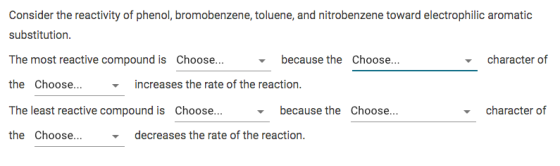
Consider the reactivity of phenol, bromobenzene, toluene, and nitrobenzene toward electrophilic aromatic substitution. 1.) The most...
Consider the reactivity of phenol, bromobenzene, toluene, and nitrobenzene toward electrophilic aromatic substitution. 1.) The most reactive compound is (pick one: phenol, bromobenzene, toluene, and nitrobenzene) because the (pick one: electron donating or electron withdrawing) character of the (pick one: alcohol group, methyl group, bromine atom, or nitro group) increases the rate of the reaction. 2.) The least reactive compound is (pick one: phenol, bromobenzene, toluene, and nitrobenzene) because the (pick one: electron donating or electron withdrawing) character of the...
Arrange the following groups of compounds in order from most reactive to least reactive toward electrophilic...
Arrange the following groups of compounds in order from most reactive to least reactive toward electrophilic aromatic substitution. 1. Benzene, ethylbenzene, chlorobenzene, nitrobenzene, anisole. 2. Toluene, p-cresol, benzene, p-xylene. 3. Benzene, benzoic acid, phenol, propylbenzene. 4. p-Methylnitrobenzene, 2-chloro-1-methyl-4-nitrobenzene, 1-methyl-2,4-dinitrobenzene, p-chloromethylbenzene.
PLEASE ANSWER ALL QUESTIONS 34) Which sequence correctly ranks the following aromatic rings in order of...
 PLEASE ANSWER ALL QUESTIONS
34) Which sequence correctly ranks the following aromatic rings in order of increasing rate of reactivity in an electrophilic aromatic substitution reaction? LOCH A) 1<2<3 B) 2 <3 <1 C) 3 <1<2 D) 2 <1<3 35) Derivatives of the compound shown below are currently being examined for their effectiveness in treating drug addiction and metabolic syndrome (J. Med. Chem. 2006, 872). Which sequence ranks the following aromatic rings of this compound in order of increasing reactivity...
PLEASE ANSWER ALL QUESTIONS
34) Which sequence correctly ranks the following aromatic rings in order of increasing rate of reactivity in an electrophilic aromatic substitution reaction? LOCH A) 1<2<3 B) 2 <3 <1 C) 3 <1<2 D) 2 <1<3 35) Derivatives of the compound shown below are currently being examined for their effectiveness in treating drug addiction and metabolic syndrome (J. Med. Chem. 2006, 872). Which sequence ranks the following aromatic rings of this compound in order of increasing reactivity...
Please fill out the missing sections, either using the drop-down options or by filling in boxes...
Please fill out the missing sections, either using the drop-down options or by filling in boxes (all boxes require numerical answers). Prior to next generation sequencing, the most commonly used DNA sequencing method was Sanger, or (______) sequencing. Sanger sequencing comes in two forms, manual and automated. One of the main differences between these methods (apart from one is manual and one is semi-automated) is the means by which reaction products are detected. In manual sequencing reaction products are detected...
1.The main product of the reaction between p-cresol and Br2 / FeBr3 is: 3-Bromo-4-methyl phenol 2-Bromo-4-methyl...
1.The main product of the reaction between p-cresol and Br2 / FeBr3 is: 3-Bromo-4-methyl phenol 2-Bromo-4-methyl phenol 2-methyl-4-bromine phenol 3-methyl-4-bromine phenol 2.Which of the following compounds is the least reactive in the nucleophilic substitution with NaOH? 2,4-dinitrochlorobenzene m-nitrochlorobenzene o-nitrochlorobenzene 3,5-dinitrochlorobenzene 3.What is the mechanism (s) for the reaction of 4-bromo-1-nitrobenzene with sodium hydroxide to form 4-nitrophenol? bimolecular nucleophilic substitution (Sn2) aromatic nucleophilic substitution by addition-elimination aromatic nucleophilic substitution by elimination-addition aromatic electrophilic substitution 4.which of the following is the correct...
Arrange the following compounds in increasing order of their reactivity to electrophiles. (least reactive first) A....
 Arrange the following compounds in increasing order of their reactivity to electrophiles. (least reactive first) A. CH CHO (benzaldehyde) B. C&HOCH, (anisole) C. C HBr (bromobenzene) D. CH3CH, (toluene) 1) A<C<D<B 2) A<D<C< B 3 ) C<A<B<D 4) C<A<D<B Nitration of chlorobenzene occurs: 1) faster than nitration of benzene and gives the ortho and para products. 2) faster than nitration of benzene and gives the meta product. 3) slower than nitration of benzene and gives the ortho and para products....
Answer ALL Question 23 The first intermediate in the Birch reduction of nitrobenzene appears as shown...
 Answer ALL
Question 23 The first intermediate in the Birch reduction of nitrobenzene appears as shown below. NO2 NO2 Na, CH,OH NH3 True O False Question 24 Imagine that the s-cis form of the below species underwent correct? Select all that apply a thermal electrocyclic reaction. Which of the folowing choices concerning this reaction is/are IV Ring formation will be conrotatory. The product formed is represented by IIl and V The product formed is represented by ll and Ii The...
Answer ALL
Question 23 The first intermediate in the Birch reduction of nitrobenzene appears as shown below. NO2 NO2 Na, CH,OH NH3 True O False Question 24 Imagine that the s-cis form of the below species underwent correct? Select all that apply a thermal electrocyclic reaction. Which of the folowing choices concerning this reaction is/are IV Ring formation will be conrotatory. The product formed is represented by IIl and V The product formed is represented by ll and Ii The...
Drop down options: 1. Garret, Mike 2. add-on, simple interest Ch 07: Assignment - Using Consumer...
 Drop down options:
1. Garret, Mike
2. add-on, simple interest
Ch 07: Assignment - Using Consumer Loans 10. Comparing payments on installment loans when using the simple interestor add-on methods to compute finance charges Comparing Loan Payments Using the simple interest and Add-on Methods of Interest Computation Installment loans allow borrowers to repay the loan with periodic payments over time. They are more common than single-payment loans because it is easier for most people to pay a fixed amount periodically...
Drop down options:
1. Garret, Mike
2. add-on, simple interest
Ch 07: Assignment - Using Consumer Loans 10. Comparing payments on installment loans when using the simple interestor add-on methods to compute finance charges Comparing Loan Payments Using the simple interest and Add-on Methods of Interest Computation Installment loans allow borrowers to repay the loan with periodic payments over time. They are more common than single-payment loans because it is easier for most people to pay a fixed amount periodically...
the weight if the initial product was 3.4 grams of methyl benzoate. Who |o yald foR 3.91SSg st prodoc...
 the
weight if the initial product was 3.4 grams of methyl
benzoate.
Who |o yald foR 3.91SSg st prodoct nd product 2.14143 EXPERIMENTAL PROCEDURE SAFETY WEAR nitrile gloves for this experiment. The nitrating moture of sulfuric acidnitric acid (1:1) is a very strong acid system. Do not allow it to come in contact with your skin or clothing. It will cause acid burns if it comes in contact with your skin (and holes an your clothes). Wash any affected area...
the
weight if the initial product was 3.4 grams of methyl
benzoate.
Who |o yald foR 3.91SSg st prodoct nd product 2.14143 EXPERIMENTAL PROCEDURE SAFETY WEAR nitrile gloves for this experiment. The nitrating moture of sulfuric acidnitric acid (1:1) is a very strong acid system. Do not allow it to come in contact with your skin or clothing. It will cause acid burns if it comes in contact with your skin (and holes an your clothes). Wash any affected area...
Grignard reagent THE GRIGNARD REAGENT-PREPARATION AND REACTION In this experiment, you will prepa...
 i need help with the postlab questions please
Grignard reagent THE GRIGNARD REAGENT-PREPARATION AND REACTION In this experiment, you will prepare a Grignard reagent, phenyl magnesium bromide, from bromobenzene and magnesium metal. The Grignard reagent will then react with methyl benzoate to form triphenylmethanol. Introduction Grignard reagents, such as organomagnesium halides, were discovered in 1910 by French chemist Victor Grignard. The Grignard reaction is one of the most general methods for carbon- carbon bond formation in all of organic chemistry....
i need help with the postlab questions please
Grignard reagent THE GRIGNARD REAGENT-PREPARATION AND REACTION In this experiment, you will prepare a Grignard reagent, phenyl magnesium bromide, from bromobenzene and magnesium metal. The Grignard reagent will then react with methyl benzoate to form triphenylmethanol. Introduction Grignard reagents, such as organomagnesium halides, were discovered in 1910 by French chemist Victor Grignard. The Grignard reaction is one of the most general methods for carbon- carbon bond formation in all of organic chemistry....
 PLEASE ANSWER ALL QUESTIONS
34) Which sequence correctly ranks the following aromatic rings in order of increasing rate of reactivity in an electrophilic aromatic substitution reaction? LOCH A) 1<2<3 B) 2 <3 <1 C) 3 <1<2 D) 2 <1<3 35) Derivatives of the compound shown below are currently being examined for their effectiveness in treating drug addiction and metabolic syndrome (J. Med. Chem. 2006, 872). Which sequence ranks the following aromatic rings of this compound in order of increasing reactivity...
PLEASE ANSWER ALL QUESTIONS
34) Which sequence correctly ranks the following aromatic rings in order of increasing rate of reactivity in an electrophilic aromatic substitution reaction? LOCH A) 1<2<3 B) 2 <3 <1 C) 3 <1<2 D) 2 <1<3 35) Derivatives of the compound shown below are currently being examined for their effectiveness in treating drug addiction and metabolic syndrome (J. Med. Chem. 2006, 872). Which sequence ranks the following aromatic rings of this compound in order of increasing reactivity...
 Arrange the following compounds in increasing order of their reactivity to electrophiles. (least reactive first) A. CH CHO (benzaldehyde) B. C&HOCH, (anisole) C. C HBr (bromobenzene) D. CH3CH, (toluene) 1) A<C<D<B 2) A<D<C< B 3 ) C<A<B<D 4) C<A<D<B Nitration of chlorobenzene occurs: 1) faster than nitration of benzene and gives the ortho and para products. 2) faster than nitration of benzene and gives the meta product. 3) slower than nitration of benzene and gives the ortho and para products....
 Answer ALL
Question 23 The first intermediate in the Birch reduction of nitrobenzene appears as shown below. NO2 NO2 Na, CH,OH NH3 True O False Question 24 Imagine that the s-cis form of the below species underwent correct? Select all that apply a thermal electrocyclic reaction. Which of the folowing choices concerning this reaction is/are IV Ring formation will be conrotatory. The product formed is represented by IIl and V The product formed is represented by ll and Ii The...
Answer ALL
Question 23 The first intermediate in the Birch reduction of nitrobenzene appears as shown below. NO2 NO2 Na, CH,OH NH3 True O False Question 24 Imagine that the s-cis form of the below species underwent correct? Select all that apply a thermal electrocyclic reaction. Which of the folowing choices concerning this reaction is/are IV Ring formation will be conrotatory. The product formed is represented by IIl and V The product formed is represented by ll and Ii The...
 Drop down options:
1. Garret, Mike
2. add-on, simple interest
Ch 07: Assignment - Using Consumer Loans 10. Comparing payments on installment loans when using the simple interestor add-on methods to compute finance charges Comparing Loan Payments Using the simple interest and Add-on Methods of Interest Computation Installment loans allow borrowers to repay the loan with periodic payments over time. They are more common than single-payment loans because it is easier for most people to pay a fixed amount periodically...
Drop down options:
1. Garret, Mike
2. add-on, simple interest
Ch 07: Assignment - Using Consumer Loans 10. Comparing payments on installment loans when using the simple interestor add-on methods to compute finance charges Comparing Loan Payments Using the simple interest and Add-on Methods of Interest Computation Installment loans allow borrowers to repay the loan with periodic payments over time. They are more common than single-payment loans because it is easier for most people to pay a fixed amount periodically...
 the
weight if the initial product was 3.4 grams of methyl
benzoate.
Who |o yald foR 3.91SSg st prodoct nd product 2.14143 EXPERIMENTAL PROCEDURE SAFETY WEAR nitrile gloves for this experiment. The nitrating moture of sulfuric acidnitric acid (1:1) is a very strong acid system. Do not allow it to come in contact with your skin or clothing. It will cause acid burns if it comes in contact with your skin (and holes an your clothes). Wash any affected area...
the
weight if the initial product was 3.4 grams of methyl
benzoate.
Who |o yald foR 3.91SSg st prodoct nd product 2.14143 EXPERIMENTAL PROCEDURE SAFETY WEAR nitrile gloves for this experiment. The nitrating moture of sulfuric acidnitric acid (1:1) is a very strong acid system. Do not allow it to come in contact with your skin or clothing. It will cause acid burns if it comes in contact with your skin (and holes an your clothes). Wash any affected area...
 i need help with the postlab questions please
Grignard reagent THE GRIGNARD REAGENT-PREPARATION AND REACTION In this experiment, you will prepare a Grignard reagent, phenyl magnesium bromide, from bromobenzene and magnesium metal. The Grignard reagent will then react with methyl benzoate to form triphenylmethanol. Introduction Grignard reagents, such as organomagnesium halides, were discovered in 1910 by French chemist Victor Grignard. The Grignard reaction is one of the most general methods for carbon- carbon bond formation in all of organic chemistry....
i need help with the postlab questions please
Grignard reagent THE GRIGNARD REAGENT-PREPARATION AND REACTION In this experiment, you will prepare a Grignard reagent, phenyl magnesium bromide, from bromobenzene and magnesium metal. The Grignard reagent will then react with methyl benzoate to form triphenylmethanol. Introduction Grignard reagents, such as organomagnesium halides, were discovered in 1910 by French chemist Victor Grignard. The Grignard reaction is one of the most general methods for carbon- carbon bond formation in all of organic chemistry....
Most questions answered within 3 hours.
-
Where is the error in this code sequence?
String s1 = "Hello";
String s2 = "ello";...
asked 10 months ago -
Financial data for Joel de Paris, Inc., for last year
follow:
Joel de Paris, Inc.
Balance...
asked 10 months ago -
Consider this reaction:
Al2(SO4)3 (aq)+ BaCl3
(aq) Al2Cl6 (aq)- +
3BaSO4(s) . What is the...
asked 10 months ago -
Suppose that Savneet is considering increasing her
recent random sample from 20 car rentals to 40...
asked 10 months ago -
Trucks arrive at an unloading terminal at an average rate of 120
per hour.
Trucks arrive...
asked 10 months ago -
Why are methanol and ethanol completely soluble in water while
octanol is not very little soluble....
asked 10 months ago -
A facilities manager at a university reads in a research report
that the mean amount of...
asked 10 months ago -
When the CuSO4 is rehydrated by adding water to the anhydrous
compound, is this an endothermic...
asked 10 months ago -
A ray of sunlight is passing from diamond into crown glass; the
angle of incidence is...
asked 10 months ago -
A block of mass 0.249 kg is placed on top of a light, vertical
spring of...
asked 10 months ago -
how do the kidneys compensate in the presences of acidosis
a) trigger hyperventilate
b) reserve acid...
asked 10 months ago -
Question 501 pts
The rental rate of capital to the firm increases. Which of the
following...
asked 10 months ago