
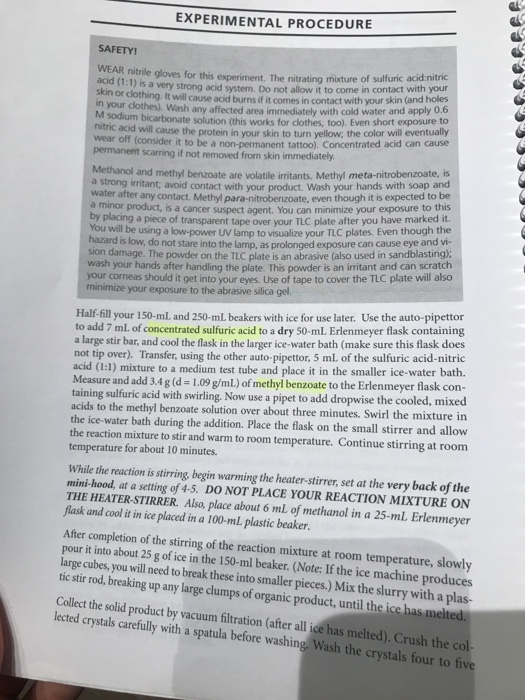


EXPERIMENTAL PROCEDURE SAFETY WEAR nitrile gloves for this experiment. The nitrating moture of sulfuric acidnitric acid (1:1) is a very strong acid system. Do not allow it to come in contact with your skin or clothing. It will cause acid burns if it comes in contact with your skin (and holes an your clothes). Wash any affected area immediately with cold water and apply 0.6 M sodium bicarbonate solution (this works for clothes, too). Even short exposure to nitric acid will cause the protein in vour skin to turn vellow; the color willl eventually wear off (consider it to be a non-permanent tattoo). Concentrated acid can cause permanent scarring if not removed from skin immediately Methanol and methyl benz0ate are volatile irritants. Methyl meta-nitrobenzoate, is a strong irritant; avoid contact with your product. Wash your hands with soap and water after any contact. Methyl para-nitrobenzoate, even though it is expected to be d minor product, is a cancer suspect agent. You can minimize your exposure to this by placing a piece of transparent tape over your TLC plate after you have marked it. You will be using a low-power UV lamp to visualize your TLC plates. Even though the hazard is low, do not stare into the lamp, as prolonged exposure can cause eye and vi- sion damage. The powder on the TLC plate is an abrasive (also used in sandblasting); wash your hands after handling the plate, This powder is an irritant and can scratch your corneas should it get into your eves. Use of tape to cover the TLC plate will also minimize your exposure to the abrasive silica gel. Half-fill your 150-mL and 250-mL beakers with ice for use later. Use the auto-pipettor to add 7 mL of concentrated sulfuric acid to a dry 50-mL. Erlenmeyer flask containing a large stir bar, and cool the flask in the larger ice-water bath (make sure this flask does not tip over). Transfer, using the other auto-pipettor, 5 ml. of the sulfuric acid-nitric acid (1:1) mixture to a medium test tube and place it in the smaller ice-water bath. Measure and add 3.4 g (d = 1.09 g/mL) of methyl benzoate to the Erlenmeyer flask con- taining sulfuric acid with swirling. Now use a pipet to add dropwise the cooled, mixed acids to the methyl benzoate solution over about three minutes. Swirl the mixture in the ice-water bath during the addition. Place the flask on the small stirrer and allow the reaction mixture to stir and warm to room temperature. Continue stirring at room temperature for about 10 minutes. While the reaction is stirring, begin warming the heater-stirrer, set at the very back of the mini-hood, at a setting of 4-5. DO NOT PLACE YOUR REACTION MIXTURE ON THE HEATER-STIRRER. Also, place about 6 mL of methanol in a 25-mL Erlenmeyer flask and cool it in ice placed in a 100-mL plastic beaker. After completion of the stirring of the reaction mixture at room temperature, slowly pour it into about 25 g of ice in the 150-ml beaker. (Note: If the ice machine produces large cubes, you will need to break these into smaller pieces.) Mix the slurry with a plas- tic stir rod, breaking up any large clumps of organic product, until the ice has melted. Collect the solid product by vacuum filtration (after all ice has melted). Crush the col- lected crystals carefully with a spatula before washing. Wash the crystals four to five
E the exeeriment, you do wenr an of KT UNT 2 Experimental Proceddares and Laboratory Reports Electrophilic Aromatic Subtitution The Nitration of Methyl Benoate NOTES NOTES nem ompaaack - c OCH oCH H Desblied resonance stchure Resonance delocaliaon of charge Figure 2-3. Figure 2-1 As previously stated, the presence of any electron-withdrawing group on the benzene ring makes a compound less reactive toward electrophilic aromatic substitution. Methyl benzoate is less reactive than benzene. After nitration, methyl nitrobenzoate contains two electron-withdrawing groups. Therefore, the product is much less reactive than the starting material, and little or no dinitration is observed. If you performed the allkyla- tion of p-xylene, you would find that polysubstitution could be a problem because the product is actually more reactive than the starting material Remember, athough "protonation" and "loss of a proton" are used as shorthand de- scriptions of the utimate outcome, an isolated proton 01) does not exist in solution 40 ONO Nitronium lons Figure 2-2 Electrophilic aromatic substitution of substituted benzenes may give rise to a mixture of positional isomers. Carbonyl, sulfonyl, nitrile, or nitro-substituted benzenes pro- dace a preponderance of meta-products when they undergo electrophilic substitution. These substituents on the benzene ring act as strong electron-withdrawing groups. This redaces the electron density of the aromatic ring and dramatically lowers its reactivity Moreover, an examination of the resonance structures for the intermediate carbocation formed by addition of a nitronium ion to methyl benzoate provides an explanation of why methyl m-nitrobenzoate is the major product (Figure 2-3). The addition of the dectrophile at either the ortho or the pana positions prodaces a carbocation intermedi- ate that bears a positive charge on the carbon directly attached to the electron-with- drawing group. This significantly raises the energy of the intermediate. Therefore, the addition of the nitronium ion at the meta position (producing resonance intermediates hat are destabilized less th
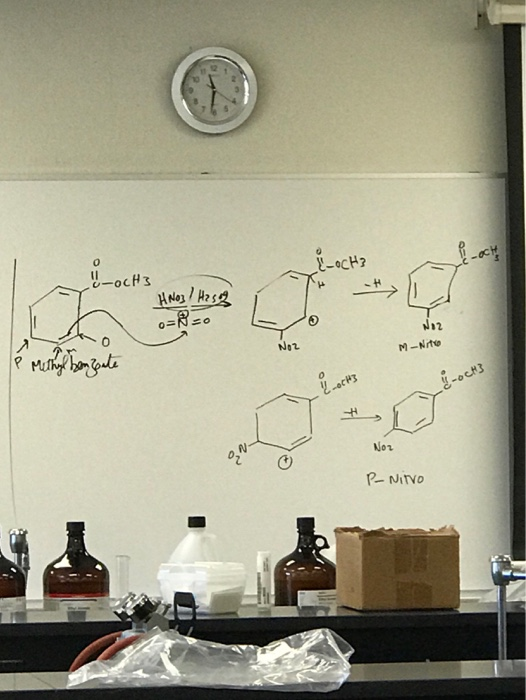
ocHs CH No2 M-Nite LecP -ocH3 Nor P-NiTvO
Methanol and methyl benzoate are volatile irritants. Methyl meta-nitrobenzoate, is a strong irritant; avoid contact with your product. Wash your hands with soap and water after any contact. Methyl para-nitrobenzoate, even though it is expected to be a minor product, is a cancer suspect agent. You can minimize your exposure to this by placing a piece of transparent tape over your TLC plate after you have marked it. You will be using a low-power UV lamp to visualize your TLC plates. Even though the hazard is low, do not stare into the lamp, as prolonged exposure can cause eye and vi- sion damage. The powder on the TLC plate is an abrasive (also used in sandblasting);: wash your hands after handling the plate. This powder is an irritant and can scratch your corneas should it get into your eyes. Use of tape to cover the TLC plate will also minimize your exposure to the abrasive silica gel. Half-fill your 150-mL and 250-mL beakers with ice for use later. Use the auto-pipettor to add 7 mL of concentrated sulfuric acid to a dry 50-mL Erlenmeyer flask containing a large stir bar, and cool the flask in the larger ice-water bath (make sure this flask does not tip over). Transfer, using the other auto-pipettor, 5 mL of the sulfuric acid-nitric acid (1:1) mixture to a medium test tube and place it in the smaller ice-water bath. Measure and add 3.4 g (d = 1.09 g/mL) of methyl benzoate to the Erlenmeyer flask con- taining sulfuric acid with swirling. Now use a pipet to add dropwise the cooled, mixed acids to the methyl benzoate solution over about three minutes. Swirl the mixture in the ice-water bath during the addition. Place the flask on the small stirrer and allow the reaction mixture to stir and warm to room temperature. Continue stirring at room temperature for about 10 minutes. While the reaction is stirring, begin warming the heater-stirrer, set at the very back of the mini-hood, at a setting of 4-5. DO NOT PLACE YOUR REACTION MLXTURE ON THE HEATER-STIRRER. Also, place about 6 mL of methanol in a 25-mL Erlenmeyer flask and cool it in ice placed in a 100-mL plastic beaker. After completion of the stirring of the reaction mixture at roo pour it into about 25 g of ice in the 150-ml beaker. (Note: If the ice machine produces large cubes, you will need to break these into smaller pieces.) Mix the slurry with a plas- tic stir rod, breaking up any large clumps of organic product, until the ice has melted. om temperature, slowly Collect the solid product by vacuum filtration (after all ice has melted). Crush the col- lected crystals carefully with a spatula before washing. Wash the crystals four to five
-cH -ocH3 OR-O No2 M-Nite Nor P-NITVO
Homework Answers
Initial mass of methyl benzoate = 3.4 gms
Molar mass of methyl benzoate = 136.15 g/mol
No. of moles of methyl benzoate = Mass/molar mass = 3.4 g/136.15 g/mol = 0.02497 moles
We can observe in the above nitration reaction the molar ratio of methyl benzoate and meta nitro methyl benzoate is 1:1
Similarly the molar ratio of methyl benzoate and para nitro methyl benzoate is 1:1
Molar mass of meta nitro methyl benzoate / para nitro methyl benzoate is 181.15 g/mol
Hence moles of meta nitro methyl benzoate / para nitro methyl benzoate = 0.02497 moles
Theoretical Mass of meta nitro methyl benzoate / para nitro methyl benzoate = moles x molar mass = 0.02497 mol x 181.15 g/mol = 4.524 g
Percentage yield of product 1 (meta nitro methyl benzoate) = (actual yield/theoretical yield) x 100 = (3.9155g/4.524 g) x 100 = 86.5 %
Percentage yield of product 2 (para nitro methyl benzoate) = (2.1999 g/4.524 g/mol) x 100 = 48.6 %
Add Answer to:
the weight if the initial product was 3.4 grams of methyl benzoate. Who |o yald foR 3.91SSg st prodoc...
For the nitration of methyl benzoate: a. Which product did you get? What evidence do you...
 For the nitration of methyl benzoate:
a. Which product did you get? What evidence do you have for
this?
b. Was your product pure? What evidence do you have for this?
Explain your evidence.
c. Draw the mechanism for the product you got.
For the bromination of acetanilide:
a. Which product did you get? What evidence do you have for
this?
b. Was your product pure? What evidence do you have for this?
Explain your evidence.
c. Draw the mechanism...
For the nitration of methyl benzoate:
a. Which product did you get? What evidence do you have for
this?
b. Was your product pure? What evidence do you have for this?
Explain your evidence.
c. Draw the mechanism for the product you got.
For the bromination of acetanilide:
a. Which product did you get? What evidence do you have for
this?
b. Was your product pure? What evidence do you have for this?
Explain your evidence.
c. Draw the mechanism...
Nitration of Methyl Benzoate to synthesize Methyl m-nitrobenzoate Find theoretical yield and percent yield. Show all...
Nitration of Methyl Benzoate to synthesize Methyl m-nitrobenzoate Find theoretical yield and percent yield. Show all steps. Results: .040 g of methyl m-nitrobenzoate crystals produced 1. Add .30 g of Methyl Benzoate to .6 ml of Sulfuric Acid in a reaction tube 2. Dropwise add a mixture of .2 ml of sulfuric acid and .2ml of nitric acid 3. After 15 min, pour onto 2.5 g of ice in a small beaker 4. Use suction filtration to dry crystals. Wash...
numbers 1-3 Post-Laboratory Questions-EXP 3 Nitration of Aromatic Compounds Name: Due after completing the lab. 1....
 numbers 1-3
Post-Laboratory Questions-EXP 3 Nitration of Aromatic Compounds Name: Due after completing the lab. 1. Why is concentrated sulfuric acid emploved in thie on? What is the electrophile that is produced by the reaction of sulfuric acid and nitric acid? 2. Why is it important to maintain the reaction temperature low and the addition of nitric acid-sulfuric acid mixture carried out slowly? 3. Explain why concentrated H2SO4, not concentrated HC1, was used in this experiment? 4. Which ring of...
numbers 1-3
Post-Laboratory Questions-EXP 3 Nitration of Aromatic Compounds Name: Due after completing the lab. 1. Why is concentrated sulfuric acid emploved in thie on? What is the electrophile that is produced by the reaction of sulfuric acid and nitric acid? 2. Why is it important to maintain the reaction temperature low and the addition of nitric acid-sulfuric acid mixture carried out slowly? 3. Explain why concentrated H2SO4, not concentrated HC1, was used in this experiment? 4. Which ring of...
3-5 pls Post-Laboratory Questions-EXP 3 Nitration of Aromatic Compounds Name: Due after completing the lab. 1....
 3-5 pls
Post-Laboratory Questions-EXP 3 Nitration of Aromatic Compounds Name: Due after completing the lab. 1. Why is concentrated sulfuric acid employed in this reaction? What is the electrophile that is produced by the reaction of sulfuric acid and nitric acid? 2. Why is it important to maintain the reaction temperature low and the addition of nitric acid-sulfuric acid mixture carried out slowly? 3. Explain why concentrated H2SO, not concentrated HCl, was used in this experiment? 4. Which ring of...
3-5 pls
Post-Laboratory Questions-EXP 3 Nitration of Aromatic Compounds Name: Due after completing the lab. 1. Why is concentrated sulfuric acid employed in this reaction? What is the electrophile that is produced by the reaction of sulfuric acid and nitric acid? 2. Why is it important to maintain the reaction temperature low and the addition of nitric acid-sulfuric acid mixture carried out slowly? 3. Explain why concentrated H2SO, not concentrated HCl, was used in this experiment? 4. Which ring of...
Complete the table of reactants and products for the following two reactions. Compound Molar Mass (g/mol)...
Complete the table of reactants and products for the following two reactions. Compound Molar Mass (g/mol) Mass Volume Density (g/mL) # Mols Equivalents of Reactants (divide actual moles by stoichiometric moles) Other (indicate which is limiting reactant) Nitration of Methyl Benzoate In a 50 mL Erlenmeyer flask, cool 6 mL of conc. H2SO4 in ice and add 3.0 g of methyl benzoate. Make sure the temperature stays at 0 oC . Using a pipet, slowly add a cooled mixture of...
PROCEDURE CAUTION!!! Nitric acid and sulfuric acid are strong and corrosive acids. For that reason, avoid...
 PROCEDURE CAUTION!!! Nitric acid and sulfuric acid are strong and corrosive acids. For that reason, avoid inhaling its vapors or causing any contact with the skin or clothing. Wear your protective glasses at all times. Use the extractors to work with these acids. A. Nitration of methyl benzoate 1. Preparation of the reactants. In the extractor you will find a burette with concentrated sulfuric acid, a second burette with concentrated nitric acid, clearly identified. Familiarize yourself with the scales of...
-NITRATION OF Methyl benzoate -addditional information. .( 3.9 g of the product methyl 3-nitrobenzoate for the...
 -NITRATION OF Methyl benzoate
-addditional information. .( 3.9 g of the product methyl
3-nitrobenzoate for the percentage yield
Materials used: Amount Compound used/ Molecular weight Density (g/mL) Moles produced 3.05g used 136.15 g/mol N/A 0.0224 mol Methyl Benzoate HO-S-OH 6mL used 98.079 g/mol 1.83 g/cm3 0.112 Sulfuric Acid 2mL used 63.01 g/mol 1.51 g/cm3 0.047g o-N-OH Nitric Acid 3.034g of pure product 181.15 g/mol produced N/A 0.0167 mol NO2 Methyl-m- nitrobenzoate Calculating limiting reagent and theoretical yield: 0.0224 mol methylbenzoate...
-NITRATION OF Methyl benzoate
-addditional information. .( 3.9 g of the product methyl
3-nitrobenzoate for the percentage yield
Materials used: Amount Compound used/ Molecular weight Density (g/mL) Moles produced 3.05g used 136.15 g/mol N/A 0.0224 mol Methyl Benzoate HO-S-OH 6mL used 98.079 g/mol 1.83 g/cm3 0.112 Sulfuric Acid 2mL used 63.01 g/mol 1.51 g/cm3 0.047g o-N-OH Nitric Acid 3.034g of pure product 181.15 g/mol produced N/A 0.0167 mol NO2 Methyl-m- nitrobenzoate Calculating limiting reagent and theoretical yield: 0.0224 mol methylbenzoate...
What is the limiting reagent in this experiment? Acetophenone or aqueous bleach? 1. Add about 1.0...
 What is the limiting reagent in this experiment? Acetophenone or
aqueous bleach?
1. Add about 1.0 g (measured accurately) of acetophenone to 40 mL of the bleach solution (5% NaCl in water - this reactant should be included in your table of reagents!) in a 100 mL round bottom flask equipped with a magnetic stirrer. Clamp the flask in the fume hood above a stir plate. 2. After the initial reaction has subsided, boil the reaction mixture gently for 5...
What is the limiting reagent in this experiment? Acetophenone or
aqueous bleach?
1. Add about 1.0 g (measured accurately) of acetophenone to 40 mL of the bleach solution (5% NaCl in water - this reactant should be included in your table of reagents!) in a 100 mL round bottom flask equipped with a magnetic stirrer. Clamp the flask in the fume hood above a stir plate. 2. After the initial reaction has subsided, boil the reaction mixture gently for 5...
How does the acetone destroy the unreacted hypochlorite? 1. Add about 1.0 g (measured accurately) of...
 How does the acetone destroy
the unreacted hypochlorite?
1. Add about 1.0 g (measured accurately) of acetophenone to 40 mL of the bleach solution (5% NaCl in water - this reactant should be included in your table of reagents!) in a 100 mL round bottom flask equipped with a magnetic stirrer. Clamp the flask in the fume hood above a stir plate. 2. After the initial reaction has subsided, boil the reaction mixture gently for 5 - 10 minutes using...
How does the acetone destroy
the unreacted hypochlorite?
1. Add about 1.0 g (measured accurately) of acetophenone to 40 mL of the bleach solution (5% NaCl in water - this reactant should be included in your table of reagents!) in a 100 mL round bottom flask equipped with a magnetic stirrer. Clamp the flask in the fume hood above a stir plate. 2. After the initial reaction has subsided, boil the reaction mixture gently for 5 - 10 minutes using...
What is the mechanism (with curved arrows) for this reaction? 1. Add about 1.0 g (measured accurately) of acetophenone t...
 What is the mechanism (with
curved arrows) for this reaction?
1. Add about 1.0 g (measured accurately) of acetophenone to 40 mL of the bleach solution (5% NaCl in water - this reactant should be included in your table of reagents!) in a 100 mL round bottom flask equipped with a magnetic stirrer. Clamp the flask in the fume hood above a stir plate. 2. After the initial reaction has subsided, boil the reaction mixture gently for 5 - 10...
What is the mechanism (with
curved arrows) for this reaction?
1. Add about 1.0 g (measured accurately) of acetophenone to 40 mL of the bleach solution (5% NaCl in water - this reactant should be included in your table of reagents!) in a 100 mL round bottom flask equipped with a magnetic stirrer. Clamp the flask in the fume hood above a stir plate. 2. After the initial reaction has subsided, boil the reaction mixture gently for 5 - 10...
 For the nitration of methyl benzoate:
a. Which product did you get? What evidence do you have for
this?
b. Was your product pure? What evidence do you have for this?
Explain your evidence.
c. Draw the mechanism for the product you got.
For the bromination of acetanilide:
a. Which product did you get? What evidence do you have for
this?
b. Was your product pure? What evidence do you have for this?
Explain your evidence.
c. Draw the mechanism...
For the nitration of methyl benzoate:
a. Which product did you get? What evidence do you have for
this?
b. Was your product pure? What evidence do you have for this?
Explain your evidence.
c. Draw the mechanism for the product you got.
For the bromination of acetanilide:
a. Which product did you get? What evidence do you have for
this?
b. Was your product pure? What evidence do you have for this?
Explain your evidence.
c. Draw the mechanism...
 numbers 1-3
Post-Laboratory Questions-EXP 3 Nitration of Aromatic Compounds Name: Due after completing the lab. 1. Why is concentrated sulfuric acid emploved in thie on? What is the electrophile that is produced by the reaction of sulfuric acid and nitric acid? 2. Why is it important to maintain the reaction temperature low and the addition of nitric acid-sulfuric acid mixture carried out slowly? 3. Explain why concentrated H2SO4, not concentrated HC1, was used in this experiment? 4. Which ring of...
numbers 1-3
Post-Laboratory Questions-EXP 3 Nitration of Aromatic Compounds Name: Due after completing the lab. 1. Why is concentrated sulfuric acid emploved in thie on? What is the electrophile that is produced by the reaction of sulfuric acid and nitric acid? 2. Why is it important to maintain the reaction temperature low and the addition of nitric acid-sulfuric acid mixture carried out slowly? 3. Explain why concentrated H2SO4, not concentrated HC1, was used in this experiment? 4. Which ring of...
 3-5 pls
Post-Laboratory Questions-EXP 3 Nitration of Aromatic Compounds Name: Due after completing the lab. 1. Why is concentrated sulfuric acid employed in this reaction? What is the electrophile that is produced by the reaction of sulfuric acid and nitric acid? 2. Why is it important to maintain the reaction temperature low and the addition of nitric acid-sulfuric acid mixture carried out slowly? 3. Explain why concentrated H2SO, not concentrated HCl, was used in this experiment? 4. Which ring of...
3-5 pls
Post-Laboratory Questions-EXP 3 Nitration of Aromatic Compounds Name: Due after completing the lab. 1. Why is concentrated sulfuric acid employed in this reaction? What is the electrophile that is produced by the reaction of sulfuric acid and nitric acid? 2. Why is it important to maintain the reaction temperature low and the addition of nitric acid-sulfuric acid mixture carried out slowly? 3. Explain why concentrated H2SO, not concentrated HCl, was used in this experiment? 4. Which ring of...
 PROCEDURE CAUTION!!! Nitric acid and sulfuric acid are strong and corrosive acids. For that reason, avoid inhaling its vapors or causing any contact with the skin or clothing. Wear your protective glasses at all times. Use the extractors to work with these acids. A. Nitration of methyl benzoate 1. Preparation of the reactants. In the extractor you will find a burette with concentrated sulfuric acid, a second burette with concentrated nitric acid, clearly identified. Familiarize yourself with the scales of...
 -NITRATION OF Methyl benzoate
-addditional information. .( 3.9 g of the product methyl
3-nitrobenzoate for the percentage yield
Materials used: Amount Compound used/ Molecular weight Density (g/mL) Moles produced 3.05g used 136.15 g/mol N/A 0.0224 mol Methyl Benzoate HO-S-OH 6mL used 98.079 g/mol 1.83 g/cm3 0.112 Sulfuric Acid 2mL used 63.01 g/mol 1.51 g/cm3 0.047g o-N-OH Nitric Acid 3.034g of pure product 181.15 g/mol produced N/A 0.0167 mol NO2 Methyl-m- nitrobenzoate Calculating limiting reagent and theoretical yield: 0.0224 mol methylbenzoate...
-NITRATION OF Methyl benzoate
-addditional information. .( 3.9 g of the product methyl
3-nitrobenzoate for the percentage yield
Materials used: Amount Compound used/ Molecular weight Density (g/mL) Moles produced 3.05g used 136.15 g/mol N/A 0.0224 mol Methyl Benzoate HO-S-OH 6mL used 98.079 g/mol 1.83 g/cm3 0.112 Sulfuric Acid 2mL used 63.01 g/mol 1.51 g/cm3 0.047g o-N-OH Nitric Acid 3.034g of pure product 181.15 g/mol produced N/A 0.0167 mol NO2 Methyl-m- nitrobenzoate Calculating limiting reagent and theoretical yield: 0.0224 mol methylbenzoate...
 What is the limiting reagent in this experiment? Acetophenone or
aqueous bleach?
1. Add about 1.0 g (measured accurately) of acetophenone to 40 mL of the bleach solution (5% NaCl in water - this reactant should be included in your table of reagents!) in a 100 mL round bottom flask equipped with a magnetic stirrer. Clamp the flask in the fume hood above a stir plate. 2. After the initial reaction has subsided, boil the reaction mixture gently for 5...
What is the limiting reagent in this experiment? Acetophenone or
aqueous bleach?
1. Add about 1.0 g (measured accurately) of acetophenone to 40 mL of the bleach solution (5% NaCl in water - this reactant should be included in your table of reagents!) in a 100 mL round bottom flask equipped with a magnetic stirrer. Clamp the flask in the fume hood above a stir plate. 2. After the initial reaction has subsided, boil the reaction mixture gently for 5...
 How does the acetone destroy
the unreacted hypochlorite?
1. Add about 1.0 g (measured accurately) of acetophenone to 40 mL of the bleach solution (5% NaCl in water - this reactant should be included in your table of reagents!) in a 100 mL round bottom flask equipped with a magnetic stirrer. Clamp the flask in the fume hood above a stir plate. 2. After the initial reaction has subsided, boil the reaction mixture gently for 5 - 10 minutes using...
How does the acetone destroy
the unreacted hypochlorite?
1. Add about 1.0 g (measured accurately) of acetophenone to 40 mL of the bleach solution (5% NaCl in water - this reactant should be included in your table of reagents!) in a 100 mL round bottom flask equipped with a magnetic stirrer. Clamp the flask in the fume hood above a stir plate. 2. After the initial reaction has subsided, boil the reaction mixture gently for 5 - 10 minutes using...
 What is the mechanism (with
curved arrows) for this reaction?
1. Add about 1.0 g (measured accurately) of acetophenone to 40 mL of the bleach solution (5% NaCl in water - this reactant should be included in your table of reagents!) in a 100 mL round bottom flask equipped with a magnetic stirrer. Clamp the flask in the fume hood above a stir plate. 2. After the initial reaction has subsided, boil the reaction mixture gently for 5 - 10...
What is the mechanism (with
curved arrows) for this reaction?
1. Add about 1.0 g (measured accurately) of acetophenone to 40 mL of the bleach solution (5% NaCl in water - this reactant should be included in your table of reagents!) in a 100 mL round bottom flask equipped with a magnetic stirrer. Clamp the flask in the fume hood above a stir plate. 2. After the initial reaction has subsided, boil the reaction mixture gently for 5 - 10...
Most questions answered within 3 hours.
-
Where is the error in this code sequence?
String s1 = "Hello";
String s2 = "ello";...
asked 11 months ago -
Financial data for Joel de Paris, Inc., for last year
follow:
Joel de Paris, Inc.
Balance...
asked 11 months ago -
Consider this reaction:
Al2(SO4)3 (aq)+ BaCl3
(aq) Al2Cl6 (aq)- +
3BaSO4(s) . What is the...
asked 11 months ago -
Suppose that Savneet is considering increasing her
recent random sample from 20 car rentals to 40...
asked 11 months ago -
Trucks arrive at an unloading terminal at an average rate of 120
per hour.
Trucks arrive...
asked 11 months ago -
Why are methanol and ethanol completely soluble in water while
octanol is not very little soluble....
asked 11 months ago -
A facilities manager at a university reads in a research report
that the mean amount of...
asked 11 months ago -
When the CuSO4 is rehydrated by adding water to the anhydrous
compound, is this an endothermic...
asked 11 months ago -
A ray of sunlight is passing from diamond into crown glass; the
angle of incidence is...
asked 11 months ago -
A block of mass 0.249 kg is placed on top of a light, vertical
spring of...
asked 11 months ago -
how do the kidneys compensate in the presences of acidosis
a) trigger hyperventilate
b) reserve acid...
asked 11 months ago -
Question 501 pts
The rental rate of capital to the firm increases. Which of the
following...
asked 11 months ago