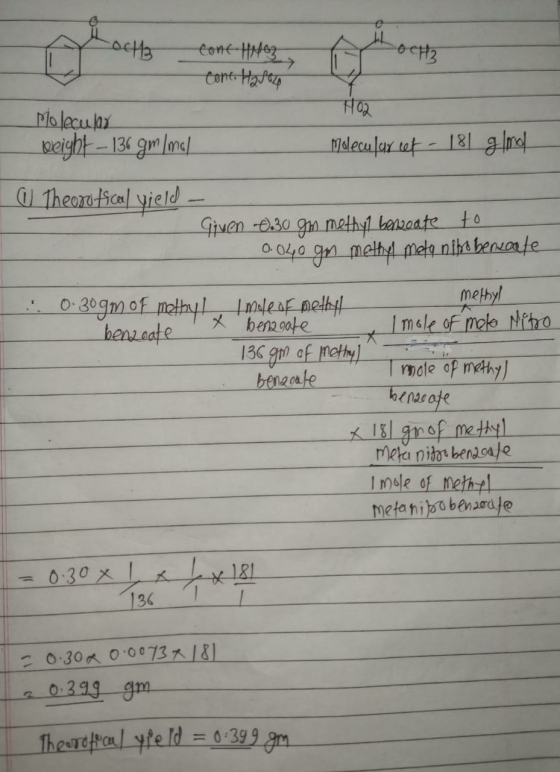
Nitration of Methyl Benzoate to synthesize Methyl m-nitrobenzoate Find theoretical yield and percent yield. Show all...
Nitration of Methyl Benzoate to synthesize Methyl m-nitrobenzoate
Find theoretical yield and percent yield. Show all steps.
Results: .040 g of methyl m-nitrobenzoate crystals produced
1. Add .30 g of Methyl Benzoate to .6 ml of Sulfuric Acid in a reaction tube
2. Dropwise add a mixture of .2 ml of sulfuric acid and .2ml of nitric acid
3. After 15 min, pour onto 2.5 g of ice in a small beaker
4. Use suction filtration to dry crystals. Wash with water and then with .2 ml of ice- cold methanol
Homework Answers

Add Answer to:
Nitration of Methyl Benzoate to synthesize Methyl m-nitrobenzoate Find theoretical yield and percent yield. Show all...
-NITRATION OF Methyl benzoate -addditional information. .( 3.9 g of the product methyl 3-nitrobenzoate for the...
 -NITRATION OF Methyl benzoate
-addditional information. .( 3.9 g of the product methyl
3-nitrobenzoate for the percentage yield
Materials used: Amount Compound used/ Molecular weight Density (g/mL) Moles produced 3.05g used 136.15 g/mol N/A 0.0224 mol Methyl Benzoate HO-S-OH 6mL used 98.079 g/mol 1.83 g/cm3 0.112 Sulfuric Acid 2mL used 63.01 g/mol 1.51 g/cm3 0.047g o-N-OH Nitric Acid 3.034g of pure product 181.15 g/mol produced N/A 0.0167 mol NO2 Methyl-m- nitrobenzoate Calculating limiting reagent and theoretical yield: 0.0224 mol methylbenzoate...
-NITRATION OF Methyl benzoate
-addditional information. .( 3.9 g of the product methyl
3-nitrobenzoate for the percentage yield
Materials used: Amount Compound used/ Molecular weight Density (g/mL) Moles produced 3.05g used 136.15 g/mol N/A 0.0224 mol Methyl Benzoate HO-S-OH 6mL used 98.079 g/mol 1.83 g/cm3 0.112 Sulfuric Acid 2mL used 63.01 g/mol 1.51 g/cm3 0.047g o-N-OH Nitric Acid 3.034g of pure product 181.15 g/mol produced N/A 0.0167 mol NO2 Methyl-m- nitrobenzoate Calculating limiting reagent and theoretical yield: 0.0224 mol methylbenzoate...
Nitration of Methyl Benzoate Calculations - please fill out every box and expected and percent yield....
 Nitration of Methyl Benzoate Calculations - please fill out
every box and expected and percent yield.
- eqt: methyl benzoate + HNO3
----->(H2SO4 above arrow)
Methyl-m-nitrobenzoate + H2O
- end product= 2.105 g
-2ml of nitric acid and 2ml of sulfuric acid were used
Calculation of Theoretical Yield Balanced Equation: RAH OH M.W.*: 18.00 g/mol 136.15 g mos 63.0lgimo 4.026g 31.505g 181.15 Horg grams*: moles*: * Include these values for all compounds, underneath that compound, in the balanced equation. Limiting...
Nitration of Methyl Benzoate Calculations - please fill out
every box and expected and percent yield.
- eqt: methyl benzoate + HNO3
----->(H2SO4 above arrow)
Methyl-m-nitrobenzoate + H2O
- end product= 2.105 g
-2ml of nitric acid and 2ml of sulfuric acid were used
Calculation of Theoretical Yield Balanced Equation: RAH OH M.W.*: 18.00 g/mol 136.15 g mos 63.0lgimo 4.026g 31.505g 181.15 Horg grams*: moles*: * Include these values for all compounds, underneath that compound, in the balanced equation. Limiting...
What would be the theoretical yield of reacting methyl benzoate (C₆H₅CO₂CH3) with nitric acid (HNO3) and...
What would be the theoretical yield of reacting methyl benzoate (C₆H₅CO₂CH3) with nitric acid (HNO3) and sulfuric acid (H2SO4), producing methyl m-nitrobenzoate (C6H4CO2CH3NO2)? 6 g methyl benzoate 4 mL nitric acid 4 mL sulfuric acid crude methyl m-nitrobenzoate recovered: 7.260 g pure methyl m-nitrobenzoate recovered: 6.227 g
For the nitration of methyl benzoate: a. Which product did you get? What evidence do you...
 For the nitration of methyl benzoate:
a. Which product did you get? What evidence do you have for
this?
b. Was your product pure? What evidence do you have for this?
Explain your evidence.
c. Draw the mechanism for the product you got.
For the bromination of acetanilide:
a. Which product did you get? What evidence do you have for
this?
b. Was your product pure? What evidence do you have for this?
Explain your evidence.
c. Draw the mechanism...
For the nitration of methyl benzoate:
a. Which product did you get? What evidence do you have for
this?
b. Was your product pure? What evidence do you have for this?
Explain your evidence.
c. Draw the mechanism for the product you got.
For the bromination of acetanilide:
a. Which product did you get? What evidence do you have for
this?
b. Was your product pure? What evidence do you have for this?
Explain your evidence.
c. Draw the mechanism...
1. Explain why the nitration of methylbenzoate occurs in the meta position 2. Why is it...
1. Explain why the nitration of methylbenzoate occurs in the meta position 2. Why is it important to a synthesis reaction of m-nitromethylbenzoate mixute to be cold? 3. What is the function of sulfuric acid in this synthesis These are the procedures for reference Procedure: Add concentrated Sulfuric acid to a conical vial (CV) to the 0.3 mL line. Perform in a fume hood. Cool the CV in an ice bath to 0-10 oC and then add 0.140 mL of...
Can you explain how to find what is the theoretical yield, and the desired percent yield...
 Can you explain how to find what is the theoretical yield, and
the desired percent yield of ethyl 4-nitrobenzoate?
1. Synthesis of ethyl 4-nitrobenzoate a) In a 50-ml round-bottom flask, weigh out 4-nitrobenzoic acid (0.85 g, 0.005 mol). Add to this 8 ml of absolute ethanol. Add boiling stones, and then bring this solution to the Lab Technologist. WATER OUT b) The Lab Technologist will deliver 1.2 ml of concentrated sulfuric acid to the mixture from the automatic pipette. [CAUTION,...
Can you explain how to find what is the theoretical yield, and
the desired percent yield of ethyl 4-nitrobenzoate?
1. Synthesis of ethyl 4-nitrobenzoate a) In a 50-ml round-bottom flask, weigh out 4-nitrobenzoic acid (0.85 g, 0.005 mol). Add to this 8 ml of absolute ethanol. Add boiling stones, and then bring this solution to the Lab Technologist. WATER OUT b) The Lab Technologist will deliver 1.2 ml of concentrated sulfuric acid to the mixture from the automatic pipette. [CAUTION,...
the weight if the initial product was 3.4 grams of methyl benzoate. Who |o yald foR 3.91SSg st prodoc...
 the
weight if the initial product was 3.4 grams of methyl
benzoate.
Who |o yald foR 3.91SSg st prodoct nd product 2.14143 EXPERIMENTAL PROCEDURE SAFETY WEAR nitrile gloves for this experiment. The nitrating moture of sulfuric acidnitric acid (1:1) is a very strong acid system. Do not allow it to come in contact with your skin or clothing. It will cause acid burns if it comes in contact with your skin (and holes an your clothes). Wash any affected area...
the
weight if the initial product was 3.4 grams of methyl
benzoate.
Who |o yald foR 3.91SSg st prodoct nd product 2.14143 EXPERIMENTAL PROCEDURE SAFETY WEAR nitrile gloves for this experiment. The nitrating moture of sulfuric acidnitric acid (1:1) is a very strong acid system. Do not allow it to come in contact with your skin or clothing. It will cause acid burns if it comes in contact with your skin (and holes an your clothes). Wash any affected area...
numbers 1-3 Post-Laboratory Questions-EXP 3 Nitration of Aromatic Compounds Name: Due after completing the lab. 1....
 numbers 1-3
Post-Laboratory Questions-EXP 3 Nitration of Aromatic Compounds Name: Due after completing the lab. 1. Why is concentrated sulfuric acid emploved in thie on? What is the electrophile that is produced by the reaction of sulfuric acid and nitric acid? 2. Why is it important to maintain the reaction temperature low and the addition of nitric acid-sulfuric acid mixture carried out slowly? 3. Explain why concentrated H2SO4, not concentrated HC1, was used in this experiment? 4. Which ring of...
numbers 1-3
Post-Laboratory Questions-EXP 3 Nitration of Aromatic Compounds Name: Due after completing the lab. 1. Why is concentrated sulfuric acid emploved in thie on? What is the electrophile that is produced by the reaction of sulfuric acid and nitric acid? 2. Why is it important to maintain the reaction temperature low and the addition of nitric acid-sulfuric acid mixture carried out slowly? 3. Explain why concentrated H2SO4, not concentrated HC1, was used in this experiment? 4. Which ring of...
3-5 pls Post-Laboratory Questions-EXP 3 Nitration of Aromatic Compounds Name: Due after completing the lab. 1....
 3-5 pls
Post-Laboratory Questions-EXP 3 Nitration of Aromatic Compounds Name: Due after completing the lab. 1. Why is concentrated sulfuric acid employed in this reaction? What is the electrophile that is produced by the reaction of sulfuric acid and nitric acid? 2. Why is it important to maintain the reaction temperature low and the addition of nitric acid-sulfuric acid mixture carried out slowly? 3. Explain why concentrated H2SO, not concentrated HCl, was used in this experiment? 4. Which ring of...
3-5 pls
Post-Laboratory Questions-EXP 3 Nitration of Aromatic Compounds Name: Due after completing the lab. 1. Why is concentrated sulfuric acid employed in this reaction? What is the electrophile that is produced by the reaction of sulfuric acid and nitric acid? 2. Why is it important to maintain the reaction temperature low and the addition of nitric acid-sulfuric acid mixture carried out slowly? 3. Explain why concentrated H2SO, not concentrated HCl, was used in this experiment? 4. Which ring of...
Complete the table of reactants and products for the following two reactions. Compound Molar Mass (g/mol)...
Complete the table of reactants and products for the following two reactions. Compound Molar Mass (g/mol) Mass Volume Density (g/mL) # Mols Equivalents of Reactants (divide actual moles by stoichiometric moles) Other (indicate which is limiting reactant) Nitration of Methyl Benzoate In a 50 mL Erlenmeyer flask, cool 6 mL of conc. H2SO4 in ice and add 3.0 g of methyl benzoate. Make sure the temperature stays at 0 oC . Using a pipet, slowly add a cooled mixture of...
 -NITRATION OF Methyl benzoate
-addditional information. .( 3.9 g of the product methyl
3-nitrobenzoate for the percentage yield
Materials used: Amount Compound used/ Molecular weight Density (g/mL) Moles produced 3.05g used 136.15 g/mol N/A 0.0224 mol Methyl Benzoate HO-S-OH 6mL used 98.079 g/mol 1.83 g/cm3 0.112 Sulfuric Acid 2mL used 63.01 g/mol 1.51 g/cm3 0.047g o-N-OH Nitric Acid 3.034g of pure product 181.15 g/mol produced N/A 0.0167 mol NO2 Methyl-m- nitrobenzoate Calculating limiting reagent and theoretical yield: 0.0224 mol methylbenzoate...
-NITRATION OF Methyl benzoate
-addditional information. .( 3.9 g of the product methyl
3-nitrobenzoate for the percentage yield
Materials used: Amount Compound used/ Molecular weight Density (g/mL) Moles produced 3.05g used 136.15 g/mol N/A 0.0224 mol Methyl Benzoate HO-S-OH 6mL used 98.079 g/mol 1.83 g/cm3 0.112 Sulfuric Acid 2mL used 63.01 g/mol 1.51 g/cm3 0.047g o-N-OH Nitric Acid 3.034g of pure product 181.15 g/mol produced N/A 0.0167 mol NO2 Methyl-m- nitrobenzoate Calculating limiting reagent and theoretical yield: 0.0224 mol methylbenzoate...
 Nitration of Methyl Benzoate Calculations - please fill out
every box and expected and percent yield.
- eqt: methyl benzoate + HNO3
----->(H2SO4 above arrow)
Methyl-m-nitrobenzoate + H2O
- end product= 2.105 g
-2ml of nitric acid and 2ml of sulfuric acid were used
Calculation of Theoretical Yield Balanced Equation: RAH OH M.W.*: 18.00 g/mol 136.15 g mos 63.0lgimo 4.026g 31.505g 181.15 Horg grams*: moles*: * Include these values for all compounds, underneath that compound, in the balanced equation. Limiting...
Nitration of Methyl Benzoate Calculations - please fill out
every box and expected and percent yield.
- eqt: methyl benzoate + HNO3
----->(H2SO4 above arrow)
Methyl-m-nitrobenzoate + H2O
- end product= 2.105 g
-2ml of nitric acid and 2ml of sulfuric acid were used
Calculation of Theoretical Yield Balanced Equation: RAH OH M.W.*: 18.00 g/mol 136.15 g mos 63.0lgimo 4.026g 31.505g 181.15 Horg grams*: moles*: * Include these values for all compounds, underneath that compound, in the balanced equation. Limiting...
 For the nitration of methyl benzoate:
a. Which product did you get? What evidence do you have for
this?
b. Was your product pure? What evidence do you have for this?
Explain your evidence.
c. Draw the mechanism for the product you got.
For the bromination of acetanilide:
a. Which product did you get? What evidence do you have for
this?
b. Was your product pure? What evidence do you have for this?
Explain your evidence.
c. Draw the mechanism...
For the nitration of methyl benzoate:
a. Which product did you get? What evidence do you have for
this?
b. Was your product pure? What evidence do you have for this?
Explain your evidence.
c. Draw the mechanism for the product you got.
For the bromination of acetanilide:
a. Which product did you get? What evidence do you have for
this?
b. Was your product pure? What evidence do you have for this?
Explain your evidence.
c. Draw the mechanism...
 Can you explain how to find what is the theoretical yield, and
the desired percent yield of ethyl 4-nitrobenzoate?
1. Synthesis of ethyl 4-nitrobenzoate a) In a 50-ml round-bottom flask, weigh out 4-nitrobenzoic acid (0.85 g, 0.005 mol). Add to this 8 ml of absolute ethanol. Add boiling stones, and then bring this solution to the Lab Technologist. WATER OUT b) The Lab Technologist will deliver 1.2 ml of concentrated sulfuric acid to the mixture from the automatic pipette. [CAUTION,...
Can you explain how to find what is the theoretical yield, and
the desired percent yield of ethyl 4-nitrobenzoate?
1. Synthesis of ethyl 4-nitrobenzoate a) In a 50-ml round-bottom flask, weigh out 4-nitrobenzoic acid (0.85 g, 0.005 mol). Add to this 8 ml of absolute ethanol. Add boiling stones, and then bring this solution to the Lab Technologist. WATER OUT b) The Lab Technologist will deliver 1.2 ml of concentrated sulfuric acid to the mixture from the automatic pipette. [CAUTION,...
 the
weight if the initial product was 3.4 grams of methyl
benzoate.
Who |o yald foR 3.91SSg st prodoct nd product 2.14143 EXPERIMENTAL PROCEDURE SAFETY WEAR nitrile gloves for this experiment. The nitrating moture of sulfuric acidnitric acid (1:1) is a very strong acid system. Do not allow it to come in contact with your skin or clothing. It will cause acid burns if it comes in contact with your skin (and holes an your clothes). Wash any affected area...
the
weight if the initial product was 3.4 grams of methyl
benzoate.
Who |o yald foR 3.91SSg st prodoct nd product 2.14143 EXPERIMENTAL PROCEDURE SAFETY WEAR nitrile gloves for this experiment. The nitrating moture of sulfuric acidnitric acid (1:1) is a very strong acid system. Do not allow it to come in contact with your skin or clothing. It will cause acid burns if it comes in contact with your skin (and holes an your clothes). Wash any affected area...
 numbers 1-3
Post-Laboratory Questions-EXP 3 Nitration of Aromatic Compounds Name: Due after completing the lab. 1. Why is concentrated sulfuric acid emploved in thie on? What is the electrophile that is produced by the reaction of sulfuric acid and nitric acid? 2. Why is it important to maintain the reaction temperature low and the addition of nitric acid-sulfuric acid mixture carried out slowly? 3. Explain why concentrated H2SO4, not concentrated HC1, was used in this experiment? 4. Which ring of...
numbers 1-3
Post-Laboratory Questions-EXP 3 Nitration of Aromatic Compounds Name: Due after completing the lab. 1. Why is concentrated sulfuric acid emploved in thie on? What is the electrophile that is produced by the reaction of sulfuric acid and nitric acid? 2. Why is it important to maintain the reaction temperature low and the addition of nitric acid-sulfuric acid mixture carried out slowly? 3. Explain why concentrated H2SO4, not concentrated HC1, was used in this experiment? 4. Which ring of...
 3-5 pls
Post-Laboratory Questions-EXP 3 Nitration of Aromatic Compounds Name: Due after completing the lab. 1. Why is concentrated sulfuric acid employed in this reaction? What is the electrophile that is produced by the reaction of sulfuric acid and nitric acid? 2. Why is it important to maintain the reaction temperature low and the addition of nitric acid-sulfuric acid mixture carried out slowly? 3. Explain why concentrated H2SO, not concentrated HCl, was used in this experiment? 4. Which ring of...
3-5 pls
Post-Laboratory Questions-EXP 3 Nitration of Aromatic Compounds Name: Due after completing the lab. 1. Why is concentrated sulfuric acid employed in this reaction? What is the electrophile that is produced by the reaction of sulfuric acid and nitric acid? 2. Why is it important to maintain the reaction temperature low and the addition of nitric acid-sulfuric acid mixture carried out slowly? 3. Explain why concentrated H2SO, not concentrated HCl, was used in this experiment? 4. Which ring of...
Most questions answered within 3 hours.
-
Where is the error in this code sequence?
String s1 = "Hello";
String s2 = "ello";...
asked 11 months ago -
Financial data for Joel de Paris, Inc., for last year
follow:
Joel de Paris, Inc.
Balance...
asked 11 months ago -
Consider this reaction:
Al2(SO4)3 (aq)+ BaCl3
(aq) Al2Cl6 (aq)- +
3BaSO4(s) . What is the...
asked 11 months ago -
Suppose that Savneet is considering increasing her
recent random sample from 20 car rentals to 40...
asked 11 months ago -
Trucks arrive at an unloading terminal at an average rate of 120
per hour.
Trucks arrive...
asked 11 months ago -
Why are methanol and ethanol completely soluble in water while
octanol is not very little soluble....
asked 11 months ago -
A facilities manager at a university reads in a research report
that the mean amount of...
asked 11 months ago -
When the CuSO4 is rehydrated by adding water to the anhydrous
compound, is this an endothermic...
asked 11 months ago -
A ray of sunlight is passing from diamond into crown glass; the
angle of incidence is...
asked 11 months ago -
A block of mass 0.249 kg is placed on top of a light, vertical
spring of...
asked 11 months ago -
how do the kidneys compensate in the presences of acidosis
a) trigger hyperventilate
b) reserve acid...
asked 11 months ago -
Question 501 pts
The rental rate of capital to the firm increases. Which of the
following...
asked 11 months ago