
Homework Answers
Answer 1: (C) Anteriorly and flexion. ( The two muscles that make up the iliopsoas group are the psoas major and iliacus)
Answer 2: (B) Acetabulum. ( The rectus femoris muscle has two origins at the anterior inferior iliac spine of the pelvis and the upper margin of the acetabulum.)
Answer 3: (C) Anteriorly and flexion. (The muscle does adduct and medially rotate the thigh but its primary function is hip flexion)
Answer 4: (A) The adductor magnus muscles.
Answer 5: (C) Rectus femoris muscles.
Answer 6: (B) It is innervated by obturator nerve. (The long head of the biceps femoris is a weaker knee flexor when the hip is extended).
Add Answer to:
muscle is located and performs of the hip. 8. The iliopsoas is A. medially; adduction B....
The bicep femoris is located ____________ and performs ______________ of the hip joint. medially, adduction laterally,...
The bicep femoris is located ____________ and performs ______________ of the hip joint. medially, adduction laterally, abduction anteriorly, flexion posteriorly, extension
1. In the context of the pelvic girdle motions, which of the following statements is true...
 1. In the context of the pelvic girdle motions, which of the following statements is true of the right lateral pelvic rotation? A. It is characterized by a left lateral tilt. B. It is accomplished by right lumbar and lateral flexion left hip abduction in the frontal plane C. The right pelvis moves inferiorly in relation to the left pelvis in the frontal plane D. Either the left pelvis rotates downward or the right pelvis rotates upward. 2. In the...
B. Thigh Movements Select the muscle(s) from the list that is (are) described by 1 the...
 B. Thigh Movements Select the muscle(s) from the list that is (are) described by 1 the statements below. 2. adductor brevis adductor longus adductor magnus gluteus maximus gluteus medius gluteus minimus piriformis 3b 3c. 1. Extends and rotates thigh laterally. 2. Abducts and rotates thigh laterally. 3. Three muscles that adduct, flex, and rotate thigh laterally 4. Two muscles that abduct and rotate thigh medially. 5. Strongest adductor muscle. 6. Superficial buttocks muscle. 7. Innermost gluteus muscle. 8. Longest adductor...
Elbow Flexion: biceps brachii, brachialis, and brachioradialis muscles Hip Flexion: iliopsoas, sartorius muscles Extension: biceps femoris,...
 Elbow Flexion: biceps brachii, brachialis, and brachioradialis muscles Hip Flexion: iliopsoas, sartorius muscles Extension: biceps femoris, semitendinosus, semimembranosus, and gluteus maxim Abduction: tensor fasciae latae, sartorius, and gluteus medius muscles Adduction: gracilis and adductor muscles I Knee Flexion: biceps femoris, semitendinosus, semimembranosus, and gastrocnemius muscles .Extension: rectus femoris, vastus medialis, vastus intermedius, and vastus lateralis Ankle Dorsiflexion: tibialis anterior muscle Plantarflexion: gastrocnemius and soleus muscles Inversion: tibialis anterior and tibialis posterior muscles Eversion: fibularis brevis and fibularis longus muscles ke...
16. The origin of the tensor fasciae latae muscle is the anterior ilium just below the...
 16. The origin of the tensor fasciae latae muscle is the anterior ilium just below the crest. A. iliac crest B. ilium and the surface of th D. lumbar 17. Which of the following is considered to be an agonist muscle during hip abduction? A. The sartorius muscle B. The gluteus medius muscle C. The rectus femoris muscle D. The semitendinosus muscle 18. The the transverse processes (L1-L5), sides of the bodies of the last thoracic vertebra (T12), lumbar vertebrae...
238 EXERCISE TEN - Muscular System 16. Which is not a flexor of the forearm? (a)...
 238 EXERCISE TEN - Muscular System 16. Which is not a flexor of the forearm? (a) biceps brachii (b) brachialis (c) brachioradialis (d) triceps brachii 17. The abductor pollicis brevis, opponeus pollicis, flexor pollicis brevis, and adductor polli- cis are all components of the (a) thenar eminence (b) midpalmar muscles (C) hypothenar eminence (d) erector spinae 18. Which muscle is not involved in moving the vertebral column? (a) splenius (b) longis- simus (c) spinalis (d) sartorius 19. Which muscle flexes...
please help label the diagram with the following muscles thank you. (can you please label the...
 please help label the diagram with the following muscles thank
you. (can you please label the diagram that is
given) if the muscle is not in the diagram where
would it be found
Adductor femoris Biceps femoris Caudofemoralis Extensor digitorum lateralis Flexor digitorum longus Gastrocnemius Gluteus maximus Gracilis Peroneus Rectus femoris Sartorius Semimembranosus Semitendinosus Soleus Tensor fasciae latae Tibialis anterior Vastus lateralis Vastus medialis
please help label the diagram with the following muscles thank
you. (can you please label the diagram that is
given) if the muscle is not in the diagram where
would it be found
Adductor femoris Biceps femoris Caudofemoralis Extensor digitorum lateralis Flexor digitorum longus Gastrocnemius Gluteus maximus Gracilis Peroneus Rectus femoris Sartorius Semimembranosus Semitendinosus Soleus Tensor fasciae latae Tibialis anterior Vastus lateralis Vastus medialis
47. The pes anserinus tendinous expansion comprises the A. biceps femoris, semimembranosus, and semitendinosus B. gracilis,...
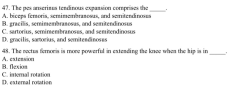 47. The pes anserinus tendinous expansion comprises the A. biceps femoris, semimembranosus, and semitendinosus B. gracilis, semimembranosus, and semitendinosus C. sartorius, semimembranosus, and semitendinosus D. gracilis, sartorius, and semitendinosus 48. The rectus femoris is more powerful in extending the knee when the hip is in A. extension B. flexion C. internal rotation D. external rotation
Sign Out <Appendicular muscles. Lower limbs. Post lab. Art-labeling Activity: Medial Muscles that Move the Thigh...
 Sign Out <Appendicular muscles. Lower limbs. Post lab. Art-labeling Activity: Medial Muscles that Move the Thigh and Leg Part A ③ 20112 Drag the labels to the appropriate location in the figure. Reset Help Sartorius Rectus femoris Adductor magnus JU Vastus medialis Semimembranosus Gracilis Adductor longus Gluteus maximus Biceps femoris Patel Semitendinosus -Gastrocnemius
What muscles make up the hip flexor muscle group, hip extensor muscle group, hip adduction muscle...
What muscles make up the hip flexor muscle group, hip extensor muscle group, hip adduction muscle group, hip abduction muscle group? What muscles make up the hamstring muscle group? Quadriceps muscle group?
 1. In the context of the pelvic girdle motions, which of the following statements is true of the right lateral pelvic rotation? A. It is characterized by a left lateral tilt. B. It is accomplished by right lumbar and lateral flexion left hip abduction in the frontal plane C. The right pelvis moves inferiorly in relation to the left pelvis in the frontal plane D. Either the left pelvis rotates downward or the right pelvis rotates upward. 2. In the...
 B. Thigh Movements Select the muscle(s) from the list that is (are) described by 1 the statements below. 2. adductor brevis adductor longus adductor magnus gluteus maximus gluteus medius gluteus minimus piriformis 3b 3c. 1. Extends and rotates thigh laterally. 2. Abducts and rotates thigh laterally. 3. Three muscles that adduct, flex, and rotate thigh laterally 4. Two muscles that abduct and rotate thigh medially. 5. Strongest adductor muscle. 6. Superficial buttocks muscle. 7. Innermost gluteus muscle. 8. Longest adductor...
 Elbow Flexion: biceps brachii, brachialis, and brachioradialis muscles Hip Flexion: iliopsoas, sartorius muscles Extension: biceps femoris, semitendinosus, semimembranosus, and gluteus maxim Abduction: tensor fasciae latae, sartorius, and gluteus medius muscles Adduction: gracilis and adductor muscles I Knee Flexion: biceps femoris, semitendinosus, semimembranosus, and gastrocnemius muscles .Extension: rectus femoris, vastus medialis, vastus intermedius, and vastus lateralis Ankle Dorsiflexion: tibialis anterior muscle Plantarflexion: gastrocnemius and soleus muscles Inversion: tibialis anterior and tibialis posterior muscles Eversion: fibularis brevis and fibularis longus muscles ke...
 16. The origin of the tensor fasciae latae muscle is the anterior ilium just below the crest. A. iliac crest B. ilium and the surface of th D. lumbar 17. Which of the following is considered to be an agonist muscle during hip abduction? A. The sartorius muscle B. The gluteus medius muscle C. The rectus femoris muscle D. The semitendinosus muscle 18. The the transverse processes (L1-L5), sides of the bodies of the last thoracic vertebra (T12), lumbar vertebrae...
 238 EXERCISE TEN - Muscular System 16. Which is not a flexor of the forearm? (a) biceps brachii (b) brachialis (c) brachioradialis (d) triceps brachii 17. The abductor pollicis brevis, opponeus pollicis, flexor pollicis brevis, and adductor polli- cis are all components of the (a) thenar eminence (b) midpalmar muscles (C) hypothenar eminence (d) erector spinae 18. Which muscle is not involved in moving the vertebral column? (a) splenius (b) longis- simus (c) spinalis (d) sartorius 19. Which muscle flexes...
 please help label the diagram with the following muscles thank
you. (can you please label the diagram that is
given) if the muscle is not in the diagram where
would it be found
Adductor femoris Biceps femoris Caudofemoralis Extensor digitorum lateralis Flexor digitorum longus Gastrocnemius Gluteus maximus Gracilis Peroneus Rectus femoris Sartorius Semimembranosus Semitendinosus Soleus Tensor fasciae latae Tibialis anterior Vastus lateralis Vastus medialis
please help label the diagram with the following muscles thank
you. (can you please label the diagram that is
given) if the muscle is not in the diagram where
would it be found
Adductor femoris Biceps femoris Caudofemoralis Extensor digitorum lateralis Flexor digitorum longus Gastrocnemius Gluteus maximus Gracilis Peroneus Rectus femoris Sartorius Semimembranosus Semitendinosus Soleus Tensor fasciae latae Tibialis anterior Vastus lateralis Vastus medialis
 47. The pes anserinus tendinous expansion comprises the A. biceps femoris, semimembranosus, and semitendinosus B. gracilis, semimembranosus, and semitendinosus C. sartorius, semimembranosus, and semitendinosus D. gracilis, sartorius, and semitendinosus 48. The rectus femoris is more powerful in extending the knee when the hip is in A. extension B. flexion C. internal rotation D. external rotation
 Sign Out <Appendicular muscles. Lower limbs. Post lab. Art-labeling Activity: Medial Muscles that Move the Thigh and Leg Part A ③ 20112 Drag the labels to the appropriate location in the figure. Reset Help Sartorius Rectus femoris Adductor magnus JU Vastus medialis Semimembranosus Gracilis Adductor longus Gluteus maximus Biceps femoris Patel Semitendinosus -Gastrocnemius
Most questions answered within 3 hours.
-
Where is the error in this code sequence?
String s1 = "Hello";
String s2 = "ello";...
asked 11 months ago -
Financial data for Joel de Paris, Inc., for last year
follow:
Joel de Paris, Inc.
Balance...
asked 11 months ago -
Consider this reaction:
Al2(SO4)3 (aq)+ BaCl3
(aq) Al2Cl6 (aq)- +
3BaSO4(s) . What is the...
asked 11 months ago -
Suppose that Savneet is considering increasing her
recent random sample from 20 car rentals to 40...
asked 11 months ago -
Trucks arrive at an unloading terminal at an average rate of 120
per hour.
Trucks arrive...
asked 11 months ago -
Why are methanol and ethanol completely soluble in water while
octanol is not very little soluble....
asked 11 months ago -
A facilities manager at a university reads in a research report
that the mean amount of...
asked 11 months ago -
When the CuSO4 is rehydrated by adding water to the anhydrous
compound, is this an endothermic...
asked 11 months ago -
A ray of sunlight is passing from diamond into crown glass; the
angle of incidence is...
asked 11 months ago -
A block of mass 0.249 kg is placed on top of a light, vertical
spring of...
asked 11 months ago -
how do the kidneys compensate in the presences of acidosis
a) trigger hyperventilate
b) reserve acid...
asked 11 months ago -
Question 501 pts
The rental rate of capital to the firm increases. Which of the
following...
asked 11 months ago