
Homework Answers
Add Answer to:
in one dimension Mech COnscretion of moment HW-62 3. Two astronauts A and B. narticipate in...
in one dimension Mech COnscretion of moment HW-62 3. Two astronauts A and B. narticipate in...
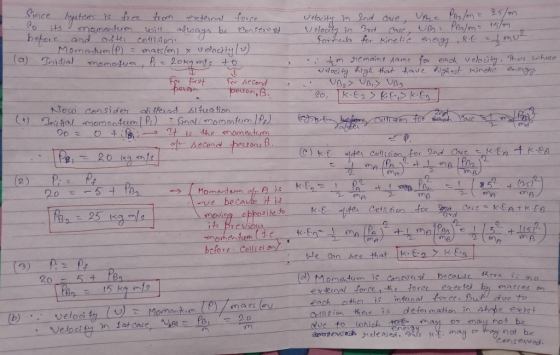
 in one dimension Mech COnscretion of moment HW-62 3. Two astronauts A and B. narticipate in three collision experiments in a weightless, friction environment. In each experiment, astronaut B is initially at rest, and astronaut A has an initial momentum of 20 kg-m/s to the right. (The velocities of the astronauts are measured with me to a nearby space station.) After Before Experiments 1, 2, and 3 At rest 13. J = 20 kg-m's At rest The astronauts push on...
Conservation of moment in two dimensions Mech HW-62 2. Two objects collide on a level, frictionless...
 Conservation of moment in two dimensions Mech HW-62 2. Two objects collide on a level, frictionless table. The mass of object A is 50 kg: the mass of object B is 3.0 kg. The objects stick together after the collision. The initial velocity of object A and the final velocity of both objects are shown. After collision Before collision BA (One side of a square represents 0.1 m/s) a. In the space provided, draw separate arrows for object A and...
Name, Pre-lab Assignment- Experiment 11 Conservation of Momentum Using the Air Track 1o t becolision ser...
 Name, Pre-lab Assignment- Experiment 11 Conservation of Momentum Using the Air Track 1o t becolision ser A,-200 ) is taveling at 3,6 m's and slider B Ms 210 g) is at rest a) (1 pò) What is the total momentum before collision? (Find the momentum of each slider before the collision and then add them together.) b). (I p) After the collision. presume that the sliders move in the same direction with vv m's and vy 3.05 m/s. What is...
Elastic collisions: one at rest one moving, two colliding, both initially moving the same direction. Inelastic...
Elastic collisions: one at rest one moving, two colliding, both initially moving the same direction. Inelastic collisions: one at rest one moving, two colliding, both initially moving the same direction. Perfectly elastic collisions: one at rest one moving, two colliding, both initially moving the same direction. Questions1. Was momentum conserved for all types of collisions you examined in this experiment? If not, explain the cause of losing orgaining momentum.2. Was total velocity conserved for all types of collisions you examined...
One object is moving and one object is at rest. The two objects then collide in...
 One object is moving and one object is at rest. The two objects then collide in a dimensional, completely inelastic collision. So the two objects stick together after the collision and move off with a common velocity. Momentum of the two-object system is conserved. The masses of the two objects are 5.00 kg and 8.50 kg, respectively. The speed of the moving object masses 5.00 kg before the collision is 22.5 m/sec. Find the final speed of the two-object system...
An Arrow (0.5 kg) travels with velocity 60 m/s to the right when it pierces an...
 An Arrow (0.5 kg) travels with velocity 60 m/s to the right when it pierces an apple (1 kg) which is initially at rest. After the collision, the arrow and the apple are stuck together. Assume that no external forces are present and therefore the momentum for the system is conserved. What is the final velocity (in m/s) of apple and arrow after the collision? m/s Submit Answer Tries 0/2 What is the initial kinetic energy of the apple and...
Two astronauts (Fig. P11.51), each having a mass of 70.0 kg, are connected by a 9.5...
 Two astronauts (Fig. P11.51), each having a mass of 70.0 kg, are connected by a 9.5 m rope of negligible mass. They are isolated in space, orbiting their center of mass at speeds of 4.50 m/s. (a) Treating the astronauts as particles, calculate the magnitude of the angular momentum. kg middot m^2/s (b) Calculate the rotational energy of the system. J (c) By pulling on the rope, one of the astronauts shortens the distance between them to 5.00 m. What...
Cart 1, with m1= 5.5 kg, is moving on a frictionless linear air track at an...
Cart 1, with m1= 5.5 kg, is moving on a frictionless linear air track at an initial speed of 1.7 m/s. It undergoes an elastic collision with an initially stationary cart 2, with m2, an unknown mass. After the collision, cart 1 continues in its original direction at 0.6 m/s. 1) The horizontal component of the momentum is conserved for A. cart 1. B. cart 2. C. the system of cart 1 and cart 2. D. Momentum is not conserved...
1) Block A started on the left, and block B on the right. The two moved...
 1) Block A started on the left, and block B on the
right. The two moved towards the middle and collided.The image
above depicts the result of the two blocks colliding.
A) What is the total initial momentum of the blocks?
B) What is the total final momentum of the blocks?
C) What is the total initial kinetic energy of the blocks?
D) What is the total final kinetic energy of the blocks?
2) What type of collision is this?...
1) Block A started on the left, and block B on the
right. The two moved towards the middle and collided.The image
above depicts the result of the two blocks colliding.
A) What is the total initial momentum of the blocks?
B) What is the total final momentum of the blocks?
C) What is the total initial kinetic energy of the blocks?
D) What is the total final kinetic energy of the blocks?
2) What type of collision is this?...
Two astronauts, each having a mass of 70.0 kg, are connected by a 9.0 m rope...
Two astronauts, each having a mass of 70.0 kg, are connected by a 9.0 m rope of negligible mass. They are isolated in space, orbiting their center of mass at speeds of 5.50 m/s. (a) Treating the astronauts as particles, calculate the magnitude of the angular momentum. (kg·m2/s) (b) Calculate the rotational energy of the system. (c) By pulling on the rope, one of the astronauts shortens the distance between them to 5.00 m. What is the new angular momentum...
 in one dimension Mech COnscretion of moment HW-62 3. Two astronauts A and B. narticipate in three collision experiments in a weightless, friction environment. In each experiment, astronaut B is initially at rest, and astronaut A has an initial momentum of 20 kg-m/s to the right. (The velocities of the astronauts are measured with me to a nearby space station.) After Before Experiments 1, 2, and 3 At rest 13. J = 20 kg-m's At rest The astronauts push on...
 Conservation of moment in two dimensions Mech HW-62 2. Two objects collide on a level, frictionless table. The mass of object A is 50 kg: the mass of object B is 3.0 kg. The objects stick together after the collision. The initial velocity of object A and the final velocity of both objects are shown. After collision Before collision BA (One side of a square represents 0.1 m/s) a. In the space provided, draw separate arrows for object A and...
 Name, Pre-lab Assignment- Experiment 11 Conservation of Momentum Using the Air Track 1o t becolision ser A,-200 ) is taveling at 3,6 m's and slider B Ms 210 g) is at rest a) (1 pò) What is the total momentum before collision? (Find the momentum of each slider before the collision and then add them together.) b). (I p) After the collision. presume that the sliders move in the same direction with vv m's and vy 3.05 m/s. What is...
 One object is moving and one object is at rest. The two objects then collide in a dimensional, completely inelastic collision. So the two objects stick together after the collision and move off with a common velocity. Momentum of the two-object system is conserved. The masses of the two objects are 5.00 kg and 8.50 kg, respectively. The speed of the moving object masses 5.00 kg before the collision is 22.5 m/sec. Find the final speed of the two-object system...
 An Arrow (0.5 kg) travels with velocity 60 m/s to the right when it pierces an apple (1 kg) which is initially at rest. After the collision, the arrow and the apple are stuck together. Assume that no external forces are present and therefore the momentum for the system is conserved. What is the final velocity (in m/s) of apple and arrow after the collision? m/s Submit Answer Tries 0/2 What is the initial kinetic energy of the apple and...
 Two astronauts (Fig. P11.51), each having a mass of 70.0 kg, are connected by a 9.5 m rope of negligible mass. They are isolated in space, orbiting their center of mass at speeds of 4.50 m/s. (a) Treating the astronauts as particles, calculate the magnitude of the angular momentum. kg middot m^2/s (b) Calculate the rotational energy of the system. J (c) By pulling on the rope, one of the astronauts shortens the distance between them to 5.00 m. What...
 1) Block A started on the left, and block B on the
right. The two moved towards the middle and collided.The image
above depicts the result of the two blocks colliding.
A) What is the total initial momentum of the blocks?
B) What is the total final momentum of the blocks?
C) What is the total initial kinetic energy of the blocks?
D) What is the total final kinetic energy of the blocks?
2) What type of collision is this?...
1) Block A started on the left, and block B on the
right. The two moved towards the middle and collided.The image
above depicts the result of the two blocks colliding.
A) What is the total initial momentum of the blocks?
B) What is the total final momentum of the blocks?
C) What is the total initial kinetic energy of the blocks?
D) What is the total final kinetic energy of the blocks?
2) What type of collision is this?...
Most questions answered within 3 hours.
-
Where is the error in this code sequence?
String s1 = "Hello";
String s2 = "ello";...
asked 11 months ago -
Financial data for Joel de Paris, Inc., for last year
follow:
Joel de Paris, Inc.
Balance...
asked 11 months ago -
Consider this reaction:
Al2(SO4)3 (aq)+ BaCl3
(aq) Al2Cl6 (aq)- +
3BaSO4(s) . What is the...
asked 11 months ago -
Suppose that Savneet is considering increasing her
recent random sample from 20 car rentals to 40...
asked 11 months ago -
Trucks arrive at an unloading terminal at an average rate of 120
per hour.
Trucks arrive...
asked 11 months ago -
Why are methanol and ethanol completely soluble in water while
octanol is not very little soluble....
asked 11 months ago -
A facilities manager at a university reads in a research report
that the mean amount of...
asked 11 months ago -
When the CuSO4 is rehydrated by adding water to the anhydrous
compound, is this an endothermic...
asked 11 months ago -
A ray of sunlight is passing from diamond into crown glass; the
angle of incidence is...
asked 11 months ago -
A block of mass 0.249 kg is placed on top of a light, vertical
spring of...
asked 11 months ago -
how do the kidneys compensate in the presences of acidosis
a) trigger hyperventilate
b) reserve acid...
asked 11 months ago -
Question 501 pts
The rental rate of capital to the firm increases. Which of the
following...
asked 11 months ago