
Homework Answers
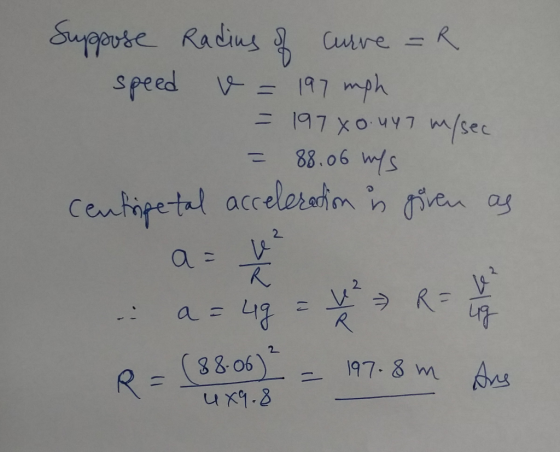
Speed of car = 197 mph = 197 × 0.447 m/s = 88.06 m/s
Add Answer to:
47. Calculate the radius of the curve on a horizontal race track that would cause a...
The Texas Motor Speedway is an oval racing track with curves of radius 229 m that...
The Texas Motor Speedway is an oval racing track with curves of radius 229 m that are banked at an angle of 24.0°. The size of the track allows for race cars to achieve speeds in excess of 400 km/h. An unintended consequence of the banked curves and high speeds is that race car drivers experience excessive G forces, especially in the "vertical" direction (with respect to their body position), causing dizziness and loss of consciousness. (a) A daring driver,...
A car with a mass of 2000 kg is moving around a banked curve with a...
A car with a mass of 2000 kg is moving around a banked curve with a constant speed of 20 m/s (about 44 MPH). The radius of curvature of the curve is 73 m. (a) What is the centripetal acceleration of the car? (b) What is the magnitude of the horizontal component of the normal force that would be required to produce this centripetal acceleration in the absence of any friction?
A race car rounds one end of a speedway. This end of the track is a...
A race car rounds one end of a speedway. This end of the track is a turn with a radius r of approximately 187 ft. If the track is assumed to be completely flat and the race car is traveling at a constant 67.00 mi/h around the turn, what is the race car's centripetal (radial) acceleration ac? 1) ac= ft/s2 Convert this result to SI units. 2) ac= m/s2 3) What is the force responsible for the centripetal acceleration in...
A race car C travels around the horizontal circular track that has a / radius of...
 A race car C travels around the horizontal circular track that has a / radius of 300 ft Fis 12-28 If the car increases its speed at a constant rate of 7 ft/s, starting from rest, determine the time needed for it to reach an acceleration o f8ns what is its speed at this instant?- 300 ft F. 12-28 Fig. 12-28
A race car rounds a curve at 59 m/s. The radius of the curve is 403...
A race car rounds a curve at 59 m/s. The radius of the curve is 403 m, and the car's mass is 640 kg. (Assume the car's speed remains constant. Take the radially inward direction to be positive. Indicate the direction with the sign of your answer.) (a) What is the car's (centripetal) acceleration? (b) What is it in g's? (enter value to 3 decimal places) (c) What is the centripetal force acting on the car?
A race car enters the circular portion of a track that has a radius of 63...
 A race car enters the circular portion of a track that has a radius of 63 m. When the car enters the curve at point P, it is traveling with a speed of 120 km/h that is increasing at 5 m/s2. Three seconds later, determine the xand y components of velocity and acceleration of the car. 120 km/h
A race car enters the circular portion of a track that has a radius of 61m....
 A race car enters the circular portion of a track that has a
radius of 61m. When the car enters the curve at point P, it is
traveling with a speed of 120km/h that is increasing at 5m/s^2.
three sec later, determine the x and y components of velocity and
acceleration of the car.
120 km/h 1 The x component of the total acceleration is The y component of the total acceleration is - The xcomponent of tne inear velocty...
A race car enters the circular portion of a track that has a
radius of 61m. When the car enters the curve at point P, it is
traveling with a speed of 120km/h that is increasing at 5m/s^2.
three sec later, determine the x and y components of velocity and
acceleration of the car.
120 km/h 1 The x component of the total acceleration is The y component of the total acceleration is - The xcomponent of tne inear velocty...
NAME Wond PwoHens- 10 Points Each 1. An 800kg racing car complete one lap ina time...
 NAME Wond PwoHens- 10 Points Each 1. An 800kg racing car complete one lap ina time of 143·around a circular race track th has a radius of 85.0 m. Assume the race cat moves at a constant speed. (a) What is the centripetal acceleration of the car? (b) w?¡at fro most the track art on the tires to produce this acceleration () What is the coefficient of static friction between the tiees and track? (10 Points each A 1200kg car...
a. Calculate the maximum safe speed for a 2 ton car traveling around a curve with...
a. Calculate the maximum safe speed for a 2 ton car traveling around a curve with a radius of 150 yards given a force of friction of 650 N. Provide your answer in m/s and mph. At the maximum safe speed, what is the centripetal acceleration of the car? Given that the force of friction remains 650N, if the car is traveling at twice the maximum safe speed around a curve with a radius that is twice as large, will...
A section of a high speed test track is circular with a radius of curvature R...
 A section of a high speed test track is circular with a radius
of curvature R = 1700 m.
At what angle of θ should the track be inclined so that a car
traveling at 77.0 m/s (172 mph) would keep moving in a circle if
there is oil on that section of the track, i.e., it would not slip
sideways even with zero friction on that section. (Hint: The car's
vertical acceleration is zero.)
A section of a high speed test track is circular with a radius
of curvature R = 1700 m.
At what angle of θ should the track be inclined so that a car
traveling at 77.0 m/s (172 mph) would keep moving in a circle if
there is oil on that section of the track, i.e., it would not slip
sideways even with zero friction on that section. (Hint: The car's
vertical acceleration is zero.)
 A race car C travels around the horizontal circular track that has a / radius of 300 ft Fis 12-28 If the car increases its speed at a constant rate of 7 ft/s, starting from rest, determine the time needed for it to reach an acceleration o f8ns what is its speed at this instant?- 300 ft F. 12-28 Fig. 12-28
 A race car enters the circular portion of a track that has a radius of 63 m. When the car enters the curve at point P, it is traveling with a speed of 120 km/h that is increasing at 5 m/s2. Three seconds later, determine the xand y components of velocity and acceleration of the car. 120 km/h
 A race car enters the circular portion of a track that has a
radius of 61m. When the car enters the curve at point P, it is
traveling with a speed of 120km/h that is increasing at 5m/s^2.
three sec later, determine the x and y components of velocity and
acceleration of the car.
120 km/h 1 The x component of the total acceleration is The y component of the total acceleration is - The xcomponent of tne inear velocty...
A race car enters the circular portion of a track that has a
radius of 61m. When the car enters the curve at point P, it is
traveling with a speed of 120km/h that is increasing at 5m/s^2.
three sec later, determine the x and y components of velocity and
acceleration of the car.
120 km/h 1 The x component of the total acceleration is The y component of the total acceleration is - The xcomponent of tne inear velocty...
 NAME Wond PwoHens- 10 Points Each 1. An 800kg racing car complete one lap ina time of 143·around a circular race track th has a radius of 85.0 m. Assume the race cat moves at a constant speed. (a) What is the centripetal acceleration of the car? (b) w?¡at fro most the track art on the tires to produce this acceleration () What is the coefficient of static friction between the tiees and track? (10 Points each A 1200kg car...
 A section of a high speed test track is circular with a radius
of curvature R = 1700 m.
At what angle of θ should the track be inclined so that a car
traveling at 77.0 m/s (172 mph) would keep moving in a circle if
there is oil on that section of the track, i.e., it would not slip
sideways even with zero friction on that section. (Hint: The car's
vertical acceleration is zero.)
A section of a high speed test track is circular with a radius
of curvature R = 1700 m.
At what angle of θ should the track be inclined so that a car
traveling at 77.0 m/s (172 mph) would keep moving in a circle if
there is oil on that section of the track, i.e., it would not slip
sideways even with zero friction on that section. (Hint: The car's
vertical acceleration is zero.)
Most questions answered within 3 hours.
-
Where is the error in this code sequence?
String s1 = "Hello";
String s2 = "ello";...
asked 11 months ago -
Financial data for Joel de Paris, Inc., for last year
follow:
Joel de Paris, Inc.
Balance...
asked 11 months ago -
Consider this reaction:
Al2(SO4)3 (aq)+ BaCl3
(aq) Al2Cl6 (aq)- +
3BaSO4(s) . What is the...
asked 11 months ago -
Suppose that Savneet is considering increasing her
recent random sample from 20 car rentals to 40...
asked 11 months ago -
Trucks arrive at an unloading terminal at an average rate of 120
per hour.
Trucks arrive...
asked 11 months ago -
Why are methanol and ethanol completely soluble in water while
octanol is not very little soluble....
asked 11 months ago -
A facilities manager at a university reads in a research report
that the mean amount of...
asked 11 months ago -
When the CuSO4 is rehydrated by adding water to the anhydrous
compound, is this an endothermic...
asked 11 months ago -
A ray of sunlight is passing from diamond into crown glass; the
angle of incidence is...
asked 11 months ago -
A block of mass 0.249 kg is placed on top of a light, vertical
spring of...
asked 11 months ago -
how do the kidneys compensate in the presences of acidosis
a) trigger hyperventilate
b) reserve acid...
asked 11 months ago -
Question 501 pts
The rental rate of capital to the firm increases. Which of the
following...
asked 11 months ago