12. The first-order rate constant for the reaction of methyl chloride (CH3Cl) with water to produce...
12. The first-order rate constant for the reaction of methyl chloride (CH3Cl) with water to produce methanol (CH3OH) and hydrochloric acid (HCl) is 3.32 × 10⁻¹⁰ s−1 at 25°C. Calculate the rate constant at 52.1°C if the activation energy is 116 kJ/mol.
_____ ×10^____ s−1
(Enter your answer in scientific notation.)
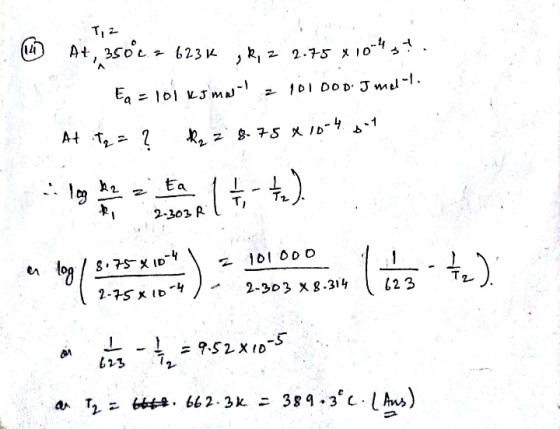
14. The rate constant of a first-order reaction is 2.75 × 10⁻⁴ s−1 at 350.°C. If the activation energy is 101 kJ/mol, calculate the temperature at which its rate constant is 8.75 × 10⁻⁴ s−1.
_____ °C
15. The rate at which tree crickets chirp is 1.80 ×
102 per minute at 28°C but only 40.9 per minute at
6.5°C. From these data, calculate the activation energy for the
chirping process.
_______ kJ/mol
Homework Answers
- All the three problems can be done by Arrhenius equation. Based on the data the numericals has been done below-
- This is question number 12.

 NOTE-
The last problem the rate constant at temperature 28°C is given as
1.80×10² min-1(given in the data) and not 1.80*10^2. I have done
the problem based on the data given by you.
NOTE-
The last problem the rate constant at temperature 28°C is given as
1.80×10² min-1(given in the data) and not 1.80*10^2. I have done
the problem based on the data given by you.
 NOTE-
The last problem the rate constant at temperature 28°C is given as
1.80×10² min-1(given in the data) and not 1.80*10^2. I have done
the problem based on the data given by you.
NOTE-
The last problem the rate constant at temperature 28°C is given as
1.80×10² min-1(given in the data) and not 1.80*10^2. I have done
the problem based on the data given by you.Add Answer to:
12. The first-order rate constant for the reaction of methyl
chloride (CH3Cl) with water to produce...
12) The first-order rate constant for the reaction of methyl chloride (CH3Cl) with water to produce...
12) The first-order rate constant for the reaction of methyl chloride (CH3Cl) with water to produce methanol (CH3OH) and hydrochloric acid (HCl) is 3.32 × 10^−10 s^−1 at 25°C. Calculate the rate constant at 50.1°C if the activation energy is 116 kJ/mol. _____ × 10^___s^-1 (Enter your answer in scientific notation.)
Be sure to answer all parts. The first-order rate constant for the reaction of methyl chloride...
 Be sure to answer all parts. The first-order rate constant for the reaction of methyl chloride (CH3CI) with water to produce methanol (CH3OH) and hydrochloric acid (HCI) is 3.32 × 10⁻¹⁰ 5-1 at 25°C. Calculate the rate constant at 48.9°C if the activation energy is 116 kJ/mol. *10 51 (Enter your answer in scientific notation.)
The rate at which tree crickets chirp is 2.00 × 10² per minute at 28 °...
The rate at which tree crickets chirp is 2.00 × 10² per minute at 28 ° C but only 39.6 per minute at 8.5 ° C. From these data, calculate the activation energy for the chirping process. kJ/mol
The rate at which tree crickets chirp is 2.10 × 10² per minute at 29°C but...
The rate at which tree crickets chirp is 2.10 × 10² per minute at 29°C but only 42.6 per minute at 6.5°C. From these data, calculate the activation energy for the chirping process.
24. We had a homework problem in which the Arrhenius equation was applied to the blinking...
 24. We had a homework problem in which the Arrhenius equation was applied to the blinking of fireflies. Several other natural phenomena also obey that equation, including the temperature dependent chirping of crickets. A particular species, the snowy tree cricket, has been widely studied. These crickets chirp at a rate of 178 times per minute at 25.0°C, and the activation energy for the chirping process is 53.9 kJ/mol. What is the temperature if the crickets chirp at a rate of...
The rate constant of a first-order reaction is 2.60 × 10⁻⁴ s−1 at 350°C. If the...
The rate constant of a first-order reaction is 2.60 × 10⁻⁴ s−1 at 350°C. If the activation energy is 159 kJ/mol, calculate the temperature at which its rate constant is 9.35 × 10⁻⁴ s−1
The rate constant of a first-order reaction is 3.95 × 10⁻⁴ s−1 at 350.°C. If the...
The rate constant of a first-order reaction is 3.95 × 10⁻⁴ s−1 at 350.°C. If the activation energy is 101 kJ/mol, calculate the temperature at which its rate constant is 7.15 × 10⁻⁴ s−1. answer in °C
The rate constant of a first-order reaction is 2.95 × 10⁻⁴ s−1 at 350.° C. If...
The rate constant of a first-order reaction is 2.95 × 10⁻⁴ s−1 at 350.° C. If the activation energy is 151 kJ/mol, calculate the temperature at which its rate constant is 6.80 × 10⁻⁴ s−1.__________________________C
14) The rate constant of a first-order reaction is 3.00 × 10^−4 s^−1 at 350.°C. If...
14) The rate constant of a first-order reaction is 3.00 × 10^−4 s^−1 at 350.°C. If the activation energy is 149 kJ/mol, calculate the temperature at which its rate constant is 7.60 × 10^−4 s^−1. _____ *C
The first-order rate constant for reaction of a particular organic compound with water varies with temperature...
The first-order rate constant for reaction of a particular organic compound with water varies with temperature as follows: Temperature (K) Rate Constant (s-1) 300 3.2 x 10⁻¹¹ 320 1.0 x 10⁻⁹ 340 3.0 x 10⁻⁸ 355 2.4 x 10⁻⁷ From this data set, calculate the activation energy in units of kJ/mol. Include your plot
 Be sure to answer all parts. The first-order rate constant for the reaction of methyl chloride (CH3CI) with water to produce methanol (CH3OH) and hydrochloric acid (HCI) is 3.32 × 10⁻¹⁰ 5-1 at 25°C. Calculate the rate constant at 48.9°C if the activation energy is 116 kJ/mol. *10 51 (Enter your answer in scientific notation.)
 24. We had a homework problem in which the Arrhenius equation was applied to the blinking of fireflies. Several other natural phenomena also obey that equation, including the temperature dependent chirping of crickets. A particular species, the snowy tree cricket, has been widely studied. These crickets chirp at a rate of 178 times per minute at 25.0°C, and the activation energy for the chirping process is 53.9 kJ/mol. What is the temperature if the crickets chirp at a rate of...
Most questions answered within 3 hours.
-
Where is the error in this code sequence?
String s1 = "Hello";
String s2 = "ello";...
asked 10 months ago -
Financial data for Joel de Paris, Inc., for last year
follow:
Joel de Paris, Inc.
Balance...
asked 10 months ago -
Consider this reaction:
Al2(SO4)3 (aq)+ BaCl3
(aq) Al2Cl6 (aq)- +
3BaSO4(s) . What is the...
asked 10 months ago -
Suppose that Savneet is considering increasing her
recent random sample from 20 car rentals to 40...
asked 10 months ago -
Trucks arrive at an unloading terminal at an average rate of 120
per hour.
Trucks arrive...
asked 10 months ago -
Why are methanol and ethanol completely soluble in water while
octanol is not very little soluble....
asked 10 months ago -
A facilities manager at a university reads in a research report
that the mean amount of...
asked 10 months ago -
When the CuSO4 is rehydrated by adding water to the anhydrous
compound, is this an endothermic...
asked 10 months ago -
A ray of sunlight is passing from diamond into crown glass; the
angle of incidence is...
asked 10 months ago -
A block of mass 0.249 kg is placed on top of a light, vertical
spring of...
asked 10 months ago -
how do the kidneys compensate in the presences of acidosis
a) trigger hyperventilate
b) reserve acid...
asked 10 months ago -
Question 501 pts
The rental rate of capital to the firm increases. Which of the
following...
asked 10 months ago