
Homework Answers
Add Answer to:
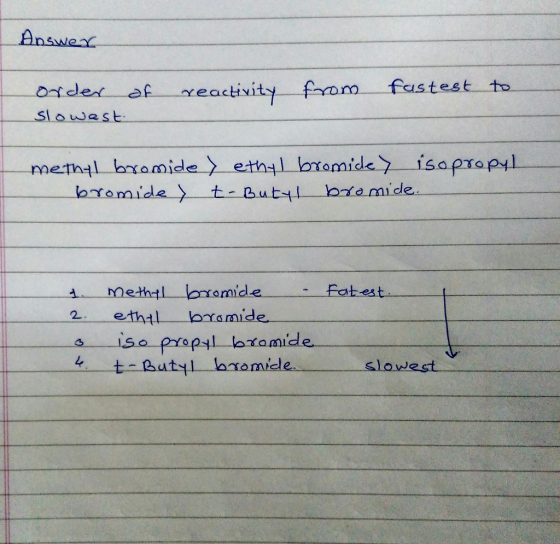
What is the order of reactivity from fastest to slowest in an SN 2 reaction for...
Arrange the following in order of decreasing reactivity (fastest to slowest) toward electrophilic aromatic substitution:...
 Arrange the following in order of decreasing reactivity
(fastest to slowest) toward electrophilic aromatic
substitution:
Arrange the following in order of decreasing reactivity (fastest to slowest) toward electrophilic aromatic substitution: COOH бо ob 6
Arrange the following in order of decreasing reactivity
(fastest to slowest) toward electrophilic aromatic
substitution:
Arrange the following in order of decreasing reactivity (fastest to slowest) toward electrophilic aromatic substitution: COOH бо ob 6
2. Predict the order of reactivity being the fastest, 4 being the slowest of primary, secondary...
 2. Predict the order of reactivity being the fastest, 4 being the slowest of primary, secondary and tertiary alkyl halides toward nucleophilic displacement by an SN2 reaction mechanism.
Rank (slowest to fastest) the following compounds in order of reactivity with respect to an SN2...
Rank (slowest to fastest) the following compounds in order of reactivity with respect to an SN2 reaction. Explain your reasoning for the ranking you propose. The compounds are 1-bromo-3-methylbutane, 1-bromo-2,2-dimethylpropane and 2-bromo-2-methylbutane.
For SN1 solvolysis of t-butyl chloride, rank the solvents from fastest reaction to slowest reaction. For SN1 solvolysis...
 For SN1 solvolysis of t-butyl chloride, rank the solvents from
fastest reaction to slowest reaction.
For SN1 solvolysis of t-butyl chloride, rank the solvents from fastest reaction to slowest reaction. ethanol water acetic acid formic acid methanol
For SN1 solvolysis of t-butyl chloride, rank the solvents from
fastest reaction to slowest reaction.
For SN1 solvolysis of t-butyl chloride, rank the solvents from fastest reaction to slowest reaction. ethanol water acetic acid formic acid methanol
Rank reactivity of following carboxylic acid derivatives as an electrophile from slowest (1) to fastest (5)...
 Rank reactivity of following carboxylic acid derivatives as an
electrophile from slowest (1) to fastest (5)
8. Rank reactivity of following carboxylic acid derivatives as an electrophile from slowest (1) to fastest (5) za zane ry rog za
Rank reactivity of following carboxylic acid derivatives as an
electrophile from slowest (1) to fastest (5)
8. Rank reactivity of following carboxylic acid derivatives as an electrophile from slowest (1) to fastest (5) za zane ry rog za
using 15% NaI-acetone solution please indicate the expected ranking quickest to slowest then answer the following...
 using 15% NaI-acetone solution
please indicate the expected ranking quickest to slowest
then answer the following questions
Part A: Structural Effects on Sn 1 Reactivity: Names Structures Expected Ranking Exi n-butyl bromide n-butyl chloride sec-butyl chloride tert-butyl chloride crotyl chloride a substrates, reagents and products and if the 2. a. Write each of the five reactions that occurred in Sn1 conditions including sub reaction did not observe include the phase "no reaction". b. Draw a reasonable mechanism for each of...
using 15% NaI-acetone solution
please indicate the expected ranking quickest to slowest
then answer the following questions
Part A: Structural Effects on Sn 1 Reactivity: Names Structures Expected Ranking Exi n-butyl bromide n-butyl chloride sec-butyl chloride tert-butyl chloride crotyl chloride a substrates, reagents and products and if the 2. a. Write each of the five reactions that occurred in Sn1 conditions including sub reaction did not observe include the phase "no reaction". b. Draw a reasonable mechanism for each of...
rank the organic chlorides from fastest to slowest based on the expected relative reactivity REACTION •...
 rank the organic chlorides from fastest to slowest based on the
expected relative reactivity
REACTION • The reaction between the four organic chlorides (given below) and a 1% ethanolic silver nitrate solution. HNO, R-CI + AgNO3 + CH3CH2OH Alkyl chloride 2.5 mL 2.0 mL R-OCH CH3 + AgCl + precipitate Alkyl chloride = Alkyl chloride = ra o u to
rank the organic chlorides from fastest to slowest based on the
expected relative reactivity
REACTION • The reaction between the four organic chlorides (given below) and a 1% ethanolic silver nitrate solution. HNO, R-CI + AgNO3 + CH3CH2OH Alkyl chloride 2.5 mL 2.0 mL R-OCH CH3 + AgCl + precipitate Alkyl chloride = Alkyl chloride = ra o u to
1.1 What is the equation for the rate of formation of tert-butyl alcohol from the reaction...
 1.1 What is the equation for the rate of formation of tert-butyl
alcohol from the reaction of tert-butyl bromide (t-BuBr) with water
by an SN1 mechanism?
A. Rate= k[t-BuBr]
B Rate=k[ t-BuBr][H2O]
C. Rate=k[ H2O]
D. Rate=k[t-BuBr]^2
1.2 What is the equation for the rate of formation of
1-iodobutane from the reaction of 1-chlorobutane (BuCl) with NaI by
an SN2 mechanism?
A. Rate=k[BuCl]
B. Rate=k[BuCl][NaI]
C. Rate=k[NaI]
D. Rate=k[BuCl]^2
1.3 What is the equation for the rate of formation of...
1.1 What is the equation for the rate of formation of tert-butyl
alcohol from the reaction of tert-butyl bromide (t-BuBr) with water
by an SN1 mechanism?
A. Rate= k[t-BuBr]
B Rate=k[ t-BuBr][H2O]
C. Rate=k[ H2O]
D. Rate=k[t-BuBr]^2
1.2 What is the equation for the rate of formation of
1-iodobutane from the reaction of 1-chlorobutane (BuCl) with NaI by
an SN2 mechanism?
A. Rate=k[BuCl]
B. Rate=k[BuCl][NaI]
C. Rate=k[NaI]
D. Rate=k[BuCl]^2
1.3 What is the equation for the rate of formation of...
For SN1 solvolysis of t-butyl chloride, rank the solvents from fastest reaction to slowest reaction. Ethanol, acetyc aci...
For SN1 solvolysis of t-butyl chloride, rank the solvents from fastest reaction to slowest reaction. Ethanol, acetyc acid, water, methanol, formic acid
Arrange the haloalkanes in order of increasing reactivity in an Sn2 reaction with NaI in acetone...
 Arrange the haloalkanes in
order of increasing reactivity in an Sn2 reaction with NaI in
acetone (least first).
a. Methyl bromide b Isopropyl chloride t-butyl iodide d. Isobutyl chloride aus CH3 cиз C. Arrange the haloalkanes in order of increasing reactivity in an SN2 reaction with Nal in acetone (least first). CH3 - CH2CH2-I C-Br CI Br CH3 I 11 II IV I, IV, III, II b II, II, I, IV a. IV,I, II, II с. d. III, II, IV,...
Arrange the haloalkanes in
order of increasing reactivity in an Sn2 reaction with NaI in
acetone (least first).
a. Methyl bromide b Isopropyl chloride t-butyl iodide d. Isobutyl chloride aus CH3 cиз C. Arrange the haloalkanes in order of increasing reactivity in an SN2 reaction with Nal in acetone (least first). CH3 - CH2CH2-I C-Br CI Br CH3 I 11 II IV I, IV, III, II b II, II, I, IV a. IV,I, II, II с. d. III, II, IV,...
 Arrange the following in order of decreasing reactivity
(fastest to slowest) toward electrophilic aromatic
substitution:
Arrange the following in order of decreasing reactivity (fastest to slowest) toward electrophilic aromatic substitution: COOH бо ob 6
Arrange the following in order of decreasing reactivity
(fastest to slowest) toward electrophilic aromatic
substitution:
Arrange the following in order of decreasing reactivity (fastest to slowest) toward electrophilic aromatic substitution: COOH бо ob 6
 2. Predict the order of reactivity being the fastest, 4 being the slowest of primary, secondary and tertiary alkyl halides toward nucleophilic displacement by an SN2 reaction mechanism.
 For SN1 solvolysis of t-butyl chloride, rank the solvents from
fastest reaction to slowest reaction.
For SN1 solvolysis of t-butyl chloride, rank the solvents from fastest reaction to slowest reaction. ethanol water acetic acid formic acid methanol
For SN1 solvolysis of t-butyl chloride, rank the solvents from
fastest reaction to slowest reaction.
For SN1 solvolysis of t-butyl chloride, rank the solvents from fastest reaction to slowest reaction. ethanol water acetic acid formic acid methanol
 Rank reactivity of following carboxylic acid derivatives as an
electrophile from slowest (1) to fastest (5)
8. Rank reactivity of following carboxylic acid derivatives as an electrophile from slowest (1) to fastest (5) za zane ry rog za
Rank reactivity of following carboxylic acid derivatives as an
electrophile from slowest (1) to fastest (5)
8. Rank reactivity of following carboxylic acid derivatives as an electrophile from slowest (1) to fastest (5) za zane ry rog za
 using 15% NaI-acetone solution
please indicate the expected ranking quickest to slowest
then answer the following questions
Part A: Structural Effects on Sn 1 Reactivity: Names Structures Expected Ranking Exi n-butyl bromide n-butyl chloride sec-butyl chloride tert-butyl chloride crotyl chloride a substrates, reagents and products and if the 2. a. Write each of the five reactions that occurred in Sn1 conditions including sub reaction did not observe include the phase "no reaction". b. Draw a reasonable mechanism for each of...
using 15% NaI-acetone solution
please indicate the expected ranking quickest to slowest
then answer the following questions
Part A: Structural Effects on Sn 1 Reactivity: Names Structures Expected Ranking Exi n-butyl bromide n-butyl chloride sec-butyl chloride tert-butyl chloride crotyl chloride a substrates, reagents and products and if the 2. a. Write each of the five reactions that occurred in Sn1 conditions including sub reaction did not observe include the phase "no reaction". b. Draw a reasonable mechanism for each of...
 rank the organic chlorides from fastest to slowest based on the
expected relative reactivity
REACTION • The reaction between the four organic chlorides (given below) and a 1% ethanolic silver nitrate solution. HNO, R-CI + AgNO3 + CH3CH2OH Alkyl chloride 2.5 mL 2.0 mL R-OCH CH3 + AgCl + precipitate Alkyl chloride = Alkyl chloride = ra o u to
rank the organic chlorides from fastest to slowest based on the
expected relative reactivity
REACTION • The reaction between the four organic chlorides (given below) and a 1% ethanolic silver nitrate solution. HNO, R-CI + AgNO3 + CH3CH2OH Alkyl chloride 2.5 mL 2.0 mL R-OCH CH3 + AgCl + precipitate Alkyl chloride = Alkyl chloride = ra o u to
 1.1 What is the equation for the rate of formation of tert-butyl
alcohol from the reaction of tert-butyl bromide (t-BuBr) with water
by an SN1 mechanism?
A. Rate= k[t-BuBr]
B Rate=k[ t-BuBr][H2O]
C. Rate=k[ H2O]
D. Rate=k[t-BuBr]^2
1.2 What is the equation for the rate of formation of
1-iodobutane from the reaction of 1-chlorobutane (BuCl) with NaI by
an SN2 mechanism?
A. Rate=k[BuCl]
B. Rate=k[BuCl][NaI]
C. Rate=k[NaI]
D. Rate=k[BuCl]^2
1.3 What is the equation for the rate of formation of...
1.1 What is the equation for the rate of formation of tert-butyl
alcohol from the reaction of tert-butyl bromide (t-BuBr) with water
by an SN1 mechanism?
A. Rate= k[t-BuBr]
B Rate=k[ t-BuBr][H2O]
C. Rate=k[ H2O]
D. Rate=k[t-BuBr]^2
1.2 What is the equation for the rate of formation of
1-iodobutane from the reaction of 1-chlorobutane (BuCl) with NaI by
an SN2 mechanism?
A. Rate=k[BuCl]
B. Rate=k[BuCl][NaI]
C. Rate=k[NaI]
D. Rate=k[BuCl]^2
1.3 What is the equation for the rate of formation of...
 Arrange the haloalkanes in
order of increasing reactivity in an Sn2 reaction with NaI in
acetone (least first).
a. Methyl bromide b Isopropyl chloride t-butyl iodide d. Isobutyl chloride aus CH3 cиз C. Arrange the haloalkanes in order of increasing reactivity in an SN2 reaction with Nal in acetone (least first). CH3 - CH2CH2-I C-Br CI Br CH3 I 11 II IV I, IV, III, II b II, II, I, IV a. IV,I, II, II с. d. III, II, IV,...
Arrange the haloalkanes in
order of increasing reactivity in an Sn2 reaction with NaI in
acetone (least first).
a. Methyl bromide b Isopropyl chloride t-butyl iodide d. Isobutyl chloride aus CH3 cиз C. Arrange the haloalkanes in order of increasing reactivity in an SN2 reaction with Nal in acetone (least first). CH3 - CH2CH2-I C-Br CI Br CH3 I 11 II IV I, IV, III, II b II, II, I, IV a. IV,I, II, II с. d. III, II, IV,...
Most questions answered within 3 hours.
-
Where is the error in this code sequence?
String s1 = "Hello";
String s2 = "ello";...
asked 11 months ago -
Financial data for Joel de Paris, Inc., for last year
follow:
Joel de Paris, Inc.
Balance...
asked 11 months ago -
Consider this reaction:
Al2(SO4)3 (aq)+ BaCl3
(aq) Al2Cl6 (aq)- +
3BaSO4(s) . What is the...
asked 11 months ago -
Suppose that Savneet is considering increasing her
recent random sample from 20 car rentals to 40...
asked 11 months ago -
Trucks arrive at an unloading terminal at an average rate of 120
per hour.
Trucks arrive...
asked 11 months ago -
Why are methanol and ethanol completely soluble in water while
octanol is not very little soluble....
asked 11 months ago -
A facilities manager at a university reads in a research report
that the mean amount of...
asked 11 months ago -
When the CuSO4 is rehydrated by adding water to the anhydrous
compound, is this an endothermic...
asked 11 months ago -
A ray of sunlight is passing from diamond into crown glass; the
angle of incidence is...
asked 11 months ago -
A block of mass 0.249 kg is placed on top of a light, vertical
spring of...
asked 11 months ago -
how do the kidneys compensate in the presences of acidosis
a) trigger hyperventilate
b) reserve acid...
asked 11 months ago -
Question 501 pts
The rental rate of capital to the firm increases. Which of the
following...
asked 11 months ago