
Homework Answers
Solution:- To find out the order of the reaction, we make plots for the concentrations vs time.
If a graph is plotted by taking concentration along y-axis and time along x-axis and gives a straight line then reaction is zero order and k = -slope.
If ln of concentration vs time gives straight line then reaction is first order and k = -slope.
And, if we make a plot of 1/concentration vs time and it gives a straight line then reaction is second order and k = slope.
We try the plots and find that ln[concentration] vs time gives the straight line. The graph is as shown below in the image.
 we know that, k = -slope


So, the reaction is first order and the rate constant is
 .
.
Add Answer to:
QUESTION 2- CHEMICAL KINETICS 2.1 The decomposition of P205 at 25 °C gave the following data:...
Chapter 13, Question 25 The following data are obtained for the decomposition of N2O5 at 45°C:...
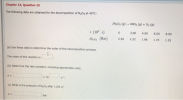 Chapter 13, Question 25 The following data are obtained for the decomposition of N2O5 at 45°C: 2N2O5 (g) 4NO2 (g) + 02 (g) (10 s) 0 3.00 4.00 6.00 8.00 PN:O, (Bar) 2.50 2.22 1.96 1.73 1.53 (a) Use these data to determine the order of the decomposition process The order of this reaction is (b) Determine the rate constant, including appropriate units. k= x 10 s1 (c) What is the pressure of N2Os after 1100 s? p bar
1) 2) 3) The decomposition of dinitrogen tetroxide to nitrogen dioxide at 400°C follows first-order kinetics...
 1)
2)
3)
The decomposition of dinitrogen tetroxide to nitrogen dioxide at 400°C follows first-order kinetics with a rate constant of 3.84 X10⁻³-1. Starting with pure N204, how many minutes will it take for 38.0% to decompose? Suppose the surface-catalyzed hydrogenation reaction of an unsaturated hydrocarbon has a rate constant of 0.374 M/min. The reaction is observed to follow zero-order kinetics. If the initial concentration of the hydrocarbon is 2.90 M, what is the half-life of the reaction in seconds?...
1)
2)
3)
The decomposition of dinitrogen tetroxide to nitrogen dioxide at 400°C follows first-order kinetics with a rate constant of 3.84 X10⁻³-1. Starting with pure N204, how many minutes will it take for 38.0% to decompose? Suppose the surface-catalyzed hydrogenation reaction of an unsaturated hydrocarbon has a rate constant of 0.374 M/min. The reaction is observed to follow zero-order kinetics. If the initial concentration of the hydrocarbon is 2.90 M, what is the half-life of the reaction in seconds?...
A study of the rate of the reaction represented as 2AB gave the following data: Time...
 A study of the rate of the reaction represented as 2AB gave the following data: Time (s) 0.0 5.0 10.0 15.0 20.0 25.0 30.0 [A] (M) 1.00 0.775 0.625 0.465 0.360 0.285 0.230 3. Determine the average rate of disappearance of A between 0.0 and 10.0 s, and between 10.0 and 20.0 s. 4. What order is the above reaction? What is the rate constant? Hint:You might have to graph the data. For the following reaction: 2NO(g)+C12(g)2NOCI(g) The observed initial...
Due Oct 11,2017 at beginning of class 3. Data for the decomposition of SO2Clz according to...
 Due Oct 11,2017 at beginning of class 3. Data for the decomposition of SO2Clz according to the equation so:A2(g) → SO2(g) + Cl2(g) is shown in the table below. Time (s) ISO2Cl2] (mol L1) Time (s) [S02Cl2] (mol L1) 0 100 200 300 400 500 0.0876 0.0768 0.0673 0.0590 0.0517 600 700 800 900 1000 1100 0.0453 0.0397 0.0348 0.0305 0.0267 00234 Graph the data to determine whether the reaction fits first or second order kinetics. Attach the appropriate graph...
1. The kinetics of the following reaction have been studied: N2 + 3 H2 → 2...
 1. The kinetics of the following reaction have been studied: N2
+ 3 H2 → 2 NH3 The rate of of appearance of NH3 was measured as
∆[NH3]/∆t = 9.00 x 10⁻² mol L-1 s-1
(a) What is the rate of the reaction in mol L-1 s-1?
(b) What is ∆[N2]/∆t in mol L-1 s-1?
(c) What is ∆[H2]/∆t in mol L-1 s-1?
2. The initial rate of the reaction of species A and B A + 2 B →...
1. The kinetics of the following reaction have been studied: N2
+ 3 H2 → 2 NH3 The rate of of appearance of NH3 was measured as
∆[NH3]/∆t = 9.00 x 10⁻² mol L-1 s-1
(a) What is the rate of the reaction in mol L-1 s-1?
(b) What is ∆[N2]/∆t in mol L-1 s-1?
(c) What is ∆[H2]/∆t in mol L-1 s-1?
2. The initial rate of the reaction of species A and B A + 2 B →...
The decomposition of phosphine, PH3, follows first-order kinetics: 4 PH3(g) → P4(g) + 6 H2(g) Calculate...
 The decomposition of phosphine, PH3, follows first-order kinetics: 4 PH3(g) → P4(g) + 6 H2(g) Calculate the activation energy, Eq, in kJ/mol for the reaction, given that the rate constant k (at 25 °C) = 0.00852 s 1 and k (at 50 °C) = 0.756 s 1. 231 kJ/mol 144 kJ/mol O 56.5 kJ/mol О 99.3 kJ/mol O 111 kJ/mol
Post Lab Question for Kinetics 1. The rate of decomposition of azomethane (C2HsN2) is studied by...
 Post Lab Question for Kinetics 1. The rate of decomposition of azomethane (C2HsN2) is studied by monitoring the partial pressure of the reactant as a function of time: CH3-N-N-CH3(g) -N2(g) + C2Hsg) The data obtained at 300 °C are listed in the following table: Time (s) 0 100 150 200 250 300 Pazomethane (mmHg) 284 220 193 170 150 132 Using Excel create Pc2HGN2 vs. t, In(Pc2H6N2) vs. t, and 1/Pc2H6N2 vs. t plot that should include linear regression trend...
1. The following chemical reaction: A → products shows first order kinetics with respect to A;...
1. The following chemical reaction: A → products shows first order kinetics with respect to A; rate = k[A]. Assume k = 10.09 x 10⁻⁴ s-1 . If the initial concentration of A was 0.82 mol L-1 and then decreased to 0.11 mol L-1 , how much time elapsed in minutes? 2. Consider the following balanced chemical equation: H2O2 (aq) + 3 I-(aq) + 2 H+(aq) → I3- (aq) + 2 H2O (l) In the first 62.9 seconds of the...
Question text The following chemical reaction: A → products shows first order kinetics with respect to...
Question text The following chemical reaction: A → products shows first order kinetics with respect to A; rate = k[A]. If k = 6.80 x 10⁻⁵ s-1 and the initial concentration of A is 0.63 mol L-1, what is the half life of this reaction in hours?
The following chemical reaction: A → products shows first order kinetics with respect to A; rate...
The following chemical reaction: A → products shows first order kinetics with respect to A; rate = k[A]. If k = 1.15 x 10⁻⁴ s-1 and the initial concentration of A is 1.11 mol L-1, what is the half life of this reaction in minutes?
 Chapter 13, Question 25 The following data are obtained for the decomposition of N2O5 at 45°C: 2N2O5 (g) 4NO2 (g) + 02 (g) (10 s) 0 3.00 4.00 6.00 8.00 PN:O, (Bar) 2.50 2.22 1.96 1.73 1.53 (a) Use these data to determine the order of the decomposition process The order of this reaction is (b) Determine the rate constant, including appropriate units. k= x 10 s1 (c) What is the pressure of N2Os after 1100 s? p bar
 1)
2)
3)
The decomposition of dinitrogen tetroxide to nitrogen dioxide at 400°C follows first-order kinetics with a rate constant of 3.84 X10⁻³-1. Starting with pure N204, how many minutes will it take for 38.0% to decompose? Suppose the surface-catalyzed hydrogenation reaction of an unsaturated hydrocarbon has a rate constant of 0.374 M/min. The reaction is observed to follow zero-order kinetics. If the initial concentration of the hydrocarbon is 2.90 M, what is the half-life of the reaction in seconds?...
1)
2)
3)
The decomposition of dinitrogen tetroxide to nitrogen dioxide at 400°C follows first-order kinetics with a rate constant of 3.84 X10⁻³-1. Starting with pure N204, how many minutes will it take for 38.0% to decompose? Suppose the surface-catalyzed hydrogenation reaction of an unsaturated hydrocarbon has a rate constant of 0.374 M/min. The reaction is observed to follow zero-order kinetics. If the initial concentration of the hydrocarbon is 2.90 M, what is the half-life of the reaction in seconds?...
 A study of the rate of the reaction represented as 2AB gave the following data: Time (s) 0.0 5.0 10.0 15.0 20.0 25.0 30.0 [A] (M) 1.00 0.775 0.625 0.465 0.360 0.285 0.230 3. Determine the average rate of disappearance of A between 0.0 and 10.0 s, and between 10.0 and 20.0 s. 4. What order is the above reaction? What is the rate constant? Hint:You might have to graph the data. For the following reaction: 2NO(g)+C12(g)2NOCI(g) The observed initial...
 Due Oct 11,2017 at beginning of class 3. Data for the decomposition of SO2Clz according to the equation so:A2(g) → SO2(g) + Cl2(g) is shown in the table below. Time (s) ISO2Cl2] (mol L1) Time (s) [S02Cl2] (mol L1) 0 100 200 300 400 500 0.0876 0.0768 0.0673 0.0590 0.0517 600 700 800 900 1000 1100 0.0453 0.0397 0.0348 0.0305 0.0267 00234 Graph the data to determine whether the reaction fits first or second order kinetics. Attach the appropriate graph...
 1. The kinetics of the following reaction have been studied: N2
+ 3 H2 → 2 NH3 The rate of of appearance of NH3 was measured as
∆[NH3]/∆t = 9.00 x 10⁻² mol L-1 s-1
(a) What is the rate of the reaction in mol L-1 s-1?
(b) What is ∆[N2]/∆t in mol L-1 s-1?
(c) What is ∆[H2]/∆t in mol L-1 s-1?
2. The initial rate of the reaction of species A and B A + 2 B →...
1. The kinetics of the following reaction have been studied: N2
+ 3 H2 → 2 NH3 The rate of of appearance of NH3 was measured as
∆[NH3]/∆t = 9.00 x 10⁻² mol L-1 s-1
(a) What is the rate of the reaction in mol L-1 s-1?
(b) What is ∆[N2]/∆t in mol L-1 s-1?
(c) What is ∆[H2]/∆t in mol L-1 s-1?
2. The initial rate of the reaction of species A and B A + 2 B →...
 The decomposition of phosphine, PH3, follows first-order kinetics: 4 PH3(g) → P4(g) + 6 H2(g) Calculate the activation energy, Eq, in kJ/mol for the reaction, given that the rate constant k (at 25 °C) = 0.00852 s 1 and k (at 50 °C) = 0.756 s 1. 231 kJ/mol 144 kJ/mol O 56.5 kJ/mol О 99.3 kJ/mol O 111 kJ/mol
 Post Lab Question for Kinetics 1. The rate of decomposition of azomethane (C2HsN2) is studied by monitoring the partial pressure of the reactant as a function of time: CH3-N-N-CH3(g) -N2(g) + C2Hsg) The data obtained at 300 °C are listed in the following table: Time (s) 0 100 150 200 250 300 Pazomethane (mmHg) 284 220 193 170 150 132 Using Excel create Pc2HGN2 vs. t, In(Pc2H6N2) vs. t, and 1/Pc2H6N2 vs. t plot that should include linear regression trend...
Most questions answered within 3 hours.
-
Where is the error in this code sequence?
String s1 = "Hello";
String s2 = "ello";...
asked 10 months ago -
Financial data for Joel de Paris, Inc., for last year
follow:
Joel de Paris, Inc.
Balance...
asked 10 months ago -
Consider this reaction:
Al2(SO4)3 (aq)+ BaCl3
(aq) Al2Cl6 (aq)- +
3BaSO4(s) . What is the...
asked 10 months ago -
Suppose that Savneet is considering increasing her
recent random sample from 20 car rentals to 40...
asked 10 months ago -
Trucks arrive at an unloading terminal at an average rate of 120
per hour.
Trucks arrive...
asked 10 months ago -
Why are methanol and ethanol completely soluble in water while
octanol is not very little soluble....
asked 10 months ago -
A facilities manager at a university reads in a research report
that the mean amount of...
asked 10 months ago -
When the CuSO4 is rehydrated by adding water to the anhydrous
compound, is this an endothermic...
asked 10 months ago -
A ray of sunlight is passing from diamond into crown glass; the
angle of incidence is...
asked 10 months ago -
A block of mass 0.249 kg is placed on top of a light, vertical
spring of...
asked 10 months ago -
how do the kidneys compensate in the presences of acidosis
a) trigger hyperventilate
b) reserve acid...
asked 10 months ago -
Question 501 pts
The rental rate of capital to the firm increases. Which of the
following...
asked 10 months ago