![Due Oct 11,2017 at beginning of class 3. Data for the decomposition of SO2Clz according to the equation so:A2(g) → SO2(g) + Cl2(g) is shown in the table below. Time (s) ISO2Cl2] (mol L1) Time (s) [S02Cl2] (mol L1) 0 100 200 300 400 500 0.0876 0.0768 0.0673 0.0590 0.0517 600 700 800 900 1000 1100 0.0453 0.0397 0.0348 0.0305 0.0267 00234 Graph the data to determine whether the reaction fits first or second order kinetics. Attach the appropriate graph to your test, remember to title and label your graph. Write the Rate Law below. a. Use the equation of the line from your graph to determine the value and units of the rate constant and the initial concentration of SO2Cl2 b. c. What is the half-life of the reaction? d. What would the concentration of SO2Cl2 be after 20.0 minutes?](http://img.homeworklib.com/questions/4d34cad0-1c2f-11ec-96d3-6d35646d698e.png?x-oss-process=image/resize,w_560)
Homework Answers

Add Answer to:
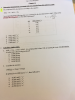
Due Oct 11,2017 at beginning of class 3. Data for the decomposition of SO2Clz according to...
The decomposition of N2O5 proceeds according to the following equation 2 N2O5(g) → 4 NO2(g) +...
The decomposition of N2O5 proceeds according to the following equation 2 N2O5(g) → 4 NO2(g) + O2(g). The rate constant, k, for the reaction at 298 K is 2.20 x 10⁻³ min-1. If a reaction is set up in a vessel at 298 K, with an initial concentration of 0.278 mol L-1; what is the concentration of reactant N2O5(g) in mol/L after 40.2 minutes? Report your answer without units
5. The decomposition of ozone is important to many atmospheric reactions: O3(g) à O2(g) + O(g)...
5. The decomposition of ozone is important to many atmospheric reactions: O3(g) à O2(g) + O(g) A study of the kinetics of the reaction resulted in the following data: Temperature (K) Rate Constant (M-1·s-1) Temperature (K) Rate Constant (M-1·s-1) 600 3.37 x 10³ 1300 7.83 x 10⁷ 700 4.85 x 10⁴ 1400 1.45 x 10⁸ 800 3.58 x 10⁵ 1500 2.46 x 10⁸ 900 1.70 x 10⁶ 1600 3.93 x 10⁸ 1000 5.90 x 10⁶ 1700 5.93 x 10⁸ 1100...
Unit 2 Test Blueprint action from data and/or a graph. 1. The compound RXs decomposes according...
 Unit 2 Test Blueprint action from data and/or a graph. 1. The compound RXs decomposes according to the equation In an experiment the following data were collected for the decomposition at 100°C. What is the average rate of reaction over the entire experiment? At 0.85 0.67 0.41 0.33 0.20 0.16 12 14 a. 0.011 mol L-1s1 b. 0.019 mol L's c. 0.044 mol L's1 d. 0.049 mol L 's e. 0.069 mol L's1 Calculate relative rates. 4N5,NO + 610 At...
QuestiII Il poll ILS) Consider the data below: Time (minutes) Concentration (M) 1 0.05 2 0.042...
 QuestiII Il poll ILS) Consider the data below: Time (minutes) Concentration (M) 1 0.05 2 0.042 3 0.034 4 0.028 5 0.018 Construct a concentration versus time plot with concentration on the y-axis and time on the x-axis. Then, determine the equation of the line that describes the data set. In blank # 1, report the slope of the line. Do not use scientific notation. In blank # 2, report the y-intercept of the line. Do not use scientific notation....
will work with up to 3 partners (similar to a lab group) to prepare a written report which analyzes kinetic data that has been provided to you. All student groups will receive data for the hy...
 will work with up to 3 partners (similar to a lab group) to prepare a written report which analyzes kinetic data that has been provided to you. All student groups will receive data for the hypothetical reaction aAlE) products where a is a numeric variable and A is a chemical variable. The reaction therefore has the form of a decomposition reaction, in which a single substance forms one or more new substances. For consistency, all concentrations start out at 1.000...
 Unit 2 Test Blueprint action from data and/or a graph. 1. The compound RXs decomposes according to the equation In an experiment the following data were collected for the decomposition at 100°C. What is the average rate of reaction over the entire experiment? At 0.85 0.67 0.41 0.33 0.20 0.16 12 14 a. 0.011 mol L-1s1 b. 0.019 mol L's c. 0.044 mol L's1 d. 0.049 mol L 's e. 0.069 mol L's1 Calculate relative rates. 4N5,NO + 610 At...
 QuestiII Il poll ILS) Consider the data below: Time (minutes) Concentration (M) 1 0.05 2 0.042 3 0.034 4 0.028 5 0.018 Construct a concentration versus time plot with concentration on the y-axis and time on the x-axis. Then, determine the equation of the line that describes the data set. In blank # 1, report the slope of the line. Do not use scientific notation. In blank # 2, report the y-intercept of the line. Do not use scientific notation....
 will work with up to 3 partners (similar to a lab group) to prepare a written report which analyzes kinetic data that has been provided to you. All student groups will receive data for the hypothetical reaction aAlE) products where a is a numeric variable and A is a chemical variable. The reaction therefore has the form of a decomposition reaction, in which a single substance forms one or more new substances. For consistency, all concentrations start out at 1.000...
Most questions answered within 3 hours.
-
Where is the error in this code sequence?
String s1 = "Hello";
String s2 = "ello";...
asked 10 months ago -
Financial data for Joel de Paris, Inc., for last year
follow:
Joel de Paris, Inc.
Balance...
asked 10 months ago -
Consider this reaction:
Al2(SO4)3 (aq)+ BaCl3
(aq) Al2Cl6 (aq)- +
3BaSO4(s) . What is the...
asked 10 months ago -
Suppose that Savneet is considering increasing her
recent random sample from 20 car rentals to 40...
asked 10 months ago -
Trucks arrive at an unloading terminal at an average rate of 120
per hour.
Trucks arrive...
asked 10 months ago -
Why are methanol and ethanol completely soluble in water while
octanol is not very little soluble....
asked 10 months ago -
A facilities manager at a university reads in a research report
that the mean amount of...
asked 10 months ago -
When the CuSO4 is rehydrated by adding water to the anhydrous
compound, is this an endothermic...
asked 10 months ago -
A ray of sunlight is passing from diamond into crown glass; the
angle of incidence is...
asked 10 months ago -
A block of mass 0.249 kg is placed on top of a light, vertical
spring of...
asked 10 months ago -
how do the kidneys compensate in the presences of acidosis
a) trigger hyperventilate
b) reserve acid...
asked 10 months ago -
Question 501 pts
The rental rate of capital to the firm increases. Which of the
following...
asked 10 months ago