
Homework Answers
Add Answer to:
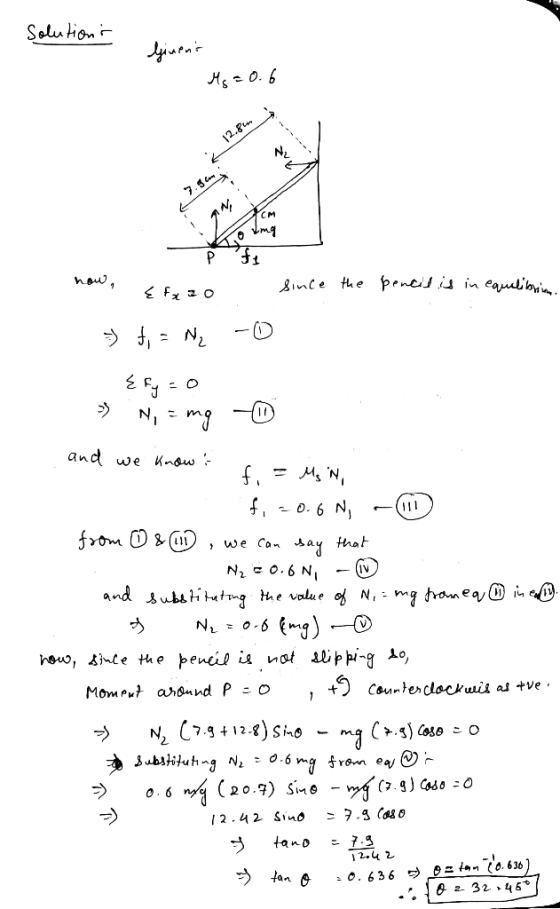
70.A pencil rests against a corner, as shown below. The sharpened end of the pencil touches...
70. A pencil rests against a corner, as shown below. The sharpened end of the pencil...
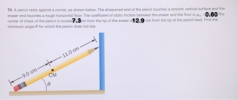 70. A pencil rests against a corner, as shown below. The sharpened end of the pencil touches a smooth vertical surface and the eraser end touches a rough horizontal floor. The coefficient of static friction between the eraser and the floor is , 0.60 The center of mass of the pencil is locate 7.3cm from the tip of the eraser a12.9 cm from the tip of the pencil lead. Find the minimum angle 0 for which the pencil does not...
Take a look at the textbook, Ch. 12, problem #70. Except, change the location of the...
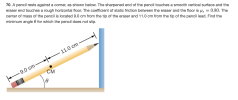 Take a look at the textbook, Ch. 12, problem #70. Except, change
the location of the center of mass to 9.7 cm from the eraser and
change the distance of the center of mass from the pencil's lead
tip to be 11 cm. Finally, assume that the coefficient of friction
is 0.7. Now solve for the minimum angle such that the pencil won't
slip. Enter your answer in degrees.
70. A pencil rests against a corner, as shown below. The...
Take a look at the textbook, Ch. 12, problem #70. Except, change
the location of the center of mass to 9.7 cm from the eraser and
change the distance of the center of mass from the pencil's lead
tip to be 11 cm. Finally, assume that the coefficient of friction
is 0.7. Now solve for the minimum angle such that the pencil won't
slip. Enter your answer in degrees.
70. A pencil rests against a corner, as shown below. The...
Edited*** Change the location of the center of mass to 7cm from the eraser and change...
 Edited***
Change the location of the center of mass to 7cm from the eraser
and change the distance of the center of mass from the pencils lead
tip to be 13.2cm. Finally, assume that the coefficient of friction
0.7. Solve for the minimum angle such that the pencil wont slip.
Enter answer in degrees.
70. A pencil rests against a corner, as shown below. The sharpened end of the pencil touches a smooth vertical surface and the eraser end touches...
Edited***
Change the location of the center of mass to 7cm from the eraser
and change the distance of the center of mass from the pencils lead
tip to be 13.2cm. Finally, assume that the coefficient of friction
0.7. Solve for the minimum angle such that the pencil wont slip.
Enter answer in degrees.
70. A pencil rests against a corner, as shown below. The sharpened end of the pencil touches a smooth vertical surface and the eraser end touches...
18. A 4.00-m-long uniform ladder, weighing 180 N, rests against a smooth vertical wall with its...
18. A 4.00-m-long uniform ladder, weighing 180 N, rests against a smooth vertical wall with its base on a horizontal rough floor, a distance of 1.20 m away from the wall. The coefficient of static friction between the ladder and the floor is 0.200. How far up the ladder, measured along the ladder, can a 600-N person climb before the ladder begins to slip? Group of answer choices 2.71 m 1.26 m 4.56 m 1.50 m 1.05 m
A 5.0-m long, 15-kg uniform ladder rests against a smooth vertical wall with the bottom of...
 A 5.0-m long, 15-kg uniform ladder rests against a smooth
vertical wall with the bottom of the ladder 3.0 m from the wall.
The coefficient of static friction between the floor and the ladder
is 0.38. What distance, measured along the ladder from the bottom,
can a 70-kg person climb before the ladder starts to slip?
Question 2 (1 point) A 5.0-m long, 15-kg uniform ladder rests against a smooth vertical wall with the bottom of the ladder 3.0 m...
A 5.0-m long, 15-kg uniform ladder rests against a smooth
vertical wall with the bottom of the ladder 3.0 m from the wall.
The coefficient of static friction between the floor and the ladder
is 0.38. What distance, measured along the ladder from the bottom,
can a 70-kg person climb before the ladder starts to slip?
Question 2 (1 point) A 5.0-m long, 15-kg uniform ladder rests against a smooth vertical wall with the bottom of the ladder 3.0 m...
The uniform 20 lb ladder rests on the rough floor at A for which the coefficient...
 The uniform 20 lb ladder rests on the rough floor at A for which the coefficient o static friction is mu_s = 0.8 and against the smooth wall at B. A horizontal for P is applied at the center of the ladder as shown. Sketch a Free Body Diagram of the ladder. Determine the minimum force required to get the ladder to move and state if the ladder slides or tips about point A.
5) A 5.0-m long, 12-kg, ladder rests against a smooth vertical wall with the bottom of...
 5) A 5.0-m long, 12-kg, ladder rests against a smooth vertical wall with the bottom of the ladder 3.0 m from the wall. The coefficient of static friction between the floor and the ladder is 0.28. What distance measured along the ladder from the bottom, can a 60-kg person climb before the ladder starts to slip? Ans: 1.7 m
A uniform ladder 12 meters long rests against a vertical frictionless wall, as shown in the...
 A uniform ladder 12 meters long rests against a vertical frictionless wall, as shown in the figure. The ladder weighs 400 N and makes an angle θ = 51° with the floor. A man weighing 874 N climbs slowly up the ladder. When he is 78 m from the bottom of the ladder, it just starts to slip. What is the coefficient of static friction between the floor and the ladder? 7.8 m
Question 2 (1 point) A 5.0-m long, 15-kg uniform ladder rests against a smooth vertical wall...
 Question 2 (1 point) A 5.0-m long, 15-kg uniform ladder rests against a smooth vertical wall with the bottom of the ladder 3.0m from the wall. The coefficient of static friction between the floor and the ladder is 0.38. What distance, measured along the ladder from the bottom, can a 70-kg person climb before the ladder starts to slip? 3.3 m O 0.9 m O 1.7 m 2.5 m 4.1 m
800mm The 20kg homogeneous cylinder of 800-mm diameter rests against the surfaces shown. B The coefficient...
 800mm The 20kg homogeneous cylinder of 800-mm diameter rests against the surfaces shown. B The coefficient of static friction is 0.5 for AB and 0.6 for AC. The coefficient of kinetic friction is 0.4 for AB and 0.5 for AC. 300 (i) 5 points: Draw the free body diagram of the cylinder (ii) 15 points: Calculate the magnitude of the clockwise couple M required to initiate the rotation. (iii) 15 points: Suppose that the contact at the surface AB is...
 70. A pencil rests against a corner, as shown below. The sharpened end of the pencil touches a smooth vertical surface and the eraser end touches a rough horizontal floor. The coefficient of static friction between the eraser and the floor is , 0.60 The center of mass of the pencil is locate 7.3cm from the tip of the eraser a12.9 cm from the tip of the pencil lead. Find the minimum angle 0 for which the pencil does not...
 Take a look at the textbook, Ch. 12, problem #70. Except, change
the location of the center of mass to 9.7 cm from the eraser and
change the distance of the center of mass from the pencil's lead
tip to be 11 cm. Finally, assume that the coefficient of friction
is 0.7. Now solve for the minimum angle such that the pencil won't
slip. Enter your answer in degrees.
70. A pencil rests against a corner, as shown below. The...
Take a look at the textbook, Ch. 12, problem #70. Except, change
the location of the center of mass to 9.7 cm from the eraser and
change the distance of the center of mass from the pencil's lead
tip to be 11 cm. Finally, assume that the coefficient of friction
is 0.7. Now solve for the minimum angle such that the pencil won't
slip. Enter your answer in degrees.
70. A pencil rests against a corner, as shown below. The...
 Edited***
Change the location of the center of mass to 7cm from the eraser
and change the distance of the center of mass from the pencils lead
tip to be 13.2cm. Finally, assume that the coefficient of friction
0.7. Solve for the minimum angle such that the pencil wont slip.
Enter answer in degrees.
70. A pencil rests against a corner, as shown below. The sharpened end of the pencil touches a smooth vertical surface and the eraser end touches...
Edited***
Change the location of the center of mass to 7cm from the eraser
and change the distance of the center of mass from the pencils lead
tip to be 13.2cm. Finally, assume that the coefficient of friction
0.7. Solve for the minimum angle such that the pencil wont slip.
Enter answer in degrees.
70. A pencil rests against a corner, as shown below. The sharpened end of the pencil touches a smooth vertical surface and the eraser end touches...
 A 5.0-m long, 15-kg uniform ladder rests against a smooth
vertical wall with the bottom of the ladder 3.0 m from the wall.
The coefficient of static friction between the floor and the ladder
is 0.38. What distance, measured along the ladder from the bottom,
can a 70-kg person climb before the ladder starts to slip?
Question 2 (1 point) A 5.0-m long, 15-kg uniform ladder rests against a smooth vertical wall with the bottom of the ladder 3.0 m...
A 5.0-m long, 15-kg uniform ladder rests against a smooth
vertical wall with the bottom of the ladder 3.0 m from the wall.
The coefficient of static friction between the floor and the ladder
is 0.38. What distance, measured along the ladder from the bottom,
can a 70-kg person climb before the ladder starts to slip?
Question 2 (1 point) A 5.0-m long, 15-kg uniform ladder rests against a smooth vertical wall with the bottom of the ladder 3.0 m...
 The uniform 20 lb ladder rests on the rough floor at A for which the coefficient o static friction is mu_s = 0.8 and against the smooth wall at B. A horizontal for P is applied at the center of the ladder as shown. Sketch a Free Body Diagram of the ladder. Determine the minimum force required to get the ladder to move and state if the ladder slides or tips about point A.
 5) A 5.0-m long, 12-kg, ladder rests against a smooth vertical wall with the bottom of the ladder 3.0 m from the wall. The coefficient of static friction between the floor and the ladder is 0.28. What distance measured along the ladder from the bottom, can a 60-kg person climb before the ladder starts to slip? Ans: 1.7 m
 A uniform ladder 12 meters long rests against a vertical frictionless wall, as shown in the figure. The ladder weighs 400 N and makes an angle θ = 51° with the floor. A man weighing 874 N climbs slowly up the ladder. When he is 78 m from the bottom of the ladder, it just starts to slip. What is the coefficient of static friction between the floor and the ladder? 7.8 m
 Question 2 (1 point) A 5.0-m long, 15-kg uniform ladder rests against a smooth vertical wall with the bottom of the ladder 3.0m from the wall. The coefficient of static friction between the floor and the ladder is 0.38. What distance, measured along the ladder from the bottom, can a 70-kg person climb before the ladder starts to slip? 3.3 m O 0.9 m O 1.7 m 2.5 m 4.1 m
 800mm The 20kg homogeneous cylinder of 800-mm diameter rests against the surfaces shown. B The coefficient of static friction is 0.5 for AB and 0.6 for AC. The coefficient of kinetic friction is 0.4 for AB and 0.5 for AC. 300 (i) 5 points: Draw the free body diagram of the cylinder (ii) 15 points: Calculate the magnitude of the clockwise couple M required to initiate the rotation. (iii) 15 points: Suppose that the contact at the surface AB is...
Most questions answered within 3 hours.
-
Where is the error in this code sequence?
String s1 = "Hello";
String s2 = "ello";...
asked 10 months ago -
Financial data for Joel de Paris, Inc., for last year
follow:
Joel de Paris, Inc.
Balance...
asked 10 months ago -
Consider this reaction:
Al2(SO4)3 (aq)+ BaCl3
(aq) Al2Cl6 (aq)- +
3BaSO4(s) . What is the...
asked 10 months ago -
Suppose that Savneet is considering increasing her
recent random sample from 20 car rentals to 40...
asked 10 months ago -
Trucks arrive at an unloading terminal at an average rate of 120
per hour.
Trucks arrive...
asked 10 months ago -
Why are methanol and ethanol completely soluble in water while
octanol is not very little soluble....
asked 10 months ago -
A facilities manager at a university reads in a research report
that the mean amount of...
asked 10 months ago -
When the CuSO4 is rehydrated by adding water to the anhydrous
compound, is this an endothermic...
asked 10 months ago -
A ray of sunlight is passing from diamond into crown glass; the
angle of incidence is...
asked 10 months ago -
A block of mass 0.249 kg is placed on top of a light, vertical
spring of...
asked 10 months ago -
how do the kidneys compensate in the presences of acidosis
a) trigger hyperventilate
b) reserve acid...
asked 10 months ago -
Question 501 pts
The rental rate of capital to the firm increases. Which of the
following...
asked 10 months ago