
Homework Answers
weight of the unknown sample = 1.013 g
sample was dissolved in 25.0 ml water and taken for analysis
it take 17.7 ml of 0.00480 M iodine
moles of iodine required = 8.5*10^-5 M
so the sample contains 8.5*10^-5 M of ascorbic acid
weight of ascorbic acid = 176.12*8.5*10^-5 = 0.015 g
percent of ascorbic acid = 1.48%
Add Answer to:
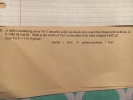
4. 1.013 g of an unknown solid mixture contains some ascorbic acid. It is dissolved in...
16 7-2 Titration Calculations Ascorbic acid (vitamin C) reacts with according to the equation Starch is used as an i...
 16 7-2 Titration Calculations Ascorbic acid (vitamin C) reacts with according to the equation Starch is used as an indicator in the reaction. The end point is marked by the appearance of a deep blue starch-iodine complex when the first fraction of a drop of unreacted remains in the solution. TI (a) Stundurdization: If 29.41 mL of iodine solution is required to react with 0.197 0 g of pure ascorbic acid, what is the molarity of the iodine solution?! (b)...
Calculate the weight percent of ascorbic acid in a tablet of Vitamin C from the following data: A 100 mg sample of a crushed Vitamin C tablet was dissolved in 40 mL of H2SO4 and 20 mL of water. Two gr...
Calculate the weight percent of ascorbic acid in a tablet of Vitamin C from the following data: A 100 mg sample of a crushed Vitamin C tablet was dissolved in 40 mL of H2SO4 and 20 mL of water. Two grams of KI and 35 mL of 0.0107 M KIO3 solution was added, and the mixture titrated to a starch endpoint. The titration required 12 mL of 0.0790 M thiosulfate solution.
Ascorbic acid (vitamin C, MM 176.124 g/mol)) can be determined using an iodometric back titration. A...
 Ascorbic acid (vitamin C, MM 176.124 g/mol)) can be determined using an iodometric back titration. A vitamin C tablet was dissolved in 60 mL of 0.3 M H2S04. To the dissolved tablet, 2 g of KI and 50.00 mL of 0.0105 M KIO3 were added, resulting in the formation of a dark orange solution indicating the presence of 13-. The resulting solution was titrated with 0.0685 M S2032- until the starch indicator turned purple. If the end point was observed...
A sample of 0.2140 g of an unknown monoprotic weak acid was dissolved in 25.0 mL...
A sample of 0.2140 g of an unknown monoprotic weak acid was dissolved in 25.0 mL of water and titrated with 0.0950 M NaOH. The acid required 15.50 mL of NaOH to reach the equivalence point. What is the molar mass of the unknown acid?
You have a 1.153 g sample of an unknown solid acid, HA, dissolved in enough water...
You have a 1.153 g sample of an unknown solid acid, HA, dissolved in enough water to make 20.00 mL of solution. HA reacts with KOH(aq) according to the following balanced chemical equation: HA(aq) + KOH (aq) --> KA (aq) + H20 (l) If 13.40 mL of 0.600 M KOH is required to titrate the unknown acid to the equivalence point, what is the concentration of the unknown acid? What is the molar mass of HA?
3) Use the mole ratios contained in both equation 3 and equation 4 to calculate the...
 3) Use the mole ratios contained in both equation 3 and
equation 4 to calculate the
volume (in mL) of 0.0100 M potassium iodate solution needed to
completely oxidize all
of the ascorbic acid contained in 20.00 mL of 0.0200 M
ascorbic acid solution.
concentration of the titrant can be used along with the mole ratios from the reaction equations to determine the amount of ascorbic acid in the solution Chemical Reactions involved with the redox titration: Equation 1 shows...
3) Use the mole ratios contained in both equation 3 and
equation 4 to calculate the
volume (in mL) of 0.0100 M potassium iodate solution needed to
completely oxidize all
of the ascorbic acid contained in 20.00 mL of 0.0200 M
ascorbic acid solution.
concentration of the titrant can be used along with the mole ratios from the reaction equations to determine the amount of ascorbic acid in the solution Chemical Reactions involved with the redox titration: Equation 1 shows...
A tablet containing some Vit C (ascorbic acid) was dissolved in water then titrated with 24.88...
 A tablet containing some Vit C (ascorbic acid) was dissolved in water then titrated with 24.88 ml of 0.1085 M NaOH. What is the w/w% of Vit C in the tablet if the tablet weighed 0.6672 g? (use Vit C = 176.0 g/mol) NaOH + Vit C rightarrow sodium ascorbate + H_2O
A sample of 0.2140 g of an unknown monoprotic acid was dissolved in 25.0 mL of...
A sample of 0.2140 g of an unknown monoprotic acid was dissolved in 25.0 mL of water and titrated with 0.0950 M NaOH. The titration required 30.0 mL of base to reach the equivalence point, at which point the pH was 8.68. a) What is the molecular weight of the acid? b) What is the pKa of the acid?
(A) A 14.5 g sample of an aqueous solution of hydrobromic acid contains an unknown amount...
(A) A 14.5 g sample of an aqueous solution of hydrobromic acid contains an unknown amount of the acid. If 26.8 mL of 0.557 M barium hydroxide are required to neutralize the hydrobromic acid, what is the percent by mass of hydrobromic acid in the mixture? (B) A 13.7 g sample of an aqueous solution of nitric acid contains an unknown amount of the acid. If 19.8 mL of 0.682 M potassium hydroxide are required to neutralize the nitric acid,...
Help (0.0034 / 0.035) times 100 Percent ionization = 9.7% A solid mixture contains both MgCl2...
 Help
(0.0034 / 0.035) times 100 Percent ionization = 9.7% A solid mixture contains both MgCl2 and NaCl. When 0.5000 g of this mixture is dissolved in enough water to form 1.000 L of solution, the osmotic pressure at 25.0 Degree C is observed to be 0.3990 atm. What is the mass percent of MgCl2 in the solid? (Assume ideal behavior for the solution and that both ionic compounds dissociate completely in the water.)
Help
(0.0034 / 0.035) times 100 Percent ionization = 9.7% A solid mixture contains both MgCl2 and NaCl. When 0.5000 g of this mixture is dissolved in enough water to form 1.000 L of solution, the osmotic pressure at 25.0 Degree C is observed to be 0.3990 atm. What is the mass percent of MgCl2 in the solid? (Assume ideal behavior for the solution and that both ionic compounds dissociate completely in the water.)
 16 7-2 Titration Calculations Ascorbic acid (vitamin C) reacts with according to the equation Starch is used as an indicator in the reaction. The end point is marked by the appearance of a deep blue starch-iodine complex when the first fraction of a drop of unreacted remains in the solution. TI (a) Stundurdization: If 29.41 mL of iodine solution is required to react with 0.197 0 g of pure ascorbic acid, what is the molarity of the iodine solution?! (b)...
 Ascorbic acid (vitamin C, MM 176.124 g/mol)) can be determined using an iodometric back titration. A vitamin C tablet was dissolved in 60 mL of 0.3 M H2S04. To the dissolved tablet, 2 g of KI and 50.00 mL of 0.0105 M KIO3 were added, resulting in the formation of a dark orange solution indicating the presence of 13-. The resulting solution was titrated with 0.0685 M S2032- until the starch indicator turned purple. If the end point was observed...
 3) Use the mole ratios contained in both equation 3 and
equation 4 to calculate the
volume (in mL) of 0.0100 M potassium iodate solution needed to
completely oxidize all
of the ascorbic acid contained in 20.00 mL of 0.0200 M
ascorbic acid solution.
concentration of the titrant can be used along with the mole ratios from the reaction equations to determine the amount of ascorbic acid in the solution Chemical Reactions involved with the redox titration: Equation 1 shows...
3) Use the mole ratios contained in both equation 3 and
equation 4 to calculate the
volume (in mL) of 0.0100 M potassium iodate solution needed to
completely oxidize all
of the ascorbic acid contained in 20.00 mL of 0.0200 M
ascorbic acid solution.
concentration of the titrant can be used along with the mole ratios from the reaction equations to determine the amount of ascorbic acid in the solution Chemical Reactions involved with the redox titration: Equation 1 shows...
 A tablet containing some Vit C (ascorbic acid) was dissolved in water then titrated with 24.88 ml of 0.1085 M NaOH. What is the w/w% of Vit C in the tablet if the tablet weighed 0.6672 g? (use Vit C = 176.0 g/mol) NaOH + Vit C rightarrow sodium ascorbate + H_2O
 Help
(0.0034 / 0.035) times 100 Percent ionization = 9.7% A solid mixture contains both MgCl2 and NaCl. When 0.5000 g of this mixture is dissolved in enough water to form 1.000 L of solution, the osmotic pressure at 25.0 Degree C is observed to be 0.3990 atm. What is the mass percent of MgCl2 in the solid? (Assume ideal behavior for the solution and that both ionic compounds dissociate completely in the water.)
Help
(0.0034 / 0.035) times 100 Percent ionization = 9.7% A solid mixture contains both MgCl2 and NaCl. When 0.5000 g of this mixture is dissolved in enough water to form 1.000 L of solution, the osmotic pressure at 25.0 Degree C is observed to be 0.3990 atm. What is the mass percent of MgCl2 in the solid? (Assume ideal behavior for the solution and that both ionic compounds dissociate completely in the water.)
Most questions answered within 3 hours.
-
Where is the error in this code sequence?
String s1 = "Hello";
String s2 = "ello";...
asked 10 months ago -
Financial data for Joel de Paris, Inc., for last year
follow:
Joel de Paris, Inc.
Balance...
asked 10 months ago -
Consider this reaction:
Al2(SO4)3 (aq)+ BaCl3
(aq) Al2Cl6 (aq)- +
3BaSO4(s) . What is the...
asked 10 months ago -
Suppose that Savneet is considering increasing her
recent random sample from 20 car rentals to 40...
asked 10 months ago -
Trucks arrive at an unloading terminal at an average rate of 120
per hour.
Trucks arrive...
asked 10 months ago -
Why are methanol and ethanol completely soluble in water while
octanol is not very little soluble....
asked 10 months ago -
A facilities manager at a university reads in a research report
that the mean amount of...
asked 10 months ago -
When the CuSO4 is rehydrated by adding water to the anhydrous
compound, is this an endothermic...
asked 10 months ago -
A ray of sunlight is passing from diamond into crown glass; the
angle of incidence is...
asked 10 months ago -
A block of mass 0.249 kg is placed on top of a light, vertical
spring of...
asked 10 months ago -
how do the kidneys compensate in the presences of acidosis
a) trigger hyperventilate
b) reserve acid...
asked 10 months ago -
Question 501 pts
The rental rate of capital to the firm increases. Which of the
following...
asked 10 months ago