
Homework Answers
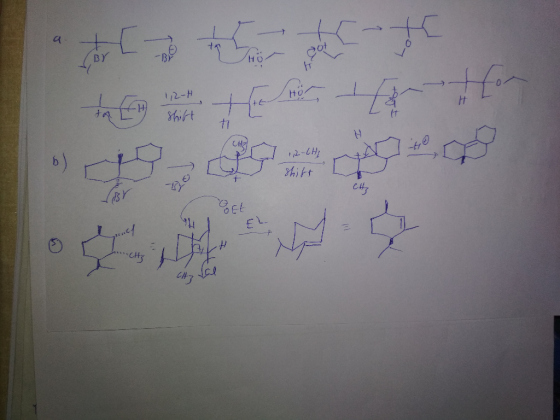
A .exs exam for SN1 reaction
B. E1 elimination
5. E2 elimination
Add Answer to:
PARTH 420points. Explain the following resulting posible mechanisms CH 5. 10points. Determine which is limination mechanism...
5. 10points. Determine which of substitution or elimination mechanism works best in order to form the...
 5. 10points. Determine which of substitution or elimination mechanism works best in order to form the major product of the following reaction? (hint: draw chair conformation for the molecule) CH3 NaOCHCH, CH,CH,OH "CH3 Hac CH3
5. 10points. Determine which of substitution or elimination mechanism works best in order to form the major product...
 5. 10points. Determine which of substitution or elimination mechanism works best in order to form the major product of the following reaction? (hint: draw chair conformation for the molecule) NOCH.CH CH.CH OH HC CH
Your Turn Which Mechanism is it? 5. In each of the problems below, consider the E1...
 Your Turn Which Mechanism is it? 5. In each of the problems below, consider the E1 or E2 reaction occurs then show the mechanism and product or products. Label major and minor products where applicable. a. Reaction of 1,1-bromomethylcyclohexane and sodium ethoxide in ethanol CH, OH сн. b. Reaction of (1R 2R) 1-bromo-2-methylcyclohexane and sodium ethoxide in ethanol. HINT: You should draw the ring in a chair conformation first. CHE 90 -CH, CH,CH,OH C. Reaction of (15,2R) 1-bromo-2-methylcyclohexane and sodium...
4)Draw stepwise mechanism that will explain the products of the following reaction. 5)draw the rate law and the transit...
 4)Draw stepwise mechanism that will explain the products of the
following reaction.
5)draw the rate law and the transition state for the following
reaction
6)what starting material would exclusively give you the
product shown? Draw the mechanism using a chair structure.
4) Draw a stepwise mechanism that will explain the products of the following reaction on the back of this page. (6 points) 5) Draw the rate law and the transition state for the following reaction: (4 pts) DMSO CH;CH...
4)Draw stepwise mechanism that will explain the products of the
following reaction.
5)draw the rate law and the transition state for the following
reaction
6)what starting material would exclusively give you the
product shown? Draw the mechanism using a chair structure.
4) Draw a stepwise mechanism that will explain the products of the following reaction on the back of this page. (6 points) 5) Draw the rate law and the transition state for the following reaction: (4 pts) DMSO CH;CH...
There are many pharmacodynamic signaling mechanisms for medications. Which signaling mechanism best describes the action of...
 There are many pharmacodynamic signaling mechanisms for medications. Which signaling mechanism best describes the action of a drug which involves a coupling protein that in turn activates a separate effector molecule in the cell? Select one: a. G-protein receptors b. tyrosine kinase receptors c. JAK-STAT receptors d. steroid intracellular receptors e. transmembrane ion channels
help please im so lost...as much detail with explainations for the mechanisms 1. For the reactions...
 help please im so lost...as much detail with explainations for
the mechanisms
1. For the reactions below: (l) draw all elimination products that would form under the stated conditions, (2) circle the major products). (3) determine how (El or E2) and (4) explain your reasoning (45 p) CH OH 2. Provide a mechanism which explains the following conversion (pt) xriy For the reactions below: (1) draw all products that could form under the stated conditions, (2) determine how they formed...
help please im so lost...as much detail with explainations for
the mechanisms
1. For the reactions below: (l) draw all elimination products that would form under the stated conditions, (2) circle the major products). (3) determine how (El or E2) and (4) explain your reasoning (45 p) CH OH 2. Provide a mechanism which explains the following conversion (pt) xriy For the reactions below: (1) draw all products that could form under the stated conditions, (2) determine how they formed...
Challenge CH 235R F 2019 Week 11 Problem #2 1. Predicting Major and Minor elimination products...
 Challenge CH 235R F 2019 Week 11 Problem #2 1. Predicting Major and Minor elimination products For each of the following alkenes, draw all possible elimination products for the following molecules, ignoring the mechanism. Indicate the major alkene product. noted II. E2 Eliminations on substituted cyclohexane halides Consider the two isomeric compounds below. a) Draw each in a chair conformation, b) Show the mechanism and final alkene product(s) that form from an E2 reaction with CH,O/CH,OH. c) If more than...
For each of the following reactions, determine which ELIMINATION mechanism (E1 or 2) will occur. Alkyl...
 For each of the following reactions, determine which ELIMINATION mechanism (E1 or 2) will occur. Alkyl Halide Substitution: Base Strength: Mechanism Type: 2° 3° Methyl Strong E1 1° Weak E2 Draw the mechanism that leads to ALL products for the reaction. Finally, underline the major product of the elimination reaction: NaOCH Challenge Problems: Synthesis: Predicted Ability: Good Average Poor Actual Ability: Good Average Poor Propose a synthesis from the starting material to obtain the indicated goal molecule. Note that any...
V. Mechanisms A. (18 pts) Propose a detailed mechanism to explain the following reactions. Make sure...
 V. Mechanisms A. (18 pts) Propose a detailed mechanism to explain the following reactions. Make sure to draw ALL pertinent resonance structures. je hi ha rör
help with all of these ! Question 8: Which is the better retrosynthesis for the given target molecule? Explain and...
 help with all of these !
Question 8: Which is the better retrosynthesis for the given target molecule? Explain and provide a one-step synthesis of the target molecule. Br Br Hас Hас Hас .CH3 b) NaQH CHy Question 7: Draw the plausible mechanism for each of the folllowing transformations: a) CHy Не нс CHs CH СH, CH3 conc. H,SO -CH3 heat CH он Question 5 Predict the major and minor products for the following reactions: a) NaSH Н,с b) Br...
help with all of these !
Question 8: Which is the better retrosynthesis for the given target molecule? Explain and provide a one-step synthesis of the target molecule. Br Br Hас Hас Hас .CH3 b) NaQH CHy Question 7: Draw the plausible mechanism for each of the folllowing transformations: a) CHy Не нс CHs CH СH, CH3 conc. H,SO -CH3 heat CH он Question 5 Predict the major and minor products for the following reactions: a) NaSH Н,с b) Br...
 5. 10points. Determine which of substitution or elimination mechanism works best in order to form the major product of the following reaction? (hint: draw chair conformation for the molecule) CH3 NaOCHCH, CH,CH,OH "CH3 Hac CH3
 5. 10points. Determine which of substitution or elimination mechanism works best in order to form the major product of the following reaction? (hint: draw chair conformation for the molecule) NOCH.CH CH.CH OH HC CH
 Your Turn Which Mechanism is it? 5. In each of the problems below, consider the E1 or E2 reaction occurs then show the mechanism and product or products. Label major and minor products where applicable. a. Reaction of 1,1-bromomethylcyclohexane and sodium ethoxide in ethanol CH, OH сн. b. Reaction of (1R 2R) 1-bromo-2-methylcyclohexane and sodium ethoxide in ethanol. HINT: You should draw the ring in a chair conformation first. CHE 90 -CH, CH,CH,OH C. Reaction of (15,2R) 1-bromo-2-methylcyclohexane and sodium...
 4)Draw stepwise mechanism that will explain the products of the
following reaction.
5)draw the rate law and the transition state for the following
reaction
6)what starting material would exclusively give you the
product shown? Draw the mechanism using a chair structure.
4) Draw a stepwise mechanism that will explain the products of the following reaction on the back of this page. (6 points) 5) Draw the rate law and the transition state for the following reaction: (4 pts) DMSO CH;CH...
4)Draw stepwise mechanism that will explain the products of the
following reaction.
5)draw the rate law and the transition state for the following
reaction
6)what starting material would exclusively give you the
product shown? Draw the mechanism using a chair structure.
4) Draw a stepwise mechanism that will explain the products of the following reaction on the back of this page. (6 points) 5) Draw the rate law and the transition state for the following reaction: (4 pts) DMSO CH;CH...
 There are many pharmacodynamic signaling mechanisms for medications. Which signaling mechanism best describes the action of a drug which involves a coupling protein that in turn activates a separate effector molecule in the cell? Select one: a. G-protein receptors b. tyrosine kinase receptors c. JAK-STAT receptors d. steroid intracellular receptors e. transmembrane ion channels
 help please im so lost...as much detail with explainations for
the mechanisms
1. For the reactions below: (l) draw all elimination products that would form under the stated conditions, (2) circle the major products). (3) determine how (El or E2) and (4) explain your reasoning (45 p) CH OH 2. Provide a mechanism which explains the following conversion (pt) xriy For the reactions below: (1) draw all products that could form under the stated conditions, (2) determine how they formed...
help please im so lost...as much detail with explainations for
the mechanisms
1. For the reactions below: (l) draw all elimination products that would form under the stated conditions, (2) circle the major products). (3) determine how (El or E2) and (4) explain your reasoning (45 p) CH OH 2. Provide a mechanism which explains the following conversion (pt) xriy For the reactions below: (1) draw all products that could form under the stated conditions, (2) determine how they formed...
 Challenge CH 235R F 2019 Week 11 Problem #2 1. Predicting Major and Minor elimination products For each of the following alkenes, draw all possible elimination products for the following molecules, ignoring the mechanism. Indicate the major alkene product. noted II. E2 Eliminations on substituted cyclohexane halides Consider the two isomeric compounds below. a) Draw each in a chair conformation, b) Show the mechanism and final alkene product(s) that form from an E2 reaction with CH,O/CH,OH. c) If more than...
 For each of the following reactions, determine which ELIMINATION mechanism (E1 or 2) will occur. Alkyl Halide Substitution: Base Strength: Mechanism Type: 2° 3° Methyl Strong E1 1° Weak E2 Draw the mechanism that leads to ALL products for the reaction. Finally, underline the major product of the elimination reaction: NaOCH Challenge Problems: Synthesis: Predicted Ability: Good Average Poor Actual Ability: Good Average Poor Propose a synthesis from the starting material to obtain the indicated goal molecule. Note that any...
 V. Mechanisms A. (18 pts) Propose a detailed mechanism to explain the following reactions. Make sure to draw ALL pertinent resonance structures. je hi ha rör
 help with all of these !
Question 8: Which is the better retrosynthesis for the given target molecule? Explain and provide a one-step synthesis of the target molecule. Br Br Hас Hас Hас .CH3 b) NaQH CHy Question 7: Draw the plausible mechanism for each of the folllowing transformations: a) CHy Не нс CHs CH СH, CH3 conc. H,SO -CH3 heat CH он Question 5 Predict the major and minor products for the following reactions: a) NaSH Н,с b) Br...
help with all of these !
Question 8: Which is the better retrosynthesis for the given target molecule? Explain and provide a one-step synthesis of the target molecule. Br Br Hас Hас Hас .CH3 b) NaQH CHy Question 7: Draw the plausible mechanism for each of the folllowing transformations: a) CHy Не нс CHs CH СH, CH3 conc. H,SO -CH3 heat CH он Question 5 Predict the major and minor products for the following reactions: a) NaSH Н,с b) Br...
Most questions answered within 3 hours.
-
Where is the error in this code sequence?
String s1 = "Hello";
String s2 = "ello";...
asked 10 months ago -
Financial data for Joel de Paris, Inc., for last year
follow:
Joel de Paris, Inc.
Balance...
asked 10 months ago -
Consider this reaction:
Al2(SO4)3 (aq)+ BaCl3
(aq) Al2Cl6 (aq)- +
3BaSO4(s) . What is the...
asked 10 months ago -
Suppose that Savneet is considering increasing her
recent random sample from 20 car rentals to 40...
asked 10 months ago -
Trucks arrive at an unloading terminal at an average rate of 120
per hour.
Trucks arrive...
asked 10 months ago -
Why are methanol and ethanol completely soluble in water while
octanol is not very little soluble....
asked 10 months ago -
A facilities manager at a university reads in a research report
that the mean amount of...
asked 10 months ago -
When the CuSO4 is rehydrated by adding water to the anhydrous
compound, is this an endothermic...
asked 10 months ago -
A ray of sunlight is passing from diamond into crown glass; the
angle of incidence is...
asked 10 months ago -
A block of mass 0.249 kg is placed on top of a light, vertical
spring of...
asked 10 months ago -
how do the kidneys compensate in the presences of acidosis
a) trigger hyperventilate
b) reserve acid...
asked 10 months ago -
Question 501 pts
The rental rate of capital to the firm increases. Which of the
following...
asked 10 months ago