Need help with part a and b
Need help with part a and b

Homework Answers

I need help with part B of this question, but you should read part A to...
 I need help with part B of this question, but you should read
part A to understand what’s going on. I found the lagrangian and
equations of motion for A, but how do they change for a Foucault
Pendulum?
I need help with part B of this question, but you should read
part A to understand what’s going on. I found the lagrangian and
equations of motion for A, but how do they change for a Foucault
Pendulum?
I need help solving part c but you need part b for part c. b. If you are 25 years old and you want to be a millionaire b...
I need help solving part c but you need part b for part c. b. If you are 25 years old and you want to be a millionaire by age 65, how much must you need to invest monthly, if you can earn 10.5 percent per year return over that period? c. If you also had a lump sum of $20,000 at age 25, how much less must you invest per month if you want to retire at age 65,...
I need help answering part b and c of question 7
 I need help answering part b and c of question 7
Animal physiology help. I need help with part a and part b. for part a, this...
 Animal physiology help.
I need help with part a and part b.
for part a, this is as far as I've gotten. The numbers on the
left are the contents inside the cell and the numbers on the right
are contents outside of the cell. I have converted everything to
mM. H+ is hard to see becuase only 10 um passed through the
membrane to go outside of the cell. (i dont know how to show this
line better on...
Animal physiology help.
I need help with part a and part b.
for part a, this is as far as I've gotten. The numbers on the
left are the contents inside the cell and the numbers on the right
are contents outside of the cell. I have converted everything to
mM. H+ is hard to see becuase only 10 um passed through the
membrane to go outside of the cell. (i dont know how to show this
line better on...
Find the polar form, need help with theta for b and whole part of c (b)...
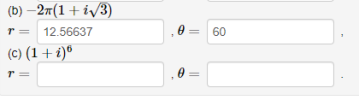 Find the polar form, need help with theta for b and whole part
of c
(b) -27(1+iV3) r= 12.56637 (C) (1 + i) o= 60 T=
Find the polar form, need help with theta for b and whole part
of c
(b) -27(1+iV3) r= 12.56637 (C) (1 + i) o= 60 T=
ONLY need help with C out of part 6, and need help with B out of...
 ONLY need help with C out of part 6, and need help with B out of
Part 4. Thank you! ☺️
H2O _Mg(OH)2 + __HPO4 → _Mg 3(PO4)2 + In the reaction above (Mg = 24.31; O = 16.00; H = 1.01; P = 30.97) a) 3.498 x 100 g of H Po, will require how many moles of Mg(OH)2? b) 3.498 x 10° g of H3PO, will produce how many molecules of Mg 3(PO4)2? c) 3.498 x 100 g...
ONLY need help with C out of part 6, and need help with B out of
Part 4. Thank you! ☺️
H2O _Mg(OH)2 + __HPO4 → _Mg 3(PO4)2 + In the reaction above (Mg = 24.31; O = 16.00; H = 1.01; P = 30.97) a) 3.498 x 100 g of H Po, will require how many moles of Mg(OH)2? b) 3.498 x 10° g of H3PO, will produce how many molecules of Mg 3(PO4)2? c) 3.498 x 100 g...
I need help with Part B. I got Part A wrong Part A The activation energy...
I need help with Part B. I got Part A wrong Part A The activation energy of a certain reaction is 41.6 kJ/mol . At 20 ∘C , the rate constant is 0.0150s−1. At what temperature in degrees Celsius would this reaction go twice as fast? ANSWER IS T2= 32 Part B Given that the initial rate constant is 0.0150s−1 at an initial temperature of 20∘C , what would the rate constant be at a temperature of 120.∘C for the same...
Need help with part A & B Question1 1 of 6> Part A What is the...
 Need help with part A & B
Question1 1 of 6> Part A What is the capacitance? Express your answer with the appropriate units Constants The plates of a parallel-plate capacitor are 3.26 mm apart, and each has an area of 9.92 cm2. Each plate carries a charge of magnitude 4.60x10⁸ C. The plates are in vacuum. Units Submit Request Answer Part B What is the potential difference between the plates? Express your answer with the appropriate units.
Need help with part A & B
Question1 1 of 6> Part A What is the capacitance? Express your answer with the appropriate units Constants The plates of a parallel-plate capacitor are 3.26 mm apart, and each has an area of 9.92 cm2. Each plate carries a charge of magnitude 4.60x10⁸ C. The plates are in vacuum. Units Submit Request Answer Part B What is the potential difference between the plates? Express your answer with the appropriate units.
I need help on part b of question 6 my answer seems to be wrong.
 I need help on part b of question 6 my answer seems to
be wrong.
I need help on part b of question 6 my answer seems to
be wrong.
I need help with part A and B please... (A. If a person is exercising would...
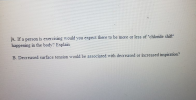 I need help with part A and B please...
(A. If a person is exercising would you expect there to be more or less of "chloride shift" happening in the body? Explain B. Decreased surface tension would be associated with decreased or increased inspiration?
I need help with part A and B please...
(A. If a person is exercising would you expect there to be more or less of "chloride shift" happening in the body? Explain B. Decreased surface tension would be associated with decreased or increased inspiration?
 I need help with part B of this question, but you should read
part A to understand what’s going on. I found the lagrangian and
equations of motion for A, but how do they change for a Foucault
Pendulum?
I need help with part B of this question, but you should read
part A to understand what’s going on. I found the lagrangian and
equations of motion for A, but how do they change for a Foucault
Pendulum?
 I need help answering part b and c of question 7
 Animal physiology help.
I need help with part a and part b.
for part a, this is as far as I've gotten. The numbers on the
left are the contents inside the cell and the numbers on the right
are contents outside of the cell. I have converted everything to
mM. H+ is hard to see becuase only 10 um passed through the
membrane to go outside of the cell. (i dont know how to show this
line better on...
Animal physiology help.
I need help with part a and part b.
for part a, this is as far as I've gotten. The numbers on the
left are the contents inside the cell and the numbers on the right
are contents outside of the cell. I have converted everything to
mM. H+ is hard to see becuase only 10 um passed through the
membrane to go outside of the cell. (i dont know how to show this
line better on...
 Find the polar form, need help with theta for b and whole part
of c
(b) -27(1+iV3) r= 12.56637 (C) (1 + i) o= 60 T=
Find the polar form, need help with theta for b and whole part
of c
(b) -27(1+iV3) r= 12.56637 (C) (1 + i) o= 60 T=
 ONLY need help with C out of part 6, and need help with B out of
Part 4. Thank you! ☺️
H2O _Mg(OH)2 + __HPO4 → _Mg 3(PO4)2 + In the reaction above (Mg = 24.31; O = 16.00; H = 1.01; P = 30.97) a) 3.498 x 100 g of H Po, will require how many moles of Mg(OH)2? b) 3.498 x 10° g of H3PO, will produce how many molecules of Mg 3(PO4)2? c) 3.498 x 100 g...
ONLY need help with C out of part 6, and need help with B out of
Part 4. Thank you! ☺️
H2O _Mg(OH)2 + __HPO4 → _Mg 3(PO4)2 + In the reaction above (Mg = 24.31; O = 16.00; H = 1.01; P = 30.97) a) 3.498 x 100 g of H Po, will require how many moles of Mg(OH)2? b) 3.498 x 10° g of H3PO, will produce how many molecules of Mg 3(PO4)2? c) 3.498 x 100 g...
 Need help with part A & B
Question1 1 of 6> Part A What is the capacitance? Express your answer with the appropriate units Constants The plates of a parallel-plate capacitor are 3.26 mm apart, and each has an area of 9.92 cm2. Each plate carries a charge of magnitude 4.60x10⁸ C. The plates are in vacuum. Units Submit Request Answer Part B What is the potential difference between the plates? Express your answer with the appropriate units.
Need help with part A & B
Question1 1 of 6> Part A What is the capacitance? Express your answer with the appropriate units Constants The plates of a parallel-plate capacitor are 3.26 mm apart, and each has an area of 9.92 cm2. Each plate carries a charge of magnitude 4.60x10⁸ C. The plates are in vacuum. Units Submit Request Answer Part B What is the potential difference between the plates? Express your answer with the appropriate units.
 I need help on part b of question 6 my answer seems to
be wrong.
I need help on part b of question 6 my answer seems to
be wrong.
 I need help with part A and B please...
(A. If a person is exercising would you expect there to be more or less of "chloride shift" happening in the body? Explain B. Decreased surface tension would be associated with decreased or increased inspiration?
I need help with part A and B please...
(A. If a person is exercising would you expect there to be more or less of "chloride shift" happening in the body? Explain B. Decreased surface tension would be associated with decreased or increased inspiration?
Most questions answered within 3 hours.
-
Where is the error in this code sequence?
String s1 = "Hello";
String s2 = "ello";...
asked 10 months ago -
Financial data for Joel de Paris, Inc., for last year
follow:
Joel de Paris, Inc.
Balance...
asked 10 months ago -
Consider this reaction:
Al2(SO4)3 (aq)+ BaCl3
(aq) Al2Cl6 (aq)- +
3BaSO4(s) . What is the...
asked 10 months ago -
Suppose that Savneet is considering increasing her
recent random sample from 20 car rentals to 40...
asked 10 months ago -
Trucks arrive at an unloading terminal at an average rate of 120
per hour.
Trucks arrive...
asked 10 months ago -
Why are methanol and ethanol completely soluble in water while
octanol is not very little soluble....
asked 10 months ago -
A facilities manager at a university reads in a research report
that the mean amount of...
asked 10 months ago -
When the CuSO4 is rehydrated by adding water to the anhydrous
compound, is this an endothermic...
asked 10 months ago -
A ray of sunlight is passing from diamond into crown glass; the
angle of incidence is...
asked 10 months ago -
A block of mass 0.249 kg is placed on top of a light, vertical
spring of...
asked 10 months ago -
how do the kidneys compensate in the presences of acidosis
a) trigger hyperventilate
b) reserve acid...
asked 10 months ago -
Question 501 pts
The rental rate of capital to the firm increases. Which of the
following...
asked 10 months ago