Which of the following compounds will form CO2 and H2O when it reacts with an acid?...
Which of the following compounds will form CO2 and H2O when it reacts with an acid?
Which of the following compounds will form CO2 and H2O when it reacts with an acid?
| NH3 |
| Mg(OH)2 |
| NaC2H3O2 |
| CaCO3 |
Homework Answers

Add Answer to:
Which of the following compounds will form CO2 and
H2O when it reacts with an acid?...
Calcium carbonate (CaCO3) reacts with stomach acid (HCl, hydrochloric acid) according to the following equation: CaCO3(s)+2HCl(aq)⟶CO2(g)+H2O(l)+CaCl2(aq)...
Calcium carbonate (CaCO3) reacts with stomach acid (HCl, hydrochloric acid) according to the following equation: CaCO3(s)+2HCl(aq)⟶CO2(g)+H2O(l)+CaCl2(aq) Tums, an antacid, contains CaCO3. If Tums is added to 10.0 mL of a solution that is 0.400 M in HCl, how many grams of CO2 gas are produced?
A. Select the correct reaction when H2PO4- (a Bronsted-Lowry acid) reacts with water. 1. H2PO4- + OH- ⇄ H2O + HPO42-...
A. Select the correct reaction when H2PO4- (a Bronsted-Lowry acid) reacts with water. 1. H2PO4- + OH- ⇄ H2O + HPO42- 2. H2PO4- + H2O ⇄ H3O+ + HPO42- 3. H2PO4- + H2O ⇄ OH- + PO43- 4. H2PO4- + H2O ⇄ O2- + H4PO4+ B. Given the following reaction at equilibrium CaO(s) + CO2(g) ⇌ CaCO3(s) select all of the answers that apply. 1. To restore equilibrium, the reaction shifts to the right (products) side when the total pressure of the system is increased. 2. To restore equilibrium, the reaction shifts to the left (reactants) side when the total pressure...
Octane (C3H18) reacts with oxygen (O2) to form carbon dioxide (CO2) and water (H2O). When the...
 Octane (C3H18) reacts with oxygen (O2) to form carbon dioxide (CO2) and water (H2O). When the equation below is balanced, the coefficient of octane is: C8H18 + O2-CO2 + H20
Octane (C8H18) reacts with oxygen (O2) to form carbon dioxide (CO2) and water (H2O).
Octane (C8H18) reacts with oxygen (O2) to form carbon dioxide (CO2) and water (H2O). When the equation in balanced, the coefficient of octane is: C8H18+ O2 --> CO2 + H2O a.8 b. 16 c.25 d. 2
Calcium carbonate, CaCO3, reacts with stomach acid, (HCI, hydrochloric acid) according to the following equation: CaCO3(s)...
 Calcium carbonate, CaCO3, reacts with stomach acid, (HCI, hydrochloric acid) according to the following equation: CaCO3(s) + 2HCl(aq)-CO2(g) + H2O(1) +CaCl2(aq) Tums, an antacid, contains CaCO3. If Tums is added to 20.0 mL of a 0.400 M HCl solution, how many grams of CO2 gas are produced?
CO32−(aq)+H2O(l)←−→HCO3−(aq)+OH−(aq) acid (proton donor) CO32−, base (proton acceptor) H2O acid (proton donor) H2O, base (proton acceptor) CO2−3...
 CO32−(aq)+H2O(l)←−→HCO3−(aq)+OH−(aq)
acid (proton donor) CO32−, base (proton acceptor)
H2O
acid (proton donor) H2O, base (proton acceptor) CO2−3
Part B
NH3(aq)+H2O(l)←−→NH4+(aq)+OH−(aq)
acid (proton donor) H2O, base (proton acceptor)
NH3
acid (proton donor) NH3, base (proton acceptor) H2O
CO32−(aq)+H2O(l)←−→HCO3−(aq)+OH−(aq)
acid (proton donor) CO32−, base (proton acceptor)
H2O
acid (proton donor) H2O, base (proton acceptor) CO2−3
Part B
NH3(aq)+H2O(l)←−→NH4+(aq)+OH−(aq)
acid (proton donor) H2O, base (proton acceptor)
NH3
acid (proton donor) NH3, base (proton acceptor) H2O
Butane, C4H10, reacts with oxygen, O2, to form water, H2O, and carbon dioxide, CO2, as shown...
Butane, C4H10, reacts with oxygen, O2, to form water, H2O, and carbon dioxide, CO2, as shown in the following chemical equation: 2C4H10(g)+13O2(g)→10H2O(g)+8CO2(g) Calculate the mass of water produced when 8.07 g of butane reacts with excess oxygen. Please show all steps. Thank you.
8) Covalent bolidnn Carbon dioxide reacts with water to form carbonic acid: CO2 + H2O →...
 8) Covalent bolidnn Carbon dioxide reacts with water to form carbonic acid: CO2 + H2O → H2CO3 Provide items (a) through (g) below for the carbon-containing molecule before and after the reaction. (32 points total) After Before (a) Lewis structure (4 pts) (b) Number of bonding pairs around C (c) Number of lone pairs (d) Number of electron around C (2 24 3 domains around C (e) Hybridization of C (f) Electron domain geometry ts (g) Molecular geometry ineay ts...
Balance the followiing equations and determine which type of reaction is occurring. 1._(NH4)2CO3 ()->NH3+H2O+CO2...
 Balance the followiing equations and determine which type of reaction is occurring. 1._(NH4)2CO3 ()->NH3+H2O+CO2 (9) 2. Zn(s) +H3CeHsO7 (ag)-Zn3(CeH 5O7)2 (a) + H2 (g) 3. Zn(C2H3O2)2 (ac)+ Na3PO4 (aa) NaC2H3O2 (a) Zn3(PO4)2 (s)
3) (1) Rainwater is slightly acidic because it reacts with dissolved CO2 gas. Complete the following...
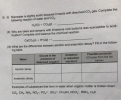 3) (1) Rainwater is slightly acidic because it reacts with dissolved CO2 gas. Complete the following reaction of water and CO2: H2O(l) + CO2(g) - (II) Why are lakes and streams with limestone rock bottoms less susceptible to acidi- fication? Complete and balance the chemical reaction. CaCO3(s) + H+(aq) → (II) What are the differences between aerobic and anaerobic decay? Fill in the follow- ing table. Occurs in the presence of dissolved oxygen? Water Possible products (Choose from the list...
 Octane (C3H18) reacts with oxygen (O2) to form carbon dioxide (CO2) and water (H2O). When the equation below is balanced, the coefficient of octane is: C8H18 + O2-CO2 + H20
 Calcium carbonate, CaCO3, reacts with stomach acid, (HCI, hydrochloric acid) according to the following equation: CaCO3(s) + 2HCl(aq)-CO2(g) + H2O(1) +CaCl2(aq) Tums, an antacid, contains CaCO3. If Tums is added to 20.0 mL of a 0.400 M HCl solution, how many grams of CO2 gas are produced?
 CO32−(aq)+H2O(l)←−→HCO3−(aq)+OH−(aq)
acid (proton donor) CO32−, base (proton acceptor)
H2O
acid (proton donor) H2O, base (proton acceptor) CO2−3
Part B
NH3(aq)+H2O(l)←−→NH4+(aq)+OH−(aq)
acid (proton donor) H2O, base (proton acceptor)
NH3
acid (proton donor) NH3, base (proton acceptor) H2O
CO32−(aq)+H2O(l)←−→HCO3−(aq)+OH−(aq)
acid (proton donor) CO32−, base (proton acceptor)
H2O
acid (proton donor) H2O, base (proton acceptor) CO2−3
Part B
NH3(aq)+H2O(l)←−→NH4+(aq)+OH−(aq)
acid (proton donor) H2O, base (proton acceptor)
NH3
acid (proton donor) NH3, base (proton acceptor) H2O
 8) Covalent bolidnn Carbon dioxide reacts with water to form carbonic acid: CO2 + H2O → H2CO3 Provide items (a) through (g) below for the carbon-containing molecule before and after the reaction. (32 points total) After Before (a) Lewis structure (4 pts) (b) Number of bonding pairs around C (c) Number of lone pairs (d) Number of electron around C (2 24 3 domains around C (e) Hybridization of C (f) Electron domain geometry ts (g) Molecular geometry ineay ts...
 Balance the followiing equations and determine which type of reaction is occurring. 1._(NH4)2CO3 ()->NH3+H2O+CO2 (9) 2. Zn(s) +H3CeHsO7 (ag)-Zn3(CeH 5O7)2 (a) + H2 (g) 3. Zn(C2H3O2)2 (ac)+ Na3PO4 (aa) NaC2H3O2 (a) Zn3(PO4)2 (s)
 3) (1) Rainwater is slightly acidic because it reacts with dissolved CO2 gas. Complete the following reaction of water and CO2: H2O(l) + CO2(g) - (II) Why are lakes and streams with limestone rock bottoms less susceptible to acidi- fication? Complete and balance the chemical reaction. CaCO3(s) + H+(aq) → (II) What are the differences between aerobic and anaerobic decay? Fill in the follow- ing table. Occurs in the presence of dissolved oxygen? Water Possible products (Choose from the list...
Most questions answered within 3 hours.
-
Where is the error in this code sequence?
String s1 = "Hello";
String s2 = "ello";...
asked 10 months ago -
Financial data for Joel de Paris, Inc., for last year
follow:
Joel de Paris, Inc.
Balance...
asked 10 months ago -
Consider this reaction:
Al2(SO4)3 (aq)+ BaCl3
(aq) Al2Cl6 (aq)- +
3BaSO4(s) . What is the...
asked 10 months ago -
Suppose that Savneet is considering increasing her
recent random sample from 20 car rentals to 40...
asked 10 months ago -
Trucks arrive at an unloading terminal at an average rate of 120
per hour.
Trucks arrive...
asked 10 months ago -
Why are methanol and ethanol completely soluble in water while
octanol is not very little soluble....
asked 10 months ago -
A facilities manager at a university reads in a research report
that the mean amount of...
asked 10 months ago -
When the CuSO4 is rehydrated by adding water to the anhydrous
compound, is this an endothermic...
asked 10 months ago -
A ray of sunlight is passing from diamond into crown glass; the
angle of incidence is...
asked 10 months ago -
A block of mass 0.249 kg is placed on top of a light, vertical
spring of...
asked 10 months ago -
how do the kidneys compensate in the presences of acidosis
a) trigger hyperventilate
b) reserve acid...
asked 10 months ago -
Question 501 pts
The rental rate of capital to the firm increases. Which of the
following...
asked 10 months ago