

Homework Answers
Add Answer to:
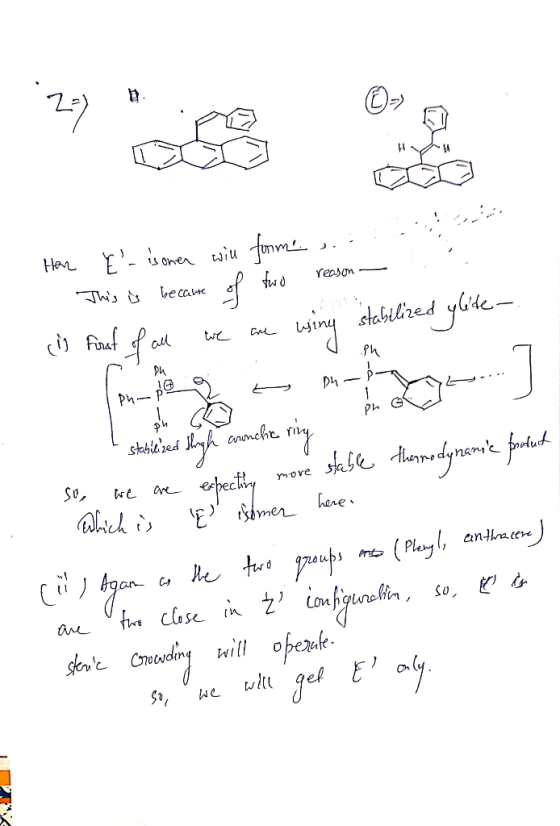
Include the proposed reaction (using structures) and mechanisms for this week's experiment, starting with benzyltriphenylphosphonium chloride...
Help needed for Wittig Reaction Synthesizing 9-(2-Phenylethenyl)anthracene: ce 9-anthraldehyde Benzyltriphenylphosphonium chloride 9-(2-phenylethenyl)anthracene
 Help needed for Wittig Reaction Synthesizing
9-(2-Phenylethenyl)anthracene:
ce 9-anthraldehyde Benzyltriphenylphosphonium chloride 9-(2-phenylethenyl)anthracene
Help needed for Wittig Reaction Synthesizing
9-(2-Phenylethenyl)anthracene:
ce 9-anthraldehyde Benzyltriphenylphosphonium chloride 9-(2-phenylethenyl)anthracene
63 cle OLI KPO photo d) K,PO, H2 Phyp-C 9-anthraldehyde M.W.. 20624 g/mol 9-(2-phenylethenyanthracene Benzyltriphenylphosphonium chloride...
 63 cle OLI KPO photo d) K,PO, H2 Phyp-C 9-anthraldehyde M.W.. 20624 g/mol 9-(2-phenylethenyanthracene Benzyltriphenylphosphonium chloride M.W. = 388.88 g/mol Phyp=g m.p. 104-105°C M.W. 280.4 g/mol m.p. - 130-132°C Benzyltriphenylphosphonium ylide QUESTIUNI Which compound is not a possible limiting reagent? o toluene 9-anthraldehyde benzyltriphenylphosphonium chloride o K3PO4 QUESTION 2 What is the theoretical yield, in moles, of 9-(2-phenylethyl)anthracene if the limiting reagent for this reaction is a 50% miv solution of NaOH and 0.266 mL are used as a base?...
This is the Wittig reaction. Below I have the reaction performed. So first we have the...
 This is the Wittig reaction. Below I have the reaction
performed. So first we have the IR of starting material and then
the product, all the peaks for all IR. Please identify the peaks in
all the IR. Please also explain the difference observed thank you!.
For this reaction an NMR is also performed, have to label the H NMR
based on the product formed also based on the values given have to
determine if the product was cis -9-2(...
This is the Wittig reaction. Below I have the reaction
performed. So first we have the IR of starting material and then
the product, all the peaks for all IR. Please identify the peaks in
all the IR. Please also explain the difference observed thank you!.
For this reaction an NMR is also performed, have to label the H NMR
based on the product formed also based on the values given have to
determine if the product was cis -9-2(...
Based on the Wittig Reaction exp. below, please answer a) and b). In b) you can...
 Based on the Wittig Reaction exp. below, please answer a) and
b). In b) you can disregard the part about the IR, just please
interpret and assign protons, shift values, which protons are for
which groups, etc on the HNMR. The % yield was 34%, and MP was
lower than expected (to assist with answering part a). This should
be all the information you need to answer the question.
HNMR
Discuss the percentage yield of the reaction. Explain and provide...
Based on the Wittig Reaction exp. below, please answer a) and
b). In b) you can disregard the part about the IR, just please
interpret and assign protons, shift values, which protons are for
which groups, etc on the HNMR. The % yield was 34%, and MP was
lower than expected (to assist with answering part a). This should
be all the information you need to answer the question.
HNMR
Discuss the percentage yield of the reaction. Explain and provide...
What is the objective of this experiment? The reaction solvent for this experiment is xylene. What...
 What is the objective of this experiment?
The reaction solvent for this experiment is xylene. What
property of this solvent makes it a better choice than toluene or
benzene?
Draw the orbitals involved in the 4+2 electrocyclization for
this reaction. Draw the structures of the reactants as best you
can. It may be appropriate to abbreviate the structure of
anthracene.
IR is not provided for this reaction product. Why is IR not
useful for monitoring the reaction or characterizing the...
What is the objective of this experiment?
The reaction solvent for this experiment is xylene. What
property of this solvent makes it a better choice than toluene or
benzene?
Draw the orbitals involved in the 4+2 electrocyclization for
this reaction. Draw the structures of the reactants as best you
can. It may be appropriate to abbreviate the structure of
anthracene.
IR is not provided for this reaction product. Why is IR not
useful for monitoring the reaction or characterizing the...
Please complete for Tuesday, we will go through the questions and mark them in class. pg 156 - 4.23,...
 Please complete for Tuesday, we will go through the questions and mark them in class. pg 156 - 4.23, 4.24, 4.26 pg 170 - 4.29, 4.31, pg 171-4.36 pg 175 - 4.59 pg 176- 4.74, 4.75, 4.80 pg 177-4.81, 4.82 pg 188- 5.1, 5.4, 5.5, 5.6, 5.11 - Using Table 5.1 pg 198-5.22, 5.25 pg 203 - 5.29 pg 206 - 5.37 pg 209 - 5.39 pg 2.14 5.61 pg 235-6.11, 6.14, 6.16 156 CHAPTER 4 Introduction to Organic Compounds...
 Help needed for Wittig Reaction Synthesizing
9-(2-Phenylethenyl)anthracene:
ce 9-anthraldehyde Benzyltriphenylphosphonium chloride 9-(2-phenylethenyl)anthracene
Help needed for Wittig Reaction Synthesizing
9-(2-Phenylethenyl)anthracene:
ce 9-anthraldehyde Benzyltriphenylphosphonium chloride 9-(2-phenylethenyl)anthracene
 63 cle OLI KPO photo d) K,PO, H2 Phyp-C 9-anthraldehyde M.W.. 20624 g/mol 9-(2-phenylethenyanthracene Benzyltriphenylphosphonium chloride M.W. = 388.88 g/mol Phyp=g m.p. 104-105°C M.W. 280.4 g/mol m.p. - 130-132°C Benzyltriphenylphosphonium ylide QUESTIUNI Which compound is not a possible limiting reagent? o toluene 9-anthraldehyde benzyltriphenylphosphonium chloride o K3PO4 QUESTION 2 What is the theoretical yield, in moles, of 9-(2-phenylethyl)anthracene if the limiting reagent for this reaction is a 50% miv solution of NaOH and 0.266 mL are used as a base?...
 This is the Wittig reaction. Below I have the reaction
performed. So first we have the IR of starting material and then
the product, all the peaks for all IR. Please identify the peaks in
all the IR. Please also explain the difference observed thank you!.
For this reaction an NMR is also performed, have to label the H NMR
based on the product formed also based on the values given have to
determine if the product was cis -9-2(...
This is the Wittig reaction. Below I have the reaction
performed. So first we have the IR of starting material and then
the product, all the peaks for all IR. Please identify the peaks in
all the IR. Please also explain the difference observed thank you!.
For this reaction an NMR is also performed, have to label the H NMR
based on the product formed also based on the values given have to
determine if the product was cis -9-2(...
 Based on the Wittig Reaction exp. below, please answer a) and
b). In b) you can disregard the part about the IR, just please
interpret and assign protons, shift values, which protons are for
which groups, etc on the HNMR. The % yield was 34%, and MP was
lower than expected (to assist with answering part a). This should
be all the information you need to answer the question.
HNMR
Discuss the percentage yield of the reaction. Explain and provide...
Based on the Wittig Reaction exp. below, please answer a) and
b). In b) you can disregard the part about the IR, just please
interpret and assign protons, shift values, which protons are for
which groups, etc on the HNMR. The % yield was 34%, and MP was
lower than expected (to assist with answering part a). This should
be all the information you need to answer the question.
HNMR
Discuss the percentage yield of the reaction. Explain and provide...
 What is the objective of this experiment?
The reaction solvent for this experiment is xylene. What
property of this solvent makes it a better choice than toluene or
benzene?
Draw the orbitals involved in the 4+2 electrocyclization for
this reaction. Draw the structures of the reactants as best you
can. It may be appropriate to abbreviate the structure of
anthracene.
IR is not provided for this reaction product. Why is IR not
useful for monitoring the reaction or characterizing the...
What is the objective of this experiment?
The reaction solvent for this experiment is xylene. What
property of this solvent makes it a better choice than toluene or
benzene?
Draw the orbitals involved in the 4+2 electrocyclization for
this reaction. Draw the structures of the reactants as best you
can. It may be appropriate to abbreviate the structure of
anthracene.
IR is not provided for this reaction product. Why is IR not
useful for monitoring the reaction or characterizing the...
 Please complete for Tuesday, we will go through the questions and mark them in class. pg 156 - 4.23, 4.24, 4.26 pg 170 - 4.29, 4.31, pg 171-4.36 pg 175 - 4.59 pg 176- 4.74, 4.75, 4.80 pg 177-4.81, 4.82 pg 188- 5.1, 5.4, 5.5, 5.6, 5.11 - Using Table 5.1 pg 198-5.22, 5.25 pg 203 - 5.29 pg 206 - 5.37 pg 209 - 5.39 pg 2.14 5.61 pg 235-6.11, 6.14, 6.16 156 CHAPTER 4 Introduction to Organic Compounds...
Most questions answered within 3 hours.
-
Where is the error in this code sequence?
String s1 = "Hello";
String s2 = "ello";...
asked 10 months ago -
Financial data for Joel de Paris, Inc., for last year
follow:
Joel de Paris, Inc.
Balance...
asked 10 months ago -
Consider this reaction:
Al2(SO4)3 (aq)+ BaCl3
(aq) Al2Cl6 (aq)- +
3BaSO4(s) . What is the...
asked 10 months ago -
Suppose that Savneet is considering increasing her
recent random sample from 20 car rentals to 40...
asked 10 months ago -
Trucks arrive at an unloading terminal at an average rate of 120
per hour.
Trucks arrive...
asked 10 months ago -
Why are methanol and ethanol completely soluble in water while
octanol is not very little soluble....
asked 10 months ago -
A facilities manager at a university reads in a research report
that the mean amount of...
asked 10 months ago -
When the CuSO4 is rehydrated by adding water to the anhydrous
compound, is this an endothermic...
asked 10 months ago -
A ray of sunlight is passing from diamond into crown glass; the
angle of incidence is...
asked 10 months ago -
A block of mass 0.249 kg is placed on top of a light, vertical
spring of...
asked 10 months ago -
how do the kidneys compensate in the presences of acidosis
a) trigger hyperventilate
b) reserve acid...
asked 10 months ago -
Question 501 pts
The rental rate of capital to the firm increases. Which of the
following...
asked 10 months ago