When only two treatments are involved, ANOVA and the Student’s t test (Chapter 11) result in...
When only two treatments are involved, ANOVA and the Student’s t test (Chapter 11) result in the same conclusions. Also, for computed test statistics, t2 = F. To demonstrate this relationship, use the following example. Fourteen randomly selected students enrolled in a history course were divided into two groups, one consisting of 6 students who took the course in the normal lecture format. The other group of 8 students took the course as a distance course format. At the end of the course, each group was examined with a 50-item test. The following is a list of the number correct for each of the two groups.
Traditional lecture: 36, 31, 40, 34, 33, 38
Distance: 45, 35, 45, 35, 45, 36, 43, 41
Complete the ANOVA table. (Round your SS, MS, and F values to 2 decimal places and p value to 4 decimal places.)
|
Use a α = 0.01 level of significance - the critical value of F:
Using the t test from Chapter 11, compute t.
Homework Answers
Solution:-
a)
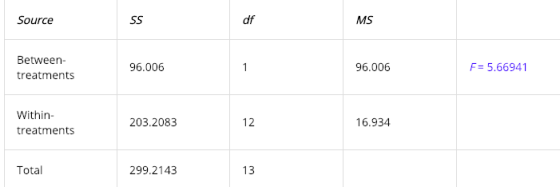
State the hypotheses. The first step is to state the null hypothesis and an alternative hypothesis.
Null hypothesis: u1 = u2
Alternative hypothesis: At-least one of the u is not equal.
Formulate an analysis plan. For this analysis, the significance level is 0.01.
Analyze sample data.
F statistics is given by:-
F = 5.67
Fcritical = 9.298
The P-value = 0.035
Interpret results. Since the P-value (0.35) is greater than the significance level (0.01), we have to accept the null hypothesis.
Conclusion:-
Reject H0, There is sufficient evidence for significant differences between the three kinds.
b)
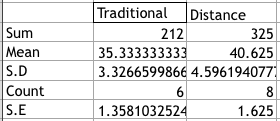
State the hypotheses. The first step is to state the null hypothesis and an alternative hypothesis.
Null hypothesis: u1 = u 2
Alternative hypothesis: u1 u 2
Note that these hypotheses constitute a two-tailed test.
Formulate an analysis plan. For this analysis, the significance level is 0.10. Using sample data, we will conduct a two-sample t-test of the null hypothesis.
Analyze sample data. Using sample data, we compute the standard error (SE), degrees of freedom (DF), and the t statistic test statistic (t).
SE = sqrt[(s12/n1) +
(s22/n2)]
SE = 2.1178
DF = 12
t = [ (x1 - x2) - d ] / SE
t = -2.499
where s1 is the standard deviation of sample 1, s2 is the standard deviation of sample 2, n1 is the size of sample 1, n2 is the size of sample 2, x1 is the mean of sample 1, x2 is the mean of sample 2, d is the hypothesized difference between the population means, and SE is the standard error.
Since we have a two-tailed test, the P-value is the probability that a t statistic having 12 degrees of freedom is more extreme than -2.499; that is, less than -2.499 or greater than 2.499.
Thus, the P-value = 0.028.
Interpret results. Since the P-value (0.028) is greater than the significance level (0.01), we have to accept the null hypothesis.
From the above test we do not have sufficient evidence in the favor of the claim that u1 = u 2 .
Add Answer to:
When only two treatments are involved, ANOVA and the Student’s t
test (Chapter 11) result in...
Question: When only two treatments are involved, ANOVA and the Student’s t test (Chapter 11) result...
Question: When only two treatments are involved, ANOVA and the Student’s t test (Chapter 11) result in the same conclusions. Also, for computed test statistics, t2 = F. To demonstrate this relationship, use the following example. Fourteen randomly selected students enrolled in a history course were divided into two groups, one consisting of 6 students who took the course in the normal lecture format. The other group of 8 students took the course as a distance course format. At the...
When only two treatments are involved, ANOVA and the Student's t test (Chapter 11) result in...
 When only two treatments are involved, ANOVA and the Student's t test (Chapter 11) result in the same conclusions. Also, for computed test statistics, t F. To demonstrate this relationship, use the following example. Fourteen randomly selected students enrolled in a history course were divided into two groups, one consisting of 6 students who took the course in the normal lecture format. The other group of 8 students took the course as a distance course format. At the end of...
When only two treatments are Involved, ANOVA and the Student's ttest (Chapter 11) result In the...
 When only two treatments are Involved, ANOVA and the Student's ttest (Chapter 11) result In the same concluslons. Also, for computed test statistics,迢= F To demonstrate this relationship, use the following example. Fourteen randomly selected students enrolled in a hlstory course were divded Into two groups, one consisting of 6 students who took the course In the normal lecture format. The other group of 8 students took the course as a distance course format. At the end of the course,...
When only two treatments are involved, ANOVA andthe Students ttest (Chapter 11) result in the same...
 When only two treatments are involved, ANOVA andthe Students ttest (Chapter 11) result in the same conclusions. Also, for computed test statistics, F. To demonstrate this relationship use the following example. Fourteen randomly selected students enrolled in a history course were divided into two groups, one consisting of 6 students who took the course in the normal lecture format. The other group of 8 students took the course as a distance course format. At the end of the course, each...
Exercise 12-33 (LO12-2) When only two treatments are involved, ANOVA and the Student's ttest (Chapter 11)...
 Exercise 12-33 (LO12-2) When only two treatments are involved, ANOVA and the Student's ttest (Chapter 11) result in the same conclusions. Also, for computed test statistics, To demonstrate this relationship, use the following example. Fourteen randomly selected students enrolled in a history course were divided into two groups, one consisting of 6 students who took the course in the normal lecture format. The other group of 8 students took the course as a distance course format At the end of...
Chapter 12 Extra Practice (Optional 1 03 pon When only two treatments are involved. ANOVA and...
 Chapter 12 Extra Practice (Optional 1 03 pon When only two treatments are involved. ANOVA and the Student's test (Chapter 19 result in the same conclusions. Also, for computed test statistics, F To demonstrate this relationship, use the following example. Fourteen randomly selected students enrolled in a history course were divided into two groups, one consisting of 6 students who took the course in the normal lecture format. The other group of students took the course as a distance course...
Question 20. The P-Value of the ANOVA F test is researchers studying treatments for agorophobia with...
 Question 20.
The P-Value of the ANOVA F test is
researchers studying treatments for agorophobia with pane disorder The treatments are to be the drug impram e at the doses 1.5 ma per kaar oor sean and s mg of boav a mee also be a contral group given a placebo. Thirty patients were randomly divided into three groups of 10 each. One group was assigned to the control, and the other two groups were assigned to each of the...
Question 20.
The P-Value of the ANOVA F test is
researchers studying treatments for agorophobia with pane disorder The treatments are to be the drug impram e at the doses 1.5 ma per kaar oor sean and s mg of boav a mee also be a contral group given a placebo. Thirty patients were randomly divided into three groups of 10 each. One group was assigned to the control, and the other two groups were assigned to each of the...
Exercise 13-45 Algo A researcher conducts a two-way ANOVA test with interaction and provides the following...
Exercise 13-45 Algo A researcher conducts a two-way ANOVA test with interaction and provides the following ANOVA table. a. Find the missing values in the ANOVA table. (Round intermediate calculations to at least 4 decimal places. Round "MS" to 4 decimal places and "F" to 3 decimal places.) ANOVA Source of Variation SS df MS F p-value Sample 776.84 2 MSB = F Factor B = 0.010 Columns 12,425.44 1 MSA = F Factor A = 4.57E-09 Interaction 56.25 2...
11. What is the null hypothesis for a t-test for two independent groups? a. If mul...
 11. What is the null hypothesis for a t-test for two independent groups? a. If mul and mu2 are the population means of the two groups, then the null hypothesis is Ho: mul-mu2=0. b. If sl and s2 are the population standard deviations of the two groups, then the null hypothesis is Ho: sl-s2=0. 12. Differentiate between a data set that should be analyzed using a paired t-test from a data set that should be analyzed using a t-test for...
Newconnect.mheducation.com Student Homa Chapter 13 Quiz A Gat Hamework Halp With Chagg Study C Sa...
 newconnect.mheducation.com Student Homa Chapter 13 Quiz A Gat Hamework Halp With Chagg Study C Salved: An accounting prafassor wants o k Chapter 13 Quiz A Help Save & ExitSubmit An accounting professor wants to know if students perform the same on the departmental final exam irrespective of the accounting section they attend. She randomly selects the exam scores of 51 students from six sections. A portion of the output from conductinga one-way ANOVA test is shown in the accompanying table....
 When only two treatments are involved, ANOVA and the Student's t test (Chapter 11) result in the same conclusions. Also, for computed test statistics, t F. To demonstrate this relationship, use the following example. Fourteen randomly selected students enrolled in a history course were divided into two groups, one consisting of 6 students who took the course in the normal lecture format. The other group of 8 students took the course as a distance course format. At the end of...
 When only two treatments are Involved, ANOVA and the Student's ttest (Chapter 11) result In the same concluslons. Also, for computed test statistics,迢= F To demonstrate this relationship, use the following example. Fourteen randomly selected students enrolled in a hlstory course were divded Into two groups, one consisting of 6 students who took the course In the normal lecture format. The other group of 8 students took the course as a distance course format. At the end of the course,...
 When only two treatments are involved, ANOVA andthe Students ttest (Chapter 11) result in the same conclusions. Also, for computed test statistics, F. To demonstrate this relationship use the following example. Fourteen randomly selected students enrolled in a history course were divided into two groups, one consisting of 6 students who took the course in the normal lecture format. The other group of 8 students took the course as a distance course format. At the end of the course, each...
 Exercise 12-33 (LO12-2) When only two treatments are involved, ANOVA and the Student's ttest (Chapter 11) result in the same conclusions. Also, for computed test statistics, To demonstrate this relationship, use the following example. Fourteen randomly selected students enrolled in a history course were divided into two groups, one consisting of 6 students who took the course in the normal lecture format. The other group of 8 students took the course as a distance course format At the end of...
 Chapter 12 Extra Practice (Optional 1 03 pon When only two treatments are involved. ANOVA and the Student's test (Chapter 19 result in the same conclusions. Also, for computed test statistics, F To demonstrate this relationship, use the following example. Fourteen randomly selected students enrolled in a history course were divided into two groups, one consisting of 6 students who took the course in the normal lecture format. The other group of students took the course as a distance course...
 Question 20.
The P-Value of the ANOVA F test is
researchers studying treatments for agorophobia with pane disorder The treatments are to be the drug impram e at the doses 1.5 ma per kaar oor sean and s mg of boav a mee also be a contral group given a placebo. Thirty patients were randomly divided into three groups of 10 each. One group was assigned to the control, and the other two groups were assigned to each of the...
Question 20.
The P-Value of the ANOVA F test is
researchers studying treatments for agorophobia with pane disorder The treatments are to be the drug impram e at the doses 1.5 ma per kaar oor sean and s mg of boav a mee also be a contral group given a placebo. Thirty patients were randomly divided into three groups of 10 each. One group was assigned to the control, and the other two groups were assigned to each of the...
 11. What is the null hypothesis for a t-test for two independent groups? a. If mul and mu2 are the population means of the two groups, then the null hypothesis is Ho: mul-mu2=0. b. If sl and s2 are the population standard deviations of the two groups, then the null hypothesis is Ho: sl-s2=0. 12. Differentiate between a data set that should be analyzed using a paired t-test from a data set that should be analyzed using a t-test for...
 newconnect.mheducation.com Student Homa Chapter 13 Quiz A Gat Hamework Halp With Chagg Study C Salved: An accounting prafassor wants o k Chapter 13 Quiz A Help Save & ExitSubmit An accounting professor wants to know if students perform the same on the departmental final exam irrespective of the accounting section they attend. She randomly selects the exam scores of 51 students from six sections. A portion of the output from conductinga one-way ANOVA test is shown in the accompanying table....
Most questions answered within 3 hours.
-
Where is the error in this code sequence?
String s1 = "Hello";
String s2 = "ello";...
asked 10 months ago -
Financial data for Joel de Paris, Inc., for last year
follow:
Joel de Paris, Inc.
Balance...
asked 10 months ago -
Consider this reaction:
Al2(SO4)3 (aq)+ BaCl3
(aq) Al2Cl6 (aq)- +
3BaSO4(s) . What is the...
asked 10 months ago -
Suppose that Savneet is considering increasing her
recent random sample from 20 car rentals to 40...
asked 10 months ago -
Trucks arrive at an unloading terminal at an average rate of 120
per hour.
Trucks arrive...
asked 10 months ago -
Why are methanol and ethanol completely soluble in water while
octanol is not very little soluble....
asked 10 months ago -
A facilities manager at a university reads in a research report
that the mean amount of...
asked 10 months ago -
When the CuSO4 is rehydrated by adding water to the anhydrous
compound, is this an endothermic...
asked 10 months ago -
A ray of sunlight is passing from diamond into crown glass; the
angle of incidence is...
asked 10 months ago -
A block of mass 0.249 kg is placed on top of a light, vertical
spring of...
asked 10 months ago -
how do the kidneys compensate in the presences of acidosis
a) trigger hyperventilate
b) reserve acid...
asked 10 months ago -
Question 501 pts
The rental rate of capital to the firm increases. Which of the
following...
asked 10 months ago