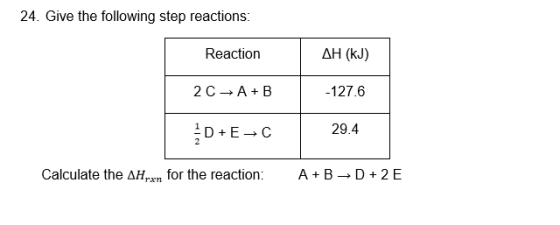
Please explain each step. Thank you in advance.
Homework Answers
Lets number the reaction as 1, 2, 3 from top to bottom
required reaction should be written in terms of other reaction
This is Hess Law
required reaction can be written as:
reaction 3 = -1 * (reaction 1) -2 * (reaction 2)
So, ΔHo rxn for required reaction will be:
ΔHo rxn = -1 * ΔHo rxn(reaction 1) -2 * ΔHo rxn(reaction 2)
= -1 * (-127.6) -2 * (29.4)
= 68.8 KJ
Answer: 68.8 KJ
Add Answer to:
Please explain each step. Thank you in advance.
24. Give the following step reactions: Reaction AH...
i have test in 2hrs. please answer. thank you AH° = -113.2 kJ AH° = ??...
 i
have test in 2hrs. please answer. thank you
AH° = -113.2 kJ AH° = ?? 4. Consider the following thermochemical equation: 2NO(g) + O2(g) → 2 NO2 (g) Calculate AHⓇ for the reaction below: 4 NO2 (g) — 4NO(g) + 202 (g) A. +334.5 kJ B. -146.19 kJ C. +226.4 kJ D. +192.38 kJ E. -509.2 kJ
i
have test in 2hrs. please answer. thank you
AH° = -113.2 kJ AH° = ?? 4. Consider the following thermochemical equation: 2NO(g) + O2(g) → 2 NO2 (g) Calculate AHⓇ for the reaction below: 4 NO2 (g) — 4NO(g) + 202 (g) A. +334.5 kJ B. -146.19 kJ C. +226.4 kJ D. +192.38 kJ E. -509.2 kJ
Any problem from number 5. Please explain step by step. I don't understand steps. Thank you....
 Any problem from number 5. Please explain step by step. I
don't understand steps. Thank you.
4. For each of the following unbalanced half-reactions, determine whether an oxidation or reduction is occurring (a)Cl2 (b) Mn2 MnO (c) H2H+ (d) NO3NO 5. Given the following pairs of balanced half-reactions, determine the balanced reaction for each pair of half reactions in an acidic solution. (a) Ca-Ca2+ + 2e-, F2 + 2e--2F- (b) Li-Li+ + e-, C1, + 2e--2C - (c) Fe Fe+...
Any problem from number 5. Please explain step by step. I
don't understand steps. Thank you.
4. For each of the following unbalanced half-reactions, determine whether an oxidation or reduction is occurring (a)Cl2 (b) Mn2 MnO (c) H2H+ (d) NO3NO 5. Given the following pairs of balanced half-reactions, determine the balanced reaction for each pair of half reactions in an acidic solution. (a) Ca-Ca2+ + 2e-, F2 + 2e--2F- (b) Li-Li+ + e-, C1, + 2e--2C - (c) Fe Fe+...
can anyone please explain me this question step by step, thank you sir/miss 1. Please write...
 can anyone please explain me this question step by
step, thank you sir/miss
1. Please write the equilibrium expression for these reactions: a. CuSO),501,00)-000,00) Suome) b. 146) 162m) 2. For the reaction 10.00-2N06) AH = $k] Where the shift direction (right/left) will be, if: a. We add more NO2(e) b. We increase the container volume C. We decrease the temperature
can anyone please explain me this question step by
step, thank you sir/miss
1. Please write the equilibrium expression for these reactions: a. CuSO),501,00)-000,00) Suome) b. 146) 162m) 2. For the reaction 10.00-2N06) AH = $k] Where the shift direction (right/left) will be, if: a. We add more NO2(e) b. We increase the container volume C. We decrease the temperature
Please explain step by step 12. Calculate the standard reaction enthalpy for the reaction: N2H4(4) +...
 Please explain step by step
12. Calculate the standard reaction enthalpy for the reaction: N2H4(4) + H2(g) → 2NH3(g) Given: N2H4(4) + O2(g) → N2(g) + 2H2O(g) AH° = 0543 kJ 2H2(g) + O2(g) → 2H2O(g) AH° = 1484 kJ N2(g) + 3H2(g) + 2NH3(g) AH° = 092.2 kJ A. - 1119 kJ B. - 33 kJ C. -151 kJ D. + 151 kJ E. + 1119 kJ
Please explain step by step
12. Calculate the standard reaction enthalpy for the reaction: N2H4(4) + H2(g) → 2NH3(g) Given: N2H4(4) + O2(g) → N2(g) + 2H2O(g) AH° = 0543 kJ 2H2(g) + O2(g) → 2H2O(g) AH° = 1484 kJ N2(g) + 3H2(g) + 2NH3(g) AH° = 092.2 kJ A. - 1119 kJ B. - 33 kJ C. -151 kJ D. + 151 kJ E. + 1119 kJ
#9-12 A simple step by step process for all please Thank you! a) -2.81 x 10³...
 #9-12
A simple step by step process for all please
Thank you!
a) -2.81 x 10³ kJ b) -25.8 k c15.6 k d) -42.6 k e) 25.8 k Given the thermochemical equation calculate AHo for the following reaction: 9. 2NOg) + 028) 2NO2g) 솨1°=-114.0 kJ NOg) NO(g) 1/2 02(g) a) +114.0 k b) +57.0 k c) -114 kJ d) -57.0k) e) +128 k] 10. The standard enthalpy change for the following reaction is -72.8 kJ. What is the standard enthalpy...
#9-12
A simple step by step process for all please
Thank you!
a) -2.81 x 10³ kJ b) -25.8 k c15.6 k d) -42.6 k e) 25.8 k Given the thermochemical equation calculate AHo for the following reaction: 9. 2NOg) + 028) 2NO2g) 솨1°=-114.0 kJ NOg) NO(g) 1/2 02(g) a) +114.0 k b) +57.0 k c) -114 kJ d) -57.0k) e) +128 k] 10. The standard enthalpy change for the following reaction is -72.8 kJ. What is the standard enthalpy...
Please write clear. Thank you. Given the information A+ B2D C—D AH = -625.0 kJ AH...
 Please write clear. Thank you.
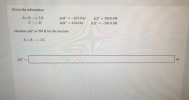
Given the information A+ B2D C—D AH = -625.0 kJ AH = 434.0 kJ AS' = 380.0 J/K AS = -201.0 J/K calculate AG at 298 K for the reaction A+B - 20 AG = kJ
Please write clear. Thank you.
Given the information A+ B2D C—D AH = -625.0 kJ AH = 434.0 kJ AS' = 380.0 J/K AS = -201.0 J/K calculate AG at 298 K for the reaction A+B - 20 AG = kJ
why is the answer C? Please kindly explain step by step. Thank you. Solubility (8 in...
 why is the answer C? Please kindly explain step by step. Thank
you.
Solubility (8 in 100mL of solution) 35.0 T31)The solubility of barium hydroxide in water was measured as a function of temperature. Use the graph produced in that experiment (shown here) to determine the 4Gº for the solubility of barium hydroxide at 25°C. MM(Ba(OH)2) = 171.34g/mol a. 22.9 kJ/mol b. 15.4 kJ/mol C. 5.72 kJ/mol d. -4.00 kJ/mol e. -6.09 kJ/mol 0 10 20 30 40 T(OC) 50...
why is the answer C? Please kindly explain step by step. Thank
you.
Solubility (8 in 100mL of solution) 35.0 T31)The solubility of barium hydroxide in water was measured as a function of temperature. Use the graph produced in that experiment (shown here) to determine the 4Gº for the solubility of barium hydroxide at 25°C. MM(Ba(OH)2) = 171.34g/mol a. 22.9 kJ/mol b. 15.4 kJ/mol C. 5.72 kJ/mol d. -4.00 kJ/mol e. -6.09 kJ/mol 0 10 20 30 40 T(OC) 50...
please and thank you :) Part A For which of the following reactions is A Han...
 please and thank you :)
Part A For which of the following reactions is A Han equal to AH of the product(s)?You do not need to look up any values to answer this question. Check all that apply. View Available Hint(s) CO(g) + O2(g) + CO2(g) C(s, graphite) + O2(8+CO(E) 0 CaCO3(g) +CaO + CO (8) Na(s) + F2(g)--NaF(s) Na(s) + F2 (1) NaF(s) 2Na(s)+F2(6)+2NaF (8) Submit Formation Reactions Part A The standard heat of formation, AH, is defined as...
please and thank you :)
Part A For which of the following reactions is A Han equal to AH of the product(s)?You do not need to look up any values to answer this question. Check all that apply. View Available Hint(s) CO(g) + O2(g) + CO2(g) C(s, graphite) + O2(8+CO(E) 0 CaCO3(g) +CaO + CO (8) Na(s) + F2(g)--NaF(s) Na(s) + F2 (1) NaF(s) 2Na(s)+F2(6)+2NaF (8) Submit Formation Reactions Part A The standard heat of formation, AH, is defined as...
Could you please explain in detail how to do these questions? Thank you in advance. 11....
 Could you please explain in detail how to do these questions?
Thank you in advance.
11. (8 points) Fill in the blanks to complete each of the following nuclear reactions. - - 233 Ac + He 2. Ca + - - 1K c. 20. Au → 291 Hg + d. 18; Eu → __ thiB 12. (10 points) The molar nuclear mass of boron-10 is 10.012937 g/mol. The molar mass of a proton is 1.007825 g/mol. The molar mass of...
Could you please explain in detail how to do these questions?
Thank you in advance.
11. (8 points) Fill in the blanks to complete each of the following nuclear reactions. - - 233 Ac + He 2. Ca + - - 1K c. 20. Au → 291 Hg + d. 18; Eu → __ thiB 12. (10 points) The molar nuclear mass of boron-10 is 10.012937 g/mol. The molar mass of a proton is 1.007825 g/mol. The molar mass of...
Please do this step by step!! PROBLEM 4.16 The bromination of methane proceeds through the following...
 Please do this step by step!!
PROBLEM 4.16 The bromination of methane proceeds through the following steps: AH® (per mole) E (per mole) Br2 h, 2 Br +192 kJ (46 kcal) 192 kJ (46 kcal) CH4 + Br − CH3 + HBr 67 kJ (16 kcal) 75 kJ (18 kcal) -CH3 + Br2 → CH BrBr: -101 kJ (-24 kcal) 4kJ (1 kcal) (a) Draw a complete reaction-energy diagram for this reaction. (b) Label the rate-limiting step. (c) Draw the...
Please do this step by step!!
PROBLEM 4.16 The bromination of methane proceeds through the following steps: AH® (per mole) E (per mole) Br2 h, 2 Br +192 kJ (46 kcal) 192 kJ (46 kcal) CH4 + Br − CH3 + HBr 67 kJ (16 kcal) 75 kJ (18 kcal) -CH3 + Br2 → CH BrBr: -101 kJ (-24 kcal) 4kJ (1 kcal) (a) Draw a complete reaction-energy diagram for this reaction. (b) Label the rate-limiting step. (c) Draw the...
 i
have test in 2hrs. please answer. thank you
AH° = -113.2 kJ AH° = ?? 4. Consider the following thermochemical equation: 2NO(g) + O2(g) → 2 NO2 (g) Calculate AHⓇ for the reaction below: 4 NO2 (g) — 4NO(g) + 202 (g) A. +334.5 kJ B. -146.19 kJ C. +226.4 kJ D. +192.38 kJ E. -509.2 kJ
i
have test in 2hrs. please answer. thank you
AH° = -113.2 kJ AH° = ?? 4. Consider the following thermochemical equation: 2NO(g) + O2(g) → 2 NO2 (g) Calculate AHⓇ for the reaction below: 4 NO2 (g) — 4NO(g) + 202 (g) A. +334.5 kJ B. -146.19 kJ C. +226.4 kJ D. +192.38 kJ E. -509.2 kJ
 Any problem from number 5. Please explain step by step. I
don't understand steps. Thank you.
4. For each of the following unbalanced half-reactions, determine whether an oxidation or reduction is occurring (a)Cl2 (b) Mn2 MnO (c) H2H+ (d) NO3NO 5. Given the following pairs of balanced half-reactions, determine the balanced reaction for each pair of half reactions in an acidic solution. (a) Ca-Ca2+ + 2e-, F2 + 2e--2F- (b) Li-Li+ + e-, C1, + 2e--2C - (c) Fe Fe+...
Any problem from number 5. Please explain step by step. I
don't understand steps. Thank you.
4. For each of the following unbalanced half-reactions, determine whether an oxidation or reduction is occurring (a)Cl2 (b) Mn2 MnO (c) H2H+ (d) NO3NO 5. Given the following pairs of balanced half-reactions, determine the balanced reaction for each pair of half reactions in an acidic solution. (a) Ca-Ca2+ + 2e-, F2 + 2e--2F- (b) Li-Li+ + e-, C1, + 2e--2C - (c) Fe Fe+...
 can anyone please explain me this question step by
step, thank you sir/miss
1. Please write the equilibrium expression for these reactions: a. CuSO),501,00)-000,00) Suome) b. 146) 162m) 2. For the reaction 10.00-2N06) AH = $k] Where the shift direction (right/left) will be, if: a. We add more NO2(e) b. We increase the container volume C. We decrease the temperature
can anyone please explain me this question step by
step, thank you sir/miss
1. Please write the equilibrium expression for these reactions: a. CuSO),501,00)-000,00) Suome) b. 146) 162m) 2. For the reaction 10.00-2N06) AH = $k] Where the shift direction (right/left) will be, if: a. We add more NO2(e) b. We increase the container volume C. We decrease the temperature
 Please explain step by step
12. Calculate the standard reaction enthalpy for the reaction: N2H4(4) + H2(g) → 2NH3(g) Given: N2H4(4) + O2(g) → N2(g) + 2H2O(g) AH° = 0543 kJ 2H2(g) + O2(g) → 2H2O(g) AH° = 1484 kJ N2(g) + 3H2(g) + 2NH3(g) AH° = 092.2 kJ A. - 1119 kJ B. - 33 kJ C. -151 kJ D. + 151 kJ E. + 1119 kJ
Please explain step by step
12. Calculate the standard reaction enthalpy for the reaction: N2H4(4) + H2(g) → 2NH3(g) Given: N2H4(4) + O2(g) → N2(g) + 2H2O(g) AH° = 0543 kJ 2H2(g) + O2(g) → 2H2O(g) AH° = 1484 kJ N2(g) + 3H2(g) + 2NH3(g) AH° = 092.2 kJ A. - 1119 kJ B. - 33 kJ C. -151 kJ D. + 151 kJ E. + 1119 kJ
 #9-12
A simple step by step process for all please
Thank you!
a) -2.81 x 10³ kJ b) -25.8 k c15.6 k d) -42.6 k e) 25.8 k Given the thermochemical equation calculate AHo for the following reaction: 9. 2NOg) + 028) 2NO2g) 솨1°=-114.0 kJ NOg) NO(g) 1/2 02(g) a) +114.0 k b) +57.0 k c) -114 kJ d) -57.0k) e) +128 k] 10. The standard enthalpy change for the following reaction is -72.8 kJ. What is the standard enthalpy...
#9-12
A simple step by step process for all please
Thank you!
a) -2.81 x 10³ kJ b) -25.8 k c15.6 k d) -42.6 k e) 25.8 k Given the thermochemical equation calculate AHo for the following reaction: 9. 2NOg) + 028) 2NO2g) 솨1°=-114.0 kJ NOg) NO(g) 1/2 02(g) a) +114.0 k b) +57.0 k c) -114 kJ d) -57.0k) e) +128 k] 10. The standard enthalpy change for the following reaction is -72.8 kJ. What is the standard enthalpy...
 Please write clear. Thank you.
Given the information A+ B2D C—D AH = -625.0 kJ AH = 434.0 kJ AS' = 380.0 J/K AS = -201.0 J/K calculate AG at 298 K for the reaction A+B - 20 AG = kJ
Please write clear. Thank you.
Given the information A+ B2D C—D AH = -625.0 kJ AH = 434.0 kJ AS' = 380.0 J/K AS = -201.0 J/K calculate AG at 298 K for the reaction A+B - 20 AG = kJ
 why is the answer C? Please kindly explain step by step. Thank
you.
Solubility (8 in 100mL of solution) 35.0 T31)The solubility of barium hydroxide in water was measured as a function of temperature. Use the graph produced in that experiment (shown here) to determine the 4Gº for the solubility of barium hydroxide at 25°C. MM(Ba(OH)2) = 171.34g/mol a. 22.9 kJ/mol b. 15.4 kJ/mol C. 5.72 kJ/mol d. -4.00 kJ/mol e. -6.09 kJ/mol 0 10 20 30 40 T(OC) 50...
why is the answer C? Please kindly explain step by step. Thank
you.
Solubility (8 in 100mL of solution) 35.0 T31)The solubility of barium hydroxide in water was measured as a function of temperature. Use the graph produced in that experiment (shown here) to determine the 4Gº for the solubility of barium hydroxide at 25°C. MM(Ba(OH)2) = 171.34g/mol a. 22.9 kJ/mol b. 15.4 kJ/mol C. 5.72 kJ/mol d. -4.00 kJ/mol e. -6.09 kJ/mol 0 10 20 30 40 T(OC) 50...
 please and thank you :)
Part A For which of the following reactions is A Han equal to AH of the product(s)?You do not need to look up any values to answer this question. Check all that apply. View Available Hint(s) CO(g) + O2(g) + CO2(g) C(s, graphite) + O2(8+CO(E) 0 CaCO3(g) +CaO + CO (8) Na(s) + F2(g)--NaF(s) Na(s) + F2 (1) NaF(s) 2Na(s)+F2(6)+2NaF (8) Submit Formation Reactions Part A The standard heat of formation, AH, is defined as...
please and thank you :)
Part A For which of the following reactions is A Han equal to AH of the product(s)?You do not need to look up any values to answer this question. Check all that apply. View Available Hint(s) CO(g) + O2(g) + CO2(g) C(s, graphite) + O2(8+CO(E) 0 CaCO3(g) +CaO + CO (8) Na(s) + F2(g)--NaF(s) Na(s) + F2 (1) NaF(s) 2Na(s)+F2(6)+2NaF (8) Submit Formation Reactions Part A The standard heat of formation, AH, is defined as...
 Could you please explain in detail how to do these questions?
Thank you in advance.
11. (8 points) Fill in the blanks to complete each of the following nuclear reactions. - - 233 Ac + He 2. Ca + - - 1K c. 20. Au → 291 Hg + d. 18; Eu → __ thiB 12. (10 points) The molar nuclear mass of boron-10 is 10.012937 g/mol. The molar mass of a proton is 1.007825 g/mol. The molar mass of...
Could you please explain in detail how to do these questions?
Thank you in advance.
11. (8 points) Fill in the blanks to complete each of the following nuclear reactions. - - 233 Ac + He 2. Ca + - - 1K c. 20. Au → 291 Hg + d. 18; Eu → __ thiB 12. (10 points) The molar nuclear mass of boron-10 is 10.012937 g/mol. The molar mass of a proton is 1.007825 g/mol. The molar mass of...
 Please do this step by step!!
PROBLEM 4.16 The bromination of methane proceeds through the following steps: AH® (per mole) E (per mole) Br2 h, 2 Br +192 kJ (46 kcal) 192 kJ (46 kcal) CH4 + Br − CH3 + HBr 67 kJ (16 kcal) 75 kJ (18 kcal) -CH3 + Br2 → CH BrBr: -101 kJ (-24 kcal) 4kJ (1 kcal) (a) Draw a complete reaction-energy diagram for this reaction. (b) Label the rate-limiting step. (c) Draw the...
Please do this step by step!!
PROBLEM 4.16 The bromination of methane proceeds through the following steps: AH® (per mole) E (per mole) Br2 h, 2 Br +192 kJ (46 kcal) 192 kJ (46 kcal) CH4 + Br − CH3 + HBr 67 kJ (16 kcal) 75 kJ (18 kcal) -CH3 + Br2 → CH BrBr: -101 kJ (-24 kcal) 4kJ (1 kcal) (a) Draw a complete reaction-energy diagram for this reaction. (b) Label the rate-limiting step. (c) Draw the...
Most questions answered within 3 hours.
-
Where is the error in this code sequence?
String s1 = "Hello";
String s2 = "ello";...
asked 10 months ago -
Financial data for Joel de Paris, Inc., for last year
follow:
Joel de Paris, Inc.
Balance...
asked 10 months ago -
Consider this reaction:
Al2(SO4)3 (aq)+ BaCl3
(aq) Al2Cl6 (aq)- +
3BaSO4(s) . What is the...
asked 10 months ago -
Suppose that Savneet is considering increasing her
recent random sample from 20 car rentals to 40...
asked 10 months ago -
Trucks arrive at an unloading terminal at an average rate of 120
per hour.
Trucks arrive...
asked 10 months ago -
Why are methanol and ethanol completely soluble in water while
octanol is not very little soluble....
asked 10 months ago -
A facilities manager at a university reads in a research report
that the mean amount of...
asked 10 months ago -
When the CuSO4 is rehydrated by adding water to the anhydrous
compound, is this an endothermic...
asked 10 months ago -
A ray of sunlight is passing from diamond into crown glass; the
angle of incidence is...
asked 10 months ago -
A block of mass 0.249 kg is placed on top of a light, vertical
spring of...
asked 10 months ago -
how do the kidneys compensate in the presences of acidosis
a) trigger hyperventilate
b) reserve acid...
asked 10 months ago -
Question 501 pts
The rental rate of capital to the firm increases. Which of the
following...
asked 10 months ago