mechanism for the transformation of ε-caprolatone to 6-hydroxyhexanoate
mechanism for the transformation of ε-caprolatone to 6-hydroxyhexanoate
Homework Answers
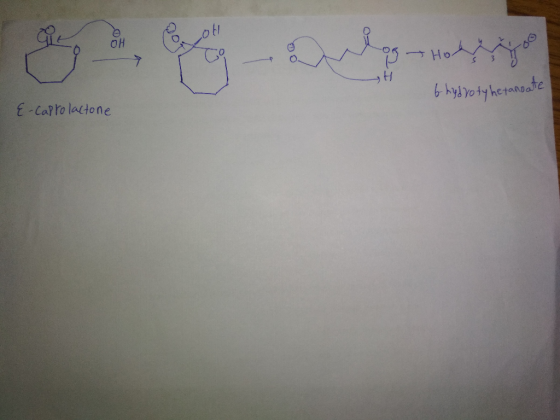
Overall reaction is an example for hydrolysis of lactone (cyclic ester) in basic medium gives hydroxy carboxylate.
Add Answer to:
mechanism for the transformation of ε-caprolatone to
6-hydroxyhexanoate
Give a plausible mechanism for the transformation of ε-caprolatone to 6-hydroxyhexanoate
Give a plausible mechanism for the transformation of ε-caprolatone to 6-hydroxyhexanoate
6. Draw the mechanism for the following transformation (5 points) HCI CH3 ci CH3
 6. Draw the mechanism for the following transformation (5 points) HCI CH3 ci CH3
Suggest a detailed mechanism for the following transformation: please show arrow pushing Suggest a detailed mechanism...
 Suggest a detailed mechanism for the following transformation:
please show arrow pushing
Suggest a detailed mechanism for the following transformation: HO O K 8 7 5 2 6 10 1143 9 (catalytic)
Suggest a detailed mechanism for the following transformation:
please show arrow pushing
Suggest a detailed mechanism for the following transformation: HO O K 8 7 5 2 6 10 1143 9 (catalytic)
9. Draw a plausible mechanism for the transformation below. (6 pts) EtOH OEt heat ОТf
 9. Draw a plausible mechanism for the transformation below. (6 pts) EtOH OEt heat ОТf
6. Provide a detailed, stepwise mechanism for the following transformation. Use curved arrows to show the...
 6. Provide a detailed, stepwise mechanism for the following transformation. Use curved arrows to show the movement of electrons. ...OH ..OH 1. Oz then SMez 2. NaBH4 . MeOH 3. TsOH Meo
Question 4 (6 marks) Provide a stepwise mechanism for the following transformation. CO2H H30+ OH Note...
 Question 4 (6 marks) Provide a stepwise mechanism for the following transformation. CO2H H30+ OH Note the position of the C-O bond in the product.
4. Provide a plausible mechanism for the reaction shown. (6 pts) Naal 5. Each transformation shown...
 4. Provide a plausible mechanism for the reaction shown. (6 pts) Naal 5. Each transformation shown below requires at least two steps. Provide the reagents/conditions for each transformation. (20 pts) Reng Remsc 6. Predict the products from the Birch reductions shown below. (3 pts) Mì, NHÀ са он Bonus: (6 pts) Provide a synthesis for the target molecule using benzene. CO2H oto сон TM
Draw the structures of compound x and y. show the curved arrow mechanism for the transformation...
 Draw the structures of compound x and y. show the curved arrow
mechanism for the transformation of compound x to compound y.
6. Draw the structures of compound X and compound Y. Show the curved arrow mechanism for the transformation of compound X to compound Y. (2) Heat OM arou K2Cr2O7 OH H2SO4, H20 compound X compound Y Mechanism of compound X to compound Y:
Draw the structures of compound x and y. show the curved arrow
mechanism for the transformation of compound x to compound y.
6. Draw the structures of compound X and compound Y. Show the curved arrow mechanism for the transformation of compound X to compound Y. (2) Heat OM arou K2Cr2O7 OH H2SO4, H20 compound X compound Y Mechanism of compound X to compound Y:
Draw a stepwise mechanism for the following transformation:
 Draw a stepwise mechanism for the following transformation:
propose a mechanism that shows the following transformation, find your electrophile and nucleophile Propose a mechanism...
 propose a mechanism that shows the following transformation,
find your electrophile and nucleophile
Propose a mechanism that shows the following transformation (Hint: find your electrophile and nucleophile) al do a SO CI + No H
propose a mechanism that shows the following transformation,
find your electrophile and nucleophile
Propose a mechanism that shows the following transformation (Hint: find your electrophile and nucleophile) al do a SO CI + No H
 6. Draw the mechanism for the following transformation (5 points) HCI CH3 ci CH3
 Suggest a detailed mechanism for the following transformation:
please show arrow pushing
Suggest a detailed mechanism for the following transformation: HO O K 8 7 5 2 6 10 1143 9 (catalytic)
Suggest a detailed mechanism for the following transformation:
please show arrow pushing
Suggest a detailed mechanism for the following transformation: HO O K 8 7 5 2 6 10 1143 9 (catalytic)
 9. Draw a plausible mechanism for the transformation below. (6 pts) EtOH OEt heat ОТf
 6. Provide a detailed, stepwise mechanism for the following transformation. Use curved arrows to show the movement of electrons. ...OH ..OH 1. Oz then SMez 2. NaBH4 . MeOH 3. TsOH Meo
 Question 4 (6 marks) Provide a stepwise mechanism for the following transformation. CO2H H30+ OH Note the position of the C-O bond in the product.
 4. Provide a plausible mechanism for the reaction shown. (6 pts) Naal 5. Each transformation shown below requires at least two steps. Provide the reagents/conditions for each transformation. (20 pts) Reng Remsc 6. Predict the products from the Birch reductions shown below. (3 pts) Mì, NHÀ са он Bonus: (6 pts) Provide a synthesis for the target molecule using benzene. CO2H oto сон TM
 Draw the structures of compound x and y. show the curved arrow
mechanism for the transformation of compound x to compound y.
6. Draw the structures of compound X and compound Y. Show the curved arrow mechanism for the transformation of compound X to compound Y. (2) Heat OM arou K2Cr2O7 OH H2SO4, H20 compound X compound Y Mechanism of compound X to compound Y:
Draw the structures of compound x and y. show the curved arrow
mechanism for the transformation of compound x to compound y.
6. Draw the structures of compound X and compound Y. Show the curved arrow mechanism for the transformation of compound X to compound Y. (2) Heat OM arou K2Cr2O7 OH H2SO4, H20 compound X compound Y Mechanism of compound X to compound Y:
 Draw a stepwise mechanism for the following transformation:
 propose a mechanism that shows the following transformation,
find your electrophile and nucleophile
Propose a mechanism that shows the following transformation (Hint: find your electrophile and nucleophile) al do a SO CI + No H
propose a mechanism that shows the following transformation,
find your electrophile and nucleophile
Propose a mechanism that shows the following transformation (Hint: find your electrophile and nucleophile) al do a SO CI + No H
Most questions answered within 3 hours.
-
Where is the error in this code sequence?
String s1 = "Hello";
String s2 = "ello";...
asked 11 months ago -
Financial data for Joel de Paris, Inc., for last year
follow:
Joel de Paris, Inc.
Balance...
asked 11 months ago -
Consider this reaction:
Al2(SO4)3 (aq)+ BaCl3
(aq) Al2Cl6 (aq)- +
3BaSO4(s) . What is the...
asked 11 months ago -
Suppose that Savneet is considering increasing her
recent random sample from 20 car rentals to 40...
asked 11 months ago -
Trucks arrive at an unloading terminal at an average rate of 120
per hour.
Trucks arrive...
asked 11 months ago -
Why are methanol and ethanol completely soluble in water while
octanol is not very little soluble....
asked 11 months ago -
A facilities manager at a university reads in a research report
that the mean amount of...
asked 11 months ago -
When the CuSO4 is rehydrated by adding water to the anhydrous
compound, is this an endothermic...
asked 11 months ago -
A ray of sunlight is passing from diamond into crown glass; the
angle of incidence is...
asked 11 months ago -
A block of mass 0.249 kg is placed on top of a light, vertical
spring of...
asked 11 months ago -
how do the kidneys compensate in the presences of acidosis
a) trigger hyperventilate
b) reserve acid...
asked 11 months ago -
Question 501 pts
The rental rate of capital to the firm increases. Which of the
following...
asked 11 months ago