
Homework Answers
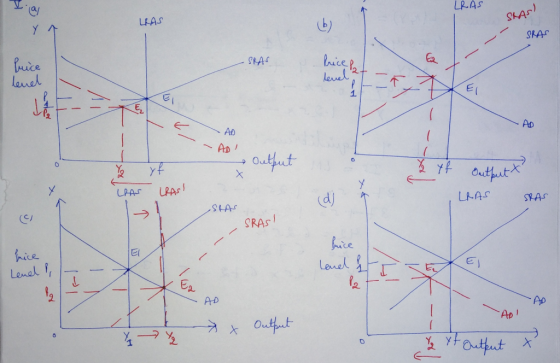
Initial equilibrium in all the cases occurs at point E1 where aggregate demand curve, short run aggregate supply curve and long run aggregate supply curve of the economy intersects.
a. A decline in the stock market will reduce investment expenditure in the economy and thus shift the AD curve leftwards to AD' and at new short run equilibrium point E2, price level has decreased and national output has fallen which increases unemployment rate in the economy.
b. War will shift the SRAS curve leftwards to SRAS' and this will lead to increase in the price level and reduce the level of national output in the economy and thus unemployment rate in the economy increases.
c. Improvement in productivity will shift both the short run and long run aggregate supply curve of the economy rightwards and at new equilibrium point E2, price level has fallen and national output has increased reducing unemployment rate in the economy.
d. Recession in Mexico will reduce net exports of US and thus shift the Ad curve leftwards and thus both price level and output has fallen leading to increase in unemployment rate in the economy.
Add Answer to:
V. For each of the following four events (a-d, below), explain the short-run effects on U.S....
For each of the following events, explain the short-run and long-run effects on output and the...
For each of the following events, explain the short-run and long-run effects on output and the price level, assuming policymakers take no action. Answer the questions using sticky-wage theory. a) The stock market declines sharply, reducing consumer’s wealth. b) Now suppose that a stock market crash causes aggregate demand to fall. Use your diagram to show what happens to output and the price level in the short run. What happens to the unemployment rate? c) A recessions overseas causes foreigners...
1. For each of the following events, explain the short-run and long-run effects on output and...
1. For each of the following events, explain the short-run and long-run effects on output and price level, assuming policymakers take no action. a. The stock market declines sharply, reducing consumers’ wealth. b. The federal government increases spending on national defense. c. A technological improvement raises productivity. d. A recession overseas causes foreigners to buy fewer U.S. goods. e. Household decide to save a larger share of their income. f. Increased job opportunities overseas cause many people to leave the...
The graph below depicts the aggregate demand, Irrun aggregate supply, and short-run aggregate supply curves for...
 The graph below depicts the aggregate demand, Irrun aggregate supply, and short-run aggregate supply curves for the United States at an initial long-run macroeconomic equilibrium Price level] (P) LRAS SRAS Real GDP Consider a situation in which two things happen simultaneously: there is a deterioration of institutions, and the federal government massively increases spending. Which of the graphs below illustrates the shifts in this model given this situation? Price level Price level (P) (P) URAS LRAS, LRAS SRAS SRAS SRAS...
drawing the graph of AD (Aggregate Demand), SRAS (Short- run aggregate supply curve) and LRAS (...
drawing the graph of AD (Aggregate Demand), SRAS (Short- run aggregate supply curve) and LRAS ( long run aggregate supply curve) and writing down what would happen under the two conditions "increase personal income taxes" and "decrease personal income taxes". You need to write down everything happens by following the seven steps: 1. What would happen under the condition? (Whether AD, SRAS, or LRAS would change? And in which direction the curve would shift?) 2. Where is the new short-run...
In the economy depicted in the graph, what happens if there is no intervention from policy...
 In the economy depicted in the graph, what happens if there is no intervention from policy makers? Use the graph, where LRAS represents long-run aggregate supply, SRAS represents short-run aggregate supply, and AD represents aggregate demand, to demonstrate the answers by shifting the appropriate curve or curves. LRAS SRAS Prices will Aggregate price level (P) decrease. O increase. Output will decrease. Real output (Q) O increase.
24 the changes in prices and output that occur in the long run. changes in wages,...
 24 the changes in prices and output that occur in the long run. changes in wages, and these are unchanged in the long run. the availability and productivity of real resources, not by the output level. b. The shape of the short-run aggregate supply curve is points eBook upsloping, because wages adjust more rapidly than the price level vertical, because wages adjust at the same rate as the price level. upsloping, because wages adjust more slowly than the price level,...
Assume the U.S. economy is in both short-run and long-run equilibrium, as shown in the graph...
 Assume the U.S. economy is in both short-run and long-run equilibrium, as shown in the graph below. Suppose the federal government increases the amount of spending on the military. either the new a. Show the effect on the short-run equilibrium as a result of increased government spending. Using the graph, dra AD curve or new AS curve resulting from this change in spending. Instructions: Use the tool provided 'New Curve' to plot the appropriate line. After placing the curve, click...
Use an AD and AS graph (and words) to explain the short-run and long-run effects on...
Use an AD and AS graph (and words) to explain the short-run and long-run effects on real GDP and price level of a decrease in net exports. Assume the economy begins at full employment. Be sure to state what happens to price level and Real GDP in both the short-run and long-run and how the economy transitions from short to long-run. (YOU MUST DRAW A GRAPH)
Update the graph below to show an increase in short run aggregate supply and show what...
 Update the graph below to show an increase in short run aggregate supply and show what effect this increase in increase short run aggregate supply will have on price levels and real GDP. 1. Price level SRAS AD Real GDF 2. Assume that a recessionary gap currently exists. If long-run supply (aka, potential output) increases and there is no change to aggregate demand or short run aggregate supply what happens to real GDP and to the recessionary gap?
Use AD-AS analysis to show how each of the events below will affect the equilibrium price...
Use AD-AS analysis to show how each of the events below will affect the equilibrium price level and real output in an economy in the short run when the aggregate supply curve is upward-sloping. Your answer must include a graph and explanation in words.Government spending increases. New technology increases the productivity of workers.
 The graph below depicts the aggregate demand, Irrun aggregate supply, and short-run aggregate supply curves for the United States at an initial long-run macroeconomic equilibrium Price level] (P) LRAS SRAS Real GDP Consider a situation in which two things happen simultaneously: there is a deterioration of institutions, and the federal government massively increases spending. Which of the graphs below illustrates the shifts in this model given this situation? Price level Price level (P) (P) URAS LRAS, LRAS SRAS SRAS SRAS...
 In the economy depicted in the graph, what happens if there is no intervention from policy makers? Use the graph, where LRAS represents long-run aggregate supply, SRAS represents short-run aggregate supply, and AD represents aggregate demand, to demonstrate the answers by shifting the appropriate curve or curves. LRAS SRAS Prices will Aggregate price level (P) decrease. O increase. Output will decrease. Real output (Q) O increase.
 24 the changes in prices and output that occur in the long run. changes in wages, and these are unchanged in the long run. the availability and productivity of real resources, not by the output level. b. The shape of the short-run aggregate supply curve is points eBook upsloping, because wages adjust more rapidly than the price level vertical, because wages adjust at the same rate as the price level. upsloping, because wages adjust more slowly than the price level,...
 Assume the U.S. economy is in both short-run and long-run equilibrium, as shown in the graph below. Suppose the federal government increases the amount of spending on the military. either the new a. Show the effect on the short-run equilibrium as a result of increased government spending. Using the graph, dra AD curve or new AS curve resulting from this change in spending. Instructions: Use the tool provided 'New Curve' to plot the appropriate line. After placing the curve, click...
 Update the graph below to show an increase in short run aggregate supply and show what effect this increase in increase short run aggregate supply will have on price levels and real GDP. 1. Price level SRAS AD Real GDF 2. Assume that a recessionary gap currently exists. If long-run supply (aka, potential output) increases and there is no change to aggregate demand or short run aggregate supply what happens to real GDP and to the recessionary gap?
Most questions answered within 3 hours.
-
Where is the error in this code sequence?
String s1 = "Hello";
String s2 = "ello";...
asked 11 months ago -
Financial data for Joel de Paris, Inc., for last year
follow:
Joel de Paris, Inc.
Balance...
asked 11 months ago -
Consider this reaction:
Al2(SO4)3 (aq)+ BaCl3
(aq) Al2Cl6 (aq)- +
3BaSO4(s) . What is the...
asked 11 months ago -
Suppose that Savneet is considering increasing her
recent random sample from 20 car rentals to 40...
asked 11 months ago -
Trucks arrive at an unloading terminal at an average rate of 120
per hour.
Trucks arrive...
asked 11 months ago -
Why are methanol and ethanol completely soluble in water while
octanol is not very little soluble....
asked 11 months ago -
A facilities manager at a university reads in a research report
that the mean amount of...
asked 11 months ago -
When the CuSO4 is rehydrated by adding water to the anhydrous
compound, is this an endothermic...
asked 11 months ago -
A ray of sunlight is passing from diamond into crown glass; the
angle of incidence is...
asked 11 months ago -
A block of mass 0.249 kg is placed on top of a light, vertical
spring of...
asked 11 months ago -
how do the kidneys compensate in the presences of acidosis
a) trigger hyperventilate
b) reserve acid...
asked 11 months ago -
Question 501 pts
The rental rate of capital to the firm increases. Which of the
following...
asked 11 months ago