


Homework Answers
Add Answer to:
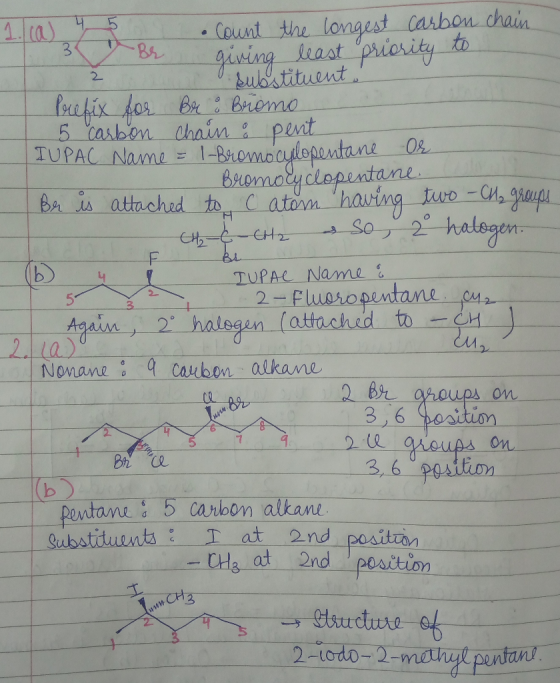
1. For each of the following structures, i. write the IUPAC name. (2 pts.) ii. classify...
2. Draw structures for the following alkyl halides. Be sure to indicate any stereochemistry as needed....
 2. Draw structures for the following alkyl halides. Be sure to indicate any stereochemistry as needed. (2 pts. each) a. 3,6-dibromo-3,6-dichlorononane b. 2-iodo-2-methylpentane
Page 2 3. I State which reagent you would expect to be more nucleophilic. (1 pt.)...
 Page 2 3. I State which reagent you would expect to be more nucleophilic. (1 pt.) ii. Explain why you would expect your choice to be more nucleophilic. (2 pts.) a) CH,CH,OH or CH,CH,0- b) Ph-S or Ph-0-
3. State which reagent you would expect to be more nucleophilic (1 pt.) ii. Explain why...
 3. State which reagent you would expect to be more nucleophilic (1 pt.) ii. Explain why you would expect your choice to be more nucleophilic (2 pts.) a) CH CH.OH or CH CHO b) Ph-5 or Ph-O-
1. Which of the following structures is/are a secondary alkyl halide? (a) I and II (b)...
 1. Which of the following structures is/are a secondary alkyl
halide? (a) I and II (b) II and V (c) I, II and V (d) IV only (e)
I, II and III 2. Which of the following is/are aprotic solvent(s)?
Choose all correct answers. (a) (b) (c) (d) (e) (f) 3. Which of the
following carbocations, if formed, is (are) likely to undergo
rearrangement through a hydride shift? (a) I (b) II (c) III (d) I
and II (e) II...
1. Which of the following structures is/are a secondary alkyl
halide? (a) I and II (b) II and V (c) I, II and V (d) IV only (e)
I, II and III 2. Which of the following is/are aprotic solvent(s)?
Choose all correct answers. (a) (b) (c) (d) (e) (f) 3. Which of the
following carbocations, if formed, is (are) likely to undergo
rearrangement through a hydride shift? (a) I (b) II (c) III (d) I
and II (e) II...
I. name the following compounds II. write structures for each of the followong structires III.Arrange alkenes from most...
 I.
name the following compounds
II. write structures for each of the followong
structires
III.Arrange alkenes from most to least stable
IV. if rearrangement is expected, draw rearranged structure
for wach carbocation
V.
PLEASE HELP, ive been struggling in organic and this is the
review for our 3rd exam. if i can get help (and explanations) for
1-4 it would be a big help
CHM 2210 Examination 3 11/02/18 Directions: Please supply all answers in the spaces provided on both...
I.
name the following compounds
II. write structures for each of the followong
structires
III.Arrange alkenes from most to least stable
IV. if rearrangement is expected, draw rearranged structure
for wach carbocation
V.
PLEASE HELP, ive been struggling in organic and this is the
review for our 3rd exam. if i can get help (and explanations) for
1-4 it would be a big help
CHM 2210 Examination 3 11/02/18 Directions: Please supply all answers in the spaces provided on both...
1) State which of the electrophiles given below will react preferentially by i) SN1, ii) by...
 1) State which of the electrophiles given below will react
preferentially by i) SN1, ii) by SN2, or iii) capable of reacting
by either of the two mechanisms depending on the given conditions.
How can you affect those conditions to favour SN1 or SN2? Reason
your predictions based on the structures of the compounds. Br-CH3,
Br-CH2CH3, Br-CH(CH3)2, Br-C(CH3)3, Br-CH2-C5H6; C5H6 = phenyl
Introduction Alkyl halides can be prepared from alcohols by reactions with hydrogen halides (HCI, HBr, or HI) via...
1) State which of the electrophiles given below will react
preferentially by i) SN1, ii) by SN2, or iii) capable of reacting
by either of the two mechanisms depending on the given conditions.
How can you affect those conditions to favour SN1 or SN2? Reason
your predictions based on the structures of the compounds. Br-CH3,
Br-CH2CH3, Br-CH(CH3)2, Br-C(CH3)3, Br-CH2-C5H6; C5H6 = phenyl
Introduction Alkyl halides can be prepared from alcohols by reactions with hydrogen halides (HCI, HBr, or HI) via...
answer all 1. In each of the following, indicate which S2 reaction will occur faster. Explain...
 answer all
1. In each of the following, indicate which S2 reaction will occur faster. Explain your reasoning. a. 1-bromo-2,2-dimethylpropane or 1-bromo-3-methylbutane with Nal in DMSO. b. 1-iodopentane with NaN, in ethanol or NaSCH, in ethanol, c. Reaction of isobutyl iodide with NaBr in acetone or in ethanol. 2. In each of the following, indicate which S, 1 reaction will occur faster. Explain your reasoning. a. Reaction of I-chloro-1-methylcyclohexane or 1-chloro-2-methylcyclohexane in aqueous ethanol. b. Reaction of 2-chloropentane or 3-bromohexane...
answer all
1. In each of the following, indicate which S2 reaction will occur faster. Explain your reasoning. a. 1-bromo-2,2-dimethylpropane or 1-bromo-3-methylbutane with Nal in DMSO. b. 1-iodopentane with NaN, in ethanol or NaSCH, in ethanol, c. Reaction of isobutyl iodide with NaBr in acetone or in ethanol. 2. In each of the following, indicate which S, 1 reaction will occur faster. Explain your reasoning. a. Reaction of I-chloro-1-methylcyclohexane or 1-chloro-2-methylcyclohexane in aqueous ethanol. b. Reaction of 2-chloropentane or 3-bromohexane...
11) (50 pts total) Consider the following 2 compounds: Yor You I II (a) (6 pts)...
 11) (50 pts total) Consider the following 2 compounds: Yor You I II (a) (6 pts) Provide the IUPAC names for compounds I and II. Compound I: Compound II: (b) (10 pts) Draw the resonance contributors of compounds I and II. Which compound is more stable? Explain in 20 words or less. (c) (6 pts) Which C-N bond below is shorter, A or B ? Explain in 20 words or less. (d) (6 pts) Draw the products obtained when compound...
CH3 (4) 1. Which of the following alkyl halides would you expect to be most reactive...
 CH3 (4) 1. Which of the following alkyl halides would you expect to be most reactive in a unimolecular reaction? a) C&H, CH, CH, CH, BY b) CH 1 CH CH Br C) CH11CCH, Br d) C6H CH2 CH CHỊ CHỊ CH3 CHỊ e) C&H, CCH Br CHE (4) 2. What would you expect to be the chief organic product(s) when tert-butyl bromide reacts with sodium acetylide, i.e., CH3 + - CH2-C-Br + Na :CECH — ? CH a) I...
 2. Draw structures for the following alkyl halides. Be sure to indicate any stereochemistry as needed. (2 pts. each) a. 3,6-dibromo-3,6-dichlorononane b. 2-iodo-2-methylpentane
 Page 2 3. I State which reagent you would expect to be more nucleophilic. (1 pt.) ii. Explain why you would expect your choice to be more nucleophilic. (2 pts.) a) CH,CH,OH or CH,CH,0- b) Ph-S or Ph-0-
 3. State which reagent you would expect to be more nucleophilic (1 pt.) ii. Explain why you would expect your choice to be more nucleophilic (2 pts.) a) CH CH.OH or CH CHO b) Ph-5 or Ph-O-
 1. Which of the following structures is/are a secondary alkyl
halide? (a) I and II (b) II and V (c) I, II and V (d) IV only (e)
I, II and III 2. Which of the following is/are aprotic solvent(s)?
Choose all correct answers. (a) (b) (c) (d) (e) (f) 3. Which of the
following carbocations, if formed, is (are) likely to undergo
rearrangement through a hydride shift? (a) I (b) II (c) III (d) I
and II (e) II...
1. Which of the following structures is/are a secondary alkyl
halide? (a) I and II (b) II and V (c) I, II and V (d) IV only (e)
I, II and III 2. Which of the following is/are aprotic solvent(s)?
Choose all correct answers. (a) (b) (c) (d) (e) (f) 3. Which of the
following carbocations, if formed, is (are) likely to undergo
rearrangement through a hydride shift? (a) I (b) II (c) III (d) I
and II (e) II...
 I.
name the following compounds
II. write structures for each of the followong
structires
III.Arrange alkenes from most to least stable
IV. if rearrangement is expected, draw rearranged structure
for wach carbocation
V.
PLEASE HELP, ive been struggling in organic and this is the
review for our 3rd exam. if i can get help (and explanations) for
1-4 it would be a big help
CHM 2210 Examination 3 11/02/18 Directions: Please supply all answers in the spaces provided on both...
I.
name the following compounds
II. write structures for each of the followong
structires
III.Arrange alkenes from most to least stable
IV. if rearrangement is expected, draw rearranged structure
for wach carbocation
V.
PLEASE HELP, ive been struggling in organic and this is the
review for our 3rd exam. if i can get help (and explanations) for
1-4 it would be a big help
CHM 2210 Examination 3 11/02/18 Directions: Please supply all answers in the spaces provided on both...
 1) State which of the electrophiles given below will react
preferentially by i) SN1, ii) by SN2, or iii) capable of reacting
by either of the two mechanisms depending on the given conditions.
How can you affect those conditions to favour SN1 or SN2? Reason
your predictions based on the structures of the compounds. Br-CH3,
Br-CH2CH3, Br-CH(CH3)2, Br-C(CH3)3, Br-CH2-C5H6; C5H6 = phenyl
Introduction Alkyl halides can be prepared from alcohols by reactions with hydrogen halides (HCI, HBr, or HI) via...
1) State which of the electrophiles given below will react
preferentially by i) SN1, ii) by SN2, or iii) capable of reacting
by either of the two mechanisms depending on the given conditions.
How can you affect those conditions to favour SN1 or SN2? Reason
your predictions based on the structures of the compounds. Br-CH3,
Br-CH2CH3, Br-CH(CH3)2, Br-C(CH3)3, Br-CH2-C5H6; C5H6 = phenyl
Introduction Alkyl halides can be prepared from alcohols by reactions with hydrogen halides (HCI, HBr, or HI) via...
 answer all
1. In each of the following, indicate which S2 reaction will occur faster. Explain your reasoning. a. 1-bromo-2,2-dimethylpropane or 1-bromo-3-methylbutane with Nal in DMSO. b. 1-iodopentane with NaN, in ethanol or NaSCH, in ethanol, c. Reaction of isobutyl iodide with NaBr in acetone or in ethanol. 2. In each of the following, indicate which S, 1 reaction will occur faster. Explain your reasoning. a. Reaction of I-chloro-1-methylcyclohexane or 1-chloro-2-methylcyclohexane in aqueous ethanol. b. Reaction of 2-chloropentane or 3-bromohexane...
answer all
1. In each of the following, indicate which S2 reaction will occur faster. Explain your reasoning. a. 1-bromo-2,2-dimethylpropane or 1-bromo-3-methylbutane with Nal in DMSO. b. 1-iodopentane with NaN, in ethanol or NaSCH, in ethanol, c. Reaction of isobutyl iodide with NaBr in acetone or in ethanol. 2. In each of the following, indicate which S, 1 reaction will occur faster. Explain your reasoning. a. Reaction of I-chloro-1-methylcyclohexane or 1-chloro-2-methylcyclohexane in aqueous ethanol. b. Reaction of 2-chloropentane or 3-bromohexane...
 11) (50 pts total) Consider the following 2 compounds: Yor You I II (a) (6 pts) Provide the IUPAC names for compounds I and II. Compound I: Compound II: (b) (10 pts) Draw the resonance contributors of compounds I and II. Which compound is more stable? Explain in 20 words or less. (c) (6 pts) Which C-N bond below is shorter, A or B ? Explain in 20 words or less. (d) (6 pts) Draw the products obtained when compound...
 CH3 (4) 1. Which of the following alkyl halides would you expect to be most reactive in a unimolecular reaction? a) C&H, CH, CH, CH, BY b) CH 1 CH CH Br C) CH11CCH, Br d) C6H CH2 CH CHỊ CHỊ CH3 CHỊ e) C&H, CCH Br CHE (4) 2. What would you expect to be the chief organic product(s) when tert-butyl bromide reacts with sodium acetylide, i.e., CH3 + - CH2-C-Br + Na :CECH — ? CH a) I...
Most questions answered within 3 hours.
-
Where is the error in this code sequence?
String s1 = "Hello";
String s2 = "ello";...
asked 10 months ago -
Financial data for Joel de Paris, Inc., for last year
follow:
Joel de Paris, Inc.
Balance...
asked 10 months ago -
Consider this reaction:
Al2(SO4)3 (aq)+ BaCl3
(aq) Al2Cl6 (aq)- +
3BaSO4(s) . What is the...
asked 10 months ago -
Suppose that Savneet is considering increasing her
recent random sample from 20 car rentals to 40...
asked 10 months ago -
Trucks arrive at an unloading terminal at an average rate of 120
per hour.
Trucks arrive...
asked 10 months ago -
Why are methanol and ethanol completely soluble in water while
octanol is not very little soluble....
asked 10 months ago -
A facilities manager at a university reads in a research report
that the mean amount of...
asked 10 months ago -
When the CuSO4 is rehydrated by adding water to the anhydrous
compound, is this an endothermic...
asked 10 months ago -
A ray of sunlight is passing from diamond into crown glass; the
angle of incidence is...
asked 10 months ago -
A block of mass 0.249 kg is placed on top of a light, vertical
spring of...
asked 10 months ago -
how do the kidneys compensate in the presences of acidosis
a) trigger hyperventilate
b) reserve acid...
asked 10 months ago -
Question 501 pts
The rental rate of capital to the firm increases. Which of the
following...
asked 10 months ago