25. What is the oxidation number of the indicated element in each of the following species?...
25. What is the oxidation number of the indicated element in each of the following species?
A. ClinCl2is+2
Cr in K2Cr2O7 is +2 NinNO3-is+3
B. Cl in Cl2 is 0
Cr in K2Cr2O7 is +6 N in NO3- is +6
C.ClinCl2 is+7
Cr in K2Cr2O7 is +3 NinNO3-is-2
D. ClinCl2 is0
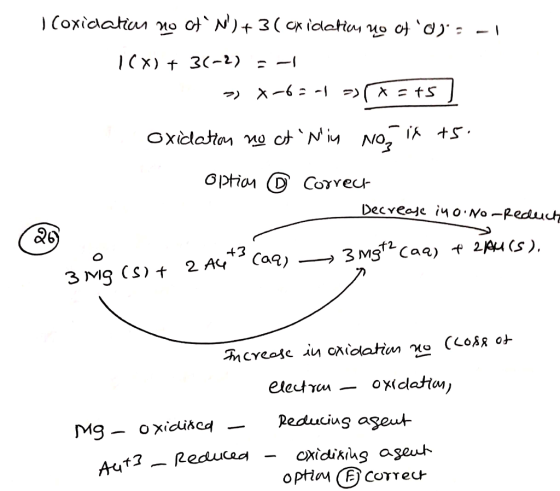
Cr in K2Cr2O7 is +6 NinNO3-is+5
E. ClinCl2is-1
Cr in K2Cr2O7 is +2 N in NO3- is -3
26. Which of the following statements is correct about the reaction shown below:
3Mg(s) + 2Au3+(aq) 3Mg2+(aq) + 2Au(s)
A. Mg is being reduced, and Au3+ is the oxidizing agent. B. Mg is being reduced, and Au3+ is the reducing agent. C. Au3+ is being reduced, and Mg is the oxidizing agent. D. Au3+ is being oxidized, and Mg is the reducing agent. E. Mg is being oxidized, and Au3+ is the oxidizing agent.
27. Which of the following are oxidation reduction reactions?
W. CaCl2(aq) + Na2CO3(aq) CaCO3(s) + 2NaCl(aq) X. Na(s) +
H2O(l) NaOH(aq) + H2(g)
Y. Sn(s) + 4HNO3(aq) SnO2(s) + 4NO2(g) + 2H2O(l) Z. HCl(aq) +
NaOH(aq) NaCl(aq) + H2O(l)
-
W and Z
-
W only
-
XandY
-
W, X, and Z
-
X only
Homework Answers


Add Answer to:
25. What is the oxidation number of the indicated element in
each of the following species?...
1. Provide the oxidation number for each of the underlined elements in following compounds or ions:...
 1. Provide the oxidation number for each of the underlined elements in following compounds or ions: (6) a) H3AsO3 b) d) H4P207 C202² KCIO4 N2H4 2. Which one of the following is not a oxidation-reduction reaction? (2) A) 2H2(g) + O2(g) → 2H2O(1) B) Zn(s) + H2SO4(aq) → ZnSO4(aq) + H2(g) C) H2O(l) + NH3(g) → NH(aq) + OH(aq) D) FeSO4(aq) + K2Cr2OH(aq) + 7H2SO4(aq) → Cr2(SO4)3(aq) + 3Fe2(SO4)3(aq) + K2SO4(aq) + 7H2O(1) E) Cl2(g) +2KBr(aq) + Bra(l) + 2KCl(aq)...
Cu(s) + 4HNO3 --> Cu(NO3)2(aq) + 2NO2(g) + 2H2O(l) Cu2+(aq) + 4NH3(aq) --> [Cu(NH3)4]2+(aq) a. For...
Cu(s) + 4HNO3 --> Cu(NO3)2(aq) + 2NO2(g) + 2H2O(l) Cu2+(aq) + 4NH3(aq) --> [Cu(NH3)4]2+(aq) a. For each reaction, identify the oxidation number for each of the elements on both sides of the equation. b. Which of the reactions above is a redox reaction? Explain. c. Identify the element that is being reduced and the one that is being oxidized in the redox reaction. d. Identify the strong oxidizing agent and strong reducing agent in the redox reaction.
Redox. For each reaction below: 1) Ensure that the reaction is balanced. 2) Assign oxidation numbers...
Redox. For each reaction below: 1) Ensure that the reaction is balanced. 2) Assign oxidation numbers to each reactant and product 3) Identify which atom was oxidized and which atom was reduced. 4) Identity which atom is the oxidizing agent, and which is the reducing agent A) Br2(l)+I^-(aq) --->Br^-(aq)+I2(s) B)Cr2O7^2-(aq)+Fe^2+(aq)--->Cr^3+(aq)+Fe^3+(aq) C) NO3^-(aq)+I2(aq)--->IO3^-(aq)+NO2(aq)
For the following, assign oxidation numbers. Which species is oxidized and which is reduced? Which species...
For the following, assign oxidation numbers. Which species is oxidized and which is reduced? Which species is the oxidizing agent and which is the reducing agent? (A) Zn(s) + CuCl2(aq) Cu(s) + ZnCl2 (B) MnO2 (s) + 4H+(aq) + 2Cl-(aq) Mn2+(aq) + 2H2O(l) + Cl2(g) (C)Zn(s) + 2HCl(aq)ZnCl2(aq) + H2(g)
1. A 75.0-mL sample of 0.200 M Lead(II) nitrate, Pb(NO3)2, is reacted with 75.0 mL of...
1. A 75.0-mL sample of 0.200 M Lead(II) nitrate, Pb(NO3)2, is reacted with 75.0 mL of 0.450 M KI solution and the following precipitation reaction occurs. Pb(NO3)2(aq) + 2KI(aq) → PbI2(s) + 2KNO3(aq) (a) Determine the limiting reactant. (b) How many grams of PbI2 will be formed if the yield is 100%? (c) What is the percent yield if 6.45 g of PbI2 were obtained? (2) K2Cr2O7(aq) + FeCl2(aq) → CrCl3(aq) + Fe(NO3)3(aq) (a) Determine the net ionic reactions and...
[References] Sc(s) + 3Ag+ (aq) + 3 Ag(s) + Sc3+ (aq) Redox? Oxidizing Agent Reducing Agent...
 [References] Sc(s) + 3Ag+ (aq) + 3 Ag(s) + Sc3+ (aq) Redox? Oxidizing Agent Reducing Agent Substance Oxidized Substance Reduced CE SC HBr(9) + NH3(g) + NH4Br(s) Redox? Oxidizing Agent in Reducing Agent Substance Oxidized Substance Reduced GeCl4 (1) + 2H2O(l) + 4HCl(aq) + GeO2 (s) Redox? Oxidizing Agent Reducing Agent Substance Oxidized Substance Reduced d. Si C14 (1) + 2Ba(s) + 2BaCl2(8) + Si(s) Redox? Oxidizing Agent Reducing Agent Substance Oxidized Substance Reduced Yes 2 SiBr, Ba SiBa Al(OH).-...
This question has multiple parts. Work all the parts to get the most points. Specify which...
 This question has multiple parts. Work all the parts to get the most points. Specify which of the following are oxidation-reduction reactions, and if it is, identify the oxidizing agent, the reducing agent, the substance being oxidized, and the substance being reduced. If it is not, select No and leave the following boxes blank. Express your answers as a chemical formulas. Omit states-of-matter. Zn(s)+2Ag (aq)2 Ag(a) +Zn2+ (aq) Redox? Oxidizing Agent Reducing Agent Substance Oxidized Substance Reduced HBr(g) +NH, (g)NH4Br(s)...
Іго, Electrochemistry Wolleet 1. Assign oxidation numbers to each element in the following compounds: a. VOCI...
 Іго, Electrochemistry Wolleet 1. Assign oxidation numbers to each element in the following compounds: a. VOCI b. Cuso c. CHOH). d. Mno, e. SO, 2. Given the following half reactions and their standard reduction potentials, i. Cl (g) + 2e- - 2 CI (aq) E' =+ 1.36 V ii. Niº (aq) + 2e - Ni (s) E' = -0.25 V iii. Ag (aq) + e- Ag () E' = +0.80 V Identify the chemical species most likely to be oxidized....
8. (12 pts) For the following reaction, identify the oxidation number for each element on each...
 8. (12 pts) For the following reaction, identify the oxidation number for each element on each side of the equation; identify what is oxidized and what is reduced; identify the oxidizing agent and the reducing agent; tell how many electrons are transferred as the reaction takes place. 2 MnCO3(s) + O2(g) → 2 MnOz(s) + 2 CO2(g) 9. (4 pts) What molarity of sodium ions results when 1.00 moles of Na2SO4 are combined with enough water to make 2.00 L...
Please help. I'm not sure how to go about figuring out which species oxidize or reduce...
 Please help. I'm not sure how to go about figuring out
which species oxidize or reduce or which are the agents.
2. Complete the table given that the following three reactions occur in the direction as written: a) 2Ag' (aq) + Fe(s) - Fe?' (aq) + 2Ag (s) b) 2Ag (aq) + Cu(s) — Cu (aq) + 2Ag (s) c) Cu (aq) + Fe (s) - Fet (aq) + Cu(s) Reaction Species oxidized Species reduced Oxidizing agent Reducing agent 3....
Please help. I'm not sure how to go about figuring out
which species oxidize or reduce or which are the agents.
2. Complete the table given that the following three reactions occur in the direction as written: a) 2Ag' (aq) + Fe(s) - Fe?' (aq) + 2Ag (s) b) 2Ag (aq) + Cu(s) — Cu (aq) + 2Ag (s) c) Cu (aq) + Fe (s) - Fet (aq) + Cu(s) Reaction Species oxidized Species reduced Oxidizing agent Reducing agent 3....
 1. Provide the oxidation number for each of the underlined elements in following compounds or ions: (6) a) H3AsO3 b) d) H4P207 C202² KCIO4 N2H4 2. Which one of the following is not a oxidation-reduction reaction? (2) A) 2H2(g) + O2(g) → 2H2O(1) B) Zn(s) + H2SO4(aq) → ZnSO4(aq) + H2(g) C) H2O(l) + NH3(g) → NH(aq) + OH(aq) D) FeSO4(aq) + K2Cr2OH(aq) + 7H2SO4(aq) → Cr2(SO4)3(aq) + 3Fe2(SO4)3(aq) + K2SO4(aq) + 7H2O(1) E) Cl2(g) +2KBr(aq) + Bra(l) + 2KCl(aq)...
 [References] Sc(s) + 3Ag+ (aq) + 3 Ag(s) + Sc3+ (aq) Redox? Oxidizing Agent Reducing Agent Substance Oxidized Substance Reduced CE SC HBr(9) + NH3(g) + NH4Br(s) Redox? Oxidizing Agent in Reducing Agent Substance Oxidized Substance Reduced GeCl4 (1) + 2H2O(l) + 4HCl(aq) + GeO2 (s) Redox? Oxidizing Agent Reducing Agent Substance Oxidized Substance Reduced d. Si C14 (1) + 2Ba(s) + 2BaCl2(8) + Si(s) Redox? Oxidizing Agent Reducing Agent Substance Oxidized Substance Reduced Yes 2 SiBr, Ba SiBa Al(OH).-...
 This question has multiple parts. Work all the parts to get the most points. Specify which of the following are oxidation-reduction reactions, and if it is, identify the oxidizing agent, the reducing agent, the substance being oxidized, and the substance being reduced. If it is not, select No and leave the following boxes blank. Express your answers as a chemical formulas. Omit states-of-matter. Zn(s)+2Ag (aq)2 Ag(a) +Zn2+ (aq) Redox? Oxidizing Agent Reducing Agent Substance Oxidized Substance Reduced HBr(g) +NH, (g)NH4Br(s)...
 Іго, Electrochemistry Wolleet 1. Assign oxidation numbers to each element in the following compounds: a. VOCI b. Cuso c. CHOH). d. Mno, e. SO, 2. Given the following half reactions and their standard reduction potentials, i. Cl (g) + 2e- - 2 CI (aq) E' =+ 1.36 V ii. Niº (aq) + 2e - Ni (s) E' = -0.25 V iii. Ag (aq) + e- Ag () E' = +0.80 V Identify the chemical species most likely to be oxidized....
 8. (12 pts) For the following reaction, identify the oxidation number for each element on each side of the equation; identify what is oxidized and what is reduced; identify the oxidizing agent and the reducing agent; tell how many electrons are transferred as the reaction takes place. 2 MnCO3(s) + O2(g) → 2 MnOz(s) + 2 CO2(g) 9. (4 pts) What molarity of sodium ions results when 1.00 moles of Na2SO4 are combined with enough water to make 2.00 L...
 Please help. I'm not sure how to go about figuring out
which species oxidize or reduce or which are the agents.
2. Complete the table given that the following three reactions occur in the direction as written: a) 2Ag' (aq) + Fe(s) - Fe?' (aq) + 2Ag (s) b) 2Ag (aq) + Cu(s) — Cu (aq) + 2Ag (s) c) Cu (aq) + Fe (s) - Fet (aq) + Cu(s) Reaction Species oxidized Species reduced Oxidizing agent Reducing agent 3....
Please help. I'm not sure how to go about figuring out
which species oxidize or reduce or which are the agents.
2. Complete the table given that the following three reactions occur in the direction as written: a) 2Ag' (aq) + Fe(s) - Fe?' (aq) + 2Ag (s) b) 2Ag (aq) + Cu(s) — Cu (aq) + 2Ag (s) c) Cu (aq) + Fe (s) - Fet (aq) + Cu(s) Reaction Species oxidized Species reduced Oxidizing agent Reducing agent 3....
Most questions answered within 3 hours.
-
Where is the error in this code sequence?
String s1 = "Hello";
String s2 = "ello";...
asked 11 months ago -
Financial data for Joel de Paris, Inc., for last year
follow:
Joel de Paris, Inc.
Balance...
asked 11 months ago -
Consider this reaction:
Al2(SO4)3 (aq)+ BaCl3
(aq) Al2Cl6 (aq)- +
3BaSO4(s) . What is the...
asked 11 months ago -
Suppose that Savneet is considering increasing her
recent random sample from 20 car rentals to 40...
asked 11 months ago -
Trucks arrive at an unloading terminal at an average rate of 120
per hour.
Trucks arrive...
asked 11 months ago -
Why are methanol and ethanol completely soluble in water while
octanol is not very little soluble....
asked 11 months ago -
A facilities manager at a university reads in a research report
that the mean amount of...
asked 11 months ago -
When the CuSO4 is rehydrated by adding water to the anhydrous
compound, is this an endothermic...
asked 11 months ago -
A ray of sunlight is passing from diamond into crown glass; the
angle of incidence is...
asked 11 months ago -
A block of mass 0.249 kg is placed on top of a light, vertical
spring of...
asked 11 months ago -
how do the kidneys compensate in the presences of acidosis
a) trigger hyperventilate
b) reserve acid...
asked 11 months ago -
Question 501 pts
The rental rate of capital to the firm increases. Which of the
following...
asked 11 months ago