
Homework Answers
Relation between frequency and wavelength
V =f*lamda
where V=speed of the string
lamda =wavelength
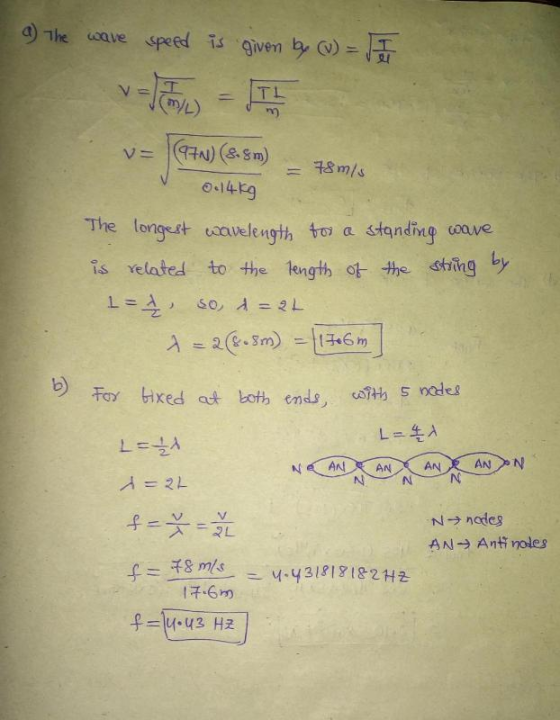
A string fixed at both ends is 11 m long and has a mass of 0.20...
A string fixed at both ends is 11 m long and has a mass of 0.20 kg. It is subjected to a tension of 100 N and set oscillating. (a) What is the speed of the waves on the string? (b) What is the longest possible wavelength for a standing wave? (c) Give the frequency of that wave.
A string fixed at both ends is 6.8 m long and has a mass of 0.026...
A string fixed at both ends is 6.8 m long and has a mass of 0.026 kg. It is subjected to a tension of 42 N and is set oscillating. What is the frequency of the longest possible wavelength for a standing wave on the string? Your answer should be in Hz, but enter only the numerical part in the box.
A string that is 2.0 meters long is fixed at both ends and tightened until the...
 A string that is 2.0 meters long is fixed at both ends and tightened until the wave speed is 81 m/s. What is the frequency of the standing wave shown in the figure? 243 Hz 490 Hz 122 Hz 360 Hz A 200 g wire that is 2.0 m long is under tension. When a transverse wave of frequency 400 Hz travels down the wire, its wavelength is 0.20 m. What is the tension in the wire? 800 N 160...
A string 3.30 m long and fixed at both ends is vibrating in its third harmonic....
A string 3.30 m long and fixed at both ends is vibrating in its third harmonic. The maximum displacement of any point on the string is 4.00 mm. The speed of transverse waves on this string is 59.5 m/s. (a) What are the wavelength and frequency of this standing wave? wavelength m frequency Hz (b) Write the wave function for this standing wave.
a 2.0 m length of string with a mass density of 2.95 x 10^-4 kg/m is...
 a 2.0 m length of string with a mass density of 2.95 x 10^-4
kg/m is fixed at both ends and driven at 120 Hz. The tension is
varied to obtain standing waves (resonance) on the string.
1. what is the longest wavelength for a standing wave possible
on the string?
2. the tension on the string is varies to obtain fourth
harmonic
a. what is the wavelength of this standing wave?
b. what is the wave speed
3. what...
a 2.0 m length of string with a mass density of 2.95 x 10^-4
kg/m is fixed at both ends and driven at 120 Hz. The tension is
varied to obtain standing waves (resonance) on the string.
1. what is the longest wavelength for a standing wave possible
on the string?
2. the tension on the string is varies to obtain fourth
harmonic
a. what is the wavelength of this standing wave?
b. what is the wave speed
3. what...
The standing wave is formed in a string with two fixed ends. The mass of the...
 The standing wave is formed in a string with two fixed ends. The mass of the string is 20.0 g and a length of 8.0 m. The tension in the string is 40.0 N. Determine the positions of the nodes and antinodes for the third harmonic. nodes: antinodes: What is the vibration frequency for this harmonic?
The standing wave is formed in a string with two fixed ends. The mass of the...
 The standing wave is formed in a string with two fixed ends. The mass of the string is 20.0 g and a length of 8.0 m. The tension in the string is 40.0 N. (a) Determine the positions of the nodes and antinodes for the third harmonic. nodes: antinodes: (b) What is the vibration frequency for this harmonic?
You generate a standing wave on a 1-m long string, fixed on both ends, by forcing...
 You generate a standing wave on a 1-m long string, fixed on both ends, by forcing it to vibrate at 100 Hz. When doing so, the standing wave has a wavelength of 1 m. According to the wave equation, v=Af, the speed of the wave along the string is 100 m/s. Suppose the forcing frequency is doubled to 200 Hz, without changing the length, tension or ends of the string. What is the new wavelength and wave speed? A. The...
A 20.9 m long string is clamped at both ends and under 9.3 N of tension....
A 20.9 m long string is clamped at both ends and under 9.3 N of tension. It supports standing waves at 40 Hz and 50 Hz. a. What is the string's mass density in g/m? b. How many nodes are on the string when the 40 Hz standing wave occurs? 0,1,2,3,4, or 5. Please explain.
Standing Waves A 0.75 m 'A' string on a guitar is held fixed at both ends....
 Standing Waves A 0.75 m 'A' string on a guitar is held fixed at both ends. The tension in the guitar string is adjusted untl the speed of the wave in the string is 165 m/s. Calculate the wavelength on the string and in the air when the string is set vibrating at the fourth harmonic.
 A string that is 2.0 meters long is fixed at both ends and tightened until the wave speed is 81 m/s. What is the frequency of the standing wave shown in the figure? 243 Hz 490 Hz 122 Hz 360 Hz A 200 g wire that is 2.0 m long is under tension. When a transverse wave of frequency 400 Hz travels down the wire, its wavelength is 0.20 m. What is the tension in the wire? 800 N 160...
 a 2.0 m length of string with a mass density of 2.95 x 10^-4
kg/m is fixed at both ends and driven at 120 Hz. The tension is
varied to obtain standing waves (resonance) on the string.
1. what is the longest wavelength for a standing wave possible
on the string?
2. the tension on the string is varies to obtain fourth
harmonic
a. what is the wavelength of this standing wave?
b. what is the wave speed
3. what...
a 2.0 m length of string with a mass density of 2.95 x 10^-4
kg/m is fixed at both ends and driven at 120 Hz. The tension is
varied to obtain standing waves (resonance) on the string.
1. what is the longest wavelength for a standing wave possible
on the string?
2. the tension on the string is varies to obtain fourth
harmonic
a. what is the wavelength of this standing wave?
b. what is the wave speed
3. what...
 The standing wave is formed in a string with two fixed ends. The mass of the string is 20.0 g and a length of 8.0 m. The tension in the string is 40.0 N. Determine the positions of the nodes and antinodes for the third harmonic. nodes: antinodes: What is the vibration frequency for this harmonic?
 The standing wave is formed in a string with two fixed ends. The mass of the string is 20.0 g and a length of 8.0 m. The tension in the string is 40.0 N. (a) Determine the positions of the nodes and antinodes for the third harmonic. nodes: antinodes: (b) What is the vibration frequency for this harmonic?
 You generate a standing wave on a 1-m long string, fixed on both ends, by forcing it to vibrate at 100 Hz. When doing so, the standing wave has a wavelength of 1 m. According to the wave equation, v=Af, the speed of the wave along the string is 100 m/s. Suppose the forcing frequency is doubled to 200 Hz, without changing the length, tension or ends of the string. What is the new wavelength and wave speed? A. The...
 Standing Waves A 0.75 m 'A' string on a guitar is held fixed at both ends. The tension in the guitar string is adjusted untl the speed of the wave in the string is 165 m/s. Calculate the wavelength on the string and in the air when the string is set vibrating at the fourth harmonic.
Most questions answered within 3 hours.
-
Where is the error in this code sequence?
String s1 = "Hello";
String s2 = "ello";...
asked 10 months ago -
Financial data for Joel de Paris, Inc., for last year
follow:
Joel de Paris, Inc.
Balance...
asked 10 months ago -
Consider this reaction:
Al2(SO4)3 (aq)+ BaCl3
(aq) Al2Cl6 (aq)- +
3BaSO4(s) . What is the...
asked 10 months ago -
Suppose that Savneet is considering increasing her
recent random sample from 20 car rentals to 40...
asked 10 months ago -
Trucks arrive at an unloading terminal at an average rate of 120
per hour.
Trucks arrive...
asked 10 months ago -
Why are methanol and ethanol completely soluble in water while
octanol is not very little soluble....
asked 10 months ago -
A facilities manager at a university reads in a research report
that the mean amount of...
asked 10 months ago -
When the CuSO4 is rehydrated by adding water to the anhydrous
compound, is this an endothermic...
asked 10 months ago -
A ray of sunlight is passing from diamond into crown glass; the
angle of incidence is...
asked 10 months ago -
A block of mass 0.249 kg is placed on top of a light, vertical
spring of...
asked 10 months ago -
how do the kidneys compensate in the presences of acidosis
a) trigger hyperventilate
b) reserve acid...
asked 10 months ago -
Question 501 pts
The rental rate of capital to the firm increases. Which of the
following...
asked 10 months ago