Acidic solution In acidic solution, the iodate ion can be used to react with a number...
Acidic solution In acidic solution, the iodate ion can be used to react with a number of metal ions. One such reaction is IO3−(aq)+Sn2+(aq)→I−(aq)+Sn4+(aq) Since this reaction takes place in acidic solution, H2O(l) and H+(aq) will be involved in the reaction. Places for these species are indicated by the blanks in the following restatement of the equation: IO3−(aq)+Sn2+(aq)+ −−−→I−(aq)+Sn4+(aq)+ −−−
Part A-
What are the coefficients of the reactants and products in the balanced equation above? Remember to include H2O(l) and H+(aq) in the appropriate blanks. Your answer should have six terms.
Enter the equation coefficients in order separated by commas (e.g., 2,2,1,4,4,3). Include coefficients of 1, as required, for grading purposes.
Part B-
|
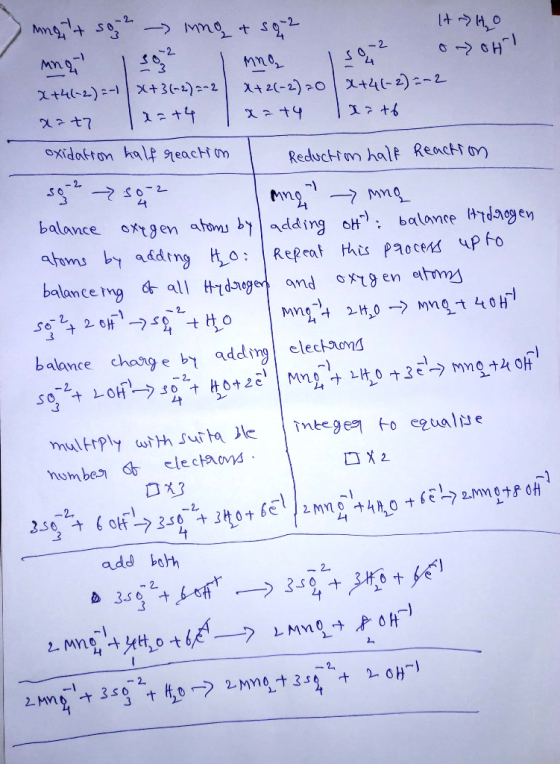
Potassium permanganate, KMnO4, is a powerful oxidizing agent. The products of a given redox reaction with the permanganate ion depend on the reaction conditions used. In basic solution, the following equation represents the reaction of this ion with a solution containing sodium sulfite: MnO4−(aq)+SO32−(aq)→MnO2(s)+SO42−(aq) Since this reaction takes place in basic solution, H2O(l) and OH−(aq) will be shown in the reaction. Places for these species are indicated by the blanks in the following restatement of the equation: MnO4−(aq)+SO32−(aq)+ −−−→MnO2(s)+SO42−(aq)+ −−− Part B What are the coefficients of the reactants and products in the balanced equation above? Remember to include H2O(l) and OH−(aq) in the blanks where appropriate. Your answer should have six terms. Enter the equation coefficients in order separated by commas (e.g., 2,2,1,4,4,3). Include coefficients of 1, as required, for grading purposes. What are the coefficients of the reactants and products in the balanced equation above? Remember to include H2O(l) and OH−(aq) in the blanks where appropriate. Your answer should have six terms. Enter the equation coefficients in order separated by commas (e.g., 2,2,1,4,4,3). Include coefficients of 1, as required, for grading purposes. |

Homework Answers

Add Answer to:
Acidic solution In acidic solution, the iodate ion can be used
to react with a number...
In acidic solution, the iodate ion can be used to react with a number of ions....
In acidic solution, the iodate ion can be used to react with a number of ions. One such reaction is IO3^- +Sn^2+ >I^- +Sn^4+ Since this reaction takes place in acidic solution, H2O and H^+ will be involved in the reaction. Places for these species are indicated by the blanks in the following restatement of the equation: IO3^- +Sn^2+ +__>I^- +Sn^4+ +__ Part A: What are the coefficient of the reactants and produces in the balanced equation above? Remember to...
In acidic solution, bromate ion can be used to react with a number of metal ions....
In acidic solution, bromate ion can be used to react with a number of metal ions. One such reaction is: BrO3−(aq)+Sn2+(aq)→Br−(aq)+Sn4+(aq). Since this reaction takes place in acidic solution, H2O(l) and H+(aq) will be involved in the reaction. Places for these species are indicated by the blanks in the following restatement of the equation:BrO3−(aq)+Sn2+(aq)+−→Br−(aq)+Sn4+(aq)+ −−−AWhat are the coefficients of the six species in the balanced equation above? Remember to include coefficients for H2O(l) and H+(aq) in the appropriate blanks. B)What are...
In addition to mass balance, oxidation-reduction reactions must be balanced such that the number of electrons...
In addition to mass balance, oxidation-reduction reactions must be balanced such that the number of electrons lost in the oxidation equals the number of electrons gained in the reduction. This balancing can be done by two methods: the half-reaction method or the oxidation number method. The half-reaction method balances the electrons lost in the oxidation half-reaction with the electrons gained in the reduction half-reaction. In either method H2O(l), OH−(aq), and H+(aq) may be added to complete the mass balance. Which...
In addition to mass balance, oxidation-reduction reactions must be balanced such that the number of electrons...
In addition to mass balance, oxidation-reduction reactions must be balanced such that the number of electrons lost in the oxidation equals the number of electrons gained in the reduction. This balancing can be done by two methods: the half-reaction method or the oxidation number method. The half-reaction method balances the electrons lost in the oxidation half-reaction with the electrons gained in the reduction half-reaction. In either method H2O(l), OH−(aq), and H+(aq) may be added to complete the mass balance. Which...
In addition to mass balance, oxidation-reduction reactions must be balanced such that the number of electrons...
In addition to mass balance, oxidation-reduction reactions must be balanced such that the number of electrons lost in the oxidation equals the number of electrons gained in the reduction. This balancing can be done by two methods: the half-reaction method or the oxidation number method. The half-reaction method balances the electrons lost in the oxidation half-reaction with the electrons gained in the reduction half-reaction. In either method H2O(l), OH?(aq), and H+(aq) may be added to complete the mass balance. Which...
Permanganate ion can oxidize sulfite to sulfate in basic solution as follows. 2 MnO4" (aq) +...
 Permanganate ion can oxidize sulfite to sulfate in basic solution as follows. 2 MnO4" (aq) + 3 SO32-(aq) + H2O 2 MnO2(s) + 3 SO42-(aq) + 2 OH-(aq) Determine the potential for the reaction at 298 K when the concentrations of the reactants and products are as follows: [MnO4-] = 0.150 M, [SOy2-1.0.281 M, [SO42-1.0.199 M, and [OH- Will the value of Erxn increase or decrease as the reaction proceeds? increase O decrease Explain
Course Home <Chapter 20 Homework Balancing Redox Equations: Half-reaction Method Review Constants Periodic Table In addition...
 Course Home <Chapter 20 Homework Balancing Redox Equations: Half-reaction Method Review Constants Periodic Table In addition to mass balance, exidation reduction reactions must be balanced such that the number of electrons lost in the oxidation equals the number of electrons gained in the reduction. This balancing can be done by two methods: the hall reaction method or the oxidation number method. The hall reaction method balances the electrons lost in the odation all reaction with the electrons gained in the...
2. For the reaction between permanganate ion and sulfite ion in basic solution, the unbalanced equation...
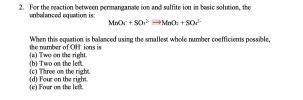 2. For the reaction between permanganate ion and sulfite ion in basic solution, the unbalanced equation is: MnO4 + SO32- MnO2 + SO42- When this equation is balanced using the smallest whole number coefficients possible, the number of OH ions is (a) Two on the right. (b) Two on the left. (c) Three on the right. (d) Four on the right. (e) Four on the left.
When the redox equation shown below is balanced in an acidic solution using the smallest set...
When the redox equation shown below is balanced in an acidic solution using the smallest set of whole number coefficients, what is the sum of all of the coefficents? Hg(l) + Cl−(aq) + SO42−(aq) ⇌ Hg2Cl2 (s) + SO32−(aq)
Permanganate ion oxidizes hydrogen peroxide in acidic solution according to the following equation: 2 MnO4–(aq) +...
 Permanganate ion oxidizes hydrogen peroxide in acidic solution
according to the following equation:
2 MnO4–(aq) + 5
H2O2(aq) + 6 H+(aq) 2 Mn2+(aq) + 5
O2(g) + 8 H2O(l)
If 35.0 mL of an acidic 0.150 M KMnO4 solution is
required to consume all the H2O2 in 50.0 mL
of a disinfectant solution, what is the concentration of
H2O2 in the disinfectant?
0.0420 M
0.105 M
0.263 M
0.368 M
When a solution of barium hydroxide is mixed with a...
Permanganate ion oxidizes hydrogen peroxide in acidic solution
according to the following equation:
2 MnO4–(aq) + 5
H2O2(aq) + 6 H+(aq) 2 Mn2+(aq) + 5
O2(g) + 8 H2O(l)
If 35.0 mL of an acidic 0.150 M KMnO4 solution is
required to consume all the H2O2 in 50.0 mL
of a disinfectant solution, what is the concentration of
H2O2 in the disinfectant?
0.0420 M
0.105 M
0.263 M
0.368 M
When a solution of barium hydroxide is mixed with a...
 Permanganate ion can oxidize sulfite to sulfate in basic solution as follows. 2 MnO4" (aq) + 3 SO32-(aq) + H2O 2 MnO2(s) + 3 SO42-(aq) + 2 OH-(aq) Determine the potential for the reaction at 298 K when the concentrations of the reactants and products are as follows: [MnO4-] = 0.150 M, [SOy2-1.0.281 M, [SO42-1.0.199 M, and [OH- Will the value of Erxn increase or decrease as the reaction proceeds? increase O decrease Explain
 Course Home <Chapter 20 Homework Balancing Redox Equations: Half-reaction Method Review Constants Periodic Table In addition to mass balance, exidation reduction reactions must be balanced such that the number of electrons lost in the oxidation equals the number of electrons gained in the reduction. This balancing can be done by two methods: the hall reaction method or the oxidation number method. The hall reaction method balances the electrons lost in the odation all reaction with the electrons gained in the...
 2. For the reaction between permanganate ion and sulfite ion in basic solution, the unbalanced equation is: MnO4 + SO32- MnO2 + SO42- When this equation is balanced using the smallest whole number coefficients possible, the number of OH ions is (a) Two on the right. (b) Two on the left. (c) Three on the right. (d) Four on the right. (e) Four on the left.
 Permanganate ion oxidizes hydrogen peroxide in acidic solution
according to the following equation:
2 MnO4–(aq) + 5
H2O2(aq) + 6 H+(aq) 2 Mn2+(aq) + 5
O2(g) + 8 H2O(l)
If 35.0 mL of an acidic 0.150 M KMnO4 solution is
required to consume all the H2O2 in 50.0 mL
of a disinfectant solution, what is the concentration of
H2O2 in the disinfectant?
0.0420 M
0.105 M
0.263 M
0.368 M
When a solution of barium hydroxide is mixed with a...
Permanganate ion oxidizes hydrogen peroxide in acidic solution
according to the following equation:
2 MnO4–(aq) + 5
H2O2(aq) + 6 H+(aq) 2 Mn2+(aq) + 5
O2(g) + 8 H2O(l)
If 35.0 mL of an acidic 0.150 M KMnO4 solution is
required to consume all the H2O2 in 50.0 mL
of a disinfectant solution, what is the concentration of
H2O2 in the disinfectant?
0.0420 M
0.105 M
0.263 M
0.368 M
When a solution of barium hydroxide is mixed with a...
Most questions answered within 3 hours.
-
Where is the error in this code sequence?
String s1 = "Hello";
String s2 = "ello";...
asked 10 months ago -
Financial data for Joel de Paris, Inc., for last year
follow:
Joel de Paris, Inc.
Balance...
asked 10 months ago -
Consider this reaction:
Al2(SO4)3 (aq)+ BaCl3
(aq) Al2Cl6 (aq)- +
3BaSO4(s) . What is the...
asked 10 months ago -
Suppose that Savneet is considering increasing her
recent random sample from 20 car rentals to 40...
asked 10 months ago -
Trucks arrive at an unloading terminal at an average rate of 120
per hour.
Trucks arrive...
asked 10 months ago -
Why are methanol and ethanol completely soluble in water while
octanol is not very little soluble....
asked 10 months ago -
A facilities manager at a university reads in a research report
that the mean amount of...
asked 10 months ago -
When the CuSO4 is rehydrated by adding water to the anhydrous
compound, is this an endothermic...
asked 10 months ago -
A ray of sunlight is passing from diamond into crown glass; the
angle of incidence is...
asked 10 months ago -
A block of mass 0.249 kg is placed on top of a light, vertical
spring of...
asked 10 months ago -
how do the kidneys compensate in the presences of acidosis
a) trigger hyperventilate
b) reserve acid...
asked 10 months ago -
Question 501 pts
The rental rate of capital to the firm increases. Which of the
following...
asked 10 months ago