In addition to mass balance, oxidation-reduction reactions must be balanced such that the number of electrons...
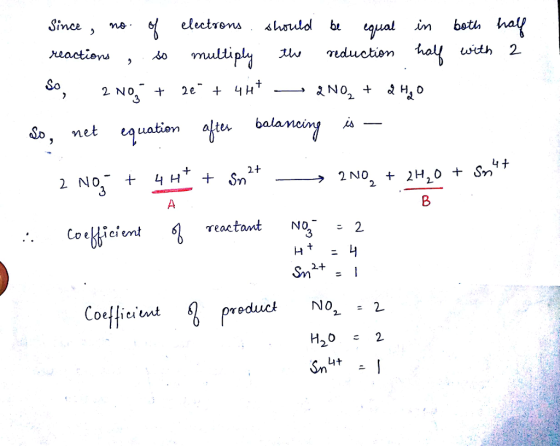
In addition to mass balance, oxidation-reduction reactions must be balanced such that the number of electrons lost in the oxidation equals the number of electrons gained in the reduction. This balancing can be done by two methods: the half-reaction method or the oxidation number method. The half-reaction method balances the electrons lost in the oxidation half-reaction with the electrons gained in the reduction half-reaction. In either method H2O(l), OH?(aq), and H+(aq) may be added to complete the mass balance. Which substances are used depends on the reaction conditions. Acidic solution In acidic solution, the nitrate ion can be used to react with a number of metal ions. One such reaction is NO3?(aq)+Sn2+(aq)?NO2(aq)+Sn4+(aq) Since this reaction takes place in acidic solution, H2O(l) and H+(aq) will be involved in the reaction. Places for these species are indicated by the blanks in the following restatement of the equation: NO3?(aq)+Sn2+(aq)+ ????NO2(aq)+Sn4+(aq)+ ??? Part A What are the coefficients of the reactants and products in the balanced equation above? Remember to include H2O(l) and H+(aq) in the appropriate blanks. Your answer should have six terms.
Homework Answers
Hello guys
Please do submit my answer
Thank you

Add Answer to:
In addition to mass balance, oxidation-reduction reactions must
be balanced such that the number of electrons...
In addition to mass balance, oxidation-reduction reactions must be balanced such that the number of electrons...
In addition to mass balance, oxidation-reduction reactions must be balanced such that the number of electrons lost in the oxidation equals the number of electrons gained in the reduction. This balancing can be done by two methods: the half-reaction method or the oxidation number method. The half-reaction method balances the electrons lost in the oxidation half-reaction with the electrons gained in the reduction half-reaction. In either method H2O(l), OH−(aq), and H+(aq) may be added to complete the mass balance. Which...
In addition to mass balance, oxidation-reduction reactions must be balanced such that the number of electrons...
In addition to mass balance, oxidation-reduction reactions must be balanced such that the number of electrons lost in the oxidation equals the number of electrons gained in the reduction. This balancing can be done by two methods: the half-reaction method or the oxidation number method. The half-reaction method balances the electrons lost in the oxidation half-reaction with the electrons gained in the reduction half-reaction. In either method H2O(l), OH−(aq), and H+(aq) may be added to complete the mass balance. Which...
Course Home <Chapter 20 Homework Balancing Redox Equations: Half-reaction Method Review Constants Periodic Table In addition...
 Course Home <Chapter 20 Homework Balancing Redox Equations: Half-reaction Method Review Constants Periodic Table In addition to mass balance, exidation reduction reactions must be balanced such that the number of electrons lost in the oxidation equals the number of electrons gained in the reduction. This balancing can be done by two methods: the hall reaction method or the oxidation number method. The hall reaction method balances the electrons lost in the odation all reaction with the electrons gained in the...
In acidic solution, bromate ion can be used to react with a number of metal ions....
In acidic solution, bromate ion can be used to react with a number of metal ions. One such reaction is: BrO3−(aq)+Sn2+(aq)→Br−(aq)+Sn4+(aq). Since this reaction takes place in acidic solution, H2O(l) and H+(aq) will be involved in the reaction. Places for these species are indicated by the blanks in the following restatement of the equation:BrO3−(aq)+Sn2+(aq)+−→Br−(aq)+Sn4+(aq)+ −−−AWhat are the coefficients of the six species in the balanced equation above? Remember to include coefficients for H2O(l) and H+(aq) in the appropriate blanks. B)What are...
Acidic solution In acidic solution, the iodate ion can be used to react with a number...
 Acidic solution In acidic solution, the iodate ion can be used
to react with a number of metal ions. One such reaction is
IO3−(aq)+Sn2+(aq)→I−(aq)+Sn4+(aq) Since this reaction takes place
in acidic solution, H2O(l) and H+(aq) will be involved in the
reaction. Places for these species are indicated by the blanks in
the following restatement of the equation: IO3−(aq)+Sn2+(aq)+
−−−→I−(aq)+Sn4+(aq)+ −−−
Part A-
What are the coefficients of the reactants and products in the
balanced equation above? Remember to include H2O(l)...
Acidic solution In acidic solution, the iodate ion can be used
to react with a number of metal ions. One such reaction is
IO3−(aq)+Sn2+(aq)→I−(aq)+Sn4+(aq) Since this reaction takes place
in acidic solution, H2O(l) and H+(aq) will be involved in the
reaction. Places for these species are indicated by the blanks in
the following restatement of the equation: IO3−(aq)+Sn2+(aq)+
−−−→I−(aq)+Sn4+(aq)+ −−−
Part A-
What are the coefficients of the reactants and products in the
balanced equation above? Remember to include H2O(l)...
RODOX EXAMINATION An oxidation-reduction reaction involves the (1) sharing of electrons &n
RODOX EXAMINATION An oxidation-reduction reaction involves the (1) sharing of electrons (3) transfer of electrons (2) sharing of protons (4) transfer of protons In this reaction, CO→ 2 CO + O2 the oxidation number of carbon changes from: (1) 0 to +4 (3) +3 to 0 (2) +2 to +4 (4) +4 to +2 Which balanced equation represents a redox reaction? AgNO3 (aq) +NaCl (aq) →AgCl (s) +NaNO3 (aq) H2CO3 (aq)...
Question 1 -/10 In the process of oxidation electrons are gained and the charge gets more...
 Question 1 -/10 In the process of oxidation electrons are gained and the charge gets more negative electrons are gained and the charge gets more positive 2 electrons are lost and the charge gets more positive 3 electrons are lost and the charge gets more negative 4 Question 2 10 When the equation Mn2+ Bio3 MnO4 Bi3+ is balanced in acid solution, the coefficient + in front of Bi3+ is 1 3 2 4 3 5 4 Question 3 -/10...
PS12.1. Balance the following oxidation-reduction reactions using the half-reaction method. a) S2-(aq) + NO3-(aq) ---> S8(s)...
PS12.1. Balance the following oxidation-reduction reactions using the half-reaction method. a) S2-(aq) + NO3-(aq) ---> S8(s) + NO2(g) acidic solution
Balance the oxidation - reduction reactions for the following reactions by inspection or by the ion...
Balance the oxidation - reduction reactions for the following reactions by inspection or by the ion electron half reaction method. Please show work so I can follow along. A) H2SO4 + HI -> H2S + I2 + H2O (acidic solution) B) NO2 + H2O -> HNO3 + NO (acidic solution) C) I^-1 + HNO3 -> NO + I2 (acidic solution)
Balance the following oxidation-reduction reactions using the half-reaction method. 1. HCOOH (aq) + MnO.. (aq) → CO2 (g) + Mn2. Acidie solution Identify the reduction half Identify the oxidation...
 Balance the following oxidation-reduction reactions using the half-reaction method. 1. HCOOH (aq) + MnO.. (aq) → CO2 (g) + Mn2. Acidie solution Identify the reduction half Identify the oxidation half Basic solution Identify the reduction half Identify the oxidation half Write a balanced equation for the electrode and overall cell reactions in the following galvanic cell and determine E°. Sketch the cell, labeling the anode and cathode and showing the direction of electron and ion flow. 2. 3. Circle the...
 Course Home <Chapter 20 Homework Balancing Redox Equations: Half-reaction Method Review Constants Periodic Table In addition to mass balance, exidation reduction reactions must be balanced such that the number of electrons lost in the oxidation equals the number of electrons gained in the reduction. This balancing can be done by two methods: the hall reaction method or the oxidation number method. The hall reaction method balances the electrons lost in the odation all reaction with the electrons gained in the...
 Acidic solution In acidic solution, the iodate ion can be used
to react with a number of metal ions. One such reaction is
IO3−(aq)+Sn2+(aq)→I−(aq)+Sn4+(aq) Since this reaction takes place
in acidic solution, H2O(l) and H+(aq) will be involved in the
reaction. Places for these species are indicated by the blanks in
the following restatement of the equation: IO3−(aq)+Sn2+(aq)+
−−−→I−(aq)+Sn4+(aq)+ −−−
Part A-
What are the coefficients of the reactants and products in the
balanced equation above? Remember to include H2O(l)...
Acidic solution In acidic solution, the iodate ion can be used
to react with a number of metal ions. One such reaction is
IO3−(aq)+Sn2+(aq)→I−(aq)+Sn4+(aq) Since this reaction takes place
in acidic solution, H2O(l) and H+(aq) will be involved in the
reaction. Places for these species are indicated by the blanks in
the following restatement of the equation: IO3−(aq)+Sn2+(aq)+
−−−→I−(aq)+Sn4+(aq)+ −−−
Part A-
What are the coefficients of the reactants and products in the
balanced equation above? Remember to include H2O(l)...
 Question 1 -/10 In the process of oxidation electrons are gained and the charge gets more negative electrons are gained and the charge gets more positive 2 electrons are lost and the charge gets more positive 3 electrons are lost and the charge gets more negative 4 Question 2 10 When the equation Mn2+ Bio3 MnO4 Bi3+ is balanced in acid solution, the coefficient + in front of Bi3+ is 1 3 2 4 3 5 4 Question 3 -/10...
 Balance the following oxidation-reduction reactions using the half-reaction method. 1. HCOOH (aq) + MnO.. (aq) → CO2 (g) + Mn2. Acidie solution Identify the reduction half Identify the oxidation half Basic solution Identify the reduction half Identify the oxidation half Write a balanced equation for the electrode and overall cell reactions in the following galvanic cell and determine E°. Sketch the cell, labeling the anode and cathode and showing the direction of electron and ion flow. 2. 3. Circle the...
Most questions answered within 3 hours.
-
Where is the error in this code sequence?
String s1 = "Hello";
String s2 = "ello";...
asked 11 months ago -
Financial data for Joel de Paris, Inc., for last year
follow:
Joel de Paris, Inc.
Balance...
asked 11 months ago -
Consider this reaction:
Al2(SO4)3 (aq)+ BaCl3
(aq) Al2Cl6 (aq)- +
3BaSO4(s) . What is the...
asked 11 months ago -
Suppose that Savneet is considering increasing her
recent random sample from 20 car rentals to 40...
asked 11 months ago -
Trucks arrive at an unloading terminal at an average rate of 120
per hour.
Trucks arrive...
asked 11 months ago -
Why are methanol and ethanol completely soluble in water while
octanol is not very little soluble....
asked 11 months ago -
A facilities manager at a university reads in a research report
that the mean amount of...
asked 11 months ago -
When the CuSO4 is rehydrated by adding water to the anhydrous
compound, is this an endothermic...
asked 11 months ago -
A ray of sunlight is passing from diamond into crown glass; the
angle of incidence is...
asked 11 months ago -
A block of mass 0.249 kg is placed on top of a light, vertical
spring of...
asked 11 months ago -
how do the kidneys compensate in the presences of acidosis
a) trigger hyperventilate
b) reserve acid...
asked 11 months ago -
Question 501 pts
The rental rate of capital to the firm increases. Which of the
following...
asked 11 months ago