
Homework Answers
Add Answer to:
A comet (see the figure below) approaches the Sun to within 0.570 AU, and its orbital...
A comet (see the figure below) approaches the Sun to within 0.570 AU, and its orbital...
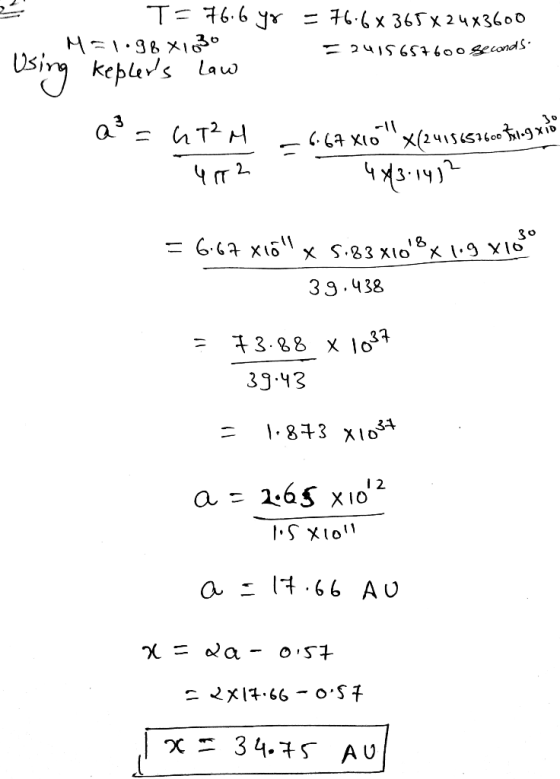
 A comet (see the figure below) approaches the Sun to within 0.570 AU, and its orbital period is 76.6 yr. (AU is the symbol for astronomical unit, where 1 AU = 1.50 x 10¹¹ m is the mean Earth-Sun distance.) How far from the Sun will the comet travel before it starts its return journey? 34.75 The comet moves in an ellipse. What equation relates the period of motion to the size of the ellipse? AU Sun 0.570 AU —2a-...
The orbit of a 1.5 ✕ 1010 kg comet around the Sun is elliptical, with an aphelion distance of 33.0 AU and...
The orbit of a 1.5 ✕ 1010 kg comet around the Sun is elliptical, with an aphelion distance of 33.0 AU and perihelion distance of 0.850 AU. (Note: 1 AU = one astronomical unit = the average distance from the Sun to the Earth = 1.496 ✕ 1011 m.) (a)What is its orbital eccentricity? (b)What is its period? (Enter your answer in yr.) (c)At aphelion what is the potential energy (in J) of the comet—Sun system?
The average distance from the Earth to the Sun is defined as one "astronomical unit" (AU)....
 The average distance from the Earth to the Sun is defined as one "astronomical unit" (AU). An asteroid orbits the Sun in one-third of a year. What is the asteroids average distance from the Sun? 0.19 AU 0.43 AU o 21 AU 5.2 AU Many comets orbit the Sun in highly elliptical orbits. What happens over time to the comet's angular momentum? It continually increases. It continually decreases. It remains constant It increases during some parts of the orbit and...
A comet moves about the Sun in an elliptical orbit, with its closest approach to the...
A comet moves about the Sun in an elliptical orbit, with its closest approach to the Sun being about 0.620 AU and its greatest distance from the sun being 35.5 AU (1 AU = the Earth-Sun distance). If the comet's speed at closest approach is 54.0 km/s, what is its speed when it is farthest from the Sun? (The gravitational force exerted by the Sun on the comet is parallel to the moment arm, so exerts no torque. Therefore, angular...
A comet orbits the Sun in 4,063 years. What is its average orbital distance from the...
 A comet orbits the Sun in 4,063 years. What is its average orbital distance from the Sun? Express your answer in AU (enter "AU" for units) and round it to the nearest integer А. An asteroid orbits the Sun at an average orbital distance of 3.12 AU. What is its average orbital period? Express your answer in years (enter "years" for units) and round it to two decimals. В. A moon orbits a planet in 1.5 days. What is the...
The semimajor axis of Mars orbit is about 1.52 astronomical units (au), where an au is the Earth's average distance from the Sun, meaning the semimajor axis of Earth's orbit is 1 au. To go from Earth to Mars and use the least energy from rocket fuel, th
The semimajor axis of Mars orbit is about 1.52 astronomical units (au), where an au is the Earth's average distance from the Sun, meaning the semimajor axis of Earth's orbit is 1 au. To go from Earth to Mars and use the least energy from rocket fuel, the orbit has a semimajor axis of 1.26 au and an eccentricity of about 0.21. Starting at Earth's orbit, to follow this path we give the spacecraft an orbital velocity of 40 km/s. ...
In recent years, scientists have discovered hundreds of planets orbiting other stars. Some of these planets...
In recent years, scientists have discovered hundreds of planets orbiting other stars. Some of these planets are in orbits that are similar to that of earth, which orbits the sun (Msun = 1.99 × 1030 kg) at a distance of 1.50 × 10¹¹ m, called 1 astronomical unit (1 au). Others have extreme orbits that are much different from anything in our solar system. The following problem relates to one of these planets that follows circular orbit around its star....
For the following, quote your numerical answers to two significant figures: a) A binary system consists...
 For the following, quote your numerical answers to two significant figures: a) A binary system consists of two stars orbiting a common center of mass. Star A is a white star of mass MA = 2.02Mo, where Mo = 1.989 x 1030 kg is the mass of the Sun. Its companion, Star B, is a white dwarf with mass Mg = 0.978M. The orbital period of the two objects is observed to be t = 50.09 years. What is the...
Problem 1: Imagine a planet whose distance to the sun varies, in the course of its...
Problem 1: Imagine a planet whose distance to the sun varies, in the course of its orbital motion, between 1.38 AU and 1.67 AU. What is the semimajor axis of this planet’s orbit? Select One of the Following: (a) 3.05 AU (b) 1.53 AU (c) 1.38 AU (d) 1.67 AU Problem 2: What is the eccentricity of this planet’s orbit? Select One of the Following: (a) 0.065 (b) 0.075 (c) 0.085 (d) 0.095 Problem 3: How long does it take...
 A comet (see the figure below) approaches the Sun to within 0.570 AU, and its orbital period is 76.6 yr. (AU is the symbol for astronomical unit, where 1 AU = 1.50 x 10¹¹ m is the mean Earth-Sun distance.) How far from the Sun will the comet travel before it starts its return journey? 34.75 The comet moves in an ellipse. What equation relates the period of motion to the size of the ellipse? AU Sun 0.570 AU —2a-...
 The average distance from the Earth to the Sun is defined as one "astronomical unit" (AU). An asteroid orbits the Sun in one-third of a year. What is the asteroids average distance from the Sun? 0.19 AU 0.43 AU o 21 AU 5.2 AU Many comets orbit the Sun in highly elliptical orbits. What happens over time to the comet's angular momentum? It continually increases. It continually decreases. It remains constant It increases during some parts of the orbit and...
 A comet orbits the Sun in 4,063 years. What is its average orbital distance from the Sun? Express your answer in AU (enter "AU" for units) and round it to the nearest integer А. An asteroid orbits the Sun at an average orbital distance of 3.12 AU. What is its average orbital period? Express your answer in years (enter "years" for units) and round it to two decimals. В. A moon orbits a planet in 1.5 days. What is the...
 For the following, quote your numerical answers to two significant figures: a) A binary system consists of two stars orbiting a common center of mass. Star A is a white star of mass MA = 2.02Mo, where Mo = 1.989 x 1030 kg is the mass of the Sun. Its companion, Star B, is a white dwarf with mass Mg = 0.978M. The orbital period of the two objects is observed to be t = 50.09 years. What is the...
Most questions answered within 3 hours.
-
Where is the error in this code sequence?
String s1 = "Hello";
String s2 = "ello";...
asked 10 months ago -
Financial data for Joel de Paris, Inc., for last year
follow:
Joel de Paris, Inc.
Balance...
asked 10 months ago -
Consider this reaction:
Al2(SO4)3 (aq)+ BaCl3
(aq) Al2Cl6 (aq)- +
3BaSO4(s) . What is the...
asked 10 months ago -
Suppose that Savneet is considering increasing her
recent random sample from 20 car rentals to 40...
asked 10 months ago -
Trucks arrive at an unloading terminal at an average rate of 120
per hour.
Trucks arrive...
asked 10 months ago -
Why are methanol and ethanol completely soluble in water while
octanol is not very little soluble....
asked 10 months ago -
A facilities manager at a university reads in a research report
that the mean amount of...
asked 10 months ago -
When the CuSO4 is rehydrated by adding water to the anhydrous
compound, is this an endothermic...
asked 10 months ago -
A ray of sunlight is passing from diamond into crown glass; the
angle of incidence is...
asked 10 months ago -
A block of mass 0.249 kg is placed on top of a light, vertical
spring of...
asked 10 months ago -
how do the kidneys compensate in the presences of acidosis
a) trigger hyperventilate
b) reserve acid...
asked 10 months ago -
Question 501 pts
The rental rate of capital to the firm increases. Which of the
following...
asked 10 months ago