Problem 1: Imagine a planet whose distance to the sun varies, in the course of its...
Problem 1: Imagine a planet whose distance to the sun varies, in the course of its orbital motion, between 1.38 AU and 1.67 AU. What is the semimajor axis of this planet’s orbit?
Select One of the Following: (a) 3.05 AU (b) 1.53 AU (c) 1.38 AU (d) 1.67 AU
Problem 2: What is the eccentricity of this planet’s orbit?
Select One of the Following: (a) 0.065 (b) 0.075 (c) 0.085 (d) 0.095
Problem 3: How long does it take for this planet to orbit the sun, in Earth-years?
Select One of the Following: (a) 5.33 yr (b) 1.89 yr (c) 1.62 yr (d) 2.16 yr
Problem 4: How much faster is this planet moving at perihelion than at aphelion?
Select One of the Following: (a) 1.41 times faster (b) 1.31 times faster (c) 1.21 times faster (d) 1.11 times faster
Problem 5: Suppose you try to spin a space station to get an artificial gravity going. Let us say the radius of the space station is 50 m (about half a football field). How fast would it have to spin, in revolutions per second, in order to get the equivalent of the earth’s gravity at the rim (that is to say, an acceleration equal to g)?
Select One of the Following: (a) 0.07 revolutions per second (b) 0.08 revolutions per second (c) 0.09 revolutions per second (d) 0.1 revolutions per second
Homework Answers
1)
Perihelion distance 
Aphelion distance 
Semi major axis 
Answer is 
2)
Eccentricity 
Answer is 
3)

Time taken for the orbit to revolve around sun is 
Answer is 
4)
Velocity at perihelion 
Velocity at aphelion 
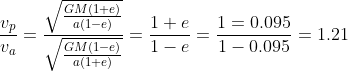
Answer is  times
faster
times
faster
5)
Acceleration of space station 

Answer is 
Add Answer to:
Problem 1: Imagine a planet whose distance to the sun varies, in
the course of its...
1 points SPreCalc7112.065.MI. My Notes Ask Your Teacher The planets move around the sun in elliptical orbits with the sun at one focus. The point in the orbit at which the planet is closest to the su...
 1 points SPreCalc7112.065.MI. My Notes Ask Your Teacher The planets move around the sun in elliptical orbits with the sun at one focus. The point in the orbit at which the planet is closest to the sun is called perihelion, and the point at which it is farthest is called aphelion. These points are the vertices of the orbit. A planet's distance from the sun is 207,000,000 km at perihelion and 249,000,000 km at aphelion. Find an equation for the...
The orbit of a 1.5 ✕ 1010 kg comet around the Sun is elliptical, with an aphelion distance of 33.0 AU and...
The orbit of a 1.5 ✕ 1010 kg comet around the Sun is elliptical, with an aphelion distance of 33.0 AU and perihelion distance of 0.850 AU. (Note: 1 AU = one astronomical unit = the average distance from the Sun to the Earth = 1.496 ✕ 1011 m.) (a)What is its orbital eccentricity? (b)What is its period? (Enter your answer in yr.) (c)At aphelion what is the potential energy (in J) of the comet—Sun system?
Soleve the problem with steps please! 4. A planet completes one orbit about its sun in...
 Soleve the problem with steps please!
4. A planet completes one orbit about its sun in 365.24 days. The planet is 93,000,000 miles away from its sun. Compute the planet's speed through space relative to its sun in a. miles per hour. b. kilometers per second 5. A train's speed is 65 miles per hour. The train's wheels are 1.5 meters in diameter. Compute the angular speed of the wheels in revolutions per second
Soleve the problem with steps please!
4. A planet completes one orbit about its sun in 365.24 days. The planet is 93,000,000 miles away from its sun. Compute the planet's speed through space relative to its sun in a. miles per hour. b. kilometers per second 5. A train's speed is 65 miles per hour. The train's wheels are 1.5 meters in diameter. Compute the angular speed of the wheels in revolutions per second
A planet is discovered to orbit around a star in the galaxy Andromeda, with the same...
 A planet is discovered to orbit around a star in the galaxy Andromeda, with the same orbital diameter as the Earth around our Sun. If that star has 4 times the mass of our Sun, what will the period of revolution of that new planet be, compared to the Earth's orb o One-fourth as much o One-half as much Twice as much A. Four times much The average distance from the Earth to the Sun is defined as one "astronomical...
The semimajor axis of Mars orbit is about 1.52 astronomical units (au), where an au is the Earth's average distance from the Sun, meaning the semimajor axis of Earth's orbit is 1 au. To go from Earth to Mars and use the least energy from rocket fuel, th
The semimajor axis of Mars orbit is about 1.52 astronomical units (au), where an au is the Earth's average distance from the Sun, meaning the semimajor axis of Earth's orbit is 1 au. To go from Earth to Mars and use the least energy from rocket fuel, the orbit has a semimajor axis of 1.26 au and an eccentricity of about 0.21. Starting at Earth's orbit, to follow this path we give the spacecraft an orbital velocity of 40 km/s. ...
3a. A planet that keeps the same hemisphere pointed towards the Sun must rotate once per...
 3a. A planet that keeps the same hemisphere pointed towards the Sun must rotate once per orbit in the prograde direction. Draw a diagram to demonstrate this fact. The rotational period in an inertial frame, the sidereal day, for such a planet is equal to the orbital period, the length of the solar day on such a planet is infinite (this is known as being tidally locked). b. If a planet rotated once per orbit in the retrograde direction, how...
3a. A planet that keeps the same hemisphere pointed towards the Sun must rotate once per...
 3a. A planet that keeps the same hemisphere pointed towards the Sun must rotate once per orbit in the prograde direction. Draw a diagram to demonstrate this fact. The rotational period in an inertial frame, the sidereal day, for such a planet is equal to the orbital period, the length of the solar day on such a planet is infinite (this is known as being tidally locked). b. If a planet rotated once per orbit in the retrograde direction, how...
105. Comet Halley will be travelling about 1.5 km/s (almost 1 mile per second) in 2023...
 105. Comet Halley will be travelling about 1.5 km/s (almost 1 mile per second) in 2023 when it reaches aphelion. When it reaches perihelion in 2061, it will be sixty times closer to the Sun, so its speed will be about: (conserve angular momentum) a. 1.5 km/s b. 90 km/s c. 5400 km/s d. 0.025 km/s e. 0.0004 km/s 106. If a force of 500 N is exerted on a 25 kg mass, what is the resulting acceleration? a. 12500...
A comet has an average distance from the sun of 7.5 AU. What is its time...
 A comet has an average distance from the sun of 7.5 AU. What is its time for going around the sun? Select one: a. 10.3N b. 19.8 N c. 27.2025 N e d. 6.6 N o e. 20,54 N At the top of a cliff 105 m high, Raoul throws a rock upward with velocity 27 m/s. How much later should he drop a second rock from rest so both rocks arrive simultaneously at the bottom of the cliff? Select...
I need help completing the WHOLE problem, parts A, B, C, and D. I know it...
 I need help completing the WHOLE problem, parts A, B, C, and D.
I know it is a long problem, would appreciate labelled and clear
steps, thank you.
Kepler's Laws I. A planet revolves around the sun in an elliptical orbit with the sun at one focus. 2. The line joining the sun to a planet sweeps out equal areas in equal times. 3. The square of the period of revolution of a planet is proportional to the cube of...
I need help completing the WHOLE problem, parts A, B, C, and D.
I know it is a long problem, would appreciate labelled and clear
steps, thank you.
Kepler's Laws I. A planet revolves around the sun in an elliptical orbit with the sun at one focus. 2. The line joining the sun to a planet sweeps out equal areas in equal times. 3. The square of the period of revolution of a planet is proportional to the cube of...
 1 points SPreCalc7112.065.MI. My Notes Ask Your Teacher The planets move around the sun in elliptical orbits with the sun at one focus. The point in the orbit at which the planet is closest to the sun is called perihelion, and the point at which it is farthest is called aphelion. These points are the vertices of the orbit. A planet's distance from the sun is 207,000,000 km at perihelion and 249,000,000 km at aphelion. Find an equation for the...
 Soleve the problem with steps please!
4. A planet completes one orbit about its sun in 365.24 days. The planet is 93,000,000 miles away from its sun. Compute the planet's speed through space relative to its sun in a. miles per hour. b. kilometers per second 5. A train's speed is 65 miles per hour. The train's wheels are 1.5 meters in diameter. Compute the angular speed of the wheels in revolutions per second
Soleve the problem with steps please!
4. A planet completes one orbit about its sun in 365.24 days. The planet is 93,000,000 miles away from its sun. Compute the planet's speed through space relative to its sun in a. miles per hour. b. kilometers per second 5. A train's speed is 65 miles per hour. The train's wheels are 1.5 meters in diameter. Compute the angular speed of the wheels in revolutions per second
 A planet is discovered to orbit around a star in the galaxy Andromeda, with the same orbital diameter as the Earth around our Sun. If that star has 4 times the mass of our Sun, what will the period of revolution of that new planet be, compared to the Earth's orb o One-fourth as much o One-half as much Twice as much A. Four times much The average distance from the Earth to the Sun is defined as one "astronomical...
 3a. A planet that keeps the same hemisphere pointed towards the Sun must rotate once per orbit in the prograde direction. Draw a diagram to demonstrate this fact. The rotational period in an inertial frame, the sidereal day, for such a planet is equal to the orbital period, the length of the solar day on such a planet is infinite (this is known as being tidally locked). b. If a planet rotated once per orbit in the retrograde direction, how...
 3a. A planet that keeps the same hemisphere pointed towards the Sun must rotate once per orbit in the prograde direction. Draw a diagram to demonstrate this fact. The rotational period in an inertial frame, the sidereal day, for such a planet is equal to the orbital period, the length of the solar day on such a planet is infinite (this is known as being tidally locked). b. If a planet rotated once per orbit in the retrograde direction, how...
 105. Comet Halley will be travelling about 1.5 km/s (almost 1 mile per second) in 2023 when it reaches aphelion. When it reaches perihelion in 2061, it will be sixty times closer to the Sun, so its speed will be about: (conserve angular momentum) a. 1.5 km/s b. 90 km/s c. 5400 km/s d. 0.025 km/s e. 0.0004 km/s 106. If a force of 500 N is exerted on a 25 kg mass, what is the resulting acceleration? a. 12500...
 A comet has an average distance from the sun of 7.5 AU. What is its time for going around the sun? Select one: a. 10.3N b. 19.8 N c. 27.2025 N e d. 6.6 N o e. 20,54 N At the top of a cliff 105 m high, Raoul throws a rock upward with velocity 27 m/s. How much later should he drop a second rock from rest so both rocks arrive simultaneously at the bottom of the cliff? Select...
 I need help completing the WHOLE problem, parts A, B, C, and D.
I know it is a long problem, would appreciate labelled and clear
steps, thank you.
Kepler's Laws I. A planet revolves around the sun in an elliptical orbit with the sun at one focus. 2. The line joining the sun to a planet sweeps out equal areas in equal times. 3. The square of the period of revolution of a planet is proportional to the cube of...
I need help completing the WHOLE problem, parts A, B, C, and D.
I know it is a long problem, would appreciate labelled and clear
steps, thank you.
Kepler's Laws I. A planet revolves around the sun in an elliptical orbit with the sun at one focus. 2. The line joining the sun to a planet sweeps out equal areas in equal times. 3. The square of the period of revolution of a planet is proportional to the cube of...
Most questions answered within 3 hours.
-
Where is the error in this code sequence?
String s1 = "Hello";
String s2 = "ello";...
asked 10 months ago -
Financial data for Joel de Paris, Inc., for last year
follow:
Joel de Paris, Inc.
Balance...
asked 10 months ago -
Consider this reaction:
Al2(SO4)3 (aq)+ BaCl3
(aq) Al2Cl6 (aq)- +
3BaSO4(s) . What is the...
asked 10 months ago -
Suppose that Savneet is considering increasing her
recent random sample from 20 car rentals to 40...
asked 10 months ago -
Trucks arrive at an unloading terminal at an average rate of 120
per hour.
Trucks arrive...
asked 10 months ago -
Why are methanol and ethanol completely soluble in water while
octanol is not very little soluble....
asked 10 months ago -
A facilities manager at a university reads in a research report
that the mean amount of...
asked 10 months ago -
When the CuSO4 is rehydrated by adding water to the anhydrous
compound, is this an endothermic...
asked 10 months ago -
A ray of sunlight is passing from diamond into crown glass; the
angle of incidence is...
asked 10 months ago -
A block of mass 0.249 kg is placed on top of a light, vertical
spring of...
asked 10 months ago -
how do the kidneys compensate in the presences of acidosis
a) trigger hyperventilate
b) reserve acid...
asked 10 months ago -
Question 501 pts
The rental rate of capital to the firm increases. Which of the
following...
asked 10 months ago