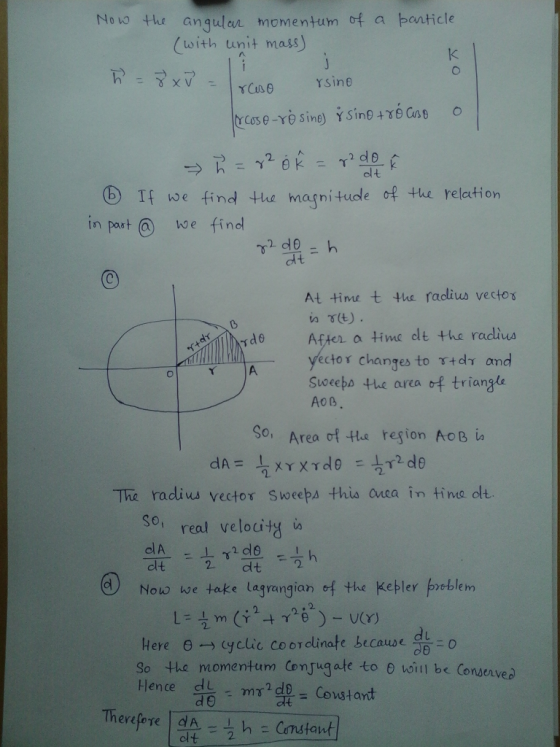
I need help completing the WHOLE problem, parts A, B, C, and D. I know it is a long problem, would appreciate labelled and clear steps, thank you.

Homework Answers

Add Answer to:
I need help completing the WHOLE problem, parts A, B, C, and D.
I know it...
Multivariable Calculus help with the magnitude of angular momentum: My questions is exercise 4 but I have attached exercise 1 and other notes that I was provided 4 Exercise 4. In any mechanics proble...
 Multivariable Calculus help with the magnitude of angular
momentum: My questions is exercise 4 but I have attached exercise 1
and other notes that I was provided
4 Exercise 4. In any mechanics problem where the mass m is constant, the position vector F sweeps out equal areas in equal times the magnitude of the angular momentum ILI is conserved (Note: be sure to prove "if and only if") (Note: don't try to use Exercise 2 in the proof of...
Multivariable Calculus help with the magnitude of angular
momentum: My questions is exercise 4 but I have attached exercise 1
and other notes that I was provided
4 Exercise 4. In any mechanics problem where the mass m is constant, the position vector F sweeps out equal areas in equal times the magnitude of the angular momentum ILI is conserved (Note: be sure to prove "if and only if") (Note: don't try to use Exercise 2 in the proof of...
Use Greens theorem (b) Let r(t) = X(t)i+Y(t)j be the position of the planet at the...
 Use Greens theorem
(b) Let r(t) = X(t)i+Y(t)j be the position of the planet at the instant t and we suppose that the sun is located at the origin (0,0). Between the times t; and t2, the line joining the sun and the planet sweeps out an area Altı, t2) (see the blue region). Express A(t1, t2) in terms of X(t), Y(t), X(t)' and Y (t)'. (c) We denote by F(t) the force exerted on the planet by the sun...
Use Greens theorem
(b) Let r(t) = X(t)i+Y(t)j be the position of the planet at the instant t and we suppose that the sun is located at the origin (0,0). Between the times t; and t2, the line joining the sun and the planet sweeps out an area Altı, t2) (see the blue region). Express A(t1, t2) in terms of X(t), Y(t), X(t)' and Y (t)'. (c) We denote by F(t) the force exerted on the planet by the sun...
All questions please 101. The mass of the Earth is almost 6.0x10⁴ kg, and the average...
 All questions please
101. The mass of the Earth is almost 6.0x10⁴ kg, and the average radius is about 6400 km. A satellite with a mass of 70 Kg is orbiting at an altitude of 600 km. Calculate the acceleration with which the satellite is falling on Earth. a. 5.7x10 m/s b. 5.7x10 m/s c. 5.7x10° m's d. 5.7x10 m/ e. 5.7x10m/s 102. The mass of the Earth is almost 6.0x 10* kg, and the average radius is about 6400...
All questions please
101. The mass of the Earth is almost 6.0x10⁴ kg, and the average radius is about 6400 km. A satellite with a mass of 70 Kg is orbiting at an altitude of 600 km. Calculate the acceleration with which the satellite is falling on Earth. a. 5.7x10 m/s b. 5.7x10 m/s c. 5.7x10° m's d. 5.7x10 m/ e. 5.7x10m/s 102. The mass of the Earth is almost 6.0x 10* kg, and the average radius is about 6400...
PLEASE HELP TO ANSWER THIS LAB ACTIVITY Activity 3: Kepler's Second Law: Objects in elliptical orbits...
 PLEASE HELP TO ANSWER THIS LAB ACTIVITY
Activity 3: Kepler's Second Law: Objects in elliptical orbits sweep oul equal areas in'equal times. This implies that the orbital speed of a planet around the sun is not uniform - it moves farthest away (known as APHELION). In this section we will calculate the difference in this fastest at the point closest to the sun (known as the PERIHELION) and slowest at the point speed using Pluto as an example. Pluto's orbit...
PLEASE HELP TO ANSWER THIS LAB ACTIVITY
Activity 3: Kepler's Second Law: Objects in elliptical orbits sweep oul equal areas in'equal times. This implies that the orbital speed of a planet around the sun is not uniform - it moves farthest away (known as APHELION). In this section we will calculate the difference in this fastest at the point closest to the sun (known as the PERIHELION) and slowest at the point speed using Pluto as an example. Pluto's orbit...
1 (10 pts). In 1601 the German astronomer Johannes Kepler became director of the Prague Observatory....
 1 (10 pts). In 1601 the German astronomer Johannes Kepler became director of the Prague Observatory. Kepler had been helping Tycho Brache in collecting 13 years of observations on relative motion of the planet Mars. By 1609, Kepler had formulated his first two laws of planetary motion: i. Each planet moves on an ellipse with the sun at one focus. ii. For each planet, the line from the sun to the planet sweeps out equal areas is equal times. Kepler's...
just 18.3 In other words, the center of mass moves as a free particle (no external...
 just 18.3
In other words, the center of mass moves as a free particle (no external force) of mass m. The solution for R corre- sponds to uniform straight-line motion, and eliminates three of the six independent variables in the original equations of motion (three components each of, and r. Let us take, as the remaining three independent variables, the three components of r -. To ma- nipulate the original dynamical equations into a single vector equation for r. divide...
just 18.3
In other words, the center of mass moves as a free particle (no external force) of mass m. The solution for R corre- sponds to uniform straight-line motion, and eliminates three of the six independent variables in the original equations of motion (three components each of, and r. Let us take, as the remaining three independent variables, the three components of r -. To ma- nipulate the original dynamical equations into a single vector equation for r. divide...
Please explain clearly. I need to know each steps reasons. 5) (Kepler's Problem) Suppose that a...
 Please explain clearly. I need to know each steps
reasons.
5) (Kepler's Problem) Suppose that a particle is moving in three dimensions under the influence of the force k F=- where k is a positive constant. (a) Find the torque acting on the particle with respect to the origin. Is angular momentum conserved? Show that the magnitude of the angular momentum is given by l = mr2ė. (b) Using Newton's second law, show that the momentum of the particle is...
Please explain clearly. I need to know each steps
reasons.
5) (Kepler's Problem) Suppose that a particle is moving in three dimensions under the influence of the force k F=- where k is a positive constant. (a) Find the torque acting on the particle with respect to the origin. Is angular momentum conserved? Show that the magnitude of the angular momentum is given by l = mr2ė. (b) Using Newton's second law, show that the momentum of the particle is...
I need help with B, C, D. These are Calc 3 problems 32. Suppose a particle...
 I need help with B, C, D. These are Calc 3 problems
32. Suppose a particle of mass m has position given by r(0) =< 1,0,0 >, and velocity given by v(0)0,1,-1 > at time t = 0. Also, assume that for every time t 20 the particle experiences only the force given by the vector function F(t) = m < -cos(t), 0, sin(t) >. Disregard units in this problem a) Use Newton's Second Law, F(t) = ma(t) (where a(t)...
I need help with B, C, D. These are Calc 3 problems
32. Suppose a particle of mass m has position given by r(0) =< 1,0,0 >, and velocity given by v(0)0,1,-1 > at time t = 0. Also, assume that for every time t 20 the particle experiences only the force given by the vector function F(t) = m < -cos(t), 0, sin(t) >. Disregard units in this problem a) Use Newton's Second Law, F(t) = ma(t) (where a(t)...
I need help with problem 39 parts b,c,d Unit 7. Work and Energy In Class Packet...
 I need help with problem 39 parts b,c,d
Unit 7. Work and Energy In Class Packet Name: 36. A 2.45 kg rock is dropped from the top of a 15.5 m vertical cliff a. What is the potential energy of the rock relative to the base of the cliff before it is dropped? b. What is the kinetic energy of the rock just before it hits the ground below? c. What is the velocity of the rock at a point...
I need help with problem 39 parts b,c,d
Unit 7. Work and Energy In Class Packet Name: 36. A 2.45 kg rock is dropped from the top of a 15.5 m vertical cliff a. What is the potential energy of the rock relative to the base of the cliff before it is dropped? b. What is the kinetic energy of the rock just before it hits the ground below? c. What is the velocity of the rock at a point...
could you please solve a and b? Chapier 2i. Note: you needn't derive Kepler's laws-but do...
 could you please solve a and b?
Chapier 2i. Note: you needn't derive Kepler's laws-but do mention when you are using them, an describe the physical concepts involved and the meanings behind the variables. u) Consider two stars Mi and M; bound together by their mutual gravitational force (and isolated from other forces) moving in elliptical orbits (of eccentricity e and semi-major axes ai and az) at distances 11 in n and r from their center of mass located at...
could you please solve a and b?
Chapier 2i. Note: you needn't derive Kepler's laws-but do mention when you are using them, an describe the physical concepts involved and the meanings behind the variables. u) Consider two stars Mi and M; bound together by their mutual gravitational force (and isolated from other forces) moving in elliptical orbits (of eccentricity e and semi-major axes ai and az) at distances 11 in n and r from their center of mass located at...
 Multivariable Calculus help with the magnitude of angular
momentum: My questions is exercise 4 but I have attached exercise 1
and other notes that I was provided
4 Exercise 4. In any mechanics problem where the mass m is constant, the position vector F sweeps out equal areas in equal times the magnitude of the angular momentum ILI is conserved (Note: be sure to prove "if and only if") (Note: don't try to use Exercise 2 in the proof of...
Multivariable Calculus help with the magnitude of angular
momentum: My questions is exercise 4 but I have attached exercise 1
and other notes that I was provided
4 Exercise 4. In any mechanics problem where the mass m is constant, the position vector F sweeps out equal areas in equal times the magnitude of the angular momentum ILI is conserved (Note: be sure to prove "if and only if") (Note: don't try to use Exercise 2 in the proof of...
 Use Greens theorem
(b) Let r(t) = X(t)i+Y(t)j be the position of the planet at the instant t and we suppose that the sun is located at the origin (0,0). Between the times t; and t2, the line joining the sun and the planet sweeps out an area Altı, t2) (see the blue region). Express A(t1, t2) in terms of X(t), Y(t), X(t)' and Y (t)'. (c) We denote by F(t) the force exerted on the planet by the sun...
Use Greens theorem
(b) Let r(t) = X(t)i+Y(t)j be the position of the planet at the instant t and we suppose that the sun is located at the origin (0,0). Between the times t; and t2, the line joining the sun and the planet sweeps out an area Altı, t2) (see the blue region). Express A(t1, t2) in terms of X(t), Y(t), X(t)' and Y (t)'. (c) We denote by F(t) the force exerted on the planet by the sun...
 All questions please
101. The mass of the Earth is almost 6.0x10⁴ kg, and the average radius is about 6400 km. A satellite with a mass of 70 Kg is orbiting at an altitude of 600 km. Calculate the acceleration with which the satellite is falling on Earth. a. 5.7x10 m/s b. 5.7x10 m/s c. 5.7x10° m's d. 5.7x10 m/ e. 5.7x10m/s 102. The mass of the Earth is almost 6.0x 10* kg, and the average radius is about 6400...
All questions please
101. The mass of the Earth is almost 6.0x10⁴ kg, and the average radius is about 6400 km. A satellite with a mass of 70 Kg is orbiting at an altitude of 600 km. Calculate the acceleration with which the satellite is falling on Earth. a. 5.7x10 m/s b. 5.7x10 m/s c. 5.7x10° m's d. 5.7x10 m/ e. 5.7x10m/s 102. The mass of the Earth is almost 6.0x 10* kg, and the average radius is about 6400...
 PLEASE HELP TO ANSWER THIS LAB ACTIVITY
Activity 3: Kepler's Second Law: Objects in elliptical orbits sweep oul equal areas in'equal times. This implies that the orbital speed of a planet around the sun is not uniform - it moves farthest away (known as APHELION). In this section we will calculate the difference in this fastest at the point closest to the sun (known as the PERIHELION) and slowest at the point speed using Pluto as an example. Pluto's orbit...
PLEASE HELP TO ANSWER THIS LAB ACTIVITY
Activity 3: Kepler's Second Law: Objects in elliptical orbits sweep oul equal areas in'equal times. This implies that the orbital speed of a planet around the sun is not uniform - it moves farthest away (known as APHELION). In this section we will calculate the difference in this fastest at the point closest to the sun (known as the PERIHELION) and slowest at the point speed using Pluto as an example. Pluto's orbit...
 1 (10 pts). In 1601 the German astronomer Johannes Kepler became director of the Prague Observatory. Kepler had been helping Tycho Brache in collecting 13 years of observations on relative motion of the planet Mars. By 1609, Kepler had formulated his first two laws of planetary motion: i. Each planet moves on an ellipse with the sun at one focus. ii. For each planet, the line from the sun to the planet sweeps out equal areas is equal times. Kepler's...
 just 18.3
In other words, the center of mass moves as a free particle (no external force) of mass m. The solution for R corre- sponds to uniform straight-line motion, and eliminates three of the six independent variables in the original equations of motion (three components each of, and r. Let us take, as the remaining three independent variables, the three components of r -. To ma- nipulate the original dynamical equations into a single vector equation for r. divide...
just 18.3
In other words, the center of mass moves as a free particle (no external force) of mass m. The solution for R corre- sponds to uniform straight-line motion, and eliminates three of the six independent variables in the original equations of motion (three components each of, and r. Let us take, as the remaining three independent variables, the three components of r -. To ma- nipulate the original dynamical equations into a single vector equation for r. divide...
 Please explain clearly. I need to know each steps
reasons.
5) (Kepler's Problem) Suppose that a particle is moving in three dimensions under the influence of the force k F=- where k is a positive constant. (a) Find the torque acting on the particle with respect to the origin. Is angular momentum conserved? Show that the magnitude of the angular momentum is given by l = mr2ė. (b) Using Newton's second law, show that the momentum of the particle is...
Please explain clearly. I need to know each steps
reasons.
5) (Kepler's Problem) Suppose that a particle is moving in three dimensions under the influence of the force k F=- where k is a positive constant. (a) Find the torque acting on the particle with respect to the origin. Is angular momentum conserved? Show that the magnitude of the angular momentum is given by l = mr2ė. (b) Using Newton's second law, show that the momentum of the particle is...
 I need help with B, C, D. These are Calc 3 problems
32. Suppose a particle of mass m has position given by r(0) =< 1,0,0 >, and velocity given by v(0)0,1,-1 > at time t = 0. Also, assume that for every time t 20 the particle experiences only the force given by the vector function F(t) = m < -cos(t), 0, sin(t) >. Disregard units in this problem a) Use Newton's Second Law, F(t) = ma(t) (where a(t)...
I need help with B, C, D. These are Calc 3 problems
32. Suppose a particle of mass m has position given by r(0) =< 1,0,0 >, and velocity given by v(0)0,1,-1 > at time t = 0. Also, assume that for every time t 20 the particle experiences only the force given by the vector function F(t) = m < -cos(t), 0, sin(t) >. Disregard units in this problem a) Use Newton's Second Law, F(t) = ma(t) (where a(t)...
 I need help with problem 39 parts b,c,d
Unit 7. Work and Energy In Class Packet Name: 36. A 2.45 kg rock is dropped from the top of a 15.5 m vertical cliff a. What is the potential energy of the rock relative to the base of the cliff before it is dropped? b. What is the kinetic energy of the rock just before it hits the ground below? c. What is the velocity of the rock at a point...
I need help with problem 39 parts b,c,d
Unit 7. Work and Energy In Class Packet Name: 36. A 2.45 kg rock is dropped from the top of a 15.5 m vertical cliff a. What is the potential energy of the rock relative to the base of the cliff before it is dropped? b. What is the kinetic energy of the rock just before it hits the ground below? c. What is the velocity of the rock at a point...
 could you please solve a and b?
Chapier 2i. Note: you needn't derive Kepler's laws-but do mention when you are using them, an describe the physical concepts involved and the meanings behind the variables. u) Consider two stars Mi and M; bound together by their mutual gravitational force (and isolated from other forces) moving in elliptical orbits (of eccentricity e and semi-major axes ai and az) at distances 11 in n and r from their center of mass located at...
could you please solve a and b?
Chapier 2i. Note: you needn't derive Kepler's laws-but do mention when you are using them, an describe the physical concepts involved and the meanings behind the variables. u) Consider two stars Mi and M; bound together by their mutual gravitational force (and isolated from other forces) moving in elliptical orbits (of eccentricity e and semi-major axes ai and az) at distances 11 in n and r from their center of mass located at...
Most questions answered within 3 hours.
-
Where is the error in this code sequence?
String s1 = "Hello";
String s2 = "ello";...
asked 10 months ago -
Financial data for Joel de Paris, Inc., for last year
follow:
Joel de Paris, Inc.
Balance...
asked 10 months ago -
Consider this reaction:
Al2(SO4)3 (aq)+ BaCl3
(aq) Al2Cl6 (aq)- +
3BaSO4(s) . What is the...
asked 10 months ago -
Suppose that Savneet is considering increasing her
recent random sample from 20 car rentals to 40...
asked 10 months ago -
Trucks arrive at an unloading terminal at an average rate of 120
per hour.
Trucks arrive...
asked 10 months ago -
Why are methanol and ethanol completely soluble in water while
octanol is not very little soluble....
asked 10 months ago -
A facilities manager at a university reads in a research report
that the mean amount of...
asked 10 months ago -
When the CuSO4 is rehydrated by adding water to the anhydrous
compound, is this an endothermic...
asked 10 months ago -
A ray of sunlight is passing from diamond into crown glass; the
angle of incidence is...
asked 10 months ago -
A block of mass 0.249 kg is placed on top of a light, vertical
spring of...
asked 10 months ago -
how do the kidneys compensate in the presences of acidosis
a) trigger hyperventilate
b) reserve acid...
asked 10 months ago -
Question 501 pts
The rental rate of capital to the firm increases. Which of the
following...
asked 10 months ago