
Homework Answers
Add Answer to:
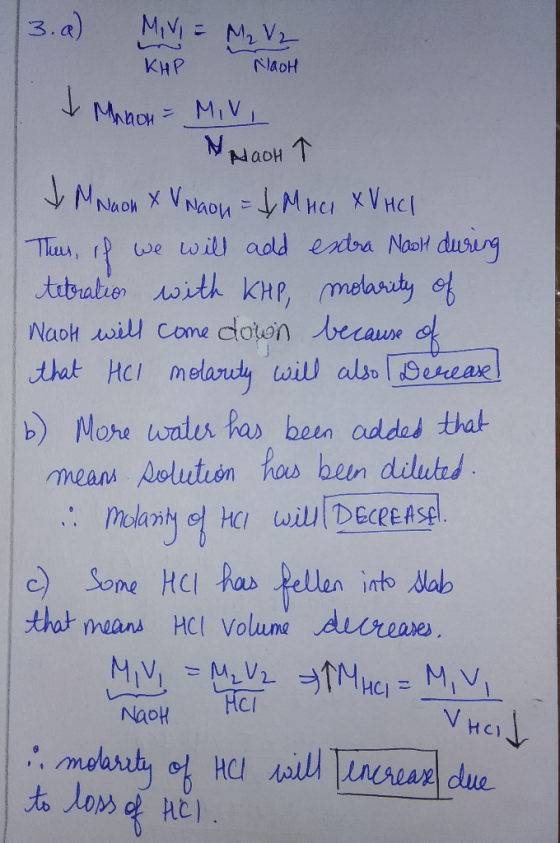
3 For each of the following scenarios, determine if the error will cause the molarity of...
Worksheet 2 2. Calculate the concentration of each of the following solutions. Determine the molarity (mol/L)...
 Worksheet 2 2. Calculate the concentration of each of the following solutions. Determine the molarity (mol/L) of a solution made by diluting 5.880 g of barium chloride to a final volume of 525.0 mL a. b. What is the molarity of a solution that dilutes 12.50 mL of 6.00 M HCI (hydrochloric acid) to a final volume of 1.50 L? If you combine 1.55 g of NH CI (ammonium chloride) with 2.38 g of CaCl, (calcium chlo- ride) and dilute...
Standardization of NaOH: Acid Base Titration Objective: In this lab, you will accurately determine the concentration...
Standardization of NaOH: Acid Base Titration Objective: In this lab, you will accurately determine the concentration of a solution of sodium hydroxide (NaOH) using a 0.500M potassium hydrogen phthalate (KHP) standard solution. Background: Acid–Base Titrations When an acid reacts with a base, a neutralization reaction occurs. The H+ ions from the acid and the HO– ions from the base combine to form water and are therefore neutralized. The other product of reaction is a salt. For example, hydrochloric acid reacts...
I need it right now, please help me?? PROCEDURE PART I: DILUTING THE VINEGAR SOLUTION The...
 I
need it right now, please help me??
PROCEDURE PART I: DILUTING THE VINEGAR SOLUTION The vinegar solution must be diluted by a factor of 5 to be suitable for titration. 1. Obtain - 20 ml of the stock vinegar solution from the fume hood. 2. Using the 10-ml. pipet, pipet" 10 mL of the stock solution to a 50-ml volumetric flask. 3. Fill the volumetric flask to the calibration line with distilled water. Be sure not to go over...
I
need it right now, please help me??
PROCEDURE PART I: DILUTING THE VINEGAR SOLUTION The vinegar solution must be diluted by a factor of 5 to be suitable for titration. 1. Obtain - 20 ml of the stock vinegar solution from the fume hood. 2. Using the 10-ml. pipet, pipet" 10 mL of the stock solution to a 50-ml volumetric flask. 3. Fill the volumetric flask to the calibration line with distilled water. Be sure not to go over...
Experiment 17A. A Solubility Product Constant Procedure Getting Started 1. Obtain a 10 ml pipet, ...
 question#1
Experiment 17A. A Solubility Product Constant Procedure Getting Started 1. Obtain a 10 ml pipet, a 50 mL buret, and 2 pieces of 120 cm filter paper Preparing Saturated Solutions of M10J MIO), is an insoluble divalent iodate salt. The identity of the cation M-is unknown. 1 Prepare MIO,), by adding S0 ml of o.2 M KIO, to 20 mL of 1 Molar M(NO,J, in a 150 mt 2. Stir the mixture vigorously with a stirring rod. A white,...
question#1
Experiment 17A. A Solubility Product Constant Procedure Getting Started 1. Obtain a 10 ml pipet, a 50 mL buret, and 2 pieces of 120 cm filter paper Preparing Saturated Solutions of M10J MIO), is an insoluble divalent iodate salt. The identity of the cation M-is unknown. 1 Prepare MIO,), by adding S0 ml of o.2 M KIO, to 20 mL of 1 Molar M(NO,J, in a 150 mt 2. Stir the mixture vigorously with a stirring rod. A white,...
Running the Reaction Add 0.100 g benzil and 0.30 mL 95% ethanol to a 3-mL conical vial. Place a s...
 Determine the theoretical yield and limiting reagent
Running the Reaction Add 0.100 g benzil and 0.30 mL 95% ethanol to a 3-mL conical vial. Place a spin vane in the vial and attach an air condenser. Heat the mixture with an aluminum block (90-100°C) while stirring until the benzil has dissolved (see inset in Tech- nique 6, Figure 6.1A). Using a 9-inch Pasteur pipette, add dropwise 0.25 mL of an aqueous potassium hydroxide solution' downward through the condenser into the...
Determine the theoretical yield and limiting reagent
Running the Reaction Add 0.100 g benzil and 0.30 mL 95% ethanol to a 3-mL conical vial. Place a spin vane in the vial and attach an air condenser. Heat the mixture with an aluminum block (90-100°C) while stirring until the benzil has dissolved (see inset in Tech- nique 6, Figure 6.1A). Using a 9-inch Pasteur pipette, add dropwise 0.25 mL of an aqueous potassium hydroxide solution' downward through the condenser into the...
i uploaded everything that was given. Where would I find the experiemental values? Complete the calcula...
 i
uploaded everything that was given. Where would I find the
experiemental values?
Complete the calculation summary below. READ THE EXPERIMENTAL DISCUSSION FIRST! REPORT ALL ANSWERS TO THE CORRECT SIGNIFICANT FIGURES. SHOW CALCULATION SET-UP on the next page. PART B: Molarity Determination via Solution Stoichiometry 7.625 g Mass of Empty 50 mL Beaker 7.976 g Mass of Beaker and NaCl (final heating) Mass of NaCl Produced (Experimental Yield of NaCl) moles Moles of Na,CO, Consumed 0.00500 Liter Volume of Na,CO,...
i
uploaded everything that was given. Where would I find the
experiemental values?
Complete the calculation summary below. READ THE EXPERIMENTAL DISCUSSION FIRST! REPORT ALL ANSWERS TO THE CORRECT SIGNIFICANT FIGURES. SHOW CALCULATION SET-UP on the next page. PART B: Molarity Determination via Solution Stoichiometry 7.625 g Mass of Empty 50 mL Beaker 7.976 g Mass of Beaker and NaCl (final heating) Mass of NaCl Produced (Experimental Yield of NaCl) moles Moles of Na,CO, Consumed 0.00500 Liter Volume of Na,CO,...
1) What chemical is the titrant in this experiment? What chemical is the analyte in this experiment? Experi...
 1) What chemical is the titrant in this experiment? What
chemical is the analyte in this
experiment?
Experiment #8: Measuring the Vitamin C Content of Emergen-C™ Objectives: • Students will learn how to use a burette. • Students will learn how to use the iodine starch indicator system to monitor oxidation/reduction reactions. Students will learn how to conduct a titration to determine the amount of analyte in an unknown solution. • Students will learn about ascorbic acid's role as a...
1) What chemical is the titrant in this experiment? What
chemical is the analyte in this
experiment?
Experiment #8: Measuring the Vitamin C Content of Emergen-C™ Objectives: • Students will learn how to use a burette. • Students will learn how to use the iodine starch indicator system to monitor oxidation/reduction reactions. Students will learn how to conduct a titration to determine the amount of analyte in an unknown solution. • Students will learn about ascorbic acid's role as a...
Construct a flow chart describing the seperation of the mixture and the isolation of each compound...
 Construct a flow chart describing the seperation of the
mixture and the isolation of each compound in this experiment. (Lab
steps/procedures includes for reference)
4. Construct a flow chart describing the separation of the mixture and the isolation of each compound in this experiment. A commonly used method of separating a mixture of organic compounds is known as liquid-liquid extraction. Most reactions of organic compounds require extraction at some stage of product purification. In this experiment you will use extraction...
Construct a flow chart describing the seperation of the
mixture and the isolation of each compound in this experiment. (Lab
steps/procedures includes for reference)
4. Construct a flow chart describing the separation of the mixture and the isolation of each compound in this experiment. A commonly used method of separating a mixture of organic compounds is known as liquid-liquid extraction. Most reactions of organic compounds require extraction at some stage of product purification. In this experiment you will use extraction...
(If you need any more information just let me know) Determine the limiting reagent for the...
(If you need any more information just let me know) Determine the limiting reagent for the preparation of 2-bromo-2-methylbutane and calculate the theoretical yield of product. 1 CHEM-2223 Organic Chemistry Laboratory I Exp. 7: Synthesis of 2-chloro-2-methylbutane In this reaction a tertiary alcohol, 2-methyl-2-butanol, is converted to a tertiary halide, 2-chloro- 2-methylbutane through a SN1 reaction. 1) Chemicals 2-Methyl-2-butanol Hydrochloric acid, HCl (12 M) Saturated sodium bicarbonate Saturated sodium chloride (380 g/L) Anhydrous sodium sulfate...
Titration: Acids and Bases 2. How can you determine which acid is diprotic? 3. using the...
 Titration: Acids and Bases
2. How can you determine which acid is diprotic?
3. using the answers to questions one and two, which acid is
diprotic?
4. Which base has more hydroxide ions per molecule?
Acid Volume Base Base Initial Volume (mL) Base Final Volume (mL) Volume of Base Used (mL) Acid: Base Ratio Acid 1 20 mL Base 1 50 mL 34.5 15.5 4:3 Acid 2 20 mL Base 1 Acid 1 20 mL Base 2 Acid 2 20...
Titration: Acids and Bases
2. How can you determine which acid is diprotic?
3. using the answers to questions one and two, which acid is
diprotic?
4. Which base has more hydroxide ions per molecule?
Acid Volume Base Base Initial Volume (mL) Base Final Volume (mL) Volume of Base Used (mL) Acid: Base Ratio Acid 1 20 mL Base 1 50 mL 34.5 15.5 4:3 Acid 2 20 mL Base 1 Acid 1 20 mL Base 2 Acid 2 20...
 Worksheet 2 2. Calculate the concentration of each of the following solutions. Determine the molarity (mol/L) of a solution made by diluting 5.880 g of barium chloride to a final volume of 525.0 mL a. b. What is the molarity of a solution that dilutes 12.50 mL of 6.00 M HCI (hydrochloric acid) to a final volume of 1.50 L? If you combine 1.55 g of NH CI (ammonium chloride) with 2.38 g of CaCl, (calcium chlo- ride) and dilute...
 I
need it right now, please help me??
PROCEDURE PART I: DILUTING THE VINEGAR SOLUTION The vinegar solution must be diluted by a factor of 5 to be suitable for titration. 1. Obtain - 20 ml of the stock vinegar solution from the fume hood. 2. Using the 10-ml. pipet, pipet" 10 mL of the stock solution to a 50-ml volumetric flask. 3. Fill the volumetric flask to the calibration line with distilled water. Be sure not to go over...
I
need it right now, please help me??
PROCEDURE PART I: DILUTING THE VINEGAR SOLUTION The vinegar solution must be diluted by a factor of 5 to be suitable for titration. 1. Obtain - 20 ml of the stock vinegar solution from the fume hood. 2. Using the 10-ml. pipet, pipet" 10 mL of the stock solution to a 50-ml volumetric flask. 3. Fill the volumetric flask to the calibration line with distilled water. Be sure not to go over...
 question#1
Experiment 17A. A Solubility Product Constant Procedure Getting Started 1. Obtain a 10 ml pipet, a 50 mL buret, and 2 pieces of 120 cm filter paper Preparing Saturated Solutions of M10J MIO), is an insoluble divalent iodate salt. The identity of the cation M-is unknown. 1 Prepare MIO,), by adding S0 ml of o.2 M KIO, to 20 mL of 1 Molar M(NO,J, in a 150 mt 2. Stir the mixture vigorously with a stirring rod. A white,...
question#1
Experiment 17A. A Solubility Product Constant Procedure Getting Started 1. Obtain a 10 ml pipet, a 50 mL buret, and 2 pieces of 120 cm filter paper Preparing Saturated Solutions of M10J MIO), is an insoluble divalent iodate salt. The identity of the cation M-is unknown. 1 Prepare MIO,), by adding S0 ml of o.2 M KIO, to 20 mL of 1 Molar M(NO,J, in a 150 mt 2. Stir the mixture vigorously with a stirring rod. A white,...
 Determine the theoretical yield and limiting reagent
Running the Reaction Add 0.100 g benzil and 0.30 mL 95% ethanol to a 3-mL conical vial. Place a spin vane in the vial and attach an air condenser. Heat the mixture with an aluminum block (90-100°C) while stirring until the benzil has dissolved (see inset in Tech- nique 6, Figure 6.1A). Using a 9-inch Pasteur pipette, add dropwise 0.25 mL of an aqueous potassium hydroxide solution' downward through the condenser into the...
Determine the theoretical yield and limiting reagent
Running the Reaction Add 0.100 g benzil and 0.30 mL 95% ethanol to a 3-mL conical vial. Place a spin vane in the vial and attach an air condenser. Heat the mixture with an aluminum block (90-100°C) while stirring until the benzil has dissolved (see inset in Tech- nique 6, Figure 6.1A). Using a 9-inch Pasteur pipette, add dropwise 0.25 mL of an aqueous potassium hydroxide solution' downward through the condenser into the...
 i
uploaded everything that was given. Where would I find the
experiemental values?
Complete the calculation summary below. READ THE EXPERIMENTAL DISCUSSION FIRST! REPORT ALL ANSWERS TO THE CORRECT SIGNIFICANT FIGURES. SHOW CALCULATION SET-UP on the next page. PART B: Molarity Determination via Solution Stoichiometry 7.625 g Mass of Empty 50 mL Beaker 7.976 g Mass of Beaker and NaCl (final heating) Mass of NaCl Produced (Experimental Yield of NaCl) moles Moles of Na,CO, Consumed 0.00500 Liter Volume of Na,CO,...
i
uploaded everything that was given. Where would I find the
experiemental values?
Complete the calculation summary below. READ THE EXPERIMENTAL DISCUSSION FIRST! REPORT ALL ANSWERS TO THE CORRECT SIGNIFICANT FIGURES. SHOW CALCULATION SET-UP on the next page. PART B: Molarity Determination via Solution Stoichiometry 7.625 g Mass of Empty 50 mL Beaker 7.976 g Mass of Beaker and NaCl (final heating) Mass of NaCl Produced (Experimental Yield of NaCl) moles Moles of Na,CO, Consumed 0.00500 Liter Volume of Na,CO,...
 1) What chemical is the titrant in this experiment? What
chemical is the analyte in this
experiment?
Experiment #8: Measuring the Vitamin C Content of Emergen-C™ Objectives: • Students will learn how to use a burette. • Students will learn how to use the iodine starch indicator system to monitor oxidation/reduction reactions. Students will learn how to conduct a titration to determine the amount of analyte in an unknown solution. • Students will learn about ascorbic acid's role as a...
1) What chemical is the titrant in this experiment? What
chemical is the analyte in this
experiment?
Experiment #8: Measuring the Vitamin C Content of Emergen-C™ Objectives: • Students will learn how to use a burette. • Students will learn how to use the iodine starch indicator system to monitor oxidation/reduction reactions. Students will learn how to conduct a titration to determine the amount of analyte in an unknown solution. • Students will learn about ascorbic acid's role as a...
 Construct a flow chart describing the seperation of the
mixture and the isolation of each compound in this experiment. (Lab
steps/procedures includes for reference)
4. Construct a flow chart describing the separation of the mixture and the isolation of each compound in this experiment. A commonly used method of separating a mixture of organic compounds is known as liquid-liquid extraction. Most reactions of organic compounds require extraction at some stage of product purification. In this experiment you will use extraction...
Construct a flow chart describing the seperation of the
mixture and the isolation of each compound in this experiment. (Lab
steps/procedures includes for reference)
4. Construct a flow chart describing the separation of the mixture and the isolation of each compound in this experiment. A commonly used method of separating a mixture of organic compounds is known as liquid-liquid extraction. Most reactions of organic compounds require extraction at some stage of product purification. In this experiment you will use extraction...
 Titration: Acids and Bases
2. How can you determine which acid is diprotic?
3. using the answers to questions one and two, which acid is
diprotic?
4. Which base has more hydroxide ions per molecule?
Acid Volume Base Base Initial Volume (mL) Base Final Volume (mL) Volume of Base Used (mL) Acid: Base Ratio Acid 1 20 mL Base 1 50 mL 34.5 15.5 4:3 Acid 2 20 mL Base 1 Acid 1 20 mL Base 2 Acid 2 20...
Titration: Acids and Bases
2. How can you determine which acid is diprotic?
3. using the answers to questions one and two, which acid is
diprotic?
4. Which base has more hydroxide ions per molecule?
Acid Volume Base Base Initial Volume (mL) Base Final Volume (mL) Volume of Base Used (mL) Acid: Base Ratio Acid 1 20 mL Base 1 50 mL 34.5 15.5 4:3 Acid 2 20 mL Base 1 Acid 1 20 mL Base 2 Acid 2 20...
Most questions answered within 3 hours.
-
Where is the error in this code sequence?
String s1 = "Hello";
String s2 = "ello";...
asked 11 months ago -
Financial data for Joel de Paris, Inc., for last year
follow:
Joel de Paris, Inc.
Balance...
asked 11 months ago -
Consider this reaction:
Al2(SO4)3 (aq)+ BaCl3
(aq) Al2Cl6 (aq)- +
3BaSO4(s) . What is the...
asked 11 months ago -
Suppose that Savneet is considering increasing her
recent random sample from 20 car rentals to 40...
asked 11 months ago -
Trucks arrive at an unloading terminal at an average rate of 120
per hour.
Trucks arrive...
asked 11 months ago -
Why are methanol and ethanol completely soluble in water while
octanol is not very little soluble....
asked 11 months ago -
A facilities manager at a university reads in a research report
that the mean amount of...
asked 11 months ago -
When the CuSO4 is rehydrated by adding water to the anhydrous
compound, is this an endothermic...
asked 11 months ago -
A ray of sunlight is passing from diamond into crown glass; the
angle of incidence is...
asked 11 months ago -
A block of mass 0.249 kg is placed on top of a light, vertical
spring of...
asked 11 months ago -
how do the kidneys compensate in the presences of acidosis
a) trigger hyperventilate
b) reserve acid...
asked 11 months ago -
Question 501 pts
The rental rate of capital to the firm increases. Which of the
following...
asked 11 months ago