

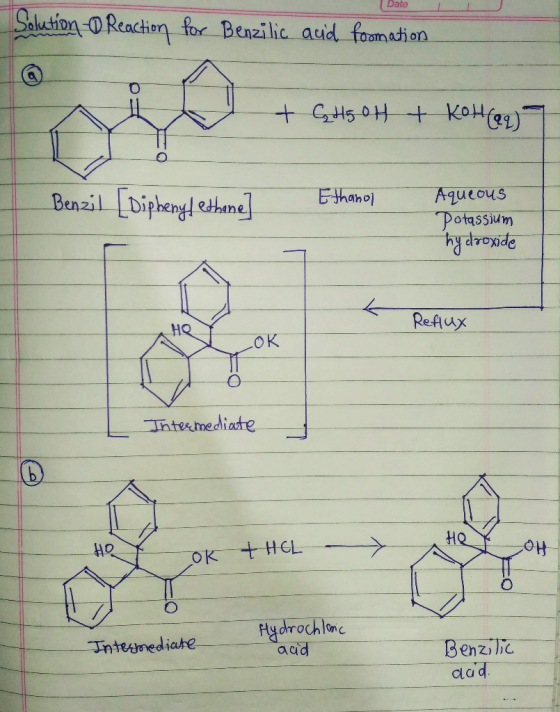
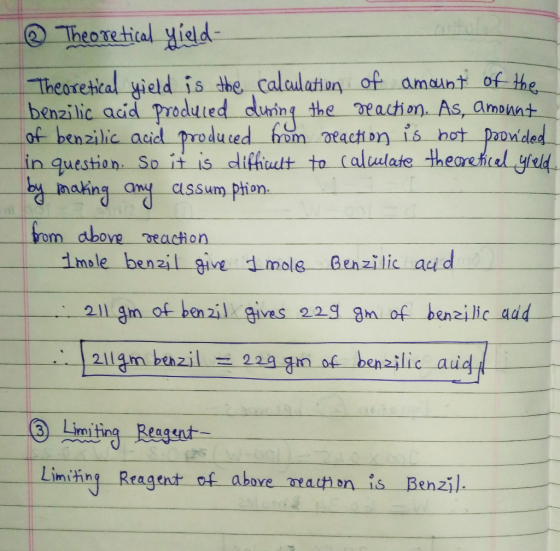
EXPERIMENT 32C Preparation of Benzilic Aciá Formation of Benzilic Acid ith swirling of the lask, add dropwise 0.50 mL of 1M hydrochloric acid to the ion of potassium benzilate. As the solution becomes acidic, solid benzilic acid H should be about 2; if it is higher than this, add a will begin to precipitate. The p few more drops of acid and check the pH again. Allow the mixture to cool to room temperature and then complete the cooling in an ice bath. Collect the benzilic acid by vacuum filtration using a Hirsch funnel. Wash the crystals with 3-4 mL of ice- cold water to remove potassium chloride salt that sometimes coprecipitates with benzilic acid during the neutralization with hydrochloric acid. Remove the wash water by drawing air through the filter. Dry the product thoroughly by allowing it to stand until the next laboratory period. Melting Point and Crystallization of Benzilic Acid Weigh the dry benzilic acid and determine the percentage yield. Determine the melt- ing point of the dry product. Pure benzilic acid melts at 150°C. If necessary, crystal- lize the product from hot water using a Craig tube (Technique 11, Section 11.4, and Figure 11.6). If some impurities remain undissolved, filter the mixture using the fol- lowing procedure. It will be necessary to keep the mixture hot during this filtration step. Transfer the hot mixture to a test tube with a Pasteur pipette. Clean the Craig tube and filter the mixture by transferring it back to the Craig tube with a filter-tip pipette. Cool the solution and induce crystallization, if necessary. Allow the mixtur to stand at room temperature until crystallization is complete (about 15 minutes Cool the mixture in an ice bath and collect the crystals by centrifugation. Determin the melting point of the crystallized product after it is thoroughly dry он о 30 C-C-OH 25 20 15
Homework Answers
Add Answer to:
Running the Reaction Add 0.100 g benzil and 0.30 mL 95% ethanol to a 3-mL conical vial. Place a s...
Place 3.0 g of salicylic acid in a 125-ml Erlenmeyer flask. Carefully add, stirring constantly, 6...
 Place 3.0 g of salicylic acid in a 125-ml Erlenmeyer flask. Carefully add, stirring constantly, 6 mL of acetic anhydride, followed by 10 drops of concentrated sulfuric acid. Swirl the contents of the flask so that the reactants are thoroughly mixed. Stopper the flask with a one- hole cork fitted with an inverted Pasteur pipet to prevent condensation of water in the reaction flask during heating on the steam bath. Heat the flask in a boiling-water or steam bath for...
QUESTION: Write a flow scheme for the work-up. THE WORK UP:
 QUESTION:
Write a flow scheme for the work-up.
THE WORK UP:
C. Work-up (save all layers) and Isolation of Product MgBrCl Benzoic acid Transfer the mixture into a test tube. Rinse the beaker with about 3 mL of regular (not anhydrous) diethyl ether and pour the washings into the test tube. There should be two distinct layers in the test tube Remove the aqueous layer (to be discarded) and shake the ether layer with about 2 mL of 3 M...
QUESTION:
Write a flow scheme for the work-up.
THE WORK UP:
C. Work-up (save all layers) and Isolation of Product MgBrCl Benzoic acid Transfer the mixture into a test tube. Rinse the beaker with about 3 mL of regular (not anhydrous) diethyl ether and pour the washings into the test tube. There should be two distinct layers in the test tube Remove the aqueous layer (to be discarded) and shake the ether layer with about 2 mL of 3 M...
1.) What side reactions occur during the following steps. 2.) How can the IR spectrum be...
 1.)
What side reactions occur during the following steps.
2.) How can the IR spectrum be used to show that there is not
starting material left and the products are ketones?
3.) Describe the major differences and similarities between
the IR spectra of benzoin and benzil. Compare your IR spectrum with
those of benzoin and benzil.
Copper-Catalyzed Oxidation of Benzoin 1. Add a stir bar and 1.5 mL of glacial acetic acid, 0.250 g of NH4NO3 and 0.500 g of...
1.)
What side reactions occur during the following steps.
2.) How can the IR spectrum be used to show that there is not
starting material left and the products are ketones?
3.) Describe the major differences and similarities between
the IR spectra of benzoin and benzil. Compare your IR spectrum with
those of benzoin and benzil.
Copper-Catalyzed Oxidation of Benzoin 1. Add a stir bar and 1.5 mL of glacial acetic acid, 0.250 g of NH4NO3 and 0.500 g of...
used. Experimental . Place 2.0 g of salicylic acid in a 125-mL conical flask. 2. Add...
 used. Experimental . Place 2.0 g of salicylic acid in a 125-mL conical flask. 2. Add 4.0 ml (d = 1.08 g/mL; 4.3 g) of acetic anhydride and 6-8 drops of 85% phosphoric acid. 3. Swirl the flask to mix all reagents, and place it in a 70°C water bath. Heat for about 10 minutes. 4. Remove the flask from the water bath and add 2 mL of cold water drop- wise, swirling the flask after each addition, 5. Add...
Write out your separation scheme for this experiment. 1. Heat 75 mL of water to 90...
Write out your separation scheme for this experiment. 1. Heat 75 mL of water to 90 °C in a 250-mL beaker. 2. While the water is being heated, place 250 mg of salicylic acid, 1 drop of 85% phosphoric acid and 0.5 mL of acetic anhydride in a test tube. Add a boiling chip to the mixture and gently shake it in order to mix the reactants. 3. Heat the tube in the beaker of water at 85 - 90...
Calculate theoretical and percent yield. In this experiment, salicylic acid and acetic anhydride will be reacted...
Calculate theoretical and percent yield. In this experiment, salicylic acid and acetic anhydride will be reacted to form acetylsalicylic acid in an acid catalyzed reaction. In a reaction tube, add approx. 140 mg salicylic acid, a boiling chip and a small drop of 85% phosphoric acid. Add 0.3mL acetic anhydride, which should wash the reactants to the bottom of the tube. Mix thoroughly. Heat in a beaker of water at 90oC for 5 min. Cautiously add 0.2 mL water to...
Draw a pathway for the reaction of phenylboronic acid with 4-iodophenol to obtain 4-phenylphenol in the...
 Draw a pathway for the
reaction of phenylboronic acid with 4-iodophenol to obtain
4-phenylphenol in the form of a catalytic
cycle. EXPLAIN and STATE all complexes formed in
EACH STEP by their electron counts (count how many
e- are there, e.g. 18 e- or 16
e- etc.), formal
oxidation states and all the reactions with
mechanistic labels (i.e. oxidative
addition, reductive elimination, etc.)
(note the amount of base used). Be sure to
EXPLAIN the catalytic cycle as to what happens...
Draw a pathway for the
reaction of phenylboronic acid with 4-iodophenol to obtain
4-phenylphenol in the form of a catalytic
cycle. EXPLAIN and STATE all complexes formed in
EACH STEP by their electron counts (count how many
e- are there, e.g. 18 e- or 16
e- etc.), formal
oxidation states and all the reactions with
mechanistic labels (i.e. oxidative
addition, reductive elimination, etc.)
(note the amount of base used). Be sure to
EXPLAIN the catalytic cycle as to what happens...
Can you explain how to find what is the theoretical yield, and the desired percent yield...
 Can you explain how to find what is the theoretical yield, and
the desired percent yield of ethyl 4-nitrobenzoate?
1. Synthesis of ethyl 4-nitrobenzoate a) In a 50-ml round-bottom flask, weigh out 4-nitrobenzoic acid (0.85 g, 0.005 mol). Add to this 8 ml of absolute ethanol. Add boiling stones, and then bring this solution to the Lab Technologist. WATER OUT b) The Lab Technologist will deliver 1.2 ml of concentrated sulfuric acid to the mixture from the automatic pipette. [CAUTION,...
Can you explain how to find what is the theoretical yield, and
the desired percent yield of ethyl 4-nitrobenzoate?
1. Synthesis of ethyl 4-nitrobenzoate a) In a 50-ml round-bottom flask, weigh out 4-nitrobenzoic acid (0.85 g, 0.005 mol). Add to this 8 ml of absolute ethanol. Add boiling stones, and then bring this solution to the Lab Technologist. WATER OUT b) The Lab Technologist will deliver 1.2 ml of concentrated sulfuric acid to the mixture from the automatic pipette. [CAUTION,...
PROCEDURE 1. Place a reaction tube into a 5-mL Erienmeyer and tare. Add between 0.275- 0.300g...
 PROCEDURE 1. Place a reaction tube into a 5-mL Erienmeyer and tare. Add between 0.275- 0.300g of salicylic acid. Record on the data sheet. 2. Transfer the reaction tube and 5-ml Erienmeyer to the hood. Add a boiling chip, 2 drops of 85% phosphoric acid, and about 0.70 mL of acetic anhydride to the reaction tube. Mix well. 3. Place a 50-ml beaker containing about 20-mls of water on a hot plate or in the sand bath. Allow the water...
What is the mechanism (with curved arrows) for this reaction? 1. Add about 1.0 g (measured accurately) of acetophenone t...
 What is the mechanism (with
curved arrows) for this reaction?
1. Add about 1.0 g (measured accurately) of acetophenone to 40 mL of the bleach solution (5% NaCl in water - this reactant should be included in your table of reagents!) in a 100 mL round bottom flask equipped with a magnetic stirrer. Clamp the flask in the fume hood above a stir plate. 2. After the initial reaction has subsided, boil the reaction mixture gently for 5 - 10...
What is the mechanism (with
curved arrows) for this reaction?
1. Add about 1.0 g (measured accurately) of acetophenone to 40 mL of the bleach solution (5% NaCl in water - this reactant should be included in your table of reagents!) in a 100 mL round bottom flask equipped with a magnetic stirrer. Clamp the flask in the fume hood above a stir plate. 2. After the initial reaction has subsided, boil the reaction mixture gently for 5 - 10...
 Place 3.0 g of salicylic acid in a 125-ml Erlenmeyer flask. Carefully add, stirring constantly, 6 mL of acetic anhydride, followed by 10 drops of concentrated sulfuric acid. Swirl the contents of the flask so that the reactants are thoroughly mixed. Stopper the flask with a one- hole cork fitted with an inverted Pasteur pipet to prevent condensation of water in the reaction flask during heating on the steam bath. Heat the flask in a boiling-water or steam bath for...
 QUESTION:
Write a flow scheme for the work-up.
THE WORK UP:
C. Work-up (save all layers) and Isolation of Product MgBrCl Benzoic acid Transfer the mixture into a test tube. Rinse the beaker with about 3 mL of regular (not anhydrous) diethyl ether and pour the washings into the test tube. There should be two distinct layers in the test tube Remove the aqueous layer (to be discarded) and shake the ether layer with about 2 mL of 3 M...
QUESTION:
Write a flow scheme for the work-up.
THE WORK UP:
C. Work-up (save all layers) and Isolation of Product MgBrCl Benzoic acid Transfer the mixture into a test tube. Rinse the beaker with about 3 mL of regular (not anhydrous) diethyl ether and pour the washings into the test tube. There should be two distinct layers in the test tube Remove the aqueous layer (to be discarded) and shake the ether layer with about 2 mL of 3 M...
 1.)
What side reactions occur during the following steps.
2.) How can the IR spectrum be used to show that there is not
starting material left and the products are ketones?
3.) Describe the major differences and similarities between
the IR spectra of benzoin and benzil. Compare your IR spectrum with
those of benzoin and benzil.
Copper-Catalyzed Oxidation of Benzoin 1. Add a stir bar and 1.5 mL of glacial acetic acid, 0.250 g of NH4NO3 and 0.500 g of...
1.)
What side reactions occur during the following steps.
2.) How can the IR spectrum be used to show that there is not
starting material left and the products are ketones?
3.) Describe the major differences and similarities between
the IR spectra of benzoin and benzil. Compare your IR spectrum with
those of benzoin and benzil.
Copper-Catalyzed Oxidation of Benzoin 1. Add a stir bar and 1.5 mL of glacial acetic acid, 0.250 g of NH4NO3 and 0.500 g of...
 used. Experimental . Place 2.0 g of salicylic acid in a 125-mL conical flask. 2. Add 4.0 ml (d = 1.08 g/mL; 4.3 g) of acetic anhydride and 6-8 drops of 85% phosphoric acid. 3. Swirl the flask to mix all reagents, and place it in a 70°C water bath. Heat for about 10 minutes. 4. Remove the flask from the water bath and add 2 mL of cold water drop- wise, swirling the flask after each addition, 5. Add...
 Draw a pathway for the
reaction of phenylboronic acid with 4-iodophenol to obtain
4-phenylphenol in the form of a catalytic
cycle. EXPLAIN and STATE all complexes formed in
EACH STEP by their electron counts (count how many
e- are there, e.g. 18 e- or 16
e- etc.), formal
oxidation states and all the reactions with
mechanistic labels (i.e. oxidative
addition, reductive elimination, etc.)
(note the amount of base used). Be sure to
EXPLAIN the catalytic cycle as to what happens...
Draw a pathway for the
reaction of phenylboronic acid with 4-iodophenol to obtain
4-phenylphenol in the form of a catalytic
cycle. EXPLAIN and STATE all complexes formed in
EACH STEP by their electron counts (count how many
e- are there, e.g. 18 e- or 16
e- etc.), formal
oxidation states and all the reactions with
mechanistic labels (i.e. oxidative
addition, reductive elimination, etc.)
(note the amount of base used). Be sure to
EXPLAIN the catalytic cycle as to what happens...
 Can you explain how to find what is the theoretical yield, and
the desired percent yield of ethyl 4-nitrobenzoate?
1. Synthesis of ethyl 4-nitrobenzoate a) In a 50-ml round-bottom flask, weigh out 4-nitrobenzoic acid (0.85 g, 0.005 mol). Add to this 8 ml of absolute ethanol. Add boiling stones, and then bring this solution to the Lab Technologist. WATER OUT b) The Lab Technologist will deliver 1.2 ml of concentrated sulfuric acid to the mixture from the automatic pipette. [CAUTION,...
Can you explain how to find what is the theoretical yield, and
the desired percent yield of ethyl 4-nitrobenzoate?
1. Synthesis of ethyl 4-nitrobenzoate a) In a 50-ml round-bottom flask, weigh out 4-nitrobenzoic acid (0.85 g, 0.005 mol). Add to this 8 ml of absolute ethanol. Add boiling stones, and then bring this solution to the Lab Technologist. WATER OUT b) The Lab Technologist will deliver 1.2 ml of concentrated sulfuric acid to the mixture from the automatic pipette. [CAUTION,...
 PROCEDURE 1. Place a reaction tube into a 5-mL Erienmeyer and tare. Add between 0.275- 0.300g of salicylic acid. Record on the data sheet. 2. Transfer the reaction tube and 5-ml Erienmeyer to the hood. Add a boiling chip, 2 drops of 85% phosphoric acid, and about 0.70 mL of acetic anhydride to the reaction tube. Mix well. 3. Place a 50-ml beaker containing about 20-mls of water on a hot plate or in the sand bath. Allow the water...
 What is the mechanism (with
curved arrows) for this reaction?
1. Add about 1.0 g (measured accurately) of acetophenone to 40 mL of the bleach solution (5% NaCl in water - this reactant should be included in your table of reagents!) in a 100 mL round bottom flask equipped with a magnetic stirrer. Clamp the flask in the fume hood above a stir plate. 2. After the initial reaction has subsided, boil the reaction mixture gently for 5 - 10...
What is the mechanism (with
curved arrows) for this reaction?
1. Add about 1.0 g (measured accurately) of acetophenone to 40 mL of the bleach solution (5% NaCl in water - this reactant should be included in your table of reagents!) in a 100 mL round bottom flask equipped with a magnetic stirrer. Clamp the flask in the fume hood above a stir plate. 2. After the initial reaction has subsided, boil the reaction mixture gently for 5 - 10...
Most questions answered within 3 hours.
-
Where is the error in this code sequence?
String s1 = "Hello";
String s2 = "ello";...
asked 11 months ago -
Financial data for Joel de Paris, Inc., for last year
follow:
Joel de Paris, Inc.
Balance...
asked 11 months ago -
Consider this reaction:
Al2(SO4)3 (aq)+ BaCl3
(aq) Al2Cl6 (aq)- +
3BaSO4(s) . What is the...
asked 11 months ago -
Suppose that Savneet is considering increasing her
recent random sample from 20 car rentals to 40...
asked 11 months ago -
Trucks arrive at an unloading terminal at an average rate of 120
per hour.
Trucks arrive...
asked 11 months ago -
Why are methanol and ethanol completely soluble in water while
octanol is not very little soluble....
asked 11 months ago -
A facilities manager at a university reads in a research report
that the mean amount of...
asked 11 months ago -
When the CuSO4 is rehydrated by adding water to the anhydrous
compound, is this an endothermic...
asked 11 months ago -
A ray of sunlight is passing from diamond into crown glass; the
angle of incidence is...
asked 11 months ago -
A block of mass 0.249 kg is placed on top of a light, vertical
spring of...
asked 11 months ago -
how do the kidneys compensate in the presences of acidosis
a) trigger hyperventilate
b) reserve acid...
asked 11 months ago -
Question 501 pts
The rental rate of capital to the firm increases. Which of the
following...
asked 11 months ago